Fluent Bit v4: A Decade of Innovation and What’s Next - Leonardo Alminana, Chronosphere
Leonardo Alminana, Chronosphere
KubeCon + CloudNativeCon Europe 2025 · Session
Overview
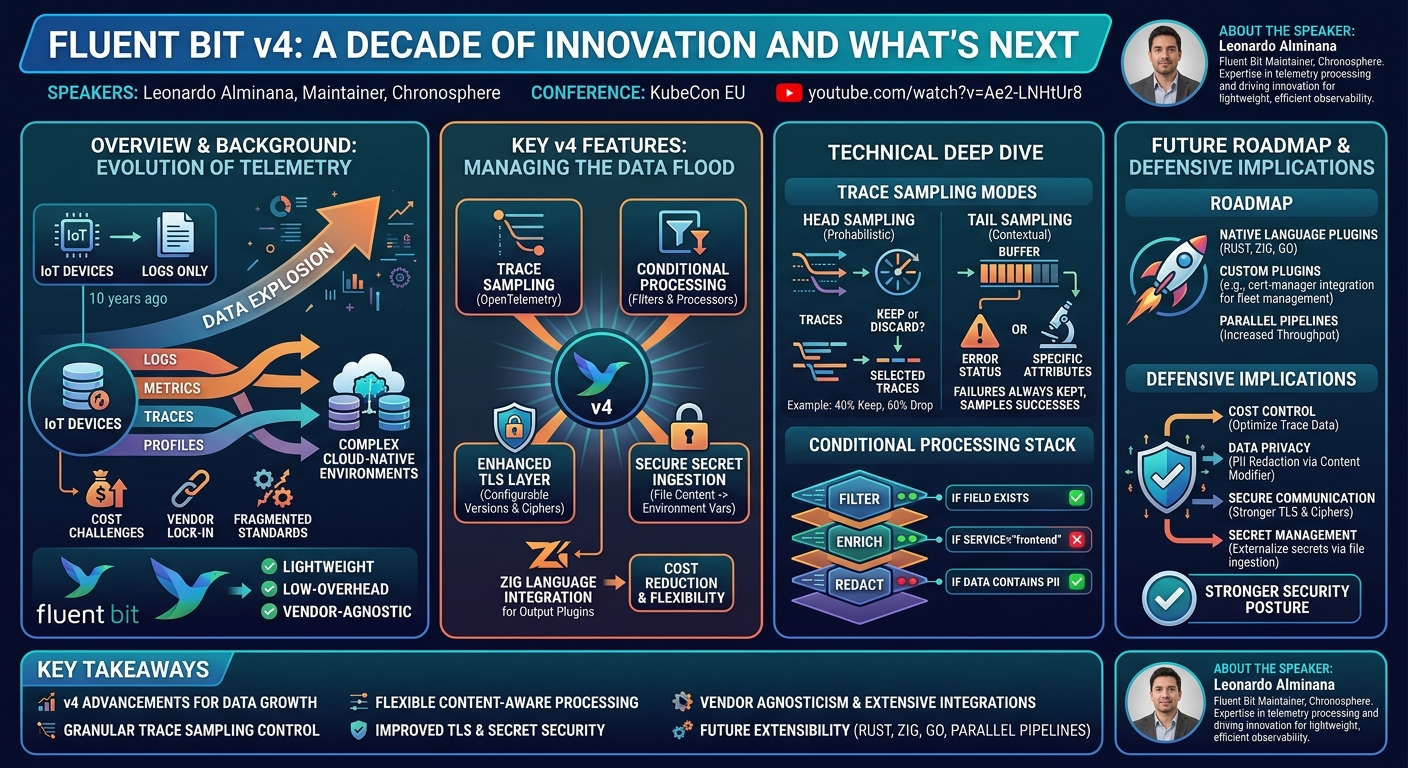
In this insightful KubeCon EU presentation, Leonardo Alminana, a maintainer of the Fluent Bit project, offered a comprehensive look at the evolution and future trajectory of this critical telemetry collector. The talk, titled "Fluent Bit v4: A Decade of Innovation and What’s Next," celebrated the recent release of Fluent Bit v4.0.0, highlighting its new features designed to address the ever-growing complexity and volume of observability data. Alminana emphasized Fluent Bit's role in providing a lightweight, vendor-agnostic solution for collecting, processing, and routing logs, metrics, and traces across diverse environments.
Key moments
- 0:00 Fluent Bit v4.0 release and talk agenda
- 2:00 The chaotic reality of telemetry data management
- 4:00 Fluent Bit's role in cost-effective telemetry processing
- 6:00 From IoT to Kubernetes: Fluent Bit's evolution
- 7:00 Commitment to vendor agnosticism and community integration
- 9:00 Key Kubernetes plugins: Events and log enrichment filters
- 10:00 Flexible output destinations for processed telemetry data
Fluent Bit v4: A Decade of Innovation and What’s Next
Speakers: Leonardo Alminana, Maintainer, Chronosphere
Conference: KubeCon EU
YouTube: https://www.youtube.com/watch?v=Ae2-LNHtUr8
Overview
In this insightful KubeCon EU presentation, Leonardo Alminana, a maintainer of the Fluent Bit project, offered a comprehensive look at the evolution and future trajectory of this critical telemetry collector. The talk, titled "Fluent Bit v4: A Decade of Innovation and What’s Next," celebrated the recent release of Fluent Bit v4.0.0, highlighting its new features designed to address the ever-growing complexity and volume of observability data. Alminana emphasized Fluent Bit's role in providing a lightweight, vendor-agnostic solution for collecting, processing, and routing logs, metrics, and traces across diverse environments.
The presentation underscored the exponential growth in telemetry data over the past decade, moving beyond simple logs to encompass metrics, traces, and profiles. This data explosion presents significant challenges in terms of cost, processing overhead, and the sheer chaos of fragmented standards. Fluent Bit v4 aims to tackle these issues head-on by introducing advanced capabilities like trace sampling, conditional processing, and enhanced security features, enabling organizations to extract value from their data without incurring prohibitive expenses or vendor lock-in.
Alminana's discussion provided a historical context for Fluent Bit's development, from its origins in the resource-constrained IoT space to its current prominence in Kubernetes and cloud-native ecosystems. The talk served as a crucial update for existing users and an excellent introduction for newcomers, outlining how Fluent Bit continues to innovate to meet the demands of modern observability, making telemetry more manageable, efficient, and cost-effective.
Background
▶ Watch: Fluent Bit v4.0 release and talk agenda (0:00)
The landscape of telemetry has undergone a dramatic transformation in the last decade. What began as primarily log collection has evolved into a multifaceted discipline encompassing logs, metrics, and traces, alongside newer data types like profiles. This exponential growth in data volume and variety has created a chaotic environment where different standards, legacy systems, and proprietary formats coexist, making it challenging for organizations to derive actionable insights without being overwhelmed by costs and complexity. The speaker likened this situation to the "spherical cow in a vacuum chamber" joke, where theoretical simplicity clashes with real-world disorder.
Fluent Bit emerged approximately ten years ago out of a clear necessity for a lightweight, low-overhead telemetry collector. Its initial design was heavily influenced by the constraints of the IoT sector, where devices often had kilobytes of RAM and limited CPU resources. This foundational focus on efficiency – minimizing CPU and memory footprint – proved serendipitous when Kubernetes gained traction. In the Kubernetes ecosystem, even with more available resources, the demand for fast, efficient, and cost-effective data processing remained paramount to avoid escalating cloud bills.
A core tenet of Fluent Bit's philosophy is vendor agnosticism. Unlike many early, vendor-tied collectors, Fluent Bit was designed to be a universal conduit, capable of ingesting data from virtually any source and routing it to any destination. This commitment manifests in an extensive array of integrations for both inputs and outputs, supporting everything from traditional syslog and local files to modern OpenTelemetry endpoints and Prometheus scrapes. It can enrich logs with Kubernetes metadata via its Kubernetes filter and even capture Kubernetes events. On the output side, it supports popular destinations like Splunk, Elasticsearch, Datadog, Chronosphere, Azure, AWS, and Stackdriver, ensuring flexibility and preventing vendor lock-in.
Fluent Bit is part of the broader Fluent family, alongside Fluentd, and is a graduated project under the CNCF (Cloud Native Computing Foundation). While Fluentd historically served a similar purpose, Alminana noted that Fluentd is largely in a maintenance state, with Fluent Bit now leading the innovation, especially in handling metrics and traces and adopting the OpenTelemetry model.
The project boasts remarkable deployment flexibility, running on bare metal, containers, virtual machines, and supporting various operating systems including Linux (with official packages), Windows (installers), and even FreeBSD. Its routing system is a particularly strong feature, allowing dynamic, runtime-based decisions on where data should go. Furthermore, Fluent Bit can function as an aggregator, receiving data from other Fluent Bit instances, OTel producers, Prometheus endpoints, or even legacy Fluentd systems, centralizing processing. A notable capability is the log-to-metrics plugin, which can convert textual logs into structured metrics, useful for integrating legacy system outputs like iostat into modern observability pipelines. This robust foundation underscores Fluent Bit's role as a versatile and essential component in contemporary observability stacks.
Key Findings
▶ Watch: Fluent Bit's role in cost-effective telemetry processing (4:00)
The release of Fluent Bit v4.0.0 marks a significant milestone, introducing a suite of features primarily focused on enhancing efficiency, flexibility, and security in telemetry processing. These advancements are critical for managing the increasing volume and complexity of observability data while controlling costs.
One of the most impactful new features is the enhanced OpenTelemetry (OTel) processing, specifically the introduction of trace sampling. This capability allows users to intelligently reduce the volume of trace data ingested and stored, which is crucial for cost management without sacrificing critical debugging information.
Another major contribution is conditional processing for filters and processors. This feature empowers users to apply specific processing logic based on the actual content and context of the telemetry data, moving beyond simple tag-based routing. This provides granular control over data manipulation within the processing pipeline.
Security and operational robustness also received significant upgrades. Fluent Bit v4 introduces new options for configuring the TLS layer, allowing users to define minimum and maximum TLS versions and specific cipher suites. Additionally, a new mechanism for ingesting file contents into environment variables addresses the secure management of secrets and external configurations, reducing the need for hardcoding sensitive information.
The talk also highlighted the integration of the Zig language for plugin development, initially for output plugins, with plans to expand to other plugin types. This reflects Fluent Bit's commitment to performance and leveraging modern, low-level languages. Looking ahead, the roadmap for Fluent Bit includes further expansion of native, idiomatic integrations for languages like Rust, Zig, and Go, enabling users to write custom inputs, processors, filters, outputs, and even specialized custom plugins for tasks like fleet management or dynamic TLS certificate handling (e.g., integrating with cert-manager). The future also envisions parallel pipelines within a single Fluent Bit instance for enhanced scalability.
Technical Deep Dive
▶ Watch: From IoT to Kubernetes: Fluent Bit's evolution (6:00)
Fluent Bit v4 introduces several architectural and functional enhancements that significantly elevate its capabilities in telemetry processing. These features are designed to provide finer control over data flow, improve security, and expand extensibility.
Trace Sampling
A standout feature in Fluent Bit v4 is the new trace sampling processor, specifically designed for OpenTelemetry traces. This is a critical addition for managing the cost and volume of trace data, which can quickly become overwhelming. The processor offers two distinct operational modes that can be combined for optimal results:
- Head Sampling (Probabilistic): This mode allows users to define a probability for a trace to be either stored or discarded at the very beginning of its journey through the Fluent Bit pipeline. For instance, setting a 40% probability means that, on average, 40% of traces will be kept, and 60% will be dropped. This is useful for reducing overall trace volume for general observability while still getting a representative sample of system behavior.
- Tail Sampling (Contextual): This more sophisticated mode buffers spans until a predefined time window expires. Once the full trace is assembled within this window, a decision is made on whether to keep or discard it based on its complete context. A prime use case is ensuring that 100% of traces related to failed transactions are retained, while only a healthy percentage of successful transactions are sampled. For example, in an e-commerce scenario, one might configure tail sampling to always keep traces where the OTel status field indicates an error or where specific attributes signify a transaction failure. This ensures that actionable information for debugging problems is always available, even if the vast majority of successful traces are down-sampled using head sampling. Combining head sampling for successes and tail sampling for failures offers a powerful strategy for cost-effective, targeted observability.
Conditional Processing
Prior to v4, Fluent Bit's processing pipeline involved inputs, a global filtering stage, and outputs. While routing rules allowed for some selection based on tags, applying specific processing logic to data based on its content within the processor stack was limited. Fluent Bit v4 addresses this with conditional processing. This feature allows users to attach conditions directly to individual processors within the stack.
Instead of merely acting on data based on its initial input tag, processors can now evaluate the data itself. For example, a processor could be configured to only redact sensitive information if a specific field exists and contains certain patterns, or to enrich data only if it originates from a particular service. This brings the flexibility of traditional filters, which could select data based on tags, directly into the more scalable and modular processor stack, enabling highly granular and context-aware data manipulation. This is a significant improvement for complex data pipelines where different types of telemetry require varied treatment based on their intrinsic properties.
TLS Layer Enhancements
Security is paramount in data transmission. Fluent Bit v4 introduces critical enhancements to its TLS layer configuration, providing users with greater control over secure communication:
- Minimum and Maximum TLS Versions: Users can now explicitly define the acceptable range of TLS protocol versions (e.g., TLSv1.2 to TLSv1.3). This prevents downgrade attacks, where an attacker might force a connection to use an older, potentially vulnerable TLS version. It also helps meet corporate security compliance requirements that mandate specific TLS versions.
- Cipher Suite Selection: The ability to specify allowed cipher suites ensures that Fluent Bit only negotiates strong, secure cryptographic algorithms. This mitigates the risk of an endpoint being forced to use a weaker cipher that might have known vulnerabilities or be computationally breakable, further bolstering the security of data in transit.
Secure Configuration and Secrets Management
Handling secrets and dynamic configurations securely is a persistent challenge. Fluent Bit v4 introduces a mechanism to ingest file contents into environment variables within its configuration. This allows sensitive information, such as API keys, database credentials, or private certificates, to be stored in files (e.g., mounted as Kubernetes secrets) rather than being hardcoded directly into configuration files or config maps. This practice significantly improves security hygiene and simplifies secret rotation.
Furthermore, this capability extends to Lua scripting. By loading Lua scripts from the file system using this mechanism, users can keep their Fluent Bit configuration maps much cleaner and more focused on Fluent Bit-specific settings, while externalizing custom logic into separate, manageable script files.
Zig Language Integration
Fluent Bit's commitment to performance and modern development practices is evident in its new Zig language integration. Zig is a relatively new low-level systems programming language, similar to Rust, but with a strong emphasis on performance and explicit control over memory. Currently, Zig is supported for writing output plugins. The roadmap, however, indicates plans to extend this support to input plugins, processors, filters, and custom plugins. This offers developers an additional high-performance option for extending Fluent Bit's functionality natively, alongside existing support for C, Go, and WASM (which includes languages like Rust).
Future Roadmap: Native Language Plugins and Parallel Pipelines
Looking ahead, Fluent Bit aims to provide idiomatic native integrations for plugin development across a broader range of modern languages, including Rust, Zig, and Go. The goal is to allow developers to write fully-featured plugins (inputs, processors, filters, outputs, and custom plugins) using the best practices and conventions of their chosen language. The concept of custom plugins is particularly intriguing; these are designed for tasks beyond data manipulation, such as fleet management (managing multiple Fluent Bit instances) or TLS certificate management. An example cited was integrating with a project like cert-manager to dynamically fetch and manage short-lived TLS certificates for Fluent Bit deployments, eliminating the need to embed certificates in config maps. Another significant future development is the introduction of parallel pipelines within a single Fluent Bit installation, which promises to enhance throughput and processing efficiency for high-volume scenarios.
Demo / Proof of Concept
▶ Watch: Key Kubernetes plugins: Events and log enrichment filters (9:00)
This particular presentation focused on providing an overview of Fluent Bit's history, current capabilities, and future roadmap, rather than including a live demonstration or proof of concept. The speaker alluded to a more extensive webinar by the project leader, Eduardo, which would delve deeper into future plans and potentially include more practical demonstrations. Therefore, the transcript does not contain details of any specific demo.
Defensive Implications
▶ Watch: Flexible output destinations for processed telemetry data (10:00)
Fluent Bit v4's new features offer significant advantages for security professionals and platform engineers responsible for defending modern systems. By optimizing telemetry collection and processing, Fluent Bit contributes to a stronger security posture and more efficient operations.
Firstly, the trace sampling capabilities directly address the challenge of observability cost management. By intelligently discarding redundant or less critical trace data (e.g., sampling successful transactions while retaining all failures), organizations can drastically reduce storage and processing expenses. This not only makes observability more sustainable but also ensures that critical debugging information for security incidents or application failures is readily available without being buried under a mountain of noise. The ability to use tail sampling to prioritize traces based on their content (e.g., keeping 100% of error traces) is a powerful defensive mechanism, ensuring rapid incident response.
Secondly, conditional processing is a game-changer for data privacy and compliance. Defenders can now implement granular rules to identify and redact or discard Personally Identifiable Information (PII) or other sensitive data directly within the Fluent Bit pipeline, based on the data's content. This prevents sensitive information from being transmitted to or stored in external systems where it might be exposed or violate regulatory requirements. Combining conditional processing with a content modifier processor enables sophisticated data sanitization.
Thirdly, the enhanced TLS layer configuration directly improves secure communication. By allowing explicit definition of minimum and maximum TLS versions and specific cipher suites, Fluent Bit can be configured to prevent downgrade attacks and enforce the use of strong, modern encryption. This protects telemetry data in transit from eavesdropping and tampering, which is crucial for maintaining the integrity and confidentiality of security-relevant logs, metrics, and traces.
Finally, the new mechanism for ingesting file contents into environment variables streamlines secure secret management. This encourages the practice of externalizing secrets from configuration files into secure file systems (e.g., Kubernetes secrets mounted as files), thereby reducing the risk of hardcoded credentials and simplifying secret rotation. This is a fundamental security best practice that Fluent Bit v4 now natively supports and promotes. The roadmap item for custom plugins integrating with tools like cert-manager for short-lived TLS certificates further promises to automate and enhance the security of certificate management, reducing the attack surface associated with long-lived credentials.
Overall, Fluent Bit v4 empowers defenders to build more resilient, compliant, and cost-effective observability pipelines, turning the flood of telemetry data into a manageable and actionable resource for security operations.
Key Takeaways
- Fluent Bit v4 introduces significant advancements for telemetry processing, addressing the challenges of exponential data growth and cost management in modern cloud-native environments.
- The new trace sampling processor (with head and tail sampling modes) provides granular control over OpenTelemetry trace volume, enabling cost reduction while ensuring critical failure data is always retained.
- Conditional processing allows for highly flexible and context-aware data manipulation within the processor stack, enabling sophisticated filtering, enrichment, and redaction based on the data's content.
- Enhanced TLS configuration (min/max versions, cipher suites) and secure file-based secret ingestion improve the security posture of Fluent Bit deployments, protecting data in transit and simplifying secret management.
- Fluent Bit remains committed to vendor agnosticism and broad integrations across inputs and outputs, serving as a lightweight, high-performance, and flexible telemetry collector for logs, metrics, and traces.
- Future developments include expanded native language plugin support (Rust, Zig, Go) and parallel pipelines, promising even greater extensibility and scalability for complex observability needs.
About the Speaker(s)
Leonardo Alminana is a dedicated maintainer of the Fluent Bit project, currently working with Chronosphere. Describing himself as "more of a tech guy," Leonardo plays a crucial role in the technical development and evolution of Fluent Bit. His expertise lies in understanding the intricate challenges of telemetry processing and driving the innovation behind Fluent Bit's features, ensuring it remains a lightweight, efficient, and versatile tool for the cloud-native community.
Reviews
Dr. Zero (Offensive Security Researcher) — STRONG ACCEPT
This talk delivered a solid technical update on Fluent Bit v4, presented by a project maintainer. The deep dive into trace sampling, conditional processing, and enhanced TLS features directly addresses critical challenges in modern observability, particularly around cost, data privacy, and secure telemetry. While not groundbreaking in fundamental concepts, the efficient and practical implementation of these features within a widely adopted, lightweight collector makes this an impactful and actionable session for anyone managing cloud-native infrastructure.
Heather Calloway (CISO) — STRONG ACCEPT
Fluent Bit v4 delivers critical capabilities for managing the escalating challenges of observability data in cloud-native environments. The introduction of intelligent trace sampling, conditional processing for PII redaction, and enhanced TLS configurations directly addresses significant business risks around cost, data privacy, and secure telemetry transmission. This release provides actionable mechanisms for security and platform leaders to build more resilient, compliant, and cost-effective data pipelines, moving beyond mere technical efficiency to tangible institutional value.