Contributing To Kubernetes in Its... Nabarun Pal, Mario Fahlandt, Madhav Jivrajani & Priyanka Saggu
Nabarun Pal, Mario Fahlandt, Madhav Jivrajani, Priyanka Saggu
KubeCon + CloudNativeCon Europe 2025 · Session
Overview
The KubeCon EU talk "Contributing To Kubernetes in Its..." delivered by Nabarun Pal, Mario Fahlandt, and Priyanka Saggu, delves into the critical role of the Kubernetes Special Interest Group Contributor Experience (SIG ContribEx) in sustaining and evolving one of the world's largest open-source projects. This presentation highlights the immense scale of the Kubernetes community, the challenges inherent in managing such a vast ecosystem, and the strategic initiatives undertaken by SIG ContribEx to foster a healthy, productive, and inclusive environment for its tens of thousands of contributors. The speakers, all deeply involved in SIG ContribEx leadership, articulate their decade-long journey, current efforts, and future plans to streamline contribution processes and ensure the project's longevity.
Key moments
- 0:00 Introduction and overview of Kubernetes contribution challenges
- 1:50 The immense scale of Kubernetes contributors and contributions
- 2:20 Understanding Kubernetes' Special Interest Groups and Committees
- 5:58 Navigating the Kubernetes contributor growth path
- 7:20 SIG Contributor Experience: improving contribution and community health
- 8:10 Key sub-projects of SIG Contributor Experience
Contributing To Kubernetes in Its... Nabarun Pal, Mario Fahlandt, Madhav Jivrajani & Priyanka Saggu
Speakers: Nabarun Pal, Co-chair, SIG Contributor Experience; Mario Fahlandt, Co-chair, SIG Contributor Experience; Priyanka Saggu, Technical Lead, SIG Contributor Experience, SUSE
Conference: KubeCon EU
YouTube: https://www.youtube.com/watch?v=ksKOPx99rIE
Overview
The KubeCon EU talk "Contributing To Kubernetes in Its..." delivered by Nabarun Pal, Mario Fahlandt, and Priyanka Saggu, delves into the critical role of the Kubernetes Special Interest Group Contributor Experience (SIG ContribEx) in sustaining and evolving one of the world's largest open-source projects. This presentation highlights the immense scale of the Kubernetes community, the challenges inherent in managing such a vast ecosystem, and the strategic initiatives undertaken by SIG ContribEx to foster a healthy, productive, and inclusive environment for its tens of thousands of contributors. The speakers, all deeply involved in SIG ContribEx leadership, articulate their decade-long journey, current efforts, and future plans to streamline contribution processes and ensure the project's longevity.
At its core, the talk serves as a comprehensive guide to understanding the intricate machinery behind Kubernetes' community management. It outlines the various programs, policies, and sub-projects that collectively aim to reduce friction for new and existing contributors, promote community health, and ensure that the project continues to thrive. For anyone involved in large-scale open-source projects, or those looking to contribute to Kubernetes, this discussion offers invaluable insights into the operational complexities and dedicated efforts required to maintain a vibrant and engaged contributor base. It underscores that beyond the technical marvel of Kubernetes itself, its sustained success is equally dependent on the robust, human-centric processes championed by SIG ContribEx.
Background
▶ Watch: Introduction and overview of Kubernetes contribution challenges (0:00)
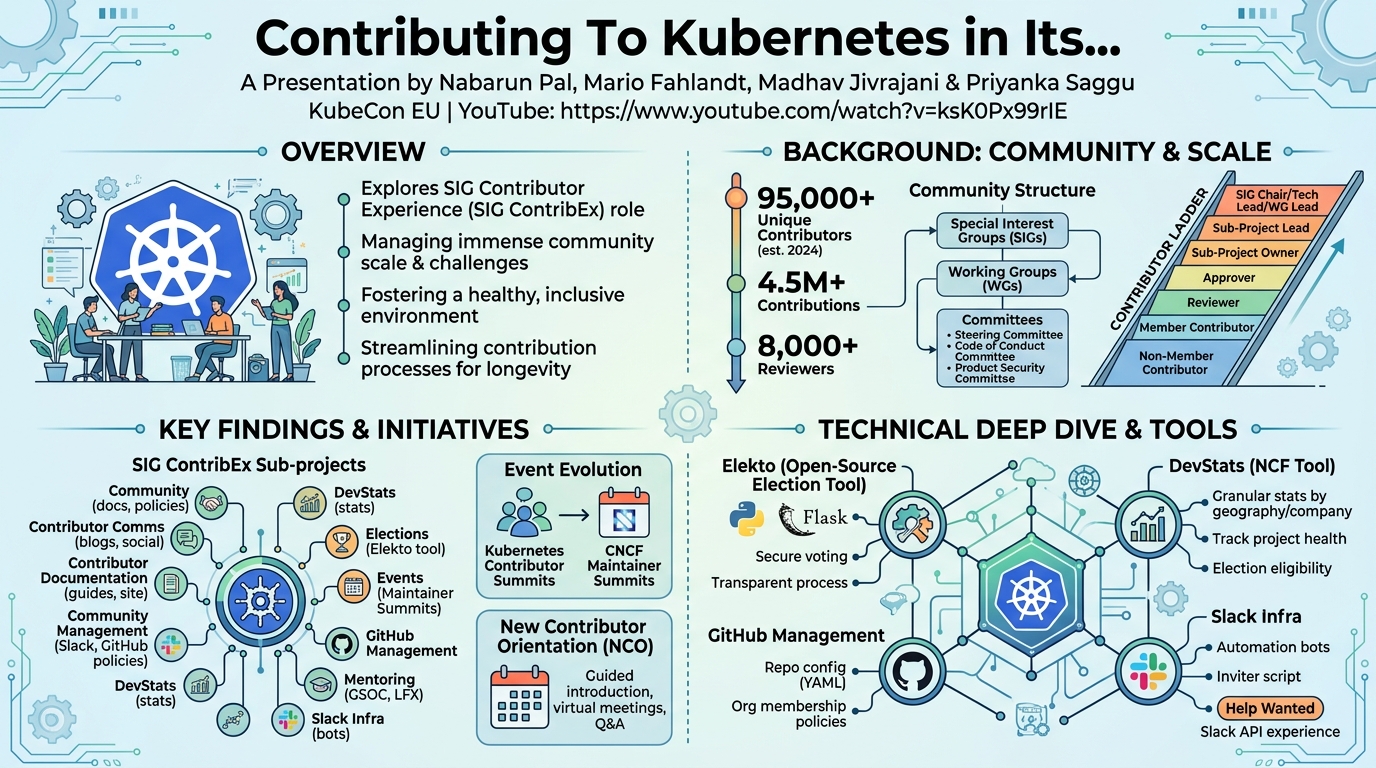
Kubernetes stands as an unparalleled success story in the open-source world, a testament to its innovative technology and the colossal community that fuels its development. The scale of this project is staggering: as of early 2024, Kubernetes boasts approximately 95,000 unique contributors over its 11-year history, generating over 4.5 million contributions (including commits, reviews, and various activities across its repositories). These contributions have been reviewed and shepherded by around 8,000 reviewers, a number that continues to grow rapidly, with projections suggesting the contributor base could reach 100,000 by the end of the year. Managing a project of this magnitude necessitates a highly structured and adaptable community framework.
The Kubernetes community is organized into three primary types of groups: Special Interest Groups (SIGs), Working Groups (WGs), and Committees. SIGs, like Contributor Experience, are long-term entities responsible for specific areas of the project, ranging from horizontal concerns like release and testing to vertical feature areas. Working Groups are designed for short-term, highly focused goals with defined exit criteria, often folding their work into existing SIGs upon completion. Committees, such as the elected Steering Committee, the Code of Conduct Committee, and the Product Security Committee, handle governance, ethical conduct, and responsible security vulnerability management, respectively. The Product Security Committee, in particular, plays a crucial role in managing CVEs, handling incoming security flaws responsibly, and overseeing embargo and patching processes to ensure the final product remains secure.
For individual contributors, Kubernetes offers a clear, albeit challenging, progression path known as the contributor ladder. Individuals typically begin as non-member contributors, contributing code or documentation without formal GitHub organization membership. Upon demonstrating substantial contributions, they can be sponsored to become member contributors. Further engagement, including code reviews, feature development, project management, or infrastructure maintenance, can lead to promotions through the ranks: reviewer, approver, sub-project owner, and sub-project lead. The apex of this ladder involves taking on broader management responsibilities as a SIG chair, tech lead, or working group lead. This progression is not solely quantitative but also highly qualitative, valuing the quality of contributions, reviews, and community engagement. This complex structure and the sheer volume of participants highlight the critical need for a dedicated entity like SIG ContribEx to streamline processes, mitigate friction, and cultivate a welcoming environment for all.
Key Findings
▶ Watch: Understanding Kubernetes' Special Interest Groups and Committees (2:20)
The talk meticulously outlines the multifaceted efforts of SIG Contributor Experience (SIG ContribEx), demonstrating its pivotal role in fostering a thriving Kubernetes community. A central finding is the comprehensive approach taken by SIG ContribEx through its various sub-projects, each addressing a specific facet of the contributor journey. These include Community, which maintains the kubernetes/community repository and associated documentation; Contributor Comms, responsible for official blogs (kubernetes.io and kubernetes.dev) and social media channels; Contributor Documentation, managing the contributor guide and the kubernetes.dev website; Community Management, which oversees policies for communication platforms like Slack and GitHub; DevStats, providing crucial project statistics; Elections, developing and maintaining the open-source Elekto tool; Events, which historically ran Kubernetes Contributor Summits and now supports CNCF Maintainer Summits; GitHub Management, handling organizational membership and repository configurations; Mentoring, facilitating programs like GSOC and LFX mentorship; and Slack Infra, maintaining the inviter bot and group management.
A significant evolution highlighted is the transformation of community events. For nearly a decade, SIG ContribEx organized Kubernetes Contributor Summits, focused exclusively on Kubernetes contributors. Recognizing the broader landscape of the Cloud Native Computing Foundation (CNCF), the initiative has evolved into the CNCF Maintainer Summit. This shift aims to unite maintainers from all CNCF projects—sandbox, incubating, and graduated—alongside the Technical Oversight Committee (TOC) and Technical Advisory Groups (TAGs). The goal is to foster cross-project learning, collaboration, and provide newer projects with insights from more established ones like Kubernetes. The inaugural Maintainer Summit in India last year and the recent one in Europe, which gathered 360 maintainers, underscore this successful transition, now supported by the CNCF events team and a formalized CFP and sponsorship process.
Another key finding is the proactive approach to onboarding new contributors through the New Contributor Orientation (NCO) initiative. Acknowledging the daunting complexity of Kubernetes' structure and the common pitfall of "good first issues" not always being truly beginner-friendly, NCO offers a guided introduction. These monthly, 1.5-hour virtual meetings (held in two time zones) provide a 40-minute presentation covering community structure, workflows, and common pitfalls, followed by a 20-minute Q&A session. While initial attendance saw a great start followed by a slight decline due to inconsistent communications, the program maintains a steady intake of new participants, demonstrating its value in demystifying the contribution process. The team is committed to improving communication to sustain and grow NCO's reach.
Finally, the talk showcases the impressive growth and reach of Kubernetes' communication channels. Since SIG ContribEx's Contributor Comms team took over the Kubernetes LinkedIn handle, it has seen a 147% growth in new followers and a staggering 985% growth in posts, with 141 new posts. Similar efforts extend to X (formerly Twitter) and newer platforms like BlueSky (6,000+ followers since November 2023) and Mastodon, covering both end-user and contributor-facing content. The management of kubernetes.io (in collaboration with SIG Docs) and kubernetes.dev blogs has resulted in 45 and 14 blog posts respectively in 2024 alone, alongside six SIG spotlight blogs, demonstrating a robust and expanding communication strategy to inform and engage the community.
Technical Deep Dive
▶ Watch: Navigating the Kubernetes contributor growth path (5:58)
The operational backbone of the Kubernetes contributor experience is meticulously managed through a suite of sub-projects, each with specific technical responsibilities. The Community sub-project is foundational, owning the kubernetes/community repository, which houses crucial documentation, governance policies, and definitions for various community groups. This central repository acts as the single source of truth for understanding how the Kubernetes project functions.
Contributor Comms and Contributor Documentation work in tandem to disseminate information and guide contributors. Contributor Comms manages the technical infrastructure for the kubernetes.io and kubernetes.dev blogs. While kubernetes.io is a collaboration with SIG Docs, the kubernetes.dev blog is solely focused on contributor-centric content. These teams leverage content management systems and static site generators (like Hugo with a Doxy theme for the contributor site) to publish announcements, technical guides, and community spotlights. The strategic use of various social media platforms—LinkedIn, X, BlueSky, and Mastodon—requires understanding platform-specific APIs and content strategies to maximize reach for both end-users and contributors.
The Elections sub-project is responsible for a critical piece of community infrastructure: Elekto. Elekto is an open-source, community-built software developed in Python using the Flask web framework. Its creation was a direct response to the "friction" experienced with a previous proprietary tool for running Kubernetes' annual elections (e.g., for the Steering Committee). Elekto streamlines the entire election process, from candidate nomination to secure voting, providing a transparent and auditable mechanism. The elector.dev website serves as its official documentation. The team actively seeks contributions for hardening the software and extending its testing framework, highlighting the ongoing technical investment in this vital tool.
DevStats is another significant sub-project, maintaining the Kubernetes-specific instance of the broader CNCF DevStats project. This tool provides granular statistics on contributions, code reviews, and other activities, often broken down by geography or contributing company. It's crucial for tracking project health, identifying active contributors, and even determining eligibility for elections. The talk also briefly mentions LFX Insights, a CNCF-wide tool offering broader project health and release statistics. While Kubernetes has been onboarded to LFX Insights, DevStats continues to be essential for specific, "nitty-gritty" details, indicating a potential future convergence or specialized roles for both platforms. The current challenge is that LFX Insights does not yet offer a 1:1 API equivalent to DevStats for all use cases, such as election eligibility.
GitHub Management focuses on the configuration and health of the numerous Kubernetes repositories and the organization's membership. While it doesn't own the underlying tooling (GitHub's own features), it manages the policies and configurations that dictate how repositories are created, maintained, and how members are onboarded and managed within the GitHub ecosystem. This involves intricate YAML configurations and adherence to best practices for large-scale open-source project management.
Finally, the Slack Infra sub-project maintains the automation surrounding the Kubernetes Slack workspace. This includes the inviter bot, which simplifies the onboarding process for new members, and various scripts for managing groups and channels. The stability of the Slack API over the past five years has meant surprisingly low maintenance overhead for this sub-project, to the extent that it currently lacks dedicated maintainers, presenting a clear "help wanted" area for those with Slack API experience. The overarching theme across these sub-projects is a commitment to automation, open-source tooling, and robust documentation to manage the complexity of the Kubernetes project.
Demo / Proof of Concept
▶ Watch: SIG Contributor Experience: improving contribution and community health (7:20)
The talk did not feature a live technical demonstration or a proof of concept in the traditional sense. Instead, the speakers presented the ongoing work and tangible outcomes of the SIG Contributor Experience's initiatives as evidence of their efficacy. For instance, the discussion of the Elekto tool (available at elector.dev) serves as a "proof of concept" for how a community-built, open-source solution can successfully manage complex processes like annual elections, overcoming the limitations of proprietary alternatives. Similarly, the detailed statistics on blog posts, social media growth (e.g., 147% growth in LinkedIn followers), and the consistent intake of participants in the New Contributor Orientation (NCO) sessions are presented as quantifiable results of their programs. While no code was run on stage, the entire presentation effectively functions as a showcase of the operational "proof" of SIG ContribEx's strategies and the tools it develops or leverages to manage the vast Kubernetes contributor ecosystem.
Defensive Implications
▶ Watch: Key sub-projects of SIG Contributor Experience (8:10)
While this talk does not directly address security vulnerabilities or defensive strategies against cyber threats, the robust community management and contributor experience efforts championed by SIG ContribEx have profound indirect implications for the overall security and resilience of the Kubernetes project. A healthy, well-managed, and engaged contributor community is a fundamental pillar for maintaining a secure software project.
Firstly, the existence and active role of the Product Security Committee (PSC), mentioned as one of the Kubernetes committees, is paramount. This committee is explicitly tasked with handling incoming security flaws, managing CVEs, and overseeing embargo and patching processes. A strong contributor experience ensures a steady supply of knowledgeable volunteers who are willing and able to participate in such critical, often sensitive, security work. Without a robust contributor pipeline and clear pathways for engagement (facilitated by SIG ContribEx), staffing and maintaining committees like the PSC could become challenging, potentially leading to delays in addressing security issues.
Secondly, clear communication channels and comprehensive documentation, managed by SIG ContribEx's Contributor Comms and Contributor Documentation sub-projects, are vital for disseminating security best practices, vulnerability advisories, and responsible disclosure guidelines to the wider community. An informed contributor base is less likely to introduce security flaws and more likely to report them appropriately. The kubernetes.io and kubernetes.dev blogs and various social media channels serve as critical conduits for these communications, ensuring that security-relevant information reaches developers, maintainers, and users effectively.
Furthermore, the structured contributor ladder and mentoring programs (like GSOC and LFX mentorship) cultivate experienced and trustworthy individuals within the project. These programs help new contributors mature into roles like reviewers and approvers, who are responsible for scrutinizing code contributions for quality, functionality, and crucially, potential security vulnerabilities. A higher quality of review, fostered by a healthy contributor ecosystem, acts as a significant defensive layer against malicious or accidental security regressions.
Finally, the very existence of a dedicated SIG ContribEx ensures project sustainability. By reducing friction, managing community health, and preventing burnout, it helps retain experienced maintainers who possess deep institutional knowledge, including an understanding of the project's security posture and historical vulnerabilities. Losing key maintainers due to a poor contributor experience could create knowledge gaps that make the project more susceptible to security oversights. In essence, while not directly a security talk, the efforts of SIG ContribEx build the foundational community health and operational resilience that are indispensable for any large-scale, security-critical open-source project like Kubernetes.
Key Takeaways
- Massive Scale and Structured Management: Kubernetes is an enormous open-source project with approximately 95,000 contributors and 4.5 million contributions over its 11-year history, necessitating a highly structured community managed through SIGs, Working Groups, and Committees (including a vital Product Security Committee).
- SIG ContribEx as the Community Engine: The Special Interest Group Contributor Experience (SIG ContribEx) is crucial for improving the contributor journey, reducing friction, and promoting community health through a diverse set of sub-projects covering documentation, communications, events, elections, and mentoring.
- Evolution of Community Events: Kubernetes Contributor Summits have evolved into the CNCF Maintainer Summits, broadening participation to maintainers across all CNCF projects (sandbox, incubating, graduated) to foster cross-project learning and collaboration, with the latest summit hosting 360 maintainers.
- New Contributor Onboarding: The New Contributor Orientation (NCO) initiative provides crucial guided onboarding for new contributors, helping them navigate the complex Kubernetes community structure and workflow, demonstrating a proactive approach to lowering the barrier to entry.
- Robust Communication and Open-Source Tooling: SIG ContribEx actively manages extensive communication channels, including
kubernetes.ioandkubernetes.devblogs, and social media (LinkedIn, X, BlueSky, Mastodon), achieving significant growth (e.g., 147% growth in LinkedIn followers). They also develop and maintain vital open-source tools like Elekto (Python/Flask) for secure elections. - Ongoing Needs and Community Engagement: Despite significant achievements, SIG ContribEx actively seeks community help in critical areas such as Slack automation, hardening the Elekto election tool, maintaining the contributor site infrastructure (Hugo/Doxy), and structuring mentoring programs, emphasizing that community involvement is key to the project's future.
About the Speaker(s)
Nabarun Pal is one of the co-chairs of SIG Contributor Experience within the Kubernetes project. Beyond his leadership in SIG ContribEx, he maintains several other areas of Kubernetes and contributes to KCP, another CNCF project. His involvement reflects a deep commitment to the health and growth of the Kubernetes contributor community.
Mario Fahlandt also serves as a co-chair of SIG Contributor Experience in Kubernetes. His work extends to finetunes projects and significant contributions to CI/CD processes across various CNCF projects. Mario brings a strong background in technical operations and community building to his role.
Priyanka Saggu works at SUSE and is one of the technical leads for the Kubernetes SIG Contributor Experience. She has been involved in areas such as GitHub management and other technical aspects of the project. Priyanka's role focuses on the technical execution and strategic direction of SIG ContribEx initiatives.
The speakers collectively represent the core leadership of SIG Contributor Experience, having progressed through the community's mentoring processes themselves to become leads. Their combined experience spans community management, technical leadership, and strategic planning for large-scale open-source projects.
Reviews
Dr. Zero (Offensive Security Researcher) — STRONG ACCEPT
This KubeCon EU talk by SIG Contributor Experience leaders provides an exceptional deep dive into the operational mechanics of managing Kubernetes' massive open-source community. It details the intricate sub-projects, programs, and custom tooling like Elekto and DevStats that sustain a project with 95,000 contributors. While not a security exploit talk, it offers invaluable, actionable insights into large-scale community management, contributor onboarding, and the critical infrastructure behind one of the world's most vital software projects. The speakers, deeply involved in the work, demonstrate unparalleled credibility and present a clear, substantive overview of efforts to ensure…
Heather Calloway (CISO) — STRONG ACCEPT
This presentation on Kubernetes' SIG Contributor Experience provides a crucial look into the operational resilience and human capital management of one of the world's most critical open-source projects. For any CISO or executive whose organization relies on Kubernetes, understanding the mechanisms that ensure its long-term health, contributor pipeline, and governance structures—including the Product Security Committee—is fundamental to assessing supply chain risk and institutional accountability. While not a direct security briefing, it offers invaluable insight into the foundational community efforts that underpin the project's security and sustainability, demonstrating a mature approach…