Lessons Learned from Successful PhD Students
Tim Dettmers (Professor · Carnegie Mellon)
Conference on Machine Learning and Systems 2025 · Day 1 · Young Professional Symposium
Overview
This article delves into the illuminating insights shared by Tim Dettmers, the visionary behind QLORA and bitsandbytes, during his MLSys 2025 talk, "Lessons Learned from Successful PhD Students." Dettmers, a highly successful researcher now joining Carnegie Mellon as a professor, offers a unique perspective on achieving academic and scientific success, drawing from his own remarkable journey. Having overcome significant personal challenges, including dyslexia and being initially barred from university studies in Germany, Dettmers attributes his success to a deliberate, scientific approach to understanding what makes scientists thrive.
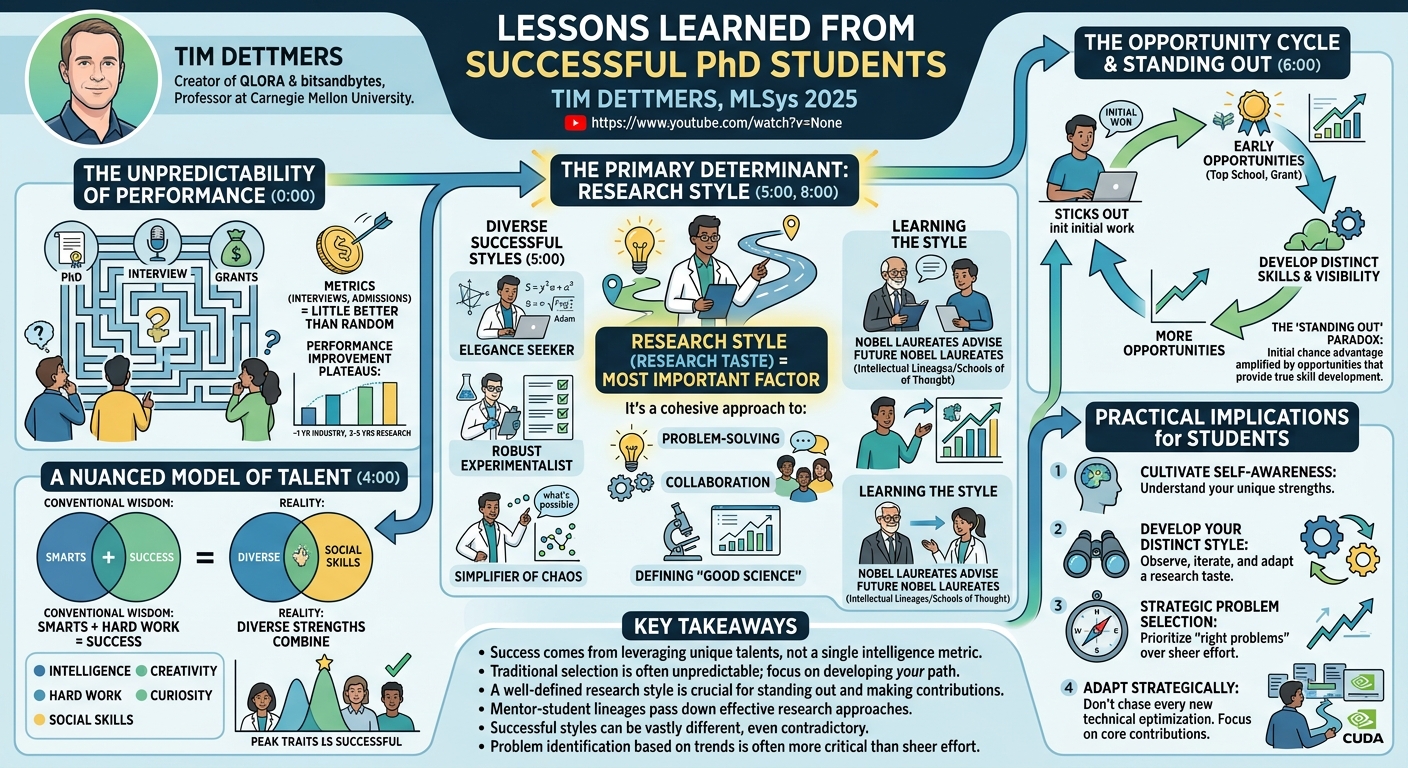
Key moments
- 0:00 Speaker's journey and talk overview
- 2:00 Unpredictability of success and research taste
- 4:00 Success comes from leveraging individual talents
- 5:00 The most important factor in scientific success
- 6:00 Cumulative advantage and the necessity to stand out
- 8:00 Developing a unique research style
Lessons Learned from Successful PhD Students
Speakers: Tim Dettmers
Conference: MLSys 2025
YouTube: https://www.youtube.com/watch?v=None
Overview
This article delves into the illuminating insights shared by Tim Dettmers, the visionary behind QLORA and bitsandbytes, during his MLSys 2025 talk, "Lessons Learned from Successful PhD Students." Dettmers, a highly successful researcher now joining Carnegie Mellon as a professor, offers a unique perspective on achieving academic and scientific success, drawing from his own remarkable journey. Having overcome significant personal challenges, including dyslexia and being initially barred from university studies in Germany, Dettmers attributes his success to a deliberate, scientific approach to understanding what makes scientists thrive.
The talk challenges conventional wisdom surrounding talent, hard work, and predictability in research careers. Dettmers argues that success is less about innate, uniformly distributed high intelligence or relentless effort, and more about strategically identifying and leveraging one's unique strengths through a concept he terms "research style" or "research taste." He presents a two-part framework: first, a quantitative analysis exploring the often-confusing evidence around scientific success, and second, a focused examination of how developing a distinct research style becomes the paramount factor for standing out and making significant contributions. This talk is crucial for aspiring and current PhD students, researchers, and anyone navigating the complexities of a scientific career, offering actionable strategies grounded in empirical observation and Dettmers' personal experiences.
Background
▶ Watch: Speaker's journey and talk overview (0:00)
The landscape of scientific and professional success is often shrouded in misconceptions, leading to frustration and misdirected effort. Dettmers begins by highlighting a series of well-established, yet frequently overlooked, meta-analyses that reveal a perplexing truth: predicting performance in jobs, including academic research, is remarkably difficult. Traditional metrics like interviews and PhD admissions perform little better than random selection in predicting a student's eventual success. Similarly, studies on grant allocation have shown that even random allocation yields comparable outcomes to merit-based systems, suggesting a significant degree of stochasticity in the early stages of scientific career progression.
Furthermore, Dettmers points out that performance plateaus are a common phenomenon. In industry roles, individuals typically max out their performance improvement after about one year, while researchers tend to plateau around three years and reach their maximum potential within five years. These findings directly contradict the popular narratives that attribute success solely to exceptional intelligence or boundless hard work. While these traits are certainly beneficial, Dettmers posits that they do not fully explain the observed patterns of success and failure. The problem, therefore, lies in understanding how individuals can navigate this unpredictable environment, identify their unique contributions, and sustain a trajectory of meaningful impact, especially when conventional predictive models fall short.
Dettmers addresses this by introducing a nuanced model of talent and success. He suggests that while we observe some individuals as "smart" or "hardworking," the reality is that "everyone has about equal talent" when considering the broader spectrum of human capabilities. Instead of a single, monolithic "talent," individuals possess diverse strengths—be it intelligence, creativity, hard work, curiosity, or exceptional social skills that foster collaboration. Success, in this view, is not about possessing all strengths but rather about identifying and effectively leveraging one's particular combination of strengths. This perspective provides a crucial context for understanding why traditional, narrow assessments of talent fail to predict long-term success, and sets the stage for Dettmers' central thesis on the importance of research style.
Key Findings
▶ Watch: Success comes from leveraging individual talents (4:00)
The talk presents several key findings that challenge conventional notions of scientific success and offer a more pragmatic framework for aspiring researchers:
- Unpredictability of Performance: Extensive meta-analyses indicate that job performance, including that of PhD students, cannot be reliably predicted. Interviews, PhD admissions, and even grant allocation often yield results no better than random selection. This suggests that initial assessments of potential are highly flawed and do not correlate strongly with actual long-term success.
- Performance Plateaus: Individuals typically reach their peak performance improvement relatively early in their careers—around one year in industry and three to five years in research. This finding implies that sustained success is not merely about continuous, incremental improvement in a fixed set of skills but rather about adaptability and strategic shifts.
- Distributed Talent and Leveraged Strengths: Dettmers proposes a model where, on average, individuals possess "equal talent" when considering a wide array of strengths (intelligence, creativity, hard work, curiosity, social skills). Success is not about having all strengths but about identifying one's unique combination of strengths and actively leveraging them. This explains why people with varied profiles can achieve success.
- The "Standing Out" Paradox and Opportunity Cycle: A critical finding is that scientific success often operates as a self-reinforcing feedback loop. Individuals who, perhaps by chance, "stick out" early on are given more opportunities (e.g., admission to top schools, prestigious grants). This exposure, in turn, helps them develop the skills and acquire the experience that truly distinguishes them. The challenge lies in initiating this cycle without prior achievements.
- Research Style as the Primary Determinant of Success: The most significant finding, derived from detailed studies of highly successful scientists (like Nobel laureates), is that a distinct research style or research taste is the single most important factor. This style is not merely a set of preferences but a coherent, often unique, approach to problem-solving, collaboration, and defining "good science." It enables researchers to stand out and effectively utilize their inherent strengths.
- Lineages and Schools of Thought: Harriet Zuckerman's study of Nobel laureates revealed that most were advised by future Nobel laureates, establishing "schools of thought" or intellectual lineages. This indicates that effective research styles are often passed down and refined, suggesting that mentorship and immersion in a strong research culture play a crucial role in cultivating success.
- Contradictory but Effective Styles: Dettmers illustrates that successful researchers, even within the same field, can possess vastly different, sometimes contradictory, research styles. This diversity underscores that there is no single "right" way to do science, but rather a multitude of paths to impactful contributions, each tailored to an individual's unique approach and strengths.
Technical Deep Dive
▶ Watch: The most important factor in scientific success (5:00)
While not discussing traditional ML architectures, this section unpacks the conceptual models and frameworks Dettmers uses to explain the science of scientific success. These "technical" insights are crucial for understanding his advice.
The Multi-Factor Talent Model
Dettmers challenges the simplistic view of talent by introducing a multi-factor model. He visualizes relative success on an X-axis (0.0 for not successful, 1.0 for very successful) and percentile of particular talents on the Y-axis. If success were solely predicted by a single talent, like intelligence, the distribution of successful individuals would be very broad: highly intelligent people would be successful, and others would not. However, this is not what is observed in reality.
Instead, Dettmers argues that success is a combinatorial outcome of multiple talents. He illustrates this with examples:
- Intelligence + Creativity: Someone needs to be intelligent and creative to achieve certain types of success.
- Intelligence + Hard Work + Curiosity: Adding more factors like hard work and curiosity further narrows the distribution of individuals possessing all these strengths, but broadens the ways one can be successful.
- Niche Strengths: He even considers a person who might not be traditionally "smart," "creative," "hardworking," or "curious," but possesses an exceptional ability to "light up" collaborations, fostering an environment where ideas flow, and everyone works effectively. Such an individual can be profoundly successful.
The core insight of this model is that as more ways of being successful emerge due to diverse talent combinations, the average talent across individuals tends to equalize. This explains the meta-analysis finding that we cannot predict success, as each person has a unique set of strengths that, when leveraged, can lead to success. The "technical" aspect here is the combinatorial logic of talents creating a broader landscape of successful profiles, moving beyond a single-metric view of capability.
The Stochastic Model of Academic Success
Dettmers presents a powerful, albeit potentially frustrating, stochastic model for how academic success unfolds. He likens it to an experiment on "what makes a great song":
- Initial Randomness: A group rates 20 songs, with the system showing average ratings. Initially, preferences are random.
- Feedback Loop: As people see others' ratings, a social feedback loop forms, leading to convergence on certain "best" songs.
- Reproducibility Failure: If the experiment is repeated, different songs emerge as the "best." This demonstrates that collective perception, rather than inherent quality, drives popularity/success in this context.
He applies this analogy to academia:
- Uniform Talent Distribution & Flawed Measurement: Individuals start with a uniformly distributed range of talents, and our initial measurements (admissions, interviews) are poor predictors.
- Chance "Stick Out": By chance, some individuals "stick out" (e.g., have a few early papers).
- Opportunity Gating: The top 1% (or similar arbitrary threshold) are then given the next opportunity (e.g., admission to a prestigious program, a significant grant).
- Reinforcement & Skill Development: This process repeats. Crucially, Dettmers notes that going through this process actually helps people become good. The opportunities themselves provide the training, mentorship, and resources that develop actual skills and distinction.
This model technically describes a positive feedback loop or a rich-get-richer phenomenon where initial, potentially random, advantages are amplified by subsequent opportunities, eventually leading to highly successful individuals like Nobel laureates. The "technical deep dive" here is in understanding this system-level dynamic, where institutional processes inadvertently reinforce initial stochastic advantages, eventually leading to genuine skill development.
The Research Style Framework
The most detailed "technical" contribution of the talk is the framework of research style or research taste. This is not a fixed algorithm but a meta-strategy for scientific conduct. Dettmers illustrates its multifaceted nature through contrasting examples:
- Ideas: Cheap vs. Essential:
- One style emphasizes "strong execution" over "cheap ideas."
- Another prioritizes "unique ideas," advocating for abandoning work if similar ideas are published.
- Defining "Good Science":
- Elegance Seekers: Believe in capturing the universe's elegance in mathematics (e.g., a "better Adam optimizer" if it's elegant).
- Robust Experimentalists: Focus on step-by-step, reliable science through "careful experiments with careful control" to minimize variance.
- Visionary Futurists: Emphasize identifying future problems and showing "what's possible," with experiments/math as secondary.
- Simplifiers of Chaos: Aim to find "simple insights" that combine and explain complex, exploding fields, making knowledge accessible.
Dettmers then provides concrete examples of successful research styles observed in his colleagues:
- Concept-Centered Experimental Visionary: Identifies future concepts and narratives, confirms them with experiments, and then crafts a compelling story.
- Fun-Seeking Collaborator: Prioritizes enjoyable problems and collaborations, then identifies small, generalizable scientific pockets within those problems.
- Mind the Gap Collaborator: Systematically reviews literature, identifies important gaps, works quickly with others to fill them, and publishes rapidly.
- Principle Neat and Tidy Collaborator: Adheres strictly to best practices, ensuring predictability, clarity, and solid, well-communicated research.
Finally, Dettmers describes his own style: viewing papers as a distraction, prioritizing identifying trends to pick the "right problems," always using his strengths (combining perspectives, future prediction), and believing that truly important, complex problems require "one brain" to solve, implying deep individual focus.
This framework is "technical" in its attempt to taxonomize successful approaches to scientific inquiry, providing a structured way to think about how individual researchers develop a unique, coherent, and effective methodology for their work. It's a meta-algorithm for scientific contribution, emphasizing self-awareness and strategic alignment.
Experimental Setup & Results
▶ Watch: Cumulative advantage and the necessity to stand out (6:00)
This talk, being a meta-scientific analysis of success, does not present new experimental results in the traditional ML sense. Instead, it draws heavily on meta-analyses and sociological studies of science to support its claims. The "experimental setup" refers to the methodologies of these foundational studies, and the "results" are their key findings, as interpreted by Dettmers.
Evidence for the Unpredictability of Performance
Dettmers cites a body of meta-analyses that form the bedrock of his initial arguments. While specific papers are not named, the methodology typically involves aggregating data from numerous studies on job performance, educational admissions, and grant allocations across various fields. The "setup" here is a large-scale statistical synthesis of existing research.
The "results" of these meta-analyses are striking:
- Job Performance Prediction: Findings consistently show that traditional methods for predicting job performance (e.g., interviews, psychological tests) have very low predictive power. Dettmers states, "we cannot predict job performance. Interviews don't work."
- PhD Admissions: Similarly, studies on PhD admissions demonstrate that admitting students randomly yields comparable performance outcomes to selective processes. Dettmers asserts, "PhD admissions also don't work. If you admit students randomly, you get the same performance."
- Grant Allocation: The same pattern extends to research funding, with Dettmers noting, "if you allocate grants randomly, you get the same performance."
- Performance Plateaus: Another aggregate finding is that performance improvement in jobs plateaus rapidly: about one year in industry and three to five years in research. This suggests that sustained, linear improvement beyond these points is uncommon.
These results collectively challenge the intuitive belief that meritocratic systems are highly effective at identifying future high-performers. They underscore the significant role of randomness and environmental factors in career trajectories.
Evidence for the Importance of Research Style
The central argument for research style is primarily supported by the seminal work of Harriet Zuckerman, specifically her detailed sociological study of Nobel laureates in the US.
- Experimental Setup (Zuckerman's Study): Zuckerman conducted an in-depth, quantitative analysis, including extensive interviews, with almost every US Nobel laureate to understand the factors contributing to their success. This was a qualitative and quantitative sociological investigation, not a controlled laboratory experiment.
- Key Results (Zuckerman's Findings):
- Mentorship Lineages: A crucial finding was that most Nobel laureates were advised by other Nobel laureates. More specifically, they were often advised by future Nobel laureates – meaning their mentors had not yet received the prize but would later. This highlights the concept of intellectual "lineages" or "schools of thought" where effective approaches to science are passed down.
- Distinct Styles: Zuckerman's work, as interpreted by Dettmers, indicated that Nobel laureates possessed very distinct research styles. Even when working on the same problems in the same fields, their approaches could be contradictory, yet equally successful. This demonstrates the validity of diverse methodologies.
The "Great Song" Analogy
Dettmers uses an illustrative "experiment" to explain how social feedback can create perceived success.
- Setup: A group of people are given 20 songs to rate and download, with real-time feedback on what "other people think so far."
- Results: Participants converge on a set of "best songs." However, when the experiment is repeated with a different group or starting conditions, different songs emerge as the "best."
This analogy serves as a proxy "experimental result" to demonstrate how seemingly objective measures of quality can be heavily influenced by social dynamics and initial stochasticity, mirroring the academic success model Dettmers proposes. While not an ML experiment, it provides a powerful conceptual model for understanding how reputation and opportunity can snowball, even from arbitrary beginnings.
Practical Implications
▶ Watch: Developing a unique research style (8:00)
The insights from Dettmers' talk carry profound practical implications for various stakeholders in the ML and broader scientific communities.
For PhD Students and Aspiring Researchers, the primary takeaway is a shift in focus from striving for a generic definition of "smartness" or "hard work" to a more introspective and strategic approach.
- Self-Awareness is Key: Instead of trying to emulate a perceived ideal, students should invest time in understanding their unique strengths, talents, and preferred ways of working. Dettmers' own journey, overcoming dyslexia to become a professor, exemplifies leveraging unconventional strengths.
- Cultivate a Distinct Research Style: This is the most actionable advice. Rather than passively absorbing existing methods, students should actively develop their own "research taste." This involves observing successful researchers (e.g., looking at essays like Richard Hamming's "You and Your Research"), understanding their styles, and then asking: "Will this work for me?" The process is iterative: try a style, if it doesn't align with your strengths or yield results, adapt and try something else. This proactive approach helps in "standing out" and attracting opportunities.
- Strategic Problem Selection: Dettmers emphasizes that "the greatest waste of time is to work really, really hard on the wrong problem." This implies that problem identification, often driven by observing trends and future predictions (as in Dettmers' own style), is more critical than sheer effort on any given task. For ML practitioners, this means critically evaluating whether a problem is truly important and impactful, rather than just technically challenging.
- Embrace Collaboration Strategically: While Dettmers notes his own preference for solving complex problems "in one brain," he also highlights the success of collaborators who thrive on teamwork (e.g., the "Fun-Seeking Collaborator" or "Mind the Gap Collaborator"). The implication is to find a collaborative style that suits one's strengths.
- Adaptability to Changing Environments: The Q&A segment directly touches on the rapid evolution of ML infrastructure, particularly in hardware-software co-design (e.g., CUDA kernels for A100 vs. H100/B100, TMA). Dettmers' advice to a researcher struggling with continuous CUDA learning is crucial: don't chase every new optimization if it doesn't align with your core strengths. He speculates that AI might soon automate much of this low-level programming. This underscores the need for researchers to focus on higher-level problem-solving and adaptable skills rather than narrow, rapidly obsolescing technical niches.
For Infra Teams and Model Builders, Dettmers' talk indirectly suggests a need to recognize the diverse pathways to contribution.
- Beyond Standard Metrics: If traditional metrics (admissions, interviews) are poor predictors of success, institutions should consider broader, more holistic evaluation methods that account for diverse strengths and potential research styles.
- Fostering Diverse Research Environments: Creating environments that support various research styles—from the elegant theoretician to the robust experimentalist to the visionary—can lead to a wider range of impactful discoveries.
- Mentorship and Lineage: The finding about Nobel laureate lineages highlights the importance of strong mentorship and the transmission of effective research styles. Infra teams and research leads should actively cultivate mentorship programs that focus on developing a researcher's unique approach, rather than just task-specific skills.
Tradeoffs and Limitations
- The "Standing Out" Paradox: Dettmers acknowledges the inherent frustration: "You kind of need to have done a PhD before you start a PhD." The talk offers strategies for how to stand out once opportunities arise, but less on how to get the very first opportunity if initial selection is random. This remains a significant challenge for early-career researchers.
- Abstractness of "Research Style": While powerful, "research style" is an abstract concept. Translating it into concrete actions requires significant self-reflection and experimentation, which can be time-consuming and challenging without direct guidance.
- Context Dependency: The efficacy of a research style is likely context-dependent. What works in a fast-paced, applied ML environment might differ from a theoretical physics department. Researchers need to assess their environment when crafting their style.
- Individual vs. Systemic Change: The talk focuses on individual strategies for success. While it implicitly critiques existing selection systems, it doesn't offer explicit solutions for systemic change to make admissions or grant allocation more effective.
In essence, Dettmers' talk empowers individuals to take agency over their scientific journey by strategically aligning their unique talents with a deliberately cultivated research style, while also providing a sobering reminder of the inherent unpredictability and feedback loops that govern scientific careers.
Key Takeaways
- Scientific success is primarily driven by leveraging unique personal strengths through a distinct research style, rather than by a singular, generic "talent."
- Traditional methods for predicting academic and job performance (e.g., interviews, admissions, grants) are often ineffective and perform little better than random selection.
- Developing a well-defined and authentic "research style" or "research taste" is the most critical factor for standing out, attracting opportunities, and making significant contributions.
- Success in academia often involves a self-reinforcing cycle where initial, potentially random, opportunities lead to the development of distinguishing skills and further opportunities.
- Effective research styles can be highly diverse and even contradictory, emphasizing that there is no single "right" way to conduct impactful science.
- Researchers should prioritize identifying and working on "right problems" based on trends and future predictions, and continuously adapt their skills and approach to rapidly changing technical landscapes.
About the Speaker(s)
Tim Dettmers is a highly accomplished researcher and academic, renowned for his significant contributions to the field of machine learning systems. He is the creator of QLORA, a highly efficient fine-tuning approach for large language models, and the author of bitsandbytes, a foundational library for GPU-accelerated deep learning primitives, which boasts over 35 million downloads. Dettmers is currently joining Carnegie Mellon University as a professor, marking a new chapter in his distinguished career. His journey to this position is particularly inspiring, as he openly shares his past struggles, including having dyslexia and being told in high school that he should pursue a job requiring no mental capacity, and subsequently being denied entry to university studies in Germany. He attributes his eventual success to diligently studying the "science of scientific success" and applying its principles. Dettmers identifies his core strengths as combining diverse perspectives from different sub-areas and disciplines, thinking about the future, and making accurate predictions about emerging trends.
Reviews
Simon Wisk (Open Source Developer & AI Tooling Expert) — WEAK
Tim Dettmers is legitimately credentialed — QLoRA and bitsandbytes are real, shipped, widely-used work — but this talk is a career advice lecture, not an engineering talk. The article is well-written but there's nothing here an engineer can build, benchmark, or implement. The 'framework' is a taxonomy of personality types for researchers, supported by sociological studies and an analogy about song ratings. That's fine content for a graduation speech; it's the wrong session for MLSys.
Jensen Hitch (AI Compute Platform CEO) — WEAK
Tim Dettmers is a legitimate contributor to ML systems — QLoRA and bitsandbytes are real infrastructure work that moved the needle on inference efficiency and memory bandwidth utilization. But this talk isn't about that. This is a motivational framework about PhD career strategy, dressed up with sociological citations and stochastic models of academic success. At MLSys — a systems conference — this is the wrong talk in the wrong room. There's no systems thinking, no physical constraint reasoning, no deployment reality, and no platform implication. The core thesis is 'find your research style,' which is genuinely good advice for a graduate seminar, but it doesn't belong on a stage where…
→ Top-rated talks at Conference on Machine Learning and Systems 2025
All talks from Conference on Machine Learning and Systems 2025