Separation is Good: A Faster Order-Fairness Byzantine Consensus
Ke Mu
Network and Distributed System Security (NDSS) Symposium 2024 · Day 2 · Blockchain Security
Overview
This article delves into SpeedyFair, a novel high-performance Byzantine Fault-Tolerant (BFT) consensus protocol designed to address the pervasive problem of adversarial transaction order manipulation in decentralized finance (DeFi). Presented by Ke Mu at the NDSS Symposium, SpeedyFair tackles the critical vulnerability known as Miner Extractable Value (MEV) or Blockchain Extractable Value (BEV), where malicious actors, such as miners or block leaders, exploit their control over transaction ordering to extract significant profits from ordinary users through tactics like front-running and sandwich attacks. Estimates suggest this phenomenon has cost users hundreds of millions of dollars on networks like Ethereum.
Key moments
- 0:00 Introduction: Problem of adversarial transaction order manipulation (MEV)
- 1:00 Limitations of existing order-fairness protocols (e.g., Themis)
- 1:30 SpeedyFair's key insight: Decoupling fair ordering from consensus
- 2:00 SpeedyFair's performance results: throughput and latency gains
- 2:40 Challenges in order-fairness: Condorcet paradox and weak liveness
- 3:30 Themis's performance bottleneck: Re-verification of fair ordering
- 4:20 SpeedyFair's Optimistic Fair Ordering (OFO) protocol
Separation is Good: A Faster Order-Fairness Byzantine Consensus
Speakers: Ke Mu
Conference: NDSS Symposium
YouTube: (no public video)
Overview
This article delves into SpeedyFair, a novel high-performance Byzantine Fault-Tolerant (BFT) consensus protocol designed to address the pervasive problem of adversarial transaction order manipulation in decentralized finance (DeFi). Presented by Ke Mu at the NDSS Symposium, SpeedyFair tackles the critical vulnerability known as Miner Extractable Value (MEV) or Blockchain Extractable Value (BEV), where malicious actors, such as miners or block leaders, exploit their control over transaction ordering to extract significant profits from ordinary users through tactics like front-running and sandwich attacks. Estimates suggest this phenomenon has cost users hundreds of millions of dollars on networks like Ethereum.
The core issue lies in traditional BFT consensus protocols, which, while guaranteeing a consistent total order of transactions across replicas, impose no constraints on how that order is determined. This leaves a loophole for a single, potentially adversarial leader to unilaterally dictate transaction inclusion and sequencing within proposed blocks without violating fundamental safety or liveness properties. To counter this, the concept of order-fairness emerged, aiming to ensure that the final transaction order genuinely reflects the collective preferences of a majority of replicas, rather than the arbitrary will of a leader. However, existing leader-based order-fairness protocols, particularly those not relying on synchronized clocks, have been plagued by significant performance bottlenecks, primarily due to computationally expensive fair ordering processes and a strong, serial coupling between fair ordering and consensus.
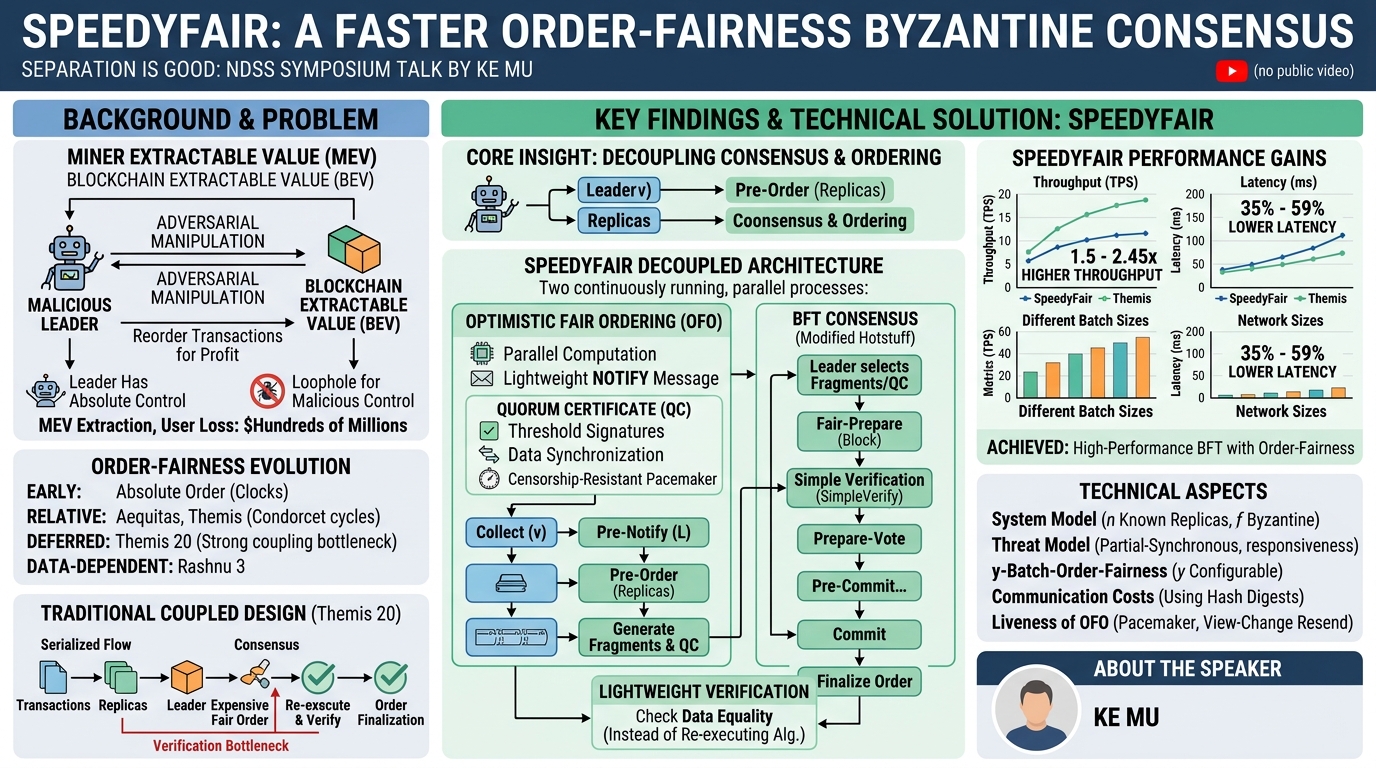
SpeedyFair introduces a groundbreaking decoupled design that fundamentally separates the fair ordering process from the consensus critical path. This innovative approach allows for parallel execution of these traditionally serial operations, eliminating mutual waiting and dramatically boosting overall system performance. Through extensive experimental evaluation, SpeedyFair has demonstrated a substantial improvement over state-of-the-art order-fairness protocols like Themis, achieving a throughput increase of 1.5 to 2.45 times and reducing latency by 35% to 59%. This work is crucial for building more robust, equitable, and efficient decentralized financial systems by ensuring that transaction ordering is fair and not susceptible to malicious manipulation, even under Byzantine conditions.
Background
[▶ Watch: Introduction: Problem of adversarial transaction order manipulation (MEV) (0:00)]()
The rapid expansion of Decentralized Finance (DeFi) on blockchain networks has underscored a fundamental design flaw in many underlying Byzantine Fault-Tolerant (BFT) consensus protocols. While BFT protocols are celebrated for their ability to ensure agreement on a global transaction order even in the presence of malicious participants, they historically grant the designated block leader considerable, often absolute, control over the sequence and inclusion of transactions within their proposed blocks. This unchecked power is the root cause of Miner Extractable Value (MEV) and the broader Blockchain Extractable Value (BEV) problem, where malicious leaders can reorder, censor, or insert transactions to maximize their own profit, frequently at the expense of other network participants. The financial scale of MEV is staggering, with hundreds of millions of dollars estimated to have been extracted from networks like Ethereum.
To combat this, the concept of order-fairness was introduced. The goal of order-fairness is to establish a transaction order that reflects the collective preferences of the network's replicas, rather than being solely dictated by a single leader. The evolution of order-fairness research has seen several distinct approaches:
- Early Attempts (e.g., Pompe and Wendy): These protocols sought to establish an absolute transaction order based on synchronized clocks or client-assigned timestamps. However, such methods proved impractical in asynchronous network environments due to inherent clock skews, unpredictable network delays, and susceptibility to timestamp manipulation by adversaries.
- Relative Order-Fairness (e.g., Aequitas and Themis): Recognizing the limitations of absolute ordering, a more robust approach focused on the relative order of transactions as perceived by a majority of replicas. The ideal receive-order-fairness property aimed to order transaction A before transaction B if a sufficient fraction of replicas received A before B. However, this ideal definition encountered the Condorcet paradox from social choice theory. Even if individual replica preferences are transitive, collective preferences can become non-transitive, leading to "Condorcet cycles" where a strict ordering is impossible (e.g., A > B, B > C, C > A).
- Batch-Order-Fairness (Aequitas): To circumvent the Condorcet paradox, Aequitas introduced batch-order-fairness, which allows transactions involved in cyclic dependencies to be delivered within the same batch. While this resolved the paradox, it introduced a new challenge: weak liveness. Chained Condorcet cycles could theoretically extend indefinitely, causing transactions to be delayed for an arbitrary, potentially infinite, period before finalization.
- Deferred Ordering (Themis 20): Themis 20 addressed the weak liveness issue by proposing a deferred ordering technique. This approach saves incomplete orderings within consecutive cycles and delivers these transactions in subsequent blocks, thereby ensuring standard liveness guarantees. Themis is particularly notable as one of the first practical implementations of a relative fair ordering protocol that operates without relying on synchronized clocks. However, as identified by the SpeedyFair research, Themis suffers from considerable performance overheads.
- Data-Dependent Order-Fairness (Rashnu 3): Rashnu 3 later introduced data-dependent order-fairness, which sought to reduce complexity by only ordering transactions that access the same data object. SpeedyFair's approach is orthogonal to Rashnu's, as it focuses on optimizing the execution flow and performance bottlenecks of the fair ordering process itself, rather than the specific fair ordering algorithm.
The performance challenges in protocols like Themis stem from a tightly coupled, serial execution model. A typical flow in a leader-based order-fairness consensus protocol, exemplified by Themis, proceeds as follows:
- Initiate Transaction: Clients broadcast transactions to all replicas.
- Collect Transactions: Each replica collects transactions, forms a local order, and sends it to the leader.
- Fair Ordering: The leader collects a sufficient number of local orders and applies a computationally intensive fair ordering algorithm (e.g., building a complex dependency graph) to generate a global fair order.
- Consensus: The leader packages these fair-ordered transactions into a proposal and initiates a BFT consensus protocol (e.g., based on Hotstuff). Critically, every replica must re-verify the correctness of the fair ordering by re-executing the same expensive algorithm performed by the leader. This re-execution is a primary source of the performance bottleneck.
- Order Finalization: After consensus, replicas locally finalize the order, particularly for any deferred transactions.
The fair ordering algorithm itself, as used by Themis, involves constructing local order lists (new and updated transactions), generating a global fair ordering by categorizing transactions and building a dependency graph using algorithms like FairPropose and FairUpdate, and finally, finalizing the order through topological sorts and handling cycles. The re-execution of this entire complex process by every replica during the consensus phase is the central performance bottleneck that SpeedyFair aims to resolve.
Key Findings
[▶ Watch: SpeedyFair's key insight: Decoupling fair ordering from consensus (1:30)]()
The research presented on SpeedyFair makes several significant contributions to the field of Byzantine consensus and order-fairness:
- Decoupled Protocol Design: The most fundamental finding is the successful design of SpeedyFair, a high-performance order-fairness BFT protocol that fundamentally decouples the computationally intensive fair ordering process from the critical path of the consensus protocol. This separation is based on the insight that the ordering of transactions primarily depends on the dependency graph of previous transaction orders, not the execution results of previous proposals.
- Enhanced Resource Utilization and Reduced Latency: This decoupled paradigm allows for more efficient utilization of network bandwidth and computing resources. By eliminating the strong, serial coupling between ordering and consensus, SpeedyFair avoids mutual waiting delays, enabling both processes to run concurrently and significantly reducing overall transaction latency.
- Optimistic Fair Ordering (OFO): SpeedyFair introduces Optimistic Fair Ordering (OFO), a novel protocol dedicated to performing fair ordering individually and consecutively, entirely separate from the consensus process. OFO achieves substantial efficiency gains by parallelizing the traditionally serial "order/verify" mode, where both the virtual leader and replicas compute the fair order simultaneously.
- Robust Quorum Certificate (QC) with Threshold Signatures: To ensure integrity and availability in the decoupled environment, SpeedyFair incorporates a robust Quorum Certificate (QC) mechanism, implemented using threshold signatures. This QC serves as irrefutable proof to the consensus phase that a fair ordering for a specific set of transactions has been successfully completed by OFO. It guarantees that valid fair ordering outputs, referred to as "fragments," can be reliably picked by the consensus process, thereby mitigating censorship and ensuring availability.
- Lightweight Verification Scheme: During the consensus phase, SpeedyFair introduces a dramatically more efficient verification scheme. Instead of replicas re-executing the entire expensive fair ordering algorithm, they only need to perform a simple verification of data equality. This drastically reduces the computational overhead for replicas when validating a leader's proposed block, allowing the consensus protocol to proceed with significantly lower latency.
- Prototype Implementation and Comprehensive Evaluation: A fully functional prototype of SpeedyFair was implemented on top of the open-source Hotstuff consensus protocol, written in Go. Extensive experimental results unequivocally demonstrate SpeedyFair's superior performance compared to Themis, the state-of-the-art order-fairness protocol. SpeedyFair consistently achieved a throughput 1.5 to 2.45 times greater and reduced latency by 35% to 59% across a diverse range of scenarios, including varying batch sizes, network sizes, fairness parameters, and geo-distributed settings.
- Formal Guarantees: The research formally proves that SpeedyFair's decoupled protocol rigorously guarantees order-fairness, safety, and liveness properties simultaneously, a critical aspect for adoption in secure decentralized systems.
Technical Deep Dive
[▶ Watch: SpeedyFair's performance results: throughput and latency gains (2:00)]()
SpeedyFair's core innovation lies in its realization that the fair ordering of transactions does not depend on the execution results of previous proposals, but rather on the dependency graph of previous transaction orders. This crucial insight allows for a complete decoupling of the fair ordering process from the critical path of the consensus protocol, effectively eliminating the performance bottlenecks caused by their strong, serial coupling in prior designs.
The protocol introduces Optimistic Fair Ordering (OFO), a novel, continuously running protocol that performs the fair ordering process individually and consecutively, entirely separate from the BFT consensus. When a round of OFO completes, a new round can begin immediately without waiting for consensus finalization. To further accelerate the ordering phase and reduce latency, OFO enables parallel computation of the expensive fair order. Instead of the leader solely computing the fair order and then sending it to replicas for verification, both the virtual leader and all replicas compute the fair ordering simultaneously. The virtual leader only broadcasts a lightweight Notify message, specifying which local orderings (from a sufficient number of replicas) were selected for that round. Replicas then use these identical inputs to compute the fair ordering in parallel.
A critical component of OFO is the Quorum Certificate (QC), implemented using threshold signatures. This QC serves as a cryptographic proof for the subsequent consensus phase, indicating that a fair ordering for a specific set of transactions (a "fragment") has been successfully completed within the decoupled OFO protocol. This mechanism ensures that valid fair ordering results can be eventually picked by consensus, preventing censorship and maintaining availability.
During the consensus phase, SpeedyFair introduces a new verification scheme. Instead of requiring replicas to re-execute the entire, computationally expensive fair ordering algorithm (as in Themis), they only need to perform a simple verification of data equality. This drastically reduces the overhead for replicas when validating a leader's proposed block, allowing the consensus protocol to proceed with significantly lower latency.
To maintain robustness in an asynchronous network, SpeedyFair incorporates a data synchronization mechanism. If a replica falls behind in its fair ordering computation, it can fetch valid fair-ordered data ("fragments") from other replicas using the QC as proof of validity. This prevents slow replicas from delaying consensus voting and ensures OFO's liveness. Furthermore, OFO includes a pacemaker mechanism to ensure progress even after a Global Stabilization Time (GST), handling timeouts and view changes. It also explicitly prevents censorship by ensuring that unprocessed local-order messages are resent to the new virtual leader during view changes.
System and Threat Model
SpeedyFair operates in a system with n known replicas, where at most f are Byzantine (malicious) and can deviate arbitrarily but are computationally bounded. It assumes a partial-synchronous network model, meaning there's an unknown Global Stabilization Time (GST) after which messages are delivered within a bounded time Δ. The protocols are designed to be responsive, meaning their performance depends on the actual network Δ, not a pessimistic upper bound. For order-fairness, SpeedyFair aims for y-batch-order-fairness, similar to Themis. The research proves that to achieve this, the number of replicas n must satisfy n ≥ 4f / (2y-1). The parameter y determines the proportion of replicas that must agree on a specific order, with y=1 representing the strongest fairness where all replicas receive the same specific order. Cryptographically, SpeedyFair relies on standard public-key cryptography for signatures, a (k, n)-threshold encryption scheme (TSEnc) for threshold signatures where k = n-f, and a collision-resistant cryptographic hash function H for message digests. These primitives ensure authenticity, integrity, and non-repudiation.
System Design and Architecture
SpeedyFair's architecture, conceptually depicted as two continuously running, decoupled processes, is central to its efficiency. The Optimistic Fair Ordering (OFO) protocol continuously generates fair-ordered transaction fragments, which are then fed into a separate, continuously running BFT consensus protocol (Figure 3 in the paper).
The OFO protocol itself (detailed in Algorithm 1 and Figure 4 in the paper) progresses through a succession of virtual views, each with a unique virtual leader.
- Collect Phase: In virtual view
v-1, each virtual replicaRfirst determines the virtual leaderLfor the next virtual viewv.Rconstructs two ordered transaction lists:TRfor new transactions not yet in any fragment, andURfor transactions from previous fragments with missing edges (using the same method as Themis).Rthen creates a signedLocal-Ordermessage:(v, R, TR, UR, PCR,v-1)σR, wherePCR,v-1is a partial certificate for the previous local-order fragmentFL_1. This message is sent to the virtual leaderL. - Pre-Notify Phase: When the virtual leader
Lreceivesn-fcorrectly signedLocal-Ordermessages from distinct virtual replicas, it verifies the partial threshold signaturesσj,v-1forFL_1. It caches these signatures and the local-order data.Lthen combines then-fpartial threshold signatures into a full threshold signatureΣv-1. Using this,Lconstructs a Quorum Certificate (QC)QCv-1 = (v-1, H(FL_1), Σv-1)as proof of voting forFL_1. Finally,Lconstructs aLocal-Order Fragment Fv = (v, L, QCv-1, LOv)(whereLOvspecifies whichn-freplicas' local orders were used) and broadcasts aNotifymessage(Notify, (v, L, Fv)σL)to all replicas. - Pre-Order Phase: Upon receiving a valid
Notifymessage, each virtual replicaRverifies the threshold signatureΣv-1withinQCv-1. If valid,RstoresFL_1in persistent storage (LOFChain).Rthen obtainsFv-1usingGetFragment()(either locally or from remote replicas usingQCv-1for validation).RstoresFv-1inFChain, computes a partial threshold signatureσR,vforFv, and constructsPCR,v.Raggregates all transaction lists (Tj/Uj) fromLOvinto its localTv/Uv. It then runs the graph-based fair ordering algorithm (FairOrder(Tv, Uv)) to compute the transaction dependency graphGvand missing edgesEv. Finally,Rconstructs the complete FragmentFv = (Gv, Ev, H(Tv), H(Uv))(note:Fvonly stores hash digests ofTvandUvfor efficiency) and stores it locally.Rthen moves to the next virtual viewv+1and initiates a newCollectphase.
To ensure OFO's liveness, a Pacemaker Mechanism (Algorithm 2 in the paper) is employed. If a virtual replica R times out waiting for a Notify message, it broadcasts a New-VirView message with its highest known quorum certificate QChigh. Crucially, R also sends its unprocessed Local-Order message from the expired view v to the new virtual leader of v+2. This prevents censorship by ensuring that transactions proposed by correct replicas are eventually considered. Upon receiving a quorum of New-VirView messages, replicas advance to a new virtual view, potentially with an exponential back-off for timeouts to avoid frequent view changes.
The Consensus Protocol in SpeedyFair (Algorithm 3 in the paper) is based on Hotstuff, with modifications primarily in the Prepare phase:
- Leader: In round
i, the leader selects a set of previously unproposed fragmentsFjfrom its localFChain. For eachFj, it obtains its correspondingQCj. The leader then appends(j, Fj, QCj)to the block data and broadcastsBlock(i)as aFair-Preparemessage. - Replica: Upon receiving
Block(i), for each(j, Fj, QCj)in the block data, the replica first obtainsFjusingGetFragment(j, QCj). IfFjis valid, the replica performs a simple verification usingSimpleVerify(). This function quickly checks if the data inFj(i.e.,Gj, Ej, H(Tj), H(Uj)) matches the expected values. This is significantly faster than re-executing the full fair ordering algorithm. If all fragments pass this simple verification, the replica sets a flagθ = trueand sends aPrepare-Voteto the leader. Otherwise, it returns. - After committing
Block(i), replicas locally run the finalization function for all fragments in the block.
Finally, a Data Synchronization Mechanism (Algorithm 4 in the paper) handles slow replicas. If a replica hasn't completed fair ordering for certain virtual views, it can use FetchRemoteF() to request missing fragments from other replicas, validating them with the QCs. This ensures that replicas can always obtain valid data to participate in consensus and maintain OFO's liveness.
Implementation Details
SpeedyFair's implementation leverages an open-source Hotstuff consensus protocol codebase written in Go. To achieve the decoupled design, SpeedyFair runs as a two-process Go program: one process dedicated to the Optimistic Fair Ordering (OFO) protocol, and another for the consensus protocol. The Hotstuff consensus code was modified in two key areas:
- Transaction Data Acquisition: The leader's method for obtaining transaction data when constructing a proposal was updated to integrate seamlessly with OFO's fragments.
- Fair Ordering Verification: The verification process for replicas after receiving a proposal was replaced with SpeedyFair's new, lightweight
SimpleVerifyscheme, eliminating the need to re-execute the full fair ordering algorithm. All other phases of the Hotstuff consensus protocol remain untouched.
For the threshold signatures used in OFO, the implementation concatenated ECDSA signatures. To ensure a fair comparison, the researchers also implemented Themis on top of the same Hotstuff base. SpeedyFair's implementation comprises five main modules: Client (for generating saturated transaction input), OFO (handling fair ordering, pacemaker, and data synchronization), Consensus (the modified Hotstuff protocol), Storage (for persistent storage of fragments), and Network (for reliable communication).
Significant implementation challenges included view control across OFO and consensus, ensuring correct view updates and data consistency, especially during timeouts or replica desynchronization. Another challenge was transaction pool management, which is concurrently updated by multiple modules (clients, OFO, consensus, data synchronization), requiring careful handling of additions, extractions, and potential rollbacks.
Regarding Communication Costs, SpeedyFair significantly reduces network overhead. The OFO Collect and Pre-Notify phases, which involve sending transaction lists, are optimized by transmitting only hash digests of transactions (e.g., 32-byte hash) instead of raw transaction data. This reduces the cost from O(Bn stx) bits (where B is batch size, n is replicas, stx is transaction size) to O(Bn Shash) bits (where Shash is hash size), achieving a substantial volume reduction ratio (e.g., 1:16 for 1000 transactions of 512B each). The consensus Prepare phase, where fragments are included in the block, has a complexity of O(B^2 Shash + Shash + Sqc), where Sqc is the size of the quorum certificate. In comparison, Themis has a communication complexity of O((B^2 + nB) stx), whereas SpeedyFair's is O((B^2 + nB) * Shash + Shash + Sqc). The strategic use of hash digests is key to SpeedyFair's reduced communication overhead.
The Liveness of OFO was also carefully considered. A fixed batch size could lead to liveness issues if insufficient transactions arrive; SpeedyFair addresses this by setting an upper bound Bup for batch size and allowing the addition of Txblank (blank transactions) to meet the batch size requirement. The virtual leader prioritizes lists with more actual transactions. In worst-case scenarios, f consecutive malicious virtual leaders or consensus leaders could delay transactions for f or 2f rounds, respectively. Mitigation strategies, such as leader election policies based on blacklists or reputation mechanisms, are proposed, leveraging the shared replica set and knowledge of malicious actors between OFO and consensus.
The paper also analyzed Reordering Attacks during Abnormal View-Change. While fair ordering mitigates network-level attacks, malicious replicas could still manipulate local orders during view changes. SpeedyFair's pacemaker mechanism, by ensuring unprocessed Local-Order messages are resent to the new virtual leader, prevents censorship. Cryptographic schemes for hiding transaction content are noted as a complementary mitigation strategy.
Finally, a qualitative comparison was made with Blind-Fairness schemes (Table II in the paper). Blind-Fairness aims to hide transaction content but does not constrain ordering, often leading to higher latency as transactions must be revealed and executed after consensus. SpeedyFair, by focusing on order-fairness, allows for immediate execution and thus lower latency. Both approaches incur additional computational and communication overheads, but SpeedyFair's are related to graph-based ordering and transaction list transmission, while Blind-Fairness's are associated with encryption and decryption.
Demo / Proof of Concept
[▶ Watch: Themis's performance bottleneck: Re-verification of fair ordering (3:30)]()
While the talk did not feature a live, interactive demo, the researchers provided a robust prototype implementation and extensive experimental evaluation to serve as a comprehensive proof of concept for SpeedyFair's design and performance claims. The implementation was built on an open-source Hotstuff consensus protocol codebase in Go, demonstrating the practical feasibility of integrating the decoupled architecture.
The evaluation was conducted on physical machines equipped with Intel Xeon Silver 4210 CPUs, 128 GB RAM, and a 10 Gbps network, using virtual machine instances each with 2 vCPUs and 12 GB RAM. Transactions were standardized at 256 bytes of unique data, but critically, for fair ordering messages, only 32-byte hash values were transmitted to optimize message size. Throughput (transactions per second) and latency (milliseconds) were measured, with results averaged over five stable executions.
The experimental results unequivocally demonstrated the practical advantages of SpeedyFair's decoupled design:
- Performance with Different Batch Sizes (Figure 5):
- For small batch sizes (e.g., 50), SpeedyFair significantly outperformed Themis. For
n=5replicas and a batch size of 50, SpeedyFair achieved 230% higher throughput and 57% lower latency compared to Themis, with only a slight 10% throughput reduction relative to the baseline Hotstuff (which lacks fair ordering). - As batch size increased, the performance of both SpeedyFair and Themis degraded due to the increasing computational overhead of building larger dependency graphs for fair ordering. However, SpeedyFair consistently maintained a substantial lead over Themis: 155%-230% throughput boosts (for n=5) and 178%-208% (for n=21), alongside 35%-57% latency reductions (for n=5) and 44%-52% (for n=21). This highlights the effectiveness of the decoupled design in enabling parallel execution.
- Performance generally declined with larger network sizes (e.g.,
n=21vs.n=5) due to increased communication costs.
- Performance with Different Network Sizes (Figure 6):
- All protocols experienced performance degradation as
nincreased (from 5 to 80), primarily due to higher communication costs inherent in consensus protocols. - For larger networks (e.g.,
n ≥ 40), the performance gap between SpeedyFair and Themis narrowed, and both performed closer to Hotstuff. This indicates that in very large networks, the consensus costs become the dominant bottleneck, overshadowing the fair ordering overhead. - SpeedyFair's performance improvement over Themis diminished from a 230% throughput increase and 57% latency reduction for
n=5to a 169% throughput increase and 41% latency reduction forn=80. This is attributed to the non-negligible overhead of computing and verifying threshold signatures in OFO in larger networks, which reduces the overall parallel efficiency.
- Performance with Different Order-Fairness Parameters y (Figure 7):
- As the
yparameter decreased (implying stronger fairness and requiring a largern), the overall performance of both protocols degraded. - At
y=0.55(requiringn=41), SpeedyFair achieved its greatest margin of outperformance over Themis, demonstrating a 245% increase in throughput and a 59% reduction in latency. This optimal point occurred when the OFO round time was significantly lower than the consensus round time, maximizing parallel efficiency.
- Performance under a Geo-distributed Setting (Figure 8):
- Introducing an additional 50ms network latency, as expected, reduced overall performance.
- The optimal batch size for maximum throughput shifted to larger values in this setting (SpeedyFair: 400, Themis: 200) compared to the local setting, as higher communication latency favored larger batches to amortize overhead.
- Even with a 38% throughput decrease compared to Hotstuff in this setting, SpeedyFair still achieved a 228% increase in throughput and 56% reduction in latency compared to Themis at a batch size of 400.
- Performance with Different Ratios of Malicious Replicas (Figure 9, Tables IV & V):
- Performance for all protocols degraded as the ratio of malicious replicas (
ffrom 0% to 24% ofn=21) increased, primarily due to the need to handle invalid and conflicting messages. - However, the impact of the specific malicious behaviors modeled was relatively small: at 24% malicious replicas, throughput reduction was only 6.1%-6.7%, and latency increase was 6.5%-7.2%.
These extensive experimental results provide compelling evidence and a strong proof of concept for SpeedyFair's ability to deliver high-performance order-fairness in Byzantine consensus environments.
Defensive Implications
[▶ Watch: SpeedyFair's Optimistic Fair Ordering (OFO) protocol (4:20)]()
SpeedyFair offers crucial insights and practical strategies for defenders in the blockchain and decentralized finance space seeking to mitigate MEV (Miner Extractable Value) and enhance the integrity of transaction ordering.
- Mitigation of MEV/BEV for Blockchain Networks: The most direct implication is that blockchain platforms and DeFi protocols can adopt SpeedyFair's principles, or the protocol itself, to fundamentally address adversarial transaction order manipulation. By moving from traditional BFT protocols that grant leaders unilateral ordering control to an order-fairness protocol like SpeedyFair, networks can significantly reduce the opportunities for front-running, sandwich attacks, and other MEV extraction strategies. This directly protects users from financial losses and fosters a more equitable transaction environment.
- Enhanced User Protection and Predictability: For ordinary users, the deployment of order-fairness protocols means a more predictable and fair execution of their transactions. The final order will reflect the collective reception order of a majority of honest replicas, rather than being subject to a malicious leader's arbitrary reordering for profit. This builds greater trust and reliability in decentralized applications.
- Architectural Paradigm Shift for Protocol Designers: SpeedyFair's success in decoupling the fair ordering process from consensus presents a powerful architectural paradigm for designers of complex distributed systems. The insight that certain computationally intensive sub-protocols can be run optimistically and in parallel, with lightweight verification during the critical path, can be applied to other areas beyond order-fairness to achieve significant performance gains without compromising security or liveness. The lightweight verification scheme is particularly impactful, demonstrating how to maintain integrity without re-executing expensive computations across all replicas.
- Considerations for Scalability in Large Networks: While SpeedyFair significantly outperforms existing order-fairness protocols, the evaluation highlights that in very large networks (e.g.,
n ≥ 40replicas), the scalability limitations of the underlying single-leader BFT consensus (Hotstuff in this case) become the dominant bottleneck. Defenders planning for extremely large-scale deployments should consider integrating SpeedyFair's decoupled fair ordering with more scalable BFT consensus protocols that inherently handle larger participant sets more efficiently.
- Importance of Robust Leader Election and Reputation: The paper acknowledges that in worst-case scenarios,
fconsecutive malicious virtual leaders or consensus leaders could still delay transactions. This underscores the importance of integrating robust leader election policies, such as blacklist or reputation mechanisms, into the overall system design. Since OFO and consensus share the same replica set, knowledge of malicious actors can be shared, making such mechanisms a reasonable and necessary defensive layer.
- Complementary Cryptographic Hiding: The discussion on reordering attacks during abnormal view-changes suggests that while SpeedyFair's pacemaker prevents censorship, integrating cryptographic schemes for hiding transaction content (e.g., Blind-Fairness approaches) could provide an additional layer of defense, mitigating reordering attacks even during leader transitions or when local orders might otherwise be manipulated. This indicates a potential for hybrid solutions combining order-fairness with privacy-preserving techniques.
- Understanding Fairness Trade-offs: The parameter
yin y-batch-order-fairness allows for a configurable level of fairness, with stronger fairness requiring a largern. Defenders must understand this trade-off and configureyappropriately for their specific application, balancing the desired level of fairness with the practical performance implications and network size requirements.
In essence, SpeedyFair provides a powerful, high-performance tool for building more resilient and equitable decentralized systems. Its defensive implications extend from direct MEV mitigation to guiding the architectural design of future secure distributed protocols.
Key Takeaways
- MEV/BEV is a Critical Vulnerability: Adversarial transaction order manipulation (MEV/BEV) by malicious leaders in traditional BFT consensus protocols poses a significant threat to DeFi, leading to hundreds of millions in user losses through attacks like front-running.
- Order-Fairness is the Solution: Order-fairness protocols aim to solve this by ensuring that the final transaction order reflects the collective preferences of most replicas, rather than being dictated by a single, potentially malicious, leader.
- Existing Protocols Suffer Performance Bottlenecks: Prior order-fairness protocols, such as Themis, are severely hampered by the computational expense of fair ordering algorithms and a strong, serial coupling with the consensus process, which necessitates costly re-execution of fair ordering by all replicas during verification.
- SpeedyFair's Decoupled Design is Key to Performance: SpeedyFair introduces a novel decoupled architecture, separating the Optimistic Fair Ordering (OFO) protocol from the consensus critical path. This enables parallel execution, eliminates mutual waiting, and incorporates a lightweight verification scheme (simple data equality check) for consensus, drastically reducing overhead.
- Significant Performance Gains Demonstrated: A prototype implementation on Hotstuff shows that SpeedyFair significantly outperforms Themis, achieving a 1.5 to 2.45 times greater throughput and a 35% to 59% reduction in latency across various network conditions, batch sizes, and fairness parameters.
- Formal Guarantees and Robustness: SpeedyFair is formally proven to guarantee order-fairness, safety, and liveness. It also includes mechanisms like Quorum Certificates (QC) with threshold signatures for integrity, data synchronization for slow replicas, and a pacemaker for OFO liveness and censorship prevention during view changes.
- Future Work on Scalability and Malicious Leaders: While highly effective, SpeedyFair's performance in very large networks can still be bottlenecked by the underlying consensus protocol's scalability. Further research is needed to integrate with more scalable BFTs and to fully evaluate advanced leader election/reputation mechanisms for handling persistent malicious virtual leaders.
About the Speaker(s)
The talk "Separation is Good: A Faster Order-Fairness Byzantine Consensus" was presented by Ke Mu. Based on the provided metadata and transcript, no specific title or company affiliation for Ke Mu is available.
All talks from Network and Distributed System Security (NDSS) Symposium 2024