Towards Automated Regulation Analysis for Effective Privacy Compliance
Sunil Manandhar
Network and Distributed System Security (NDSS) Symposium 2024 · Day 2 · Policy & Intelligence · Policy & Intelligence
Overview
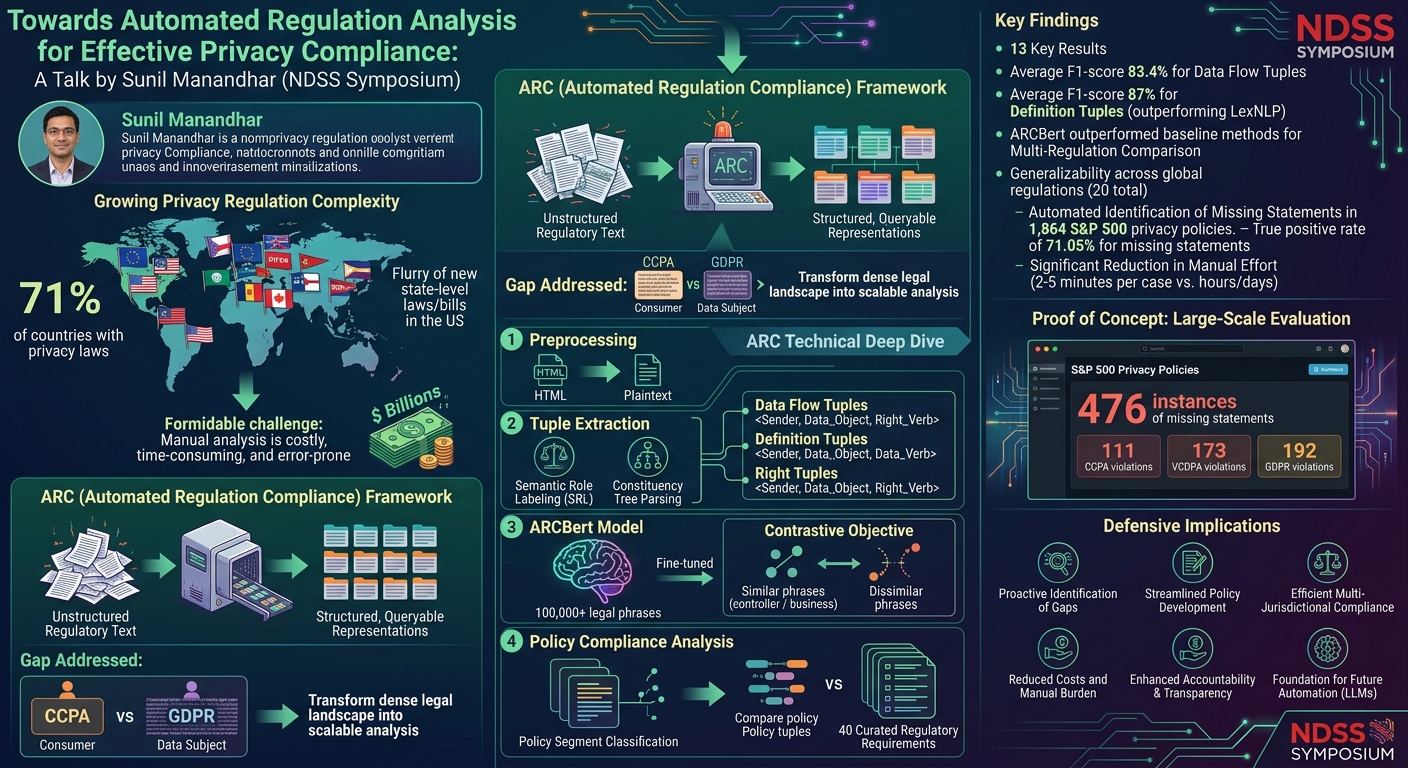
In a world increasingly shaped by digital interactions, the proliferation of privacy and data protection regulations presents a formidable challenge for businesses and researchers alike. Sunil Manandhar's talk, "Towards Automated Regulation Analysis for Effective Privacy Compliance," introduces ARC (Automated Regulation Compliance), a novel framework designed to automate the complex, time-consuming, and error-prone process of understanding and complying with these global privacy laws. ARC addresses the critical need for a scalable solution to navigate the dense legal landscape, where 71% of countries now boast their own legislations, and the US alone has seen a flurry of new state-level laws and bills.
Key moments
- 0:00 Introduction to ARC and privacy compliance challenges
- 1:50 ARC's goal: semi-automated regulation analysis
- 3:20 Four key design goals for the ARC framework
- 4:00 Technical approach: NLP for structured ARC tuples
- 4:20 Three types of ARC tuples: data flow, definition, right
- 5:00 Overview of ARC's system design and modules
- 6:40 Detailed structure and attributes of ARC tuple types
Towards Automated Regulation Analysis for Effective Privacy Compliance
Speakers: Sunil Manandhar
Conference: NDSS Symposium
YouTube: N/A
Overview
In a world increasingly shaped by digital interactions, the proliferation of privacy and data protection regulations presents a formidable challenge for businesses and researchers alike. Sunil Manandhar's talk, "Towards Automated Regulation Analysis for Effective Privacy Compliance," introduces ARC (Automated Regulation Compliance), a novel framework designed to automate the complex, time-consuming, and error-prone process of understanding and complying with these global privacy laws. ARC addresses the critical need for a scalable solution to navigate the dense legal landscape, where 71% of countries now boast their own legislations, and the US alone has seen a flurry of new state-level laws and bills.
The core problem ARC tackles is the overwhelming manual burden associated with analyzing and comparing regulatory texts. Despite similar underlying principles, regulations like the CCPA (California Consumer Privacy Act) and GDPR (General Data Protection Regulation) use distinct legal jargon and intricate contextual details, making direct comparison and compliance assessment prohibitively difficult. This leads to billions in compliance costs for companies and limits the scale of privacy research. ARC's ambition is to transform unstructured regulatory text into a structured, queryable representation, moving from a fully manual to a semi-automated analysis paradigm.
By leveraging advanced Natural Language Processing (NLP) techniques, ARC aims to reduce manual effort significantly, enabling more accurate and scalable privacy compliance. The framework's ability to systematically extract, represent, and compare regulatory requirements offers a powerful tool for organizations striving to meet their obligations and for researchers seeking to analyze privacy trends and gaps across diverse jurisdictions. This work represents a significant step towards making privacy compliance more efficient and accessible in the face of an ever-expanding regulatory environment.
Background
[▶ Watch: Introduction to ARC and privacy compliance challenges (0:00)]()
The landscape of privacy and data protection regulations has undergone a dramatic transformation, characterized by rapid growth and increasing complexity. Regulations like GDPR, CCPA, PIPEDA (Personal Information Protection and Electronic Documents Act), and VCDPA (Virginia Consumer Data Protection Act), among many others, impose stringent requirements on how organizations collect, process, and protect personal information. While these laws are crucial for safeguarding consumer privacy, their sheer volume and the nuanced, jurisdiction-specific legal language make them exceptionally challenging to interpret and comply with. This complexity often leads to significant compliance costs, potential legal penalties, and a high barrier to entry for effective privacy research.
Prior research in this domain has primarily focused on analyzing privacy policies for issues such as inconsistencies or vague language, or on evaluating specific technical requirements, like the presence of "Do Not Sell" links. For instance, tools like PrivGuard perform static analysis of software against policies that have been manually encoded. In the broader field of legal NLP, techniques have been developed for tasks such as document segmentation, fact extraction, or multi-label classification within general legal texts or criminal law. Examples include LexPredict and Legal-BERT. However, these approaches typically do not provide a systematic framework for analyzing the regulations themselves to extract structured, actionable requirements that can be used for automated compliance checking or comparative analysis across different legal frameworks.
The gap identified by this work is the lack of a robust, automated methodology for transforming the verbose and often ambiguous text of privacy regulations into a machine-consumable format. Existing methods either rely heavily on manual effort, which is not scalable, or are too generic to capture the specific semantic nuances of privacy law. The problem is exacerbated by the fact that similar concepts are often expressed using different terminology across jurisdictions (e.g., "consumer" in CCPA vs. "data subject" in GDPR), and critical contextual details (like temporal conditions) are embedded within complex sentences. ARC directly addresses this gap by adapting and integrating advanced NLP techniques to systematically extract and represent these regulatory requirements, thereby laying the groundwork for truly automated privacy compliance and comparative legal analysis.
Key Findings
[▶ Watch: Four key design goals for the ARC framework (3:20)]()
The ARC framework demonstrates significant effectiveness across several critical areas, validated through 13 key results. These findings underscore ARC's ability to accurately extract structured information from regulatory texts, compare regulations, and evaluate privacy policy compliance at scale.
- High-Accuracy Tuple Extraction: ARC exhibits strong performance in transforming unstructured regulatory text into structured representations, achieving an average F1-score of 83.4% for Data Flow Tuples across CCPA, GDPR, PIPEDA, and VCDPA, with individual scores ranging from 0.759 to 0.937. For Definition Tuples, ARC achieved an average F1-score of 87% (80% precision, 95% recall), outperforming the state-of-the-art regex-based LexNLP, which scored 82% (94% precision, 73% recall), particularly excelling in handling complex definitions. Right Tuples extraction achieved an average F1-score of 81% (73% precision, 91% recall), indicating robust identification of consumer rights.
- Superior Multi-Regulation Comparison with ARCBert: The specialized ARCBert model significantly outperforms baseline methods. When comparing PIPEDA and GDPR, ARCBert identified 1,212 highly similar phrase-pairs (similarity score > 0.75), whereas a naive lemmatized keyword search found only 8. ARCBert also proved more restrictive and accurate than generic GloVe vectors, which often identified an excessively large number of broadly similar phrases (e.g., 39,652 pairs for PIPEDA vs. GDPR), making prioritization difficult. ARCBert's focused approach provides better prioritization of truly semantically similar phrases.
- ARCBert Phrase Similarity Validation: Manual validation confirmed ARCBert's utility, with evaluators agreeing on its identified similar phrases in 82.30% of instances. In 87% of cases, at least one similar phrase was found within the top-3 predictions, demonstrating its effectiveness in identifying common requirements, such as processor-specific obligations across CCPA and GDPR.
- Effective Definition Similarities: ARCBert successfully identifies similar definitions across regulations, highlighting, for example, the high number of shared definitions between CCPA and VCDPA due to their US-centric nature. It accurately maps semantically equivalent terms like "controller" in GDPR and "business" in CCPA (similarity score 0.84), which both describe entities determining data processing purposes. It also effectively identifies areas of divergence, such as PIPEDA lacking a definition for "biometric information" while CCPA provides one.
- Generalizability Across Global Regulations: ARC demonstrated its broad applicability by successfully extracting 536 Definition, 844 Data Flow, and 176 Right Tuples from an additional 16 diverse global privacy regulations, confirming its consistent performance beyond the initial four evaluated regulations.
- Meaningful Phrase Clusters: Utilizing techniques like k-means clustering and BerTopic, ARC identified fine-grained clusters of semantically similar phrases across all 20 regulations. This capability helps in understanding complex requirements by grouping similar contextual elements, such as temporal modifiers (e.g., "for at least 12 months before next").
- Automated Compliance Analysis and Missing Statements Identification: In a large-scale evaluation against 1,864 privacy policies from S&P 500 companies, ARC identified 476 instances of missing statements relevant to 40 regulatory requirements. This included 111 CCPA violations across 38 companies, 173 VCDPA violations across 35 companies, and 192 GDPR violations across 49 companies, showcasing its practical utility in uncovering non-compliance.
- High Accuracy in Policy Reasoning: Manual validation of the policy compliance analysis revealed a 71.05% true positive rate for identifying missing statements and 90.13% accuracy for full matches. Furthermore, 66.80% of statements initially flagged as partial matches were confirmed as full matches after manual review, leading to the discovery of 288 additional missing disclosures.
- Significant Reduction in Manual Effort: ARC substantially reduces the manual effort required for compliance validation. By providing detailed context for each identified issue, including requirement-specific statements and missing attributes, the validation time was reduced to an estimated 2-5 minutes per case, making the compliance process far more efficient.
- Public Data Release: The project has publicly released its data and artifacts, fostering reproducibility and facilitating future research in automated privacy compliance.
These findings collectively establish ARC as a robust and scalable framework for automated privacy regulation analysis, providing significant advancements for both privacy research and practical compliance efforts.
Technical Deep Dive
[▶ Watch: Technical approach: NLP for structured ARC tuples (4:00)]()
The ARC framework is engineered to systematically transform unstructured, complex regulatory text into a structured, machine-consumable representation. This process involves a sophisticated integration of Natural Language Processing (NLP) techniques, designed to meet four key design goals: G1) Capturing the semantics of regulatory statements, G2) Simplifying complex regulatory statements, G3) Defining representations of the extracted semantics, and G4) Enabling the use of these representations to aid compliance tasks.
The architecture of ARC begins with the Preprocessing module, which takes raw privacy regulation documents. Using tools like HtmlToPlainText, it normalizes the text by resolving bullet points and list objects into full sentences, preparing the data for deeper linguistic analysis.
The core of ARC's extraction capabilities lies in its Tuple Extraction module, which employs two primary NLP techniques:
- Semantic Role Labeling (SRL): ARC leverages SRL to identify the predicate-argument structure of sentences. This involves identifying verbs (predicates) that convey requirements and their associated arguments (e.g., who performed an action, what was affected, when, where, why). ARC specifically retrained a BERT-based SRL model, reimplementing AllenNLP code. This custom model was trained on the CONLL2012 dataset and optimized for both argument identification (achieving an F1-score of 86.0%) and crucial verb sense disambiguation (achieving 95.5% accuracy). Verb sense disambiguation is particularly important for accurately mapping verbs to their arguments, especially for defining statements where a verb like 'refer' can have multiple meanings.
- Constituency Tree Parsing: To simplify complex SRL arguments, ARC incorporates the Benepar model for constituency tree parsing. Regulatory sentences often contain intricate clauses (e.g., "A business that collects a consumer's personal information"). Benepar segments these into Phrase, Clause pairs (e.g., "A business" as a Sender Phrase and "that collects a consumer's personal information" as a Sender Clause). This allows ARC to separate the main entity from its surrounding contextual details, providing a more granular understanding.
These extracted semantic roles and clauses are then mapped to create ARC's novel structured representation: ARC Tuples. ARC defines three primary types of tuples, crucial for privacy compliance:
- Data Flow Tuples: Inspired by the Contextual Integrity framework, these tuples capture statements about the movement of information. They are represented as:
(Sender, Deontic_Modal, Data_Flow_Verb, Receiver, Data_Object, Transmission_Principles). TheDeontic_Modal(e.g., 'shall', 'must') indicates normative concepts. - Definition Tuples: These extract definitions of key terms within regulations:
(Definiendum, Definition_Verb, Definiens). - Right Tuples: These capture information about rights afforded to entities:
(Entity, Deontic_Modal, Right_Verb, Right_Statement).
General SRL clauses (like argm_tmp for temporal modifiers) and constituency parsing clauses (like sender_clause) are mapped to the Transmission_Principles attribute, ensuring that all relevant contextual information is preserved within the structured tuples.
For Multi-Regulation Comparison, ARC introduces ARCBert, a specialized BERT-based model. ARCBert is fine-tuned using the Phrase-BERT procedure with a contrastive objective. This objective pulls semantically similar contexts closer together in the embedding space and pushes dissimilar ones apart. A critical aspect of ARCBert's training is its augmented dataset, which includes 100,000 frequent contextual phrases extracted from a vast corpus: 22,000 US privacy bills, 37,000 EU legal documents, and 56 global privacy regulations. This domain-specific fine-tuning allows ARCBert to accurately identify semantic similarities between legal phrases across different regulations, even when terminology varies.
To facilitate Privacy Policy Compliance Analysis, ARC includes a dedicated module. This module involved:
- Policy Collection: Semi-automatically collecting 1,864 regulation-specific privacy policies from S&P 500 companies across the US, Canada, and Europe.
- Policy Segment Classification: Building a multi-label policy segment classifier trained on the OPP-115 dataset. This classifier identifies the category of policy segments (e.g., data collection, data sharing) and maps them to ARC's requirement tuples, achieving an average F1-score of 0.86.
- Tuple Extraction from Policies: Extracting tuples from privacy policies in a manner similar to regulations, but without relying on deontic modals, as policies describe current practices rather than normative requirements.
- Requirement Curation: Curating 40 regulatory requirements applicable to privacy policy disclosures from CCPA, PIPEDA, VCDPA, and GDPR.
- Comparison Logic: Preprocessing these regulatory requirement tuples and comparing them with extracted policy tuples using three types of comparisons:
- Data Ontology Comparison: Checking subsumptive relations for data objects (e.g., if "personal information" in a policy covers "name" in a regulation).
- Attribute Value Comparison: Performing keyword searches for verbs, rights, and terms.
- Attribute Presence Comparison: Checking for the presence of crucial attributes like purpose, temporal conditions, sender, and receiver.
The implementation of ARC integrates these modules within the Spacy pipeline, utilizing its pluggable architecture. Filtering for requirement-specific statements is done using lemma comparison against curated sets of verbs and deontic modals, ensuring that only relevant statements are processed for tuple creation. For example, a Data Flow tuple requires a Data Flow verb associated with a deontic modal, while Definition tuples require specific definition verbs, a definiendum, and a definiens. This layered and specialized technical approach enables ARC to achieve its high accuracy and generalizability in navigating the complexities of privacy regulation analysis.
Demo / Proof of Concept
[▶ Watch: Overview of ARC's system design and modules (5:00)]()
While the talk did not feature a live, interactive demonstration, ARC's practical utility and effectiveness were thoroughly validated through a large-scale, real-world proof of concept: the Large-Scale Privacy Compliance Evaluation of S&P 500 company privacy policies. This extrinsic evaluation serves as a powerful demonstration of how the ARC framework can be applied to identify concrete compliance gaps and significantly reduce manual effort in the auditing process.
The evaluation involved analyzing 1,864 privacy policies collected from S&P 500 companies operating across the US, Canada, and Europe. These policies were systematically compared against 40 curated regulatory requirements derived from the CCPA, PIPEDA, VCDPA, and GDPR. The process involved:
- Policy Segment Classification: ARC's multi-label policy segment classifier, trained on the OPP-115 dataset, first categorized segments of each privacy policy to understand their subject matter (e.g., data collection, data sharing, user rights).
- Tuple Extraction from Policies: Similar to how it processes regulations, ARC extracted structured tuples from these privacy policies, representing the actual practices and disclosures of the companies.
- Automated Comparison: The extracted policy tuples were then automatically compared against the 40 predefined regulatory requirement tuples using the three comparison types: Data Ontology Comparison, Attribute Value Comparison, and Attribute Presence Comparison.
The results of this evaluation were highly impactful, demonstrating ARC's capability to uncover genuine compliance issues:
- Identified Missing Statements: ARC successfully identified 476 instances of missing statements across the S&P 500 companies, indicating specific failures to disclose information mandated by regulations. This included:
- 111 CCPA violations across 38 companies.
- 173 VCDPA violations across 35 companies.
- 192 GDPR violations across 49 companies.
These numbers highlight concrete areas where companies were non-compliant with their disclosure obligations.
- High Accuracy in Policy Reasoning: Manual validation of these findings further confirmed ARC's precision. The framework achieved a 71.05% true positive rate in identifying missing statements, meaning a high percentage of its flagged issues were indeed actual compliance gaps. For statements identified as full matches, the accuracy was even higher at 90.13%. Crucially, an additional 288 missing disclosures were discovered through manual analysis of statements initially flagged as "partial matches," where ARC had correctly identified a potential issue but required human verification to confirm the full extent of the non-compliance.
- Significant Reduction in Manual Effort: One of the most compelling aspects of this proof of concept was the demonstrable reduction in manual effort. By providing highly contextualized results, including the specific requirement statement and the missing attributes, ARC reduced the time required for human validation to an estimated 2-5 minutes per case. This contrasts sharply with the laborious and time-consuming process of manually reviewing thousands of privacy policies against complex legal texts.
This large-scale evaluation provides concrete evidence that ARC is not merely a theoretical framework but a practical tool capable of performing automated privacy compliance analysis with high accuracy and efficiency, thereby addressing a critical need in the industry.
Defensive Implications
[▶ Watch: Detailed structure and attributes of ARC tuple types (6:40)]()
The ARC framework offers profound implications for organizations striving to achieve and maintain robust privacy compliance, transforming the defensive posture against regulatory scrutiny and potential legal liabilities. By automating the analysis of complex privacy regulations and privacy policies, ARC empowers defenders with actionable insights and tools to proactively manage their compliance obligations.
- Proactive Identification of Compliance Gaps: ARC's ability to identify missing statements in privacy policies against specific regulatory requirements is a game-changer. Instead of waiting for audits or consumer complaints, organizations can use ARC to continuously scan their public-facing policies and internal documentation for non-compliance. The identification of 476 missing statements across S&P 500 companies demonstrates its capacity to uncover tangible vulnerabilities, allowing defenders to remediate issues before they escalate into costly penalties or reputational damage.
- Streamlined Policy Development and Review: Privacy teams can leverage ARC during the drafting or updating of privacy policies. By inputting draft policies into ARC, they can quickly receive feedback on whether all mandated disclosures are present and accurately articulated according to regulations like CCPA, GDPR, PIPEDA, and VCDPA. This significantly reduces the risk of human error and ensures comprehensive coverage of legal requirements.
- Efficient Multi-Jurisdictional Compliance: For global organizations, navigating diverse and often conflicting privacy regulations is a major challenge. ARCBert's capability to identify semantically similar requirements across different regulations (e.g., "controller" in GDPR and "business" in CCPA) allows compliance teams to understand commonalities and differences more efficiently. This enables the development of harmonized compliance strategies where possible and highlights areas requiring jurisdiction-specific tailoring, reducing redundant efforts and ensuring consistency.
- Reduced Compliance Costs and Manual Burden: The significant reduction in manual effort—from hours or days per policy to just 2-5 minutes per case for validation—translates directly into substantial cost savings. Legal and compliance teams can reallocate resources from tedious manual reviews to higher-value tasks, such as risk assessment, internal training, or strategic privacy initiatives. This automation democratizes access to sophisticated compliance analysis, benefiting even smaller organizations with limited resources.
- Enhanced Accountability and Transparency: By providing structured, machine-consumable tuples of regulatory requirements, ARC creates a clear, auditable trail of compliance logic. This transparency can improve internal accountability, as specific requirements can be directly mapped to business operations. It also enhances external transparency by ensuring that public-facing privacy policies accurately reflect legal obligations.
- Benchmarking and Competitive Analysis: Researchers and companies can use ARC to benchmark their compliance efforts against industry peers or analyze the compliance posture of competitors. The ability to process a large volume of policies (e.g., 1,864 S&P 500 policies) facilitates large-scale studies on industry-wide compliance trends and common pitfalls.
- Foundation for Future Automation: ARC's structured representation of regulations lays the groundwork for even deeper automation. These machine-consumable tuples can be integrated with other systems, such as privacy-enhancing technologies, data inventory tools, or consent management platforms, to create an end-to-end automated privacy compliance ecosystem. The framework also offers avenues for integrating with future Large Language Models (LLMs) by providing structured, labeled datasets for fine-tuning, mitigating LLM risks like hallucination while leveraging their advanced reasoning capabilities.
In essence, ARC transforms privacy compliance from a reactive, manual, and costly burden into a proactive, automated, and strategic advantage. It equips defenders with the intelligence and efficiency needed to navigate the ever-evolving regulatory landscape with greater confidence and precision.
Key Takeaways
- ARC Automates Complex Regulation Analysis: The ARC framework provides a novel, semi-automated approach to analyze complex privacy and data protection regulations, significantly reducing the manual effort, time, and cost associated with compliance.
- High-Accuracy Structured Data Extraction: ARC leverages Semantic Role Labeling and Constituency Tree Parsing to extract regulatory text into structured Data Flow (83.4% F1-score), Definition (87% F1-score), and Right (81% F1-score) tuples, outperforming baseline methods like LexNLP for definition extraction.
- ARCBert Enables Precise Multi-Regulation Comparison: The specialized ARCBert model, fine-tuned with legal and privacy context, accurately identifies semantically similar phrases across different regulations, providing better prioritization than generic vector embeddings and facilitating cross-jurisdictional compliance understanding.
- Proven Efficacy in Large-Scale Compliance Evaluation: ARC successfully identified 476 missing statements across 1,864 S&P 500 company privacy policies against 40 requirements from CCPA, GDPR, PIPEDA, and VCDPA, demonstrating its practical utility in uncovering non-compliance with high accuracy (71.05% true positive rate).
- Significant Reduction in Manual Effort: The framework dramatically reduces the time required for compliance validation, cutting it down to 2-5 minutes per case due to its contextualized output, making privacy compliance more efficient and scalable for organizations.
- Generalizable and Extensible Framework: ARC's ability to consistently extract tuples and cluster phrases from 20 diverse global privacy regulations, coupled with its public data release, positions it as a foundational tool for future research and integration with advanced NLP techniques like fine-tuned Large Language Models.
About the Speaker(s)
The talk was presented by Sunil Manandhar. Based on the provided transcript and metadata, further biographical details regarding his title or affiliation are not available.
All talks from Network and Distributed System Security (NDSS) Symposium 2024