Security-Performance Tradeoff in DAG-based Proof-of-Work Blockchain Protocols
Shichen Wu
Network and Distributed System Security (NDSS) Symposium 2024 · Day 2 · Blockchain & Smart Contracts · Blockchain & Smart Contracts
Overview
This talk presents a critical re-evaluation of the security guarantees in Directed Acyclic Graph (DAG)-based Proof-of-Work (PoW) blockchain protocols, specifically focusing on Prism and OHIE. These protocols emerged as promising solutions to overcome the inherent performance limitations—low transaction throughput and high confirmation latency—of Nakamoto Consensus (NC), as exemplified by Bitcoin. While NC's security relies on strict block size and interval bounds, DAG-based designs aim to increase throughput by allowing simultaneous block mining. Early DAG protocols often lacked rigorous security analyses, but Prism and OHIE stood out by claiming to achieve NC-like security (tolerance to nearly 50% adversarial mining power) almost independently of throughput, effectively breaking the fundamental security-performance tradeoff.
Key moments
- 0:00 Nakamoto Consensus limitations and DAG-based protocols' promise
- 0:40 Prism and OHIE claimed to break security-performance tradeoff
- 1:00 Identifying the critical 'Assumption of Decoupling'
- 1:25 Explaining Block Jam and Late Predecessor phenomena
- 1:50 Key contributions: CBM and Late-Predecessor Attack
- 4:00 Prism's critical flaw: cannot process priority blocks without large predecessors
- 4:50 OHIE's vulnerability acknowledged by its own authors
Security-Performance Tradeoff in DAG-based Proof-of-Work Blockchain Protocols
Speakers: Shichen Wu
Conference: NDSS Symposium
YouTube: (no public video)
Overview
This talk presents a critical re-evaluation of the security guarantees in Directed Acyclic Graph (DAG)-based Proof-of-Work (PoW) blockchain protocols, specifically focusing on Prism and OHIE. These protocols emerged as promising solutions to overcome the inherent performance limitations—low transaction throughput and high confirmation latency—of Nakamoto Consensus (NC), as exemplified by Bitcoin. While NC's security relies on strict block size and interval bounds, DAG-based designs aim to increase throughput by allowing simultaneous block mining. Early DAG protocols often lacked rigorous security analyses, but Prism and OHIE stood out by claiming to achieve NC-like security (tolerance to nearly 50% adversarial mining power) almost independently of throughput, effectively breaking the fundamental security-performance tradeoff.
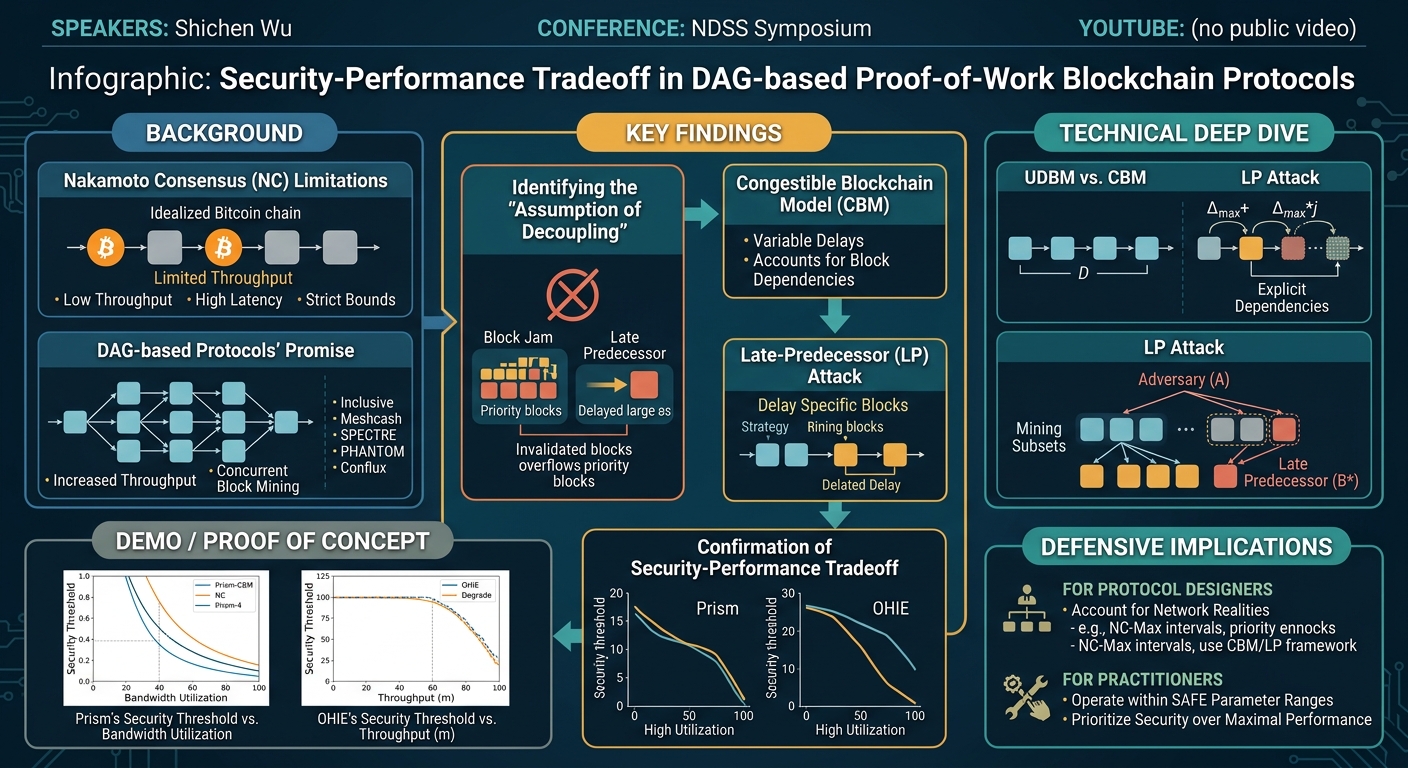
The core contribution of this research is to demonstrate that Prism and OHIE are, in fact, not exempt from this tradeoff when operating at the network's physical limits. The speaker identifies a critical, implicit assumption in their original security proofs, termed the Assumption of Decoupling. This assumption posits that small, priority blocks can propagate quickly and be immediately accepted by all miners, even when larger transaction blocks are saturating the network. The paper argues that under high-throughput conditions, two inevitable phenomena—Block Jam (where the volume of priority blocks exceeds network capacity) and Late Predecessor (where a block cannot be processed until its dependent predecessors, potentially large ones, have propagated)—invalidate this assumption.
To address these challenges, the authors propose a novel Congestible Blockchain Model (CBM), which realistically accounts for variable block propagation delays and dependencies, and devise a Late-Predecessor (LP) Attack strategy. By re-evaluating Prism and OHIE under this new model and attack, the research unequivocally shows that both protocols suffer from reduced security thresholds and extended transaction confirmation latency in high-throughput environments, much like their chain-based predecessors. This work highlights the crucial need for future blockchain designs to explicitly consider network-layer realities and block dependencies, moving beyond idealized assumptions.
Background
[▶ Watch: Nakamoto Consensus limitations and DAG-based protocols' promise (0:00)]()
Nakamoto Consensus (NC), the foundational mechanism behind Bitcoin, established a decentralized and unalterable ledger without requiring trusted third parties. This was achieved through a system where miners compete to solve cryptographic puzzles, broadcasting blocks upon success, and extending a single blockchain. However, NC's robust security relies on strict design choices: blocks must be mined primarily after the majority of miners have received their predecessors. This necessitates tight upper bounds on block size and lower bounds on block intervals, which inherently restrict transaction throughput and increase confirmation latency, preventing the system from utilizing the network's full physical capacity. Prior analyses by researchers like Garay et al. and Pass et al. have thoroughly explored this fundamental security-performance tradeoff within the context of NC, typically operating under a Uniform-Delay Blockchain Model (UDBM), which assumes a fixed and uniform block propagation delay.
To circumvent this limitation, Directed Acyclic Graph (DAG)-based blockchain protocols emerged. These protocols depart from the single-chain structure by allowing blocks to refer to multiple predecessors, forming a graph rather than a linear chain. The key benefit is that multiple blocks can be mined and contribute to transaction confirmation concurrently, thereby boosting throughput by relaxing the strict block interval limits. However, early DAG-based protocols often struggled with providing robust security guarantees or lacked rigorous formal analyses. For instance, the Inclusive protocol inherited NC's tradeoff by adopting a longest-chain rule. Meshcash offered weak security, only proving resilience against an attacker with 1/15 of the total mining power. SPECTRE and PHANTOM provided partial analyses, often against specific attack vectors, and their security properties were sometimes not fully compatible with NC's. Conflux, another variant, presented informal arguments, and its security was observed to deteriorate rapidly with increasing throughput.
This brings us to Prism and OHIE, two prominent DAG-based protocols that distinguished themselves by offering rigorous security proofs. They claimed to tolerate adversarial mining power close to 50%, a threshold comparable to NC, and critically, asserted that this security level was almost independent of throughput. This alleged decoupling of security and performance was central to their claims of breaking the traditional tradeoff.
Let's briefly examine their core mechanisms:
- Prism introduces a hierarchical block structure with three types: transaction blocks (carrying actual transactions, typically large and slow to propagate), proposer blocks (forming a proposer blocktree by referring to other transaction and proposer blocks, establishing a level-based structure), and voter blocks (tied to specific tree indices, voting for proposer blocks to form leader sequences analogous to NC's main chain). Prism's security relies on these leader sequences. The original authors claimed that proposer and voter blocks are small, enjoy priority propagation, and thus have short, constant propagation delays. This was the basis for decoupling: the fast-growing proposer/voter chains ensure security, while large transaction blocks provide throughput. However, a critical observation made in this research is that a proposer/voter block cannot be processed until all its referred blocks, including potentially large transaction blocks, are received and verified. This dependency undermines the assumed decoupling in practice.
- OHIE simplifies the block structure, using only one block type, but scales by maintaining m parallel Nakamoto Consensus instances. Miners work on all
mchains simultaneously, with a block's hash determining its chain index. OHIE blocks includerankandnext_rankfields for cross-chain ordering, forming a structured DAG. OHIE's analysis similarly relied on the assumption that with small block sizes (e.g., 20 KB) and a large number of parallel chainsm, block propagation delay would remain short and stable. This allowed them to prove an optimal security threshold near 50% while throughput scaled linearly withmuntil network bandwidth saturation. Crucially, the OHIE authors themselves acknowledged that this short, stable propagation delay was contingent on the network not being saturated. Their own experiments showed a non-trivial increase in delay when bandwidth utilization exceeded 50%, confirming the "block jam" phenomenon. However, their theoretical analysis did not account for how this increased delay would impact OHIE's security.
The limitations of the Uniform-Delay Blockchain Model (UDBM) for DAGs are profound. UDBM's assumptions of a fixed, uniform propagation delay, immediate acceptance of a valid block and all its ancestors, and invalidation of all but one overlapping block, are problematic for DAGs. DAG protocols inherently involve simultaneous blocks and complex dependencies, often with multiple block types and priority policies. More importantly, as DAGs reduce block intervals to increase throughput, overlapping block propagation becomes frequent and by design. This leads to phenomena like block jams (where network capacity limits propagation) and late predecessors (where a block cannot be processed because a dependent predecessor has not yet arrived). These complexities mean that simply using a larger, fixed propagation delay in UDBM is insufficient, as it ignores network-layer intricacies and, as this work demonstrates, significantly misrepresents the protocols' security and performance.
Key Findings
[▶ Watch: Identifying the critical 'Assumption of Decoupling' (1:00)]()
This research makes several pivotal findings that fundamentally challenge the prevailing understanding of DAG-based Proof-of-Work blockchain protocols:
- Invalidation of the Assumption of Decoupling: The most significant finding is the identification and invalidation of the "Assumption of Decoupling," an implicit yet critical assumption in the security proofs of Prism and OHIE. This assumption, which posits that small, priority blocks can be propagated and accepted quickly regardless of network congestion from larger transaction blocks, is demonstrated to be flawed. Under realistic, high-throughput conditions, two inevitable phenomena—Block Jam (where the total size of newly mined priority blocks exceeds network processing capacity) and Late Predecessor (where a block cannot be processed until its referred predecessors, potentially non-priority ones, have propagated)—break this decoupling.
- Introduction of the Congestible Blockchain Model (CBM): To accurately capture these network realities, the authors propose the Congestible Blockchain Model (CBM). This novel model generalizes the traditional UDBM by allowing for case-by-case upper bounds on block propagation delay, reflecting factors like block size, network saturation, and priority policies. Crucially, CBM explicitly models that a miner can only accept and mine on a block after all its predecessors have been received and validated, directly addressing the late predecessor phenomenon.
- Development of the Late-Predecessor (LP) Attack: A new, practical adversarial strategy, the Late-Predecessor (LP) Attack, is introduced. This attack exploits block dependencies to strategically delay the processing of honest blocks within the CBM. By manipulating the propagation of certain "late predecessor" blocks, the adversary can maximize the average actual delay of critical blocks, thereby wasting honest mining power and reducing effective chain growth. The attack is designed to be agnostic to specific consensus rules, making it broadly applicable.
- Re-evaluation of Prism and OHIE's Security: Applying the CBM and the LP attack, the research provides updated security analyses and extensive simulations for Prism and OHIE:
- Prism: Contrary to its original claims, Prism's security threshold is not constant but significantly decreases with increasing bandwidth utilization. For example, the security threshold, originally claimed at 0.487, drops to 0.39 at 90% bandwidth and 0.38 at 100% bandwidth utilization. This means Prism can lose liveness and consistency at adversarial power levels previously considered safe, and its transaction confirmation latency increases.
- OHIE: While OHIE's security remains stable below 50% bandwidth utilization (confirming the authors' claims in that range), it degrades significantly once throughput exceeds this threshold due to block jams. The security threshold drops to 0.37 at 100% bandwidth, a similar level of degradation observed in Prism.
- Confirmation of the Security-Performance Tradeoff: The research conclusively demonstrates that both Prism and OHIE are not exempt from the fundamental security-performance tradeoff. Their security properties and performance metrics degrade when operating at high network utilization, mirroring the limitations of traditional chain-based protocols. This highlights a critical gap between theoretical guarantees based on idealized network models and real-world performance under congestion.
Technical Deep Dive
[▶ Watch: Explaining Block Jam and Late Predecessor phenomena (1:25)]()
The core of this research lies in the development of the Congestible Blockchain Model (CBM) and the Late-Predecessor (LP) Attack, which together provide a more realistic framework for analyzing DAG-based PoW protocols.
The Congestible Blockchain Model (CBM)
The CBM generalizes the traditional Uniform-Delay Blockchain Model (UDBM) by introducing two fundamental changes to better capture the complexities of high-throughput DAGs:
- Flexible, Block-Specific Propagation Delay: Instead of a fixed, uniform delay, CBM allows the environment (denoted as Z) to determine a block-specific maximum propagation delay,
d_max(st, r, B), for each newly generated blockB. This flexibility enables the model to incorporate various realistic factors such as block size, network saturation, and protocol-specific priority propagation policies. Thus,d_maxcan vary for different blocks and under different network conditions, directly modeling block jams. The model maintains synchronicity by requiringd_maxto be chosen from a finite, predefined set of values. - Explicit Modeling of Predecessor Dependencies: In CBM, a miner receiving a block
Bdoes not automatically imply that all its predecessors have been received and accepted. A miner can only mine onBafter it has received all ofB's predecessors and any earlier priority blocks that might have caused a block jam. This explicitly models the late predecessor phenomenon, where a block's acceptance and subsequent mining can be delayed even if it has arrived, simply because its dependencies are still propagating.
The CBM adopts a round-based timing model.
- Mining:
nparticipating nodes, each with identical mining power.pis the probability of finding a new block per round. The expected number of blocks mined per round isf = np. - Environment (Z): This entity encapsulates all external factors, including mining history, the global DAG state, and block processing states. Z is responsible for collecting and sending messages and, crucially, for computing
d_maxfor each new block. - Message Propagation Delay: When Z receives a new block
B, it first determinesd_max(st, r, B). This information is then passed to the adversary (A), who decides the specific propagation delayδ_ifor each nodeP_i, ensuringδ_i ≤ d_max. This allows Z to set the network's upper bound, while A can strategically manipulate delays within that bound. - Block Processing: The model distinguishes between a block being received (delivered by Z), accepted (passed validity checks, all predecessors received), confirmed (part of the final ledger), and orphaned. The critical point is that an honest node can only mine after a block is accepted. The time spent on transaction and block validation is considered negligible. The only factor delaying a block's acceptance after its reception is the arrival of its late predecessors. The processing delay,
v_B+, is defined as the interval between a blockB+'sarrival and the arrival of its latest predecessor. The total actual delay for a block isΔ = δ + v_B+.
Security Properties and the Late-Predecessor Attack
To evaluate security, standard properties of liveness (transaction confirmation speed, derived from chain growth and quality) and consistency (difficulty for an adversary to modify the ledger, derived from common prefix property) are adapted for CBM:
- Chain Growth (Definition 2): A chain
Chasg-chain growthif its length grows by at leastg * ToverTrounds, with high probability. - Chain Quality (Definition 3): A chain
Chasμ-chain qualityif, overTconsecutive blocks, at leastμTare honest blocks. - Common Prefix (Definition 4): For any two honest chains, one is a prefix of the other after removing
Tblocks, with high probability.
The Late Predecessor (LP) phenomenon is formalized:
- Definition 5 (Late Predecessor and Lag Time): A block
B*is a late predecessor for nodeP_iifB*is a predecessor ofB+, andB*is received byP_iafterB+is received byP_i. Thelag time,lt(B*, B+, P_i), is the duration of this reversed arrival order. The processing delayv_B+forB+atP_iis the maximum lag time among all its predecessors. - Lemma 1 establishes that the maximum actual delay of a block
B+(Δ_max+) is bounded by the larger value between its own propagation delay (δ_max+) and the propagation delays of its predecessors (δ_max*j). This explicitly links a block's acceptance to its dependencies. - Lemma 2 proves that a globally uniform actual delay is almost impossible for a block with late predecessors, demonstrating UDBM's inadequacy.
This leads to the Late-Predecessor (LP) Attack. The adversary's goal is to maximize the average actual delay (EΔ+) of priority blocks. The strategy involves the adversary dividing n nodes into s disjoint subsets (G_1, ..., G_s):
- If a potential late predecessor block
B*is mined in subsetG_j, the adversary immediately deliversB*to nodes inG_j, but delays its delivery to other subsets untilδ_max*rounds. - If an affected block
B+is mined, the adversary delivers it to all nodes afterδ_max+rounds.
This creates scenarios where B* arrives late for nodes outside its mining subset, delaying B+ that refers to it.
- Theorem 1 quantifies the attacker's utility:
EΔ+ = δ_max+ + (1 - 1/s)(k - s(1 - w))/f*, wherekis the expected number of in-propagationB*blocks. This showsEΔ+increases with longer propagation delays (δ_max*) and more late predecessors (f*). An optimalsvalue (typicallys ≈ k) maximizes this delay.
Updated Security Properties in the Presence of an LP Attacker
The security properties are then updated for DAG-based protocols under the LP attack:
- Chain Growth (Theorem 2): Under the LP attack, the affected chain
C+hasg-chain growth, whereg = (1 - σ)γf+andγ = α/(1 + αf+EΔ+). This key insight is that honest nodes' computing power is wasted during the delay caused by late predecessors. For everyαf+EΔ+blocks mined during the delay, only one out of1 + αf+EΔ+blocks is expected to extend the affected chain.EΔ+directly reduces the effective honest mining power contributing to chain growth. - Chain Quality (Theorem 3): The affected chain
C+hasμ-chain quality (μ > 0)if and only ifβ < γ. This means honest blocks form a significant portion of the chain if the adversary's block generation rate is slower than the honest affected chain's growth rate. - Common Prefix (Theorem 4): The affected chain
C+satisfies the common prefix property. This is derived from Lemma 7, stating that ifγ > β, honest nodes will converge to the same chain with high probability, limiting the adversary's ability to maintain a fork.
This comprehensive framework links protocol parameters, network propagation, and security under adversarial conditions, enabling a rigorous analysis of the security-performance tradeoff for Prism and OHIE.
Evaluation: Prism's Security-Performance Tradeoff
Applying CBM and the LP attack to Prism reveals that its claimed decoupling fails under high-throughput conditions. The LP attack targets transaction blocks and honest proposer blocks as potential late predecessors (B*), and honest proposer blocks as the affected blocks (B+).
- Corollary 1: The honest proposer block's average actual delay,
EΔ_p, is no longer constant. It is significantly influenced by the propagation delay of transaction blocks (δ_t) and their generation rate (f_t). - Corollary 2: The proposer leader sequence growth rate
gis reduced asEΔ_pincreases. - Corollary 3: The leader sequence quality
μdepends onβ < γ, whereγis now a function ofEΔ_p.
To quantify this, the derived security threshold for β is β = (1/2) * sqrt((f_pEΔ_p)2 + 4) - 2 / (2f_pEΔ_p).
Using Prism's original parameters (f_p = f_t = 0.1 block/sec, transaction block size B_t = 9C (where C is network capacity), minimum network delay D = 1 sec, leading to δ_t = 10 sec, and δ_p ≈ 1 sec), the authors claimed Prism was safe with β = 0.48. Our analysis, using a round time of 0.001 sec and s = 2 for the LP attack, calculates EΔ_p ≈ 2376 (or 2.376 seconds), significantly higher than the 1 second claimed. Consequently, the security threshold γ drops to 0.47, implying Prism loses liveness when β = 0.48, as the attacker can dominate the proposer leader sequence.
Evaluation: OHIE's Security-Performance Tradeoff
For OHIE under high bandwidth utilization (exceeding 50%), where block propagation delay is no longer constant, both block jams and late predecessors become critical.
- Block Jams: Modeled with a linear function for the propagation delay upper bound
δ = c_bj * max(m - m_nc, 0) + D, wheremis the number of parallel chains,m_ncis a threshold (50% bandwidth utilization), andc_bjis a constant. - Late Predecessors: For OHIE's single block type, trailing blocks (
B_r) (the earliest block with a new rank) are identified asB*targets for delay, as they are referred to by multiple subsequent blocks. - Lemma 8 shows that the generation rate of trailing blocks (
f_r) increases withm. - Corollary 4: Honest blocks in OHIE are delayed
Δrounds for a fraction of nodes, andEΔis influenced byδandf_r. - Corollary 5: The chain growth rate for each chain becomes
αf/(1 + αfEΔ). Liveness and consistency requireα/(1 + αfEΔ) > βfor every chain.
The analysis reveals that increasing m, which OHIE authors claimed improves performance, actually decreases OHIE's security threshold through three mechanisms: 1) δ increases due to block jams, increasing EΔ and lowering chain growth; 2) more parallel chains mean more affected blocks; 3) f_r increases, providing more attack targets. This is counterintuitive as increasing m doesn't change a single chain's growth rate, but the minimum interval to mine two consecutive blocks across m chains decreases, which the LP attack exploits.
Demo / Proof of Concept
[▶ Watch: Prism's critical flaw: cannot process priority blocks without large predecessors (4:00)]()
To validate the theoretical analyses, the researchers performed extensive simulations by modifying SimBlock, a Bitcoin network simulator. Approximately 1000 lines of code were added to SimBlock to accurately simulate Prism and OHIE under the proposed Congestible Blockchain Model (CBM). For comparative purposes, Nakamoto Consensus (NC) was also simulated.
The simulation setup involved:
- A P2P network of
n = 200nodes. - Each node was connected to
d = 8randomly selected peers, forming a random graph, resulting in an average of2.5hops between any two nodes. - The per-node bandwidth was capped at
C = 8 Mbps. - The latency between any two connected nodes was set to
0.4seconds, leading to an average network propagation delayD = 1second, consistent with Prism's original setup.
For Prism simulations:
- Mining rates for both proposer and transaction blocks were set to
f_p = f_t = 0.1block/sec. - Transaction block sizes (
B_t) were varied from2, 4, 6, 8, to 10 MB, corresponding to20% to 100%bandwidth utilization, respectively. - The propagation delay for transaction blocks was calculated as
δ_t = B_t * 2.5/C + D, while for proposer blocks, it was approximated asδ_p ≈ 1sec.
For OHIE simulations:
- The block interval on each parallel chain was 10 seconds, and block size was 20 KB.
- The number of parallel chains (
m) was varied from1 to 500. - For
m ≤ 250(below 50% bandwidth utilization), the propagation delayδwas set to1sec. - For
m > 250(above 50% bandwidth utilization), the block jam model was applied:δ = c_bj * max(m - m_nc, 0) + D, withm_nc = 250andc_bj = 0.08(estimated from OHIE's original simulations).
For NC simulations:
- The block interval was 10 seconds.
- Block sizes (
B) were varied from2 to 10 MB(20-100% bandwidth utilization). - Propagation delay
δ = B/C * 2.5 + D.
Theoretical security thresholds were calculated for comparison:
- Prism-CBM and OHIE-CBM used the analyses derived from the presented theorems.
- Prism-UDBM and OHIE-UDBM represented the UDBM variant, where actual delays were replaced with their upper bounds, simulating a naive application of the old model.
- Prism-4 represented Prism's original analysis, which claimed a constant security threshold of 0.487.
The simulation results, visualized in figures (e.g., Figure 5 for Prism, Figure 6 for OHIE), clearly demonstrated the security-performance tradeoff. For Prism, the Prism-CBM curve aligned very well with the Prism-Sim (simulation) results, confirming the accuracy of the CBM. It showed that Prism's security threshold, contrary to original claims, decreased significantly with increasing bandwidth utilization, dropping to 0.39 at 90% bandwidth and 0.38 at 100% bandwidth. The Prism-UDBM curve drastically underestimated Prism's security, appearing no better than NC, highlighting UDBM's inadequacy. For OHIE, the simulations confirmed that decoupling holds below 50% bandwidth utilization, with a stable security threshold of 0.47. However, above 50% bandwidth, the threshold dropped to 0.37 at 100% bandwidth, demonstrating a clear tradeoff. These simulation-based proof-of-concept results empirically validate the theoretical findings, confirming that both Prism and OHIE exhibit a clear security-performance tradeoff under high network utilization due to the breakdown of the Assumption of Decoupling.
Defensive Implications
[▶ Watch: OHIE's vulnerability acknowledged by its own authors (4:50)]()
The findings of this research carry significant implications for both the design of future blockchain protocols and the operational practices of existing DAG-based systems.
For protocol designers, the primary takeaway is the critical need to explicitly account for network-layer realities, particularly the phenomena of block jams and late predecessors. Relying on the "Assumption of Decoupling"—where small, priority blocks are assumed to propagate and be accepted instantly, independent of network congestion—is shown to be a flawed approach. Future DAG-based protocols must integrate mechanisms that either inherently avoid these phenomena or remove reliance on such idealized assumptions. For instance, designers could explore introducing explicit intervals between transaction synchronization and confirmation, similar to approaches seen in protocols like NC-Max, to create buffers against network delays. The Congestible Blockchain Model (CBM) and the Late-Predecessor (LP) Attack framework introduced in this paper serve as valuable tools for rigorously assessing the security and performance of new designs under realistic, congested network conditions, not just under idealized scenarios. This framework can also be generalized to evaluate other types of distributed ledger technologies, including Proof-of-Stake (PoS) protocols like LMD-GHOST in Ethereum 2.0 and BFT protocols such as DAG-Rider, Tusk, and Bullshark, by adapting for their specific block intervals and consensus mechanisms.
For practitioners and operators of DAG-based Proof-of-Work protocols, the research provides a stark warning: pushing these systems to their perceived maximum throughput, especially near the network's physical capacity limits, will inevitably compromise security. The security thresholds of protocols like Prism and OHIE degrade significantly under high bandwidth utilization. Therefore, operators should implement and run these protocols within demonstrably safe parameter ranges, well below the theoretical maximums claimed under idealized conditions. Prioritizing robust security over maximal, potentially unstable, performance is crucial. Until future protocol designs explicitly address and mitigate the impact of block jams and late predecessors, a conservative approach to network utilization is the most prudent defensive strategy to maintain the liveness and consistency guarantees of the blockchain.
Key Takeaways
- The Security-Performance Tradeoff Persists: Despite claims, DAG-based Proof-of-Work protocols like Prism and OHIE are not exempt from the fundamental security-performance tradeoff inherent in Nakamoto Consensus.
- Flawed Assumption Identified: The "Assumption of Decoupling," which posits that small, priority blocks can propagate and be accepted quickly regardless of network congestion, is a critical implicit assumption in prior analyses that is invalidated by Block Jam and Late Predecessor phenomena under high-throughput conditions.
- Realistic Modeling is Crucial: The novel Congestible Blockchain Model (CBM) and the Late-Predecessor (LP) Attack provide a more accurate and comprehensive framework for analyzing DAG-based protocols by explicitly accounting for variable propagation delays and block dependencies.
- Degraded Security at High Throughput: Both Prism and OHIE suffer from significantly reduced security thresholds and extended transaction confirmation latency when operating at high network utilization, confirming their vulnerability to the identified tradeoff.
- Designers Must Adapt: Future DAG-based protocol designs must explicitly address network-layer realities like block jams and late predecessors, rather than relying on idealized network models, potentially by introducing mechanisms to mitigate these issues or by decoupling security from immediate transaction finality.
- Operators Should Exercise Caution: Practitioners deploying these protocols should operate them within safe parameter ranges, avoiding pushing the network to its capacity limits, as doing so will compromise the protocol's security guarantees.
About the Speaker(s)
Shichen Wu is the speaker who presented this research on the security-performance tradeoff in DAG-based Proof-of-Work blockchain protocols. The provided transcript and metadata do not include additional details about their title, affiliation, or specific background beyond their name.
All talks from Network and Distributed System Security (NDSS) Symposium 2024