WiFinger: Fingerprinting Noisy IoT Event Traffic Using Packet-level Sequence Matching
Ronghua Li
Network and Distributed System Security (NDSS) Symposium 2026 · Day 1 · Network Security
Overview
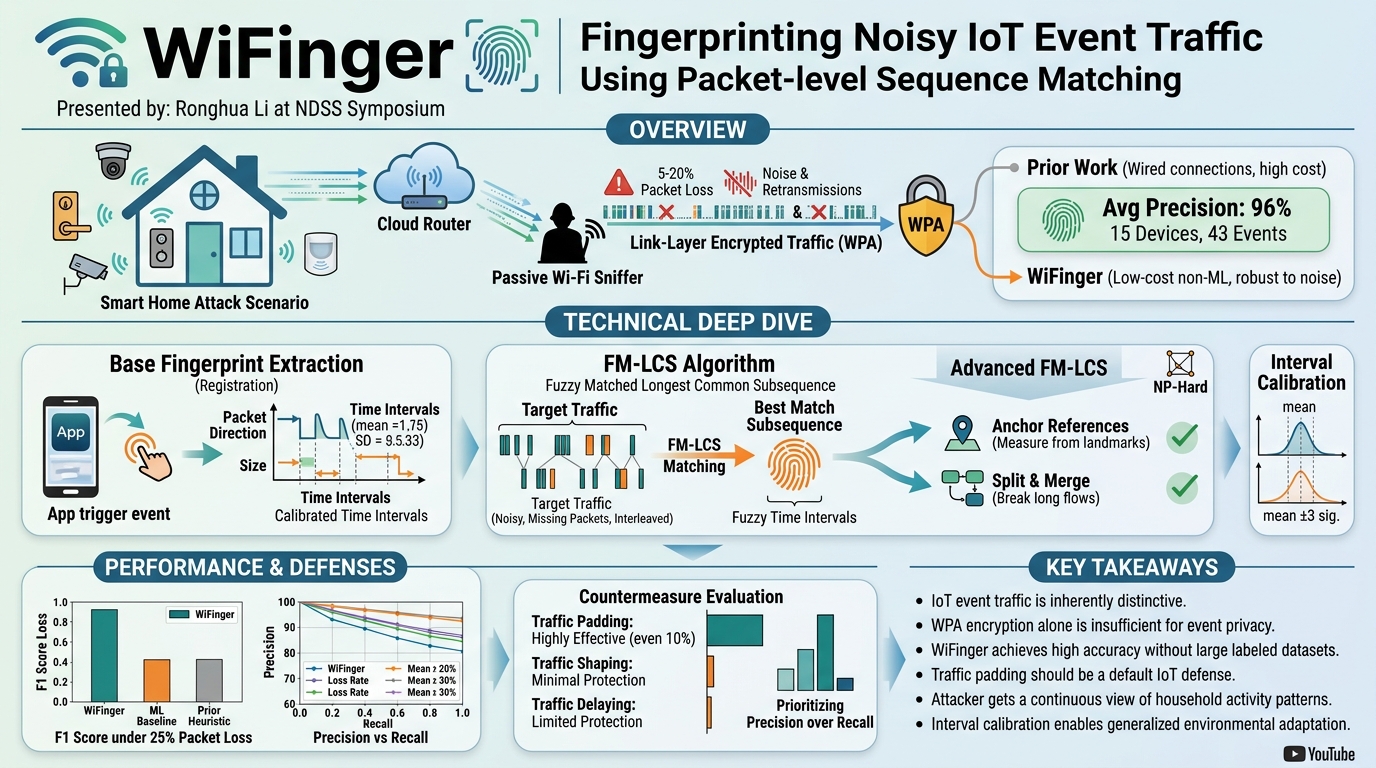
This talk presents WiFinger, a non-machine-learning approach to fingerprinting IoT device events from encrypted Wi-Fi traffic captured by a passive sniffer. Unlike prior work that targets transport/network layer traffic on wired connections, WiFinger operates at the link layer where traffic is substantially noisier -- suffering from 5-20% packet loss and significant obfuscation from retransmissions, background noise, and WPA encryption. The system achieves an average precision of 96% across 15 devices and 43 events using a novel Fuzzy Matched Longest Common Subsequence (FM-LCS) algorithm that handles missing packets and traffic interleaving without requiring large labeled datasets.
Key moments
- 0:00 Introduction to IoT traffic fingerprinting and smart home attack scenario
- 4:00 Link-layer noise: 5-20% packet loss and obfuscation challenges
- 8:00 Core insight: Fuzzy Matched LCS for robust pattern matching
- 10:00 NP-hard complexity and anchor reference optimization
- 14:00 Interval calibration for real-world environmental adaptation
- 16:00 Results: 96% precision across 15 devices and 43 events
- 18:00 Defense evaluation: only padding works; shaping and delaying fail
- 22:00 Q&A: scalability to medical environments and fingerprint longevity
WiFinger: Fingerprinting Noisy IoT Event Traffic Using Packet-level Sequence Matching
Speakers: Ronghua Li
Conference: NDSS Symposium
YouTube: https://www.youtube.com/watch?v=H9yy6rY64KQ
Overview
This talk presents WiFinger, a non-machine-learning approach to fingerprinting IoT device events from encrypted Wi-Fi traffic captured by a passive sniffer. Unlike prior work that targets transport/network layer traffic on wired connections, WiFinger operates at the link layer where traffic is substantially noisier -- suffering from 5-20% packet loss and significant obfuscation from retransmissions, background noise, and WPA encryption. The system achieves an average precision of 96% across 15 devices and 43 events using a novel Fuzzy Matched Longest Common Subsequence (FM-LCS) algorithm that handles missing packets and traffic interleaving without requiring large labeled datasets.
The research demonstrates that a Wi-Fi sniffer deployed outside a smart home can reliably determine whether doors are locked, cameras are on, or occupants are present -- even through substantial packet loss and noise. The evaluation also reveals that among common defenses, traffic padding is the most effective countermeasure against WiFinger, while traffic shaping and delaying provide minimal protection.
Background
▶ Watch: Introduction to IoT traffic fingerprinting and smart home attack scenario (0:00)
Traffic fingerprinting is a well-established research area spanning website fingerprinting, mobile application identification, IoT event detection, and human activity recognition. While these techniques can serve both defensive (network monitoring) and offensive (surveillance) purposes, the IoT smart home scenario presents a particularly concerning attack surface.
In a typical smart home deployment, multiple devices -- smart bulbs, cameras, locks, motion sensors -- connect to a Wi-Fi router that mediates communication with cloud services and ISPs. Because wireless channels are inherently open, an attacker needs only to deploy a Wi-Fi sniffer outside the home to capture traffic, representing a much lower barrier than compromising wired infrastructure or performing man-in-the-middle attacks.
Existing traffic fingerprinting approaches fall into two categories. Machine learning and deep learning methods analyze flow statistics (inter-arrival times, throughput) or raw headers, but require large amounts of labeled training data to account for traffic incompleteness. Heuristic/packet-matching approaches have low data requirements and operational costs but assume high traffic completeness, making them brittle in noisy environments. Critically, all prior approaches were designed for wired connections at the transport and network layers. Link-layer traffic from a passive Wi-Fi sniffer is fundamentally noisier due to two major issues: massive packet loss (5-20% even with the best sniffer hardware) and traffic obfuscation from constant retransmissions, protocol noise, and WPA encryption that blocks all upper-layer characteristics.
Most IoT events are short but versatile, creating a need for a low-cost approach that combines the efficiency of packet matching with robustness to significant noise. WiFinger aims to achieve this by exploiting the observation that relative packet order and time intervals remain stable across IoT events, even when individual packets are lost or interleaved with noise.
Key Findings
▶ Watch: Core insight: Fuzzy Matched LCS for robust pattern matching (8:00)
- 96% average precision across 15 representative IoT devices and 43 events in continuous real-time tracking
- WiFinger significantly outperforms ML-based and prior heuristic baselines, particularly under high packet loss
- Under 25% packet loss (the most challenging test case), WiFinger maintains strong F1 scores while baseline methods degrade substantially
- Bursty packet loss (modeled by Gilbert-Elliott) is more challenging than uniform loss, but WiFinger handles both effectively
- Among defenses tested, traffic padding is highly effective -- even 10% additional bandwidth overhead substantially degrades WiFinger's accuracy
- Traffic shaping provides minimal defense because the original fingerprint's size, direction, and time intervals remain intact within shaped traffic
- Traffic delaying provides limited defense because WiFinger's interval calibration mechanism accommodates natural timing fluctuations
- The system prioritizes precision over recall because false positives are more harmful than missed detections for an attacker trying to determine device states
Technical Deep Dive
▶ Watch: Interval calibration for real-world environmental adaptation (14:00)
WiFinger's core algorithm is the Fuzzy Matched Longest Common Subsequence (FM-LCS), a novel adaptation of the classical LCS problem designed for noisy traffic matching.
Base Fingerprint Extraction. WiFinger begins with a registration process (not ML training) where IoT events are triggered from companion apps while traffic is captured. Clean fingerprints are extracted, capturing packet direction, size, and time intervals between packets. Multiple registration runs establish statistical distributions for each inter-packet interval.
FM-LCS Matching. Given a target traffic stream and a base fingerprint, FM-LCS searches for the longest common subsequence that matches on packet direction and size while allowing fuzzy matching on time intervals. When multiple candidate matches exist, the algorithm selects the one whose time intervals most closely match the fingerprint's expected intervals. This is formally an NP-hard problem, as proven in the paper.
Advanced FM-LCS with Anchor References. To address computational complexity, WiFinger introduces two optimizations. First, anchor reference selection identifies specific anchor packets from the fingerprint and measures time intervals from these anchors to neighboring packets, substantially reducing the search space and eliminating spurious candidates. Second, split and merge segments long traffic flows into sub-bursts that can be matched independently and then reassembled, enabling efficient processing of extended interactions (e.g., Alexa voice commands that can last 30-40 seconds). These optimizations reduce processing time by an order of magnitude while maintaining comparable accuracy.
Interval Calibration. To handle real-world timing variability from network jitter, interference, and condition changes, WiFinger performs environmental adaptation during fingerprint registration. For each pair of neighboring packets, multiple measurements establish the mean and standard deviation of the inter-packet interval distribution. During matching, a tolerance of mean +/- 3 sigma is applied, accommodating natural network fluctuations without over-broadening the matching criteria.
The overall pipeline operates as: event triggering and trace collection, fingerprint extraction and registration, algorithm selection based on flow length, and continuous real-time matching against live traffic.
Demo / Proof of Concept
▶ Watch: Results: 96% precision across 15 devices and 43 events (16:00)
The evaluation testbed comprised 15 representative IoT devices spanning diverse categories and 43 distinct events. The evaluation was conducted as continuous real-time tracking rather than isolated event classification, making it more realistic than prior work. Devices included smart plugs, bulbs, cameras, locks, motion sensors, and voice assistants (Alexa/Google Home).
Testing under varying packet loss rates from 0% to 25% demonstrated WiFinger's robustness. Both uniform and bursty (Gilbert-Elliott) loss models were applied. Defense evaluations tested traffic shaping, traffic delaying, and traffic padding, with padding emerging as the only effective countermeasure. The Q&A session raised important questions about fingerprint longevity (firmware updates may require re-registration) and scalability to noisier environments like medical or conference settings, with the presenter expressing confidence that the interval calibration mechanism enables adaptation.
Defensive Implications
▶ Watch: Q&A: scalability to medical environments and fingerprint longevity (22:00)
WiFinger's results have direct implications for IoT device manufacturers and smart home users:
- Traffic padding should be a default: Even modest padding overhead (10% bandwidth) substantially defeats fingerprinting attacks, while shaping and delaying do not
- Firmware updates may reset fingerprints: Device manufacturers who change communication patterns through firmware updates inadvertently provide temporary protection, but re-registration by an attacker is straightforward
- WPA encryption alone is insufficient: WiFinger demonstrates that link-layer encryption does not prevent event fingerprinting -- packet metadata (size, direction, timing) is sufficient
- IoT event traffic is inherently distinctive: The short, structured nature of IoT event communications creates strong fingerprints that are robust to significant noise
- Continuous monitoring is the correct threat model: WiFinger performs continuous real-time tracking rather than one-shot classification, meaning an attacker gains a comprehensive view of household activity patterns over time
- ML-based defenses are not the answer: Since WiFinger uses no ML, defenses designed to confuse ML classifiers (adversarial perturbations) are ineffective
Key Takeaways
- WiFinger demonstrates practical IoT event fingerprinting from link-layer Wi-Fi traffic despite 5-20% packet loss and significant noise
- The Fuzzy Matched LCS approach achieves 96% precision without requiring ML training, just a brief fingerprint registration process
- Anchor references and split-and-merge optimizations reduce computational complexity by an order of magnitude while maintaining accuracy
- Among tested defenses, only traffic padding is effective; shaping and delaying provide minimal protection
- Smart home users should assume that a passive Wi-Fi sniffer can determine device states (locks, cameras, occupancy) through encrypted traffic
- The approach generalizes to diverse environments through its interval calibration mechanism
About the Speaker(s)
Ronghua Li presented the work and fielded questions from multiple audience members including researchers from Google, Microsoft, and Georgetown University. The presentation demonstrated deep familiarity with the research area and practical deployment considerations. The research team developed an automated testbed for IoT event capture and fingerprint registration. The speaker expressed interest in extending the approach to more challenging environments such as medical settings and acknowledged that fingerprint drift from firmware updates represents an area for future work.
Reviews
Dr. Zero (Offensive Security Researcher) — STRONG ACCEPT
A refreshingly practical attack that fingerprints IoT events from passive Wi-Fi captures without any ML, achieving 96% precision even with 25% packet loss. The Fuzzy Matched LCS algorithm is elegant, the NP-hardness proof is solid, and the defense evaluation reveals that only traffic padding works -- shaping and delaying are useless. This is directly usable reconnaissance tradecraft for smart home surveillance.
Heather Calloway (CISO) — STRONG
A significant privacy threat to smart home deployments that every organization managing IoT environments should understand. WiFinger demonstrates that encrypted Wi-Fi traffic from IoT devices can be fingerprinted by a passive sniffer to determine device states, occupancy patterns, and security system status. The defense finding that only traffic padding works provides clear actionable guidance for mitigating this risk.
→ Top-rated talks at Network and Distributed System Security (NDSS) Symposium 2026
All talks from Network and Distributed System Security (NDSS) Symposium 2026