Mirage: Private, Mobility-based Routing for Censorship Evasion
Zachary Ratliff
Network and Distributed System Security (NDSS) Symposium 2026 · Day 1 · Cross-Domain Attacks
Overview
When governments shut down the internet to suppress communication, mobile ad hoc networks (MANETs) offer a lifeline -- routing messages between people via Bluetooth or Wi-Fi Direct based on physical proximity. But existing protocols that use historical mobility patterns to improve routing efficiency inadvertently leak users' location histories to other participants. This talk introduces Mirage, a differentially private routing protocol for human networks (human-nets) that achieves comparable message delivery rates and network efficiency to non-private protocols while providing formal privacy guarantees against statistical disclosure attacks.
Key moments
- 0:00 The problem: communicating when internet infrastructure fails
- 2:00 Human-nets: routing based on historical mobility patterns
- 4:00 Mirage overview and differential privacy guarantees
- 6:00 Statistical disclosure attack against PPBR: identifying minority subgroups
- 8:00 Private mobility graphs via randomized response
- 10:00 Global mobility profile construction and private routing function
- 12:00 Performance evaluation on Beijing and Japan mobility datasets
- 14:00 Q&A: security layers, personalized epsilon, and cross-border operation
Mirage: Private, Mobility-based Routing for Censorship Evasion
Speakers: Zachary Ratliff
Conference: NDSS Symposium 2026
YouTube: https://www.youtube.com/watch?v=GDzu5YqmNl0
Overview
When governments shut down the internet to suppress communication, mobile ad hoc networks (MANETs) offer a lifeline -- routing messages between people via Bluetooth or Wi-Fi Direct based on physical proximity. But existing protocols that use historical mobility patterns to improve routing efficiency inadvertently leak users' location histories to other participants. This talk introduces Mirage, a differentially private routing protocol for human networks (human-nets) that achieves comparable message delivery rates and network efficiency to non-private protocols while providing formal privacy guarantees against statistical disclosure attacks.
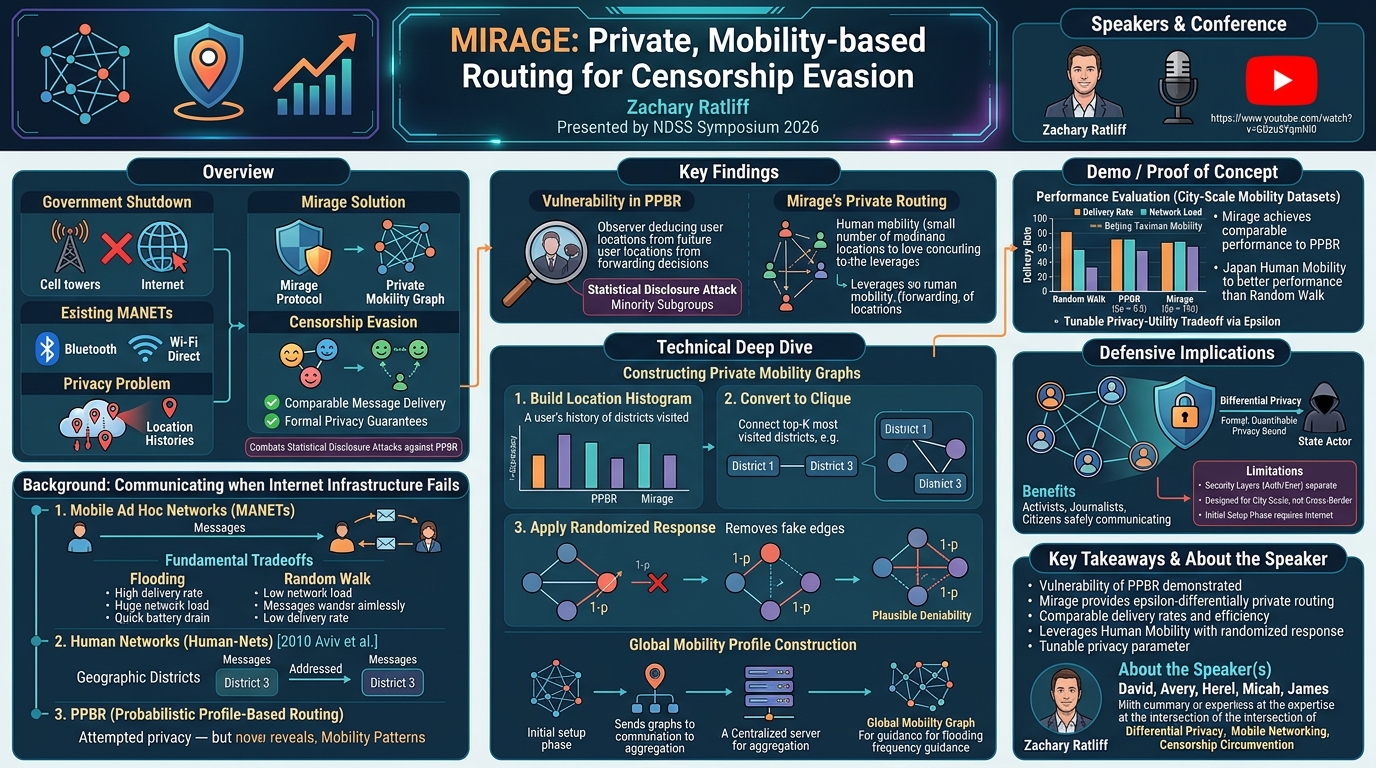
The researchers first demonstrate that the prior state-of-the-art private routing protocol, Probabilistic Profile-Based Routing (PPBR), is vulnerable to statistical disclosure attacks that can identify minority subgroups within a population based on their forwarding decisions. Mirage addresses this by constructing private mobility graphs using randomized response and routing messages based on these graphs, ensuring that any individual's forwarding decision is differentially private -- an observer cannot distinguish whether a user accepted a message because they actually visit the destination district or because of the privacy noise.
Background
▶ Watch: The problem: communicating when internet infrastructure fails (0:00)
The motivating scenario is censorship and communication shutdown: governments or nation-states disabling internet infrastructure to prevent information circulation. Mobile ad hoc networks provide communication without relying on centralized routers or ISPs, with messages moving wherever people physically move.
Two baseline MANET protocols have fundamental tradeoffs. Flooding sends every message to every contact, achieving high delivery rates but at enormous network load and battery cost. Random walk sends messages to random contacts, reducing load but causing messages to "wander aimlessly" with low delivery rates. The research question is whether historical mobility patterns can be leveraged to route more efficiently -- sending messages preferentially to people who are likely to travel to the destination.
This idea was formalized in 2010 by Aviv, Sher, Blaze, and Smith as "human-nets," where messages are addressed to geographic districts rather than individuals. Users build location profiles from their movement history, and routing decisions are based on which users are likely to travel to a message's destination district. However, this creates a severe privacy problem: if routing decisions reveal mobility patterns, users' location histories are exposed to anyone they interact with.
PPBR attempted to solve this by having users silently accept messages for their top-K districts without explicitly announcing their profiles. However, the researchers show that subsequent forwarding decisions implicitly reveal whether a user is a good router for a particular district, enabling statistical inference of mobility patterns.
Key Findings
▶ Watch: Mirage overview and differential privacy guarantees (4:00)
The researchers demonstrate a statistical disclosure attack against PPBR: when a user silently accepts a message destined for a particular district and later forwards it to another user, this forwarding decision reveals that the user either originated the message or accepted it because they visit that district. There is no randomness in the acceptance criteria that would provide plausible deniability. The paper shows this attack can identify minority subgroups within a population based on their mobility patterns.
Mirage's core privacy mechanism relies on a key observation about human behavior: the average person frequently travels between a small number of locations (home, work, school). Each user constructs a private mobility graph by:
- Periodically polling their location to build a histogram over districts
- Converting this into a clique between their top-K most visited districts
- Applying randomized response: removing each edge with probability (1-p) and adding edges to other districts with probability (1-p)
This randomized response satisfies epsilon-locally differentially private guarantees where epsilon = 2k * log(p/(1-p)). An observer seeing a user's forwarding decision cannot determine with high confidence whether the user actually visits a destination district or whether the edge was added by the privacy mechanism.
Technical Deep Dive
▶ Watch: Private mobility graphs via randomized response (8:00)
Mirage uses private mobility graphs in two ways:
Global mobility profile construction: During an initial setup phase (before internet shutdown), users send their private mobility graphs to a centralized server that aggregates and debiases them to produce a global mobility graph. This graph encodes conditional probability mappings -- for example, if most users reported an edge between district 3 and district 4, then conditioned on being in district 3, forwarding to a few users should be sufficient to reach someone who will visit district 4. This guides the flooding frequency for messages.
Private routing function: When two users meet (e.g., via Bluetooth), and one has a message destined for a specific district, the receiving user checks their private mobility graph. If the graph contains an edge to the destination district, they accept the message. The key privacy property: from any observer's perspective, the user would have accepted the message with probability (1-p) regardless, because that edge might have been added by randomized response. Formally, the routing decision function satisfies differential privacy -- interacting with user Bob versus a completely different user Charlie with different mobility patterns produces acceptance probabilities that differ by at most a multiplicative factor of e^epsilon.
Message delivery occurs when a user carrying a message arrives at the destination district, at which point they flood it locally to nearby users.
The privacy-utility tradeoff is tunable via epsilon: higher epsilon (less privacy) produces better delivery efficiency, while lower epsilon (more privacy) reduces delivery efficiency -- a result consistent with differential privacy theory.
Demo / Proof of Concept
▶ Watch: Global mobility profile construction and private routing function (10:00)
Mirage was evaluated using the CADENCE simulator designed for human-net protocol evaluation, on two real-world city-scale mobility datasets:
- Beijing taxi traces (T-Drive dataset)
- Human mobility data from a large metropolitan area in Japan
Results show that Mirage achieves comparable performance to PPBR (which is not private) in terms of delivery rate and network load, with the exception of the T-Drive dataset where PPBR's non-private routing degenerates to flooding (high delivery but high load). Mirage provides significantly better performance than random walk while maintaining formal privacy guarantees.
The delivery efficiency metric (delivery rate divided by network load) confirms the expected privacy-utility tradeoff: higher epsilon values produce better efficiency, and the relationship is smooth and predictable.
Defensive Implications
▶ Watch: Q&A: security layers, personalized epsilon, and cross-border operation (14:00)
Mirage addresses a critical gap in censorship circumvention technology. Existing MANET protocols either sacrifice efficiency (flooding) or privacy (mobility-based routing). For activists, journalists, and citizens in censorship environments, using a routing protocol that leaks location history to other network participants is potentially dangerous -- the network itself could be infiltrated by state actors performing the statistical disclosure attacks the paper demonstrates.
The differential privacy guarantee provides a formal, quantifiable privacy bound rather than relying on heuristic protections. This allows users and deployers to make informed decisions about the privacy-utility tradeoff based on their threat environment.
However, several limitations were acknowledged in the Q&A:
- Security guarantees (authentication, encryption) are handled at a different layer and not part of Mirage itself
- Cross-region or cross-border message transfer was not evaluated -- the system is designed for city-scale operation, and international message routing via human mobility would have very high latency
- Personalized epsilon values (different users choosing different privacy levels) were not studied but could improve efficiency for users who care less about privacy
- The initial setup phase requires internet connectivity to construct the global mobility profile
Key Takeaways
- Existing private mobile ad hoc routing (PPBR) is vulnerable to statistical disclosure attacks that identify minority subgroups from forwarding decisions
- Mirage provides epsilon-differentially private routing using private mobility graphs constructed via randomized response
- Private routing achieves comparable delivery rates and network load to non-private protocols on real-world city-scale mobility datasets
- Human mobility patterns (most people travel between a small number of locations) enable efficient routing without revealing individual location histories
- The privacy-utility tradeoff is tunable and predictable via the epsilon parameter
- System is designed for city-scale censorship evasion; cross-border operation remains an open question
About the Speaker(s)
Zachary Ratliff presented this joint work with collaborators David, Avery, Herel, Micah, and James. The research team works at the intersection of differential privacy, mobile networking, and censorship circumvention. Their expertise spans formal privacy frameworks, network protocol design, and evaluation using real-world mobility datasets.
Reviews
Dr. Zero (Offensive Security Researcher) — WEAK
A differentially private routing protocol for mobile ad hoc networks in censorship scenarios. The statistical disclosure attack against PPBR is a valid contribution, but the defensive system is primarily privacy engineering with no offensive security content, no exploitation, and limited relevance to the security practitioner audience.
Heather Calloway (CISO) — USEFUL
Addresses a niche but important problem: ensuring that censorship-resistant mobile ad hoc routing does not leak participants' location histories. The differential privacy approach is sound, but the practical applicability is limited to specific censorship evasion scenarios and the system lacks security guarantees at the routing layer.
→ Top-rated talks at Network and Distributed System Security (NDSS) Symposium 2026
All talks from Network and Distributed System Security (NDSS) Symposium 2026