Better Safe than Sorry: Uncovering the Insecure Resource Management in App-in-App Cloud Services
Yizhe Shi
Network and Distributed System Security (NDSS) Symposium 2026 · Day 1 · Apps & Cloud Security · Apps & Cloud Security
Overview
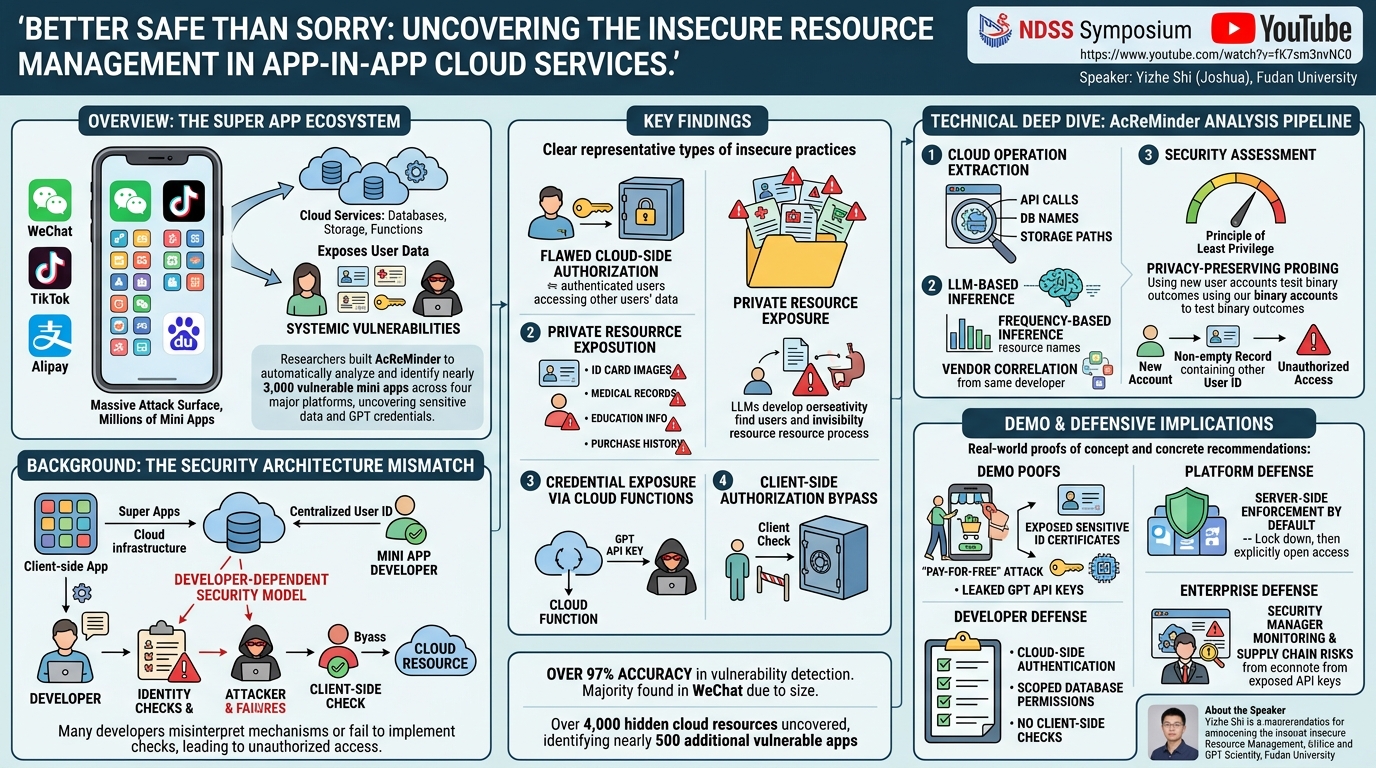
The "super app" ecosystem -- where platforms like WeChat, TikTok, Alipay, and Baidu host millions of mini apps -- has created a massive attack surface that most security researchers outside of Asia have barely examined. This talk reveals systemic insecure resource management vulnerabilities in the cloud services that power these mini app ecosystems. The researchers built an automated analysis tool called AcReMinder that identified nearly 3,000 vulnerable mini apps across four major super app platforms, exposing sensitive user data including ID cards, medical records, education information, and even API keys like GPT credentials.
Key moments
- 0:00 Super app ecosystem and the mini app cloud architecture
- 2:00 Developer misinterpretation: exposed ID cards and GPT API keys
- 4:00 Challenges in analyzing cloud-side code and resources
- 6:00 AcReMinder pipeline: crafted payloads to expose hidden resources
- 8:00 LLM-based inference to uncover hidden cloud databases
- 10:00 Privacy-preserving probing using new user accounts
- 10:30 Results: 3,000 vulnerable mini apps across four platforms
- 12:00 Pay-for-free attacks and sensitive data exposure categories
Better Safe than Sorry: Uncovering the Insecure Resource Management in App-in-App Cloud Services
Speakers: Yizhe Shi
Conference: NDSS Symposium
YouTube: https://www.youtube.com/watch?v=fK7sm3nvNC0
Overview
The "super app" ecosystem -- where platforms like WeChat, TikTok, Alipay, and Baidu host millions of mini apps -- has created a massive attack surface that most security researchers outside of Asia have barely examined. This talk reveals systemic insecure resource management vulnerabilities in the cloud services that power these mini app ecosystems. The researchers built an automated analysis tool called AcReMinder that identified nearly 3,000 vulnerable mini apps across four major super app platforms, exposing sensitive user data including ID cards, medical records, education information, and even API keys like GPT credentials.
The core problem is an architectural mismatch: super app platforms provide cloud databases, cloud storage, and cloud functions to mini app developers, along with user identity information for access control. But the actual responsibility for enforcing identity checks and access control falls squarely on the mini app developers -- and many of them get it wrong, leading to unauthorized data access, privacy violations, and even "pay-for-free" attacks where attackers can manipulate account balances.
Background
▶ Watch: Super app ecosystem and the mini app cloud architecture (0:00)
The app-in-app ecosystem represents a paradigm where super apps serve as platforms hosting smaller applications (mini apps) within their runtime environment. TikTok alone hosts over 7 million mini apps. These platforms provide mini apps with cloud infrastructure including cloud databases, cloud storage, and cloud functions to manage customer data cost-effectively and at scale.
To secure resource management, super apps provide a centralized user-based access control mechanism. Each mini app user receives a unique identifier that serves as the basis for enforcing access control over sensitive cloud resources. However, the critical architectural decision is that while platforms provide the identity information, the primary responsibility for enforcing identity checks falls on the mini app developers themselves. When a user tries to access a cloud resource, the mini app developer must retrieve and verify the user identity based on information from the super platform.
This developer-dependent security model creates a systemic vulnerability: many developers misinterpret the mechanism, fail to implement proper checks, or place authorization logic on the client side where it can be bypassed. The result is widespread exposure of sensitive resources across the ecosystem.
Key Findings
▶ Watch: Challenges in analyzing cloud-side code and resources (4:00)
The researchers identified four representative types of insecure practices in the cloud resource management mechanism:
Flawed Authorization on Cloud Side: Many developers fail to properly verify user identities before granting access to sensitive cloud resources, allowing any authenticated user to access other users' data.
Private Resource Exposure: Sensitive data including ID card images, medical records, education information, and purchase histories stored in cloud storage is accessible without proper authorization checks.
Credential Exposure via Cloud Functions: Some mini apps expose sensitive credentials such as GPT API keys through improperly secured cloud functions.
Client-Side Authorization Bypass: Many developers mistakenly place user identity checks on the client side rather than the cloud side. Since client-side checks can be trivially bypassed by attackers, this effectively provides no security.
At scale, AcReMinder achieved over 97% accuracy in vulnerability detection across the four platforms, with the majority of vulnerable mini apps found in the WeChat ecosystem due to its massive size and market dominance. The tool uncovered over 4,000 hidden cloud resources and identified nearly 500 additional vulnerable mini apps through advanced capability excavation techniques.
Technical Deep Dive
▶ Watch: LLM-based inference to uncover hidden cloud databases (8:00)
AcReMinder operates through a multi-stage analysis pipeline:
Stage 1 - Cloud Operation Extraction: The tool extracts all cloud-related API operations performed on the mini app client side, modeling the data flows and tracking parameters such as database names, cloud function names, and storage paths.
Stage 2 - Hidden Capability Excavation: Not all cloud resources are directly referenced in client-side code. Some are managed entirely on the cloud side and are invisible to static analysis. The researchers developed three techniques to uncover these hidden resources:
- Frequency-based inference: Many mini app developers use common or similar database names. Frequently occurring names across mini apps likely correspond to real cloud resources that can be probed.
- LLM-based inference: A large language model analyzes client-side operations to predict what cloud resources might exist on the server side, even when not directly referenced.
- Vendor correlation: Mini apps developed by the same vendor often share identical cloud architectures, including database names and resource structures. Cross-correlating these apps reveals hidden resources.
Stage 3 - Security Assessment: AcReMinder applies service-specific rules for cloud databases, cloud storage, and cloud functions to identify insecure practices. The assessment is guided by the principle of least privilege -- determining whether exposed capabilities exceed what is necessary for the mini app's intended functionality.
Privacy-Preserving Probing: To avoid causing actual data leakage during assessment, the researchers developed a dynamic probing method using new user accounts. Since a new user who has never used a mini app cannot have any data stored in its cloud database, any non-empty records retrieved by that account containing another user's identifier indicate unauthorized cross-user data access. The probing requests only a binary outcome (whether a user ID exists) rather than collecting actual sensitive content.
Demo / Proof of Concept
▶ Watch: Privacy-preserving probing using new user accounts (10:00)
The researchers demonstrated real-world findings across the four super app platforms. Notable examples include:
- A mini app exposing sensitive ID certificates (national ID card images) of mini app users stored in cloud storage without proper access controls
- A mini app leaking GPT API keys through improperly secured cloud functions
- A "pay-for-free" attack where flawed authorization allowed attackers to manipulate account balances, enabling purchases without actual payment
- Mini apps in business and education categories exposing user education records, component certificates, and sensitive business data
The vulnerable mini apps span multiple categories, with concentrations in domains rich in sensitive data: business, education, healthcare, and e-commerce. The researchers confirmed all findings through manual analysis, validating the 97%+ accuracy of their automated detection.
Defensive Implications
▶ Watch: Pay-for-free attacks and sensitive data exposure categories (12:00)
This research exposes a fundamental architectural weakness in the super app ecosystem: delegating security enforcement to individual developers at scale produces predictable, systemic failures. The findings have direct implications for platform operators and security teams:
For super app platforms: The current model of providing identity information but leaving enforcement to developers is insufficient. Platforms should consider implementing server-side enforcement by default, where cloud resources are locked down unless developers explicitly open access -- flipping the current permissive-by-default model.
For mini app developers: Client-side authorization checks provide zero security. All access control logic must be implemented on the cloud side, with proper user identity verification before any resource access is granted. Database permissions should be scoped to the minimum necessary for the application's functionality.
For enterprise security teams: Organizations whose employees or customers interact with mini app ecosystems should be aware that sensitive data submitted to mini apps may be inadequately protected. The exposure of API keys through cloud functions also creates supply chain risk -- a compromised GPT API key could be used for unauthorized access to AI services.
The privacy-preserving assessment methodology is also notable: it demonstrates that large-scale vulnerability assessment of cloud services can be conducted ethically without exposing actual user data.
Key Takeaways
- The app-in-app ecosystem (WeChat, TikTok, Alipay, Baidu) has systemic insecure resource management affecting nearly 3,000 mini apps across four major platforms
- The root cause is architectural: platforms delegate access control enforcement to individual developers, and many developers implement it incorrectly or not at all
- Common failures include flawed cloud-side authorization, exposed private resources (ID cards, medical records), leaked API keys via cloud functions, and bypassable client-side checks
- AcReMinder achieves over 97% accuracy in automated vulnerability detection using cloud operation extraction, hidden capability excavation, and privacy-preserving probing
- LLM-based inference of hidden cloud resources outperformed other discovery techniques for uncovering server-side resources not referenced in client code
- "Pay-for-free" attacks are possible when developers fail to properly enforce payment verification on the cloud side
About the Speaker(s)
Yizhe Shi (presenting as Joshua) is a researcher from Fudan University. His research focuses on mobile application security, with particular expertise in the app-in-app ecosystem that dominates mobile computing in China and increasingly in global markets. The work demonstrates deep understanding of the cloud service architectures underlying super app platforms and their security implications at scale.
Reviews
Dr. Zero (Offensive Security Researcher) — SOLID
A systematic large-scale analysis of insecure cloud resource management in the super app mini app ecosystem, identifying nearly 3,000 vulnerable apps across WeChat, TikTok, Alipay, and Baidu. The automated tool AcReMinder achieves 97%+ accuracy and the findings -- exposed ID cards, medical records, API keys, and pay-for-free attacks -- are real and impactful. Technically competent work, though the underlying vulnerabilities are largely variants of missing server-side authorization rather than novel attack classes.
Heather Calloway (CISO) — USEFUL
A large-scale study revealing systemic access control failures in the super app mini app ecosystem, with nearly 3,000 vulnerable apps exposing user PII, medical records, and payment manipulation vectors. Directly relevant for organizations operating in or interacting with the WeChat/TikTok/Alipay/Baidu ecosystems, and a cautionary tale about delegating security enforcement to third-party developers at scale.
→ Top-rated talks at Network and Distributed System Security (NDSS) Symposium 2026
All talks from Network and Distributed System Security (NDSS) Symposium 2026