Beyond Conventional Triggers: Auto-Contextualized Covert Triggers for Android Logic Bombs
Ye Wang
Network and Distributed System Security (NDSS) Symposium 2026 · Day 1 · Systems Security
Overview
Logic bombs -- malicious code that remains dormant until specific trigger conditions are met -- have largely fallen off the security research radar as detection tools like static analysis and dynamic fuzzing improved. This talk from the University of Kansas challenges that complacency by introducing auto-contextualized sensor-based logic bombs that simultaneously evade static analysis, dynamic fuzzing, and anomaly detection. By leveraging onboard sensor-actuator covert channels (e.g., vibration motor to accelerometer, camera flash to light sensor), the researchers achieve 100% evasion against the state-of-the-art logic bomb detector Diffuser, 100% attack success rate in static usage scenarios, and zero false triggers. They successfully injected triggers into 1,400 APKs at scale and built three working prototypes demonstrating real-world viability.
Key moments
- 0:00 Logic bomb evolution and why academic attention has declined
- 2:00 Real-world sensor bombs evading Diffuser and low attack success rates
- 4:00 Auto-contextualization: sensor-actuator covert channel pairs
- 6:00 Pattern generation with dynamic anti-fuzzing triggers
- 8:00 Evaluation setup: 7 device models, 1700 APKs, 3 prototypes
- 10:00 Results: 100% attack success rate with zero false triggers
- 12:00 Fuzzing resistance: 100+ hours for sensor bombs vs 2 hours for conventional
- 14:00 100% evasion of static analysis, fuzzing, and anomaly detection simultaneously
Beyond Conventional Triggers: Auto-Contextualized Covert Triggers for Android Logic Bombs
Speakers: Ye Wang
Conference: NDSS Symposium
YouTube: https://www.youtube.com/watch?v=KrhsPpER43c
Overview
Logic bombs -- malicious code that remains dormant until specific trigger conditions are met -- have largely fallen off the security research radar as detection tools like static analysis and dynamic fuzzing improved. This talk from the University of Kansas challenges that complacency by introducing auto-contextualized sensor-based logic bombs that simultaneously evade static analysis, dynamic fuzzing, and anomaly detection. By leveraging onboard sensor-actuator covert channels (e.g., vibration motor to accelerometer, camera flash to light sensor), the researchers achieve 100% evasion against the state-of-the-art logic bomb detector Diffuser, 100% attack success rate in static usage scenarios, and zero false triggers. They successfully injected triggers into 1,400 APKs at scale and built three working prototypes demonstrating real-world viability.
Background
▶ Watch: Logic bomb evolution and why academic attention has declined (0:00)
Logic bombs have caused significant damage to critical infrastructure -- Stuxnet remains the most famous example of condition-triggered malicious code targeting Iran's nuclear facilities. Android logic bombs have continuously evolved by leveraging new trigger types to evade detection, with time-based triggers being the most common (e.g., triggering on a specific date). Both static and dynamic analysis have evolved accordingly, with modern detectors like Diffuser leveraging machine learning and large-scale data to detect a wide range of potential triggers.
However, the researchers identified that some sensor-based logic bombs have already evaded static analysis and been released in the wild. Sabros (also called Separas) is a real-world logic bomb triggered by motion sensors. Testing confirmed that some common sensor-and-sensitive-operation combinations can evade Diffuser. Additionally, real-world sensor-based logic bombs using direct sensor readings have a critical limitation: sensors have limited reading ranges, and requiring specific sensor values dramatically reduces the attack success rate -- below 20% when requiring more than one hour of fuzzing resistance.
Key Findings
▶ Watch: Auto-contextualization: sensor-actuator covert channel pairs (4:00)
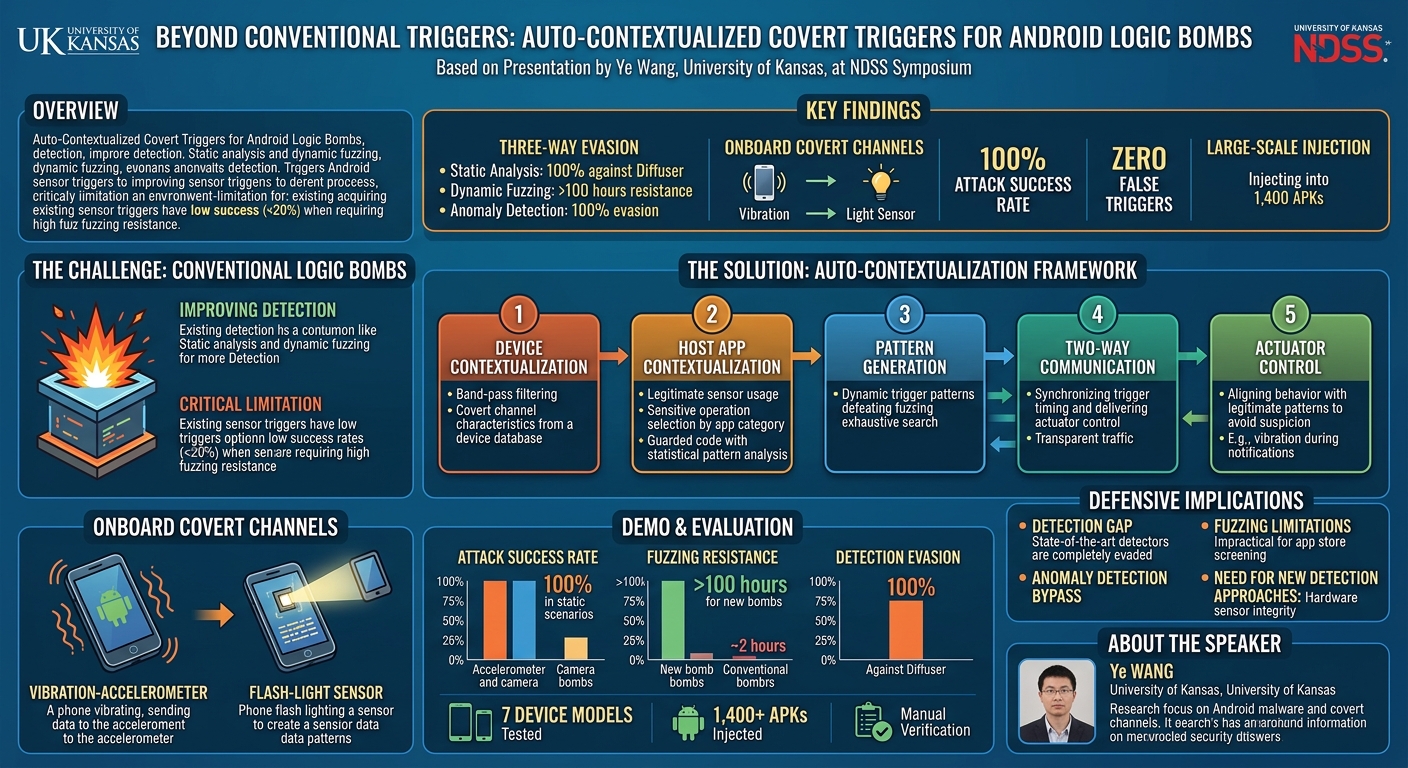
Three-Way Evasion: The auto-contextualization framework achieves simultaneous evasion of:
- Static analysis (100% evasion against Diffuser) by mimicking legitimate sensor usage based on host app category
- Dynamic fuzzing (requiring >100 hours vs. ~2 hours for conventional sensor bombs) by using dynamic trigger patterns that change values that have already been fuzzed
- Anomaly detection (100% evasion across 12 usage scenarios) by mimicking legitimate actuator behaviors
Onboard Covert Channels: The researchers identified sensor-actuator pairs on smartphones that can serve as covert communication channels. Some are previously known, and some are newly proposed. These include:
- Vibration motor -> Accelerometer: The vibration motor creates detectable accelerometer readings that can encode binary data
- Camera flash/screen -> Light sensor: Controlling light emission creates detectable patterns for the ambient light sensor
- Speaker -> Microphone: Audio-based covert channel
100% Attack Success Rate: The accelerometer bomb achieved 100% attack success rate across 12 common usage scenarios when the smartphone is in static scenarios (desk, pocket, etc.). The sensor bomb only triggers when conditions are optimal, using trigger timing inference to find the right moment.
Zero False Triggers: By collecting exclusion data patterns (scenarios where triggering would be incorrect), the framework ensures zero false triggers even in dynamic, noisy usage scenarios.
Large-Scale Injection: Using the AndroidBomb tool, triggers were successfully injected into 1,400 APKs out of 1,729 candidates from AndroidZoo. All passed ADB-based automated testing, and 159 randomly selected apps passed manual verification.
Technical Deep Dive
▶ Watch: Evaluation setup: 7 device models, 1700 APKs, 3 prototypes (8:00)
The auto-contextualization framework has five components:
1. Device Contextualization: Automatically configures parameters of onboard covert channels and filters based on device specifications and a knowledge database. Band-pass filters (e.g., centered at 80-100 Hz for vibration motor resonant frequency) extract the covert channel signal from environmental noise. Parameters are derived from a database of covert channel characteristics across different device models.
2. Host App Contextualization: Generates guarded code with two parts: sensor data collection with real-time statistical pattern analysis to infer optimal trigger timing (achieving high success rate) and exclusion data collection (ensuring zero false triggers). The framework automatically selects sensitive operations that can evade static analysis based on the host app category, sensor type, and a knowledge base.
3. Pattern Generation: Generates dynamic trigger patterns that balance transmission errors, false triggers, and fuzzing resistance. The dynamic patterns change over time, so fuzzing tools that record and replay signal values cannot exhaustively search the trigger space -- by the time fuzzing returns to previously tested values, the trigger condition has changed.
4. Two-Way Communication: Traffic between device and server synchronizes trigger timing and exclusion patterns (device to server) and delivers actuator control commands (server to device). All traffic appears transparent and non-suspicious.
5. Actuator Control: Since smartphone actuators (vibration, flash, speaker) interact directly with users, any unfamiliar behavior would raise suspicion. The framework aligns actuator behaviors with legitimate usage patterns (e.g., vibrations during notifications, flash during camera use) to avoid user suspicion.
Three prototypes were built: an accelerometer bomb (broadest attack class -- nearly all apps use accelerometer and vibration), a camera bomb (verifying newly proposed covert channel), and a user bomb (comparing against existing real-world user behavior triggers, achieving >90% success rate even at 700+ hours of fuzzing resistance).
Demo / Proof of Concept
▶ Watch: Results: 100% attack success rate with zero false triggers (10:00)
The researchers tested across five smartphone vendors with seven models representing different device tiers:
- Accelerometer bomb: 100% attack success rate and 0% false triggers in static scenarios across 12 usage contexts; does not trigger in moving scenarios (by design)
- Camera bomb: 100% attack success rate and 0% false triggers under dim light conditions; does not work under strong ambient light (expected limitation)
- User bomb: >90% attack success rate even at 700+ hours of required fuzzing time, significantly outperforming real-world user behavior triggers
- Static analysis evasion: 100% against Diffuser across different app categories
- Fuzzing resistance: >100 hours for sensor bombs vs. ~2 hours for conventional sensor reading bombs
- Anomaly detection evasion: 100% across 12 common usage scenarios
Large-scale injection into 1,400 APKs with automated and manual verification confirmed real-world deployment viability.
Defensive Implications
▶ Watch: 100% evasion of static analysis, fuzzing, and anomaly detection simultaneously (14:00)
This research has sobering implications for Android malware detection:
Detection Gap: Current state-of-the-art logic bomb detectors (Diffuser) are completely evaded by auto-contextualized sensor bombs. The 100% evasion rate means that existing detection tools provide no protection against this class of threat.
Fuzzing Limitations: Dynamic fuzzing, which was considered an effective countermeasure against sensor-based triggers, is defeated by dynamic patterns. The >100 hour fuzzing time requirement makes exhaustive testing impractical for app store-scale screening.
Anomaly Detection Bypass: Mimicking legitimate actuator behaviors makes sensor data anomaly detection ineffective. The bombs only trigger during static usage scenarios, which are the same scenarios where legitimate actuator activity (vibration for notifications) is normal.
Need for New Detection Approaches: The comprehensive evasion of static, dynamic, and behavioral analysis suggests the need for fundamentally new detection approaches -- perhaps hardware-level monitoring of actuator-sensor interactions or cryptographic attestation of sensor data integrity.
Covert Channel Awareness: The catalog of onboard sensor-actuator covert channels should be considered in mobile threat models. These channels are inherent to smartphone hardware design and cannot be easily eliminated without impacting legitimate functionality.
Key Takeaways
- Auto-contextualized sensor-based logic bombs simultaneously evade static analysis (100% vs. Diffuser), dynamic fuzzing (>100 hours resistance), and anomaly detection (100% evasion)
- Onboard sensor-actuator covert channels (vibration-accelerometer, flash-light sensor) enable controlled trigger patterns without suspicious network traffic
- Dynamic trigger patterns defeat fuzzing by changing conditions after values have been tested, preventing exhaustive search
- Successful large-scale injection into 1,400 APKs demonstrates automated deployment viability
- Zero false trigger rate is achieved through exclusion pattern collection and optimal trigger timing inference
- This is the first systematic study of sensor-based logic bomb evasion, demonstrating comprehensive evasion of all three major detection approaches
About the Speaker(s)
Ye Wang (presenting as Yong) is a researcher from the University of Kansas, working with Dr. Bolo and Dr. Fujini. The research focuses on Android malware, logic bomb evasion, and covert channel exploitation on mobile devices. The speaker mentioned being on the academic job market, indicating this work represents a significant portion of their doctoral or postdoctoral research.
Reviews
Dr. Zero (Offensive Security Researcher) — STRONG ACCEPT
An impressive offensive research contribution that demonstrates auto-contextualized Android logic bombs achieving 100% evasion against static analysis, dynamic fuzzing, and anomaly detection simultaneously. The use of onboard sensor-actuator covert channels (vibration-accelerometer, flash-light sensor) for controlled trigger delivery is creative and practical. Three working prototypes, large-scale injection into 1,400 APKs, and 100% attack success rate with zero false triggers make this a real threat, not a theoretical exercise.
Heather Calloway (CISO) — STRONG
A concerning demonstration that state-of-the-art Android logic bomb detection is comprehensively defeated by auto-contextualized sensor-based triggers. The 100% evasion rates against static analysis, dynamic fuzzing, and anomaly detection mean that current app store screening and enterprise mobile security tools provide no protection against this threat class. Security leaders managing Android device fleets or app distribution should treat this as a wake-up call.
→ Top-rated talks at Network and Distributed System Security (NDSS) Symposium 2026
All talks from Network and Distributed System Security (NDSS) Symposium 2026