From Obfuscated to Obvious: A Comprehensive JavaScript Deobfuscation Tool for Security Analysis
Dongchao Zhou
Network and Distributed System Security (NDSS) Symposium 2026 · Day 1 · Web Security
Overview
This talk presents JSimplify, a comprehensive JavaScript deobfuscation tool designed to handle the full spectrum of obfuscation techniques used by real-world malware. The researchers from Beijing University of Post and Telecommunications and Tian Technology Research Institute first surveyed 12 major JavaScript obfuscation tools, identified 20 distinct obfuscation techniques organized into four categories, and then built a three-stage pipeline that achieves 100% success rate across all 20 techniques -- significantly outperforming 13 existing approaches.
Key moments
- 0:00 Introduction and survey of 12 major JavaScript obfuscation tools
- 1:30 JSphere Track campaign: 260,000 pages compromised with six-character obfuscation
- 2:30 Three fundamental challenges of existing deobfuscation tools
- 4:00 Hybrid static-dynamic deobfuscation engine architecture
- 6:00 LLM humanizer: context-aware variable renaming
- 6:30 Largest obfuscated JavaScript dataset and evaluation methodology
- 8:00 100% syntactic correctness and 93% CFG similarity results
- 10:00 Readability improvement from 1.5 to 7.5 and JSphere Track case study
From Obfuscated to Obvious: A Comprehensive JavaScript Deobfuscation Tool for Security Analysis
Speakers: Dongchao Zhou
Conference: NDSS Symposium
YouTube: https://www.youtube.com/watch?v=_LmXCj4gKzY
Overview
This talk presents JSimplify, a comprehensive JavaScript deobfuscation tool designed to handle the full spectrum of obfuscation techniques used by real-world malware. The researchers from Beijing University of Post and Telecommunications and Tian Technology Research Institute first surveyed 12 major JavaScript obfuscation tools, identified 20 distinct obfuscation techniques organized into four categories, and then built a three-stage pipeline that achieves 100% success rate across all 20 techniques -- significantly outperforming 13 existing approaches.
The work addresses a critical gap in malware analysis: existing deobfuscation tools either crash on malformed code, fail on multi-layer obfuscation combinations, or produce output that remains unreadable to human analysts. JSimplify solves all three problems through a fault-tolerant preprocessor, a hybrid static-dynamic analysis core, and an LLM-powered "humanizer" that transforms obfuscated variable names into descriptive, context-aware identifiers.
Background
▶ Watch: Introduction and survey of 12 major JavaScript obfuscation tools (0:00)
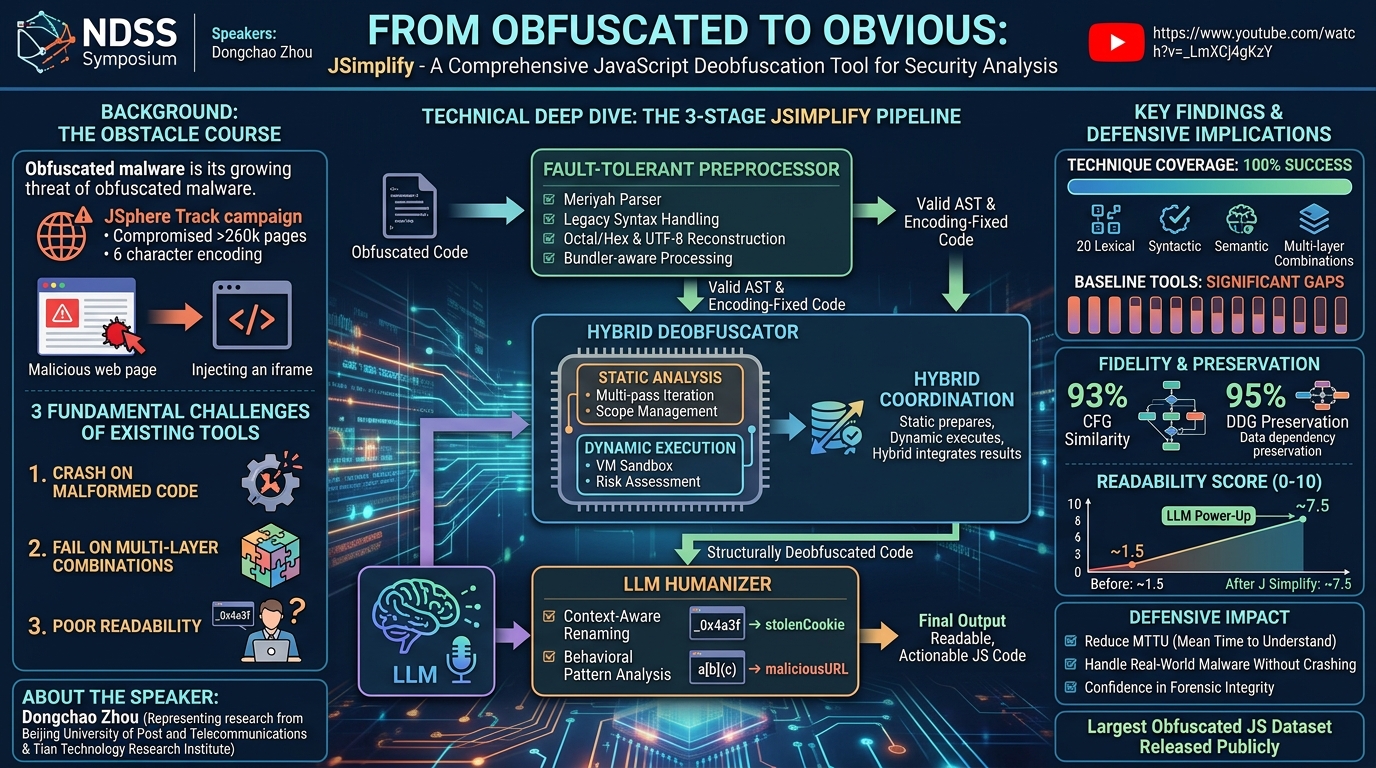
JavaScript powers the modern web, making it a prime target for attackers who employ sophisticated obfuscation to hide malicious code. The problem is exemplified by the JSphere Track campaign, reported by Palo Alto Networks Unit 42, which compromised over 260,000 web pages in a single month using extreme multi-layer obfuscation. That campaign used only six ASCII characters, exploiting JavaScript's type coercion with character array lookups and String.fromCharCode functions to create multiple decoding layers that execute malicious payloads.
The researchers identified three fundamental challenges with existing deobfuscation tools: (1) tools crash on the deliberately malformed code found in real-world malware, (2) tools target specific obfuscation patterns but cannot handle multi-layer combinations where attackers stack multiple techniques, and (3) even when tools succeed in structural deobfuscation, the output remains unreadable because variable names and code structure are still meaningless to human analysts.
Prior to this work, the landscape of JavaScript deobfuscation consisted of traditional tools that struggle with basic lexical changes and specialized tools that fail due to strict pattern matching. No single tool could handle the full range of obfuscation techniques encountered in production malware.
Key Findings
▶ Watch: Three fundamental challenges of existing deobfuscation tools (2:30)
The research produced several significant results:
Taxonomy of 20 obfuscation techniques: The survey of 12 major obfuscation tools (both commercial and open source) yielded a systematic taxonomy organized into four categories -- lexical, syntactic, semantic, and multi-layer combinations. This taxonomy provides the first comprehensive classification of JavaScript obfuscation in the wild.
100% technique coverage: JSimplify achieved a 100% success rate across all 20 identified obfuscation techniques, while the 13 baseline tools all showed significant gaps in coverage.
High fidelity deobfuscation: The tool maintained 93% control flow graph (CFG) similarity and 95% data dependency graph (DDG) preservation, confirming that deobfuscation preserves the runtime behavior of the original code.
Dramatic readability improvement: Using four state-of-the-art LLMs (Claude, Gemini, DeepSeek, and GPT) to score code readability on a 0-10 scale, JSimplify improved scores from approximately 1.5 to 7.5 -- a five-fold improvement in human interpretability.
Largest obfuscated JavaScript dataset: The researchers built the largest dataset of obfuscated JavaScript to date, containing malicious samples from a cybersecurity company partner (MalJS), benign samples from top websites and GitHub repositories (BenignJS), and a benchmark subset from prior work (CombinBench).
Technical Deep Dive
▶ Watch: LLM humanizer: context-aware variable renaming (6:00)
JSimplify operates through a three-stage pipeline:
Stage 1 -- Fault-Tolerant Preprocessor: Real-world malware deliberately uses malformed syntax, mixed character encodings, and tricks designed to crash standard parsers. The preprocessor uses the Meriyah parser to generate complete ASTs even with legacy syntax and heavy obfuscation. It performs octal/hex and UTF-8 reconstruction to resolve encoding tricks that block static analysis. Additional components include lexical code modernization, duplicate declaration elimination, and bundler-aware processing for modern web applications.
Stage 2 -- Hybrid Deobfuscator: This is the core engine, combining static and dynamic analysis through three components. Static analysis uses multi-pass iteration with automatic fallback, enhanced expression evaluation for complex patterns like destructuring and short-circuit logic, and intelligent scope management across function boundaries. When static analysis reaches its limits, dynamic execution takes over with risk assessment, function relationship mapping, and VM sandbox execution with timeout and memory protection. A hybrid coordination layer bridges both approaches -- it packages evaluable expressions for the dynamic environment and integrates validated results back through type-aware replacement for accuracy and integrity.
Stage 3 -- LLM Humanizer: Structural deobfuscation alone is insufficient because obfuscated variable names remain unreadable. The humanizer leverages large language models like ChatGPT for context-aware renaming, analyzing code logic and behavioral patterns to transform variables into descriptive names such as stolenCookie or maliciousURL based on behavioral context. This bridges the gap between machine-readable structure and human-interpretable semantics.
The ablation study on 10,000 MalJS samples showed that static and dynamic modules add minimal overhead (under 10 seconds on average) while enabling 19 out of 20 obfuscation techniques. The full system with LLM integration takes approximately 87 seconds, mainly due to API latency, but achieves complete coverage of all 20 techniques.
Demo / Proof of Concept
▶ Watch: Largest obfuscated JavaScript dataset and evaluation methodology (6:30)
The talk demonstrated JSimplify's capabilities using the JSphere Track campaign as a case study. The tool transformed the encoded characters (using only six ASCII characters with multi-layer encoding) into clear, readable JavaScript code. In the demonstrated example, the deobfuscated output revealed that the attacker's intent was to detect search engine referrers and inject malicious iframes redirecting visitors to attacker-controlled domains -- intent that was completely hidden in the obfuscated form.
The researchers also presented comparative results on the CombinBench dataset using Halstead complexity metrics: HLR (physical code reduction) of 0.88 and HDR (mental effort reduction) of 0.93, significantly outperforming all baseline tools.
Defensive Implications
▶ Watch: Readability improvement from 1.5 to 7.5 and JSphere Track case study (10:00)
JSimplify represents a meaningful advance for security operations teams dealing with obfuscated JavaScript malware. The tool's ability to handle real-world malformed code without crashing addresses one of the most frustrating operational pain points -- analysts frequently encounter samples that break their existing tools before analysis can even begin.
The LLM-powered variable renaming feature is particularly significant for incident response workflows. Rather than spending hours manually reverse-engineering what _0x4a3f or a[b](c) means, analysts receive code with descriptive variable names that immediately reveal attacker intent. This could dramatically reduce mean time to understand (MTTU) for JavaScript-based threats.
The 93% CFG similarity preservation is important for forensic integrity -- defenders need confidence that the deobfuscated code faithfully represents the original behavior when presenting findings or building detection signatures.
All datasets and the tool itself have been publicly released, enabling the broader security community to build upon this work and integrate it into existing analysis pipelines.
Key Takeaways
- JSimplify achieves 100% success rate across 20 distinct JavaScript obfuscation techniques, outperforming 13 existing tools
- The three-stage pipeline (preprocessor, hybrid deobfuscator, humanizer) addresses the three core challenges of malformed code handling, multi-layer obfuscation, and human readability
- LLM-powered variable renaming improves code readability scores from 1.5 to 7.5 on a 10-point scale, making deobfuscated code immediately actionable for analysts
- The tool preserves runtime behavior with 93% CFG similarity and 95% DDG preservation
- The largest obfuscated JavaScript dataset to date has been publicly released for future research
- Processing takes approximately 87 seconds per sample with full LLM integration, with most latency attributable to API calls
About the Speaker(s)
Dongchao Zhou presented this paper as a proxy speaker on behalf of the research team from Beijing University of Post and Telecommunications and Tian Technology Research Institute. The lead author can be contacted at [email protected] for technical inquiries. The research represents a collaboration between academic researchers and cybersecurity industry partners who provided the malicious JavaScript samples used in evaluation.
Reviews
Dr. Zero (Offensive Security Researcher) — SOLID
A rigorous engineering effort that builds a comprehensive JavaScript deobfuscation pipeline achieving 100% coverage across 20 obfuscation techniques. The taxonomy is useful, the dataset is the largest of its kind, and the hybrid static-dynamic approach with LLM-powered variable renaming is well-designed. However, this is a tool-building paper rather than an offensive research contribution -- no new obfuscation bypasses, no novel attack techniques, and the proxy presentation limits the depth of technical Q&A.
Heather Calloway (CISO) — STRONG
A highly practical tool release that addresses a real operational pain point for security teams: reliably deobfuscating JavaScript malware at scale. The 100% technique coverage, fault-tolerant preprocessing, and LLM-powered variable renaming directly reduce analyst workload and mean time to understand for JavaScript-based threats. The publicly released dataset and tool make this immediately actionable for SOC teams and incident responders.
→ Top-rated talks at Network and Distributed System Security (NDSS) Symposium 2026
All talks from Network and Distributed System Security (NDSS) Symposium 2026