Light2Lie: Detecting Deepfake Images Using Physical Reflectance Laws
Kavita Kumari (Post-doctoral Researcher · Technical University of Tamstad)
Network and Distributed System Security (NDSS) Symposium 2026 · Day 2 · Multimedia Forensics
Overview
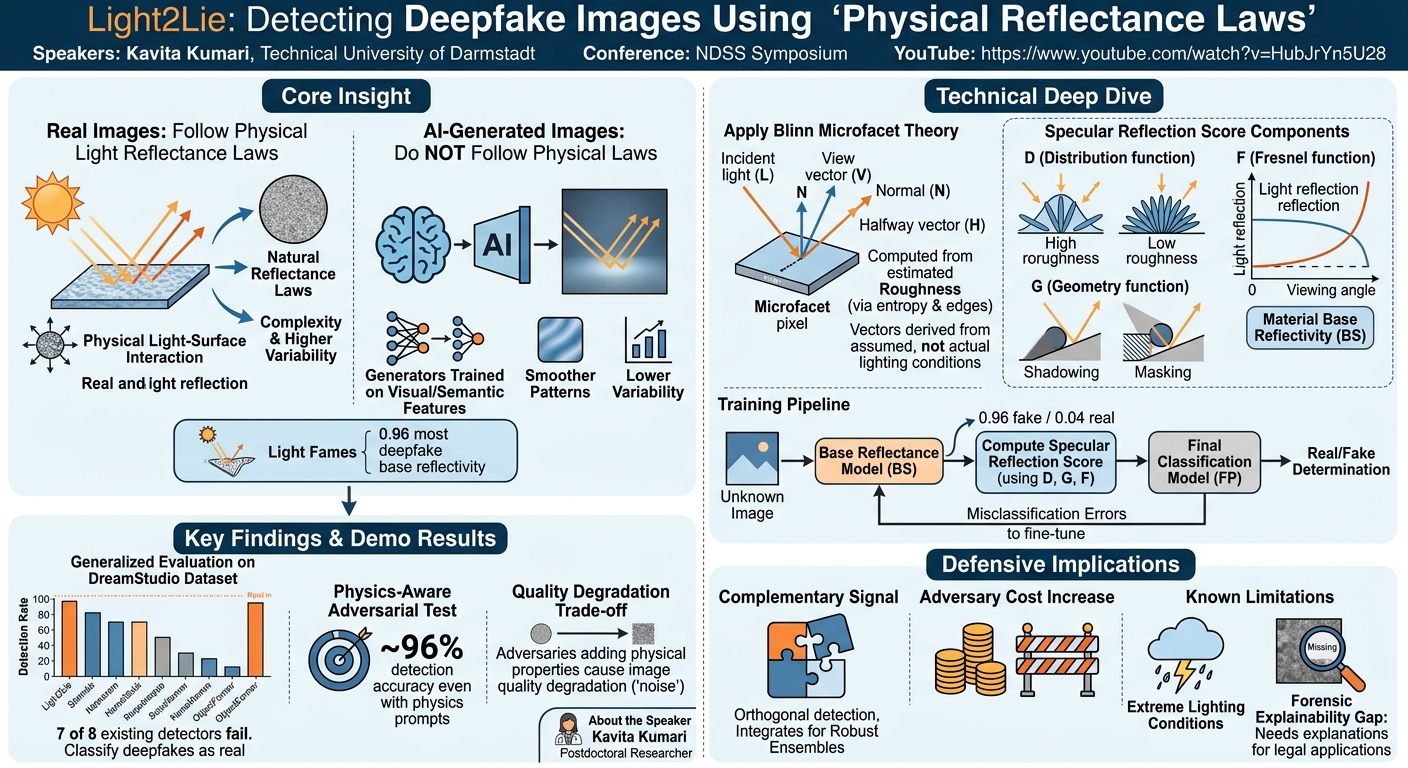
This talk presents Light2Lie, a deepfake detection approach based on the insight that real images follow physical light reflectance laws while AI-generated images do not. By modeling each pixel as a microfacet using the Blinn microfacet theory from computer graphics, the system computes a specular reflection score for each image that captures how light interacts with the surface. Real images exhibit complex, highly variable reflectance patterns because they result from actual light-surface interactions, while AI-generated images produce smoother, less variable patterns because generators are not trained on these physical laws.
Key moments
- 0:00 Existing detectors fail: 7 of 8 classify deepfakes as real
- 2:00 Core intuition: real images follow physical light laws, generated ones don't
- 4:00 Blinn microfacet theory applied to deepfake detection
- 6:00 Computing roughness, light vectors, and specular reflection scores
- 10:00 D, G, and F components of the microfacet reflection model
- 12:00 Training pipeline with base reflectance feedback loop
- 14:00 Results: outperforms 8 existing detectors on DreamStudio
- 16:00 Q&A: adversarial robustness and the quality-realism trade-off
Light2Lie: Detecting Deepfake Images Using Physical Reflectance Laws
Speakers: Kavita Kumari
Conference: NDSS Symposium
YouTube: https://www.youtube.com/watch?v=HubJrYn5U28
Overview
This talk presents Light2Lie, a deepfake detection approach based on the insight that real images follow physical light reflectance laws while AI-generated images do not. By modeling each pixel as a microfacet using the Blinn microfacet theory from computer graphics, the system computes a specular reflection score for each image that captures how light interacts with the surface. Real images exhibit complex, highly variable reflectance patterns because they result from actual light-surface interactions, while AI-generated images produce smoother, less variable patterns because generators are not trained on these physical laws.
Light2Lie outperforms eight existing deepfake detectors in generalized evaluation on the DreamStudio dataset, where most existing detectors erroneously classify AI-generated images as real. The approach demonstrates that physics-augmented intelligence can provide a more robust detection signal than purely statistical or frequency-based methods, though the speaker acknowledges the approach is still a work in progress with known limitations in extreme lighting conditions.
Background
▶ Watch: Existing detectors fail: 7 of 8 classify deepfakes as real (0:00)
The proliferation of deepfake images has created urgent needs for detection systems that can reliably distinguish AI-generated content from real photographs. Existing detection approaches fall into three main categories: frequency domain analysis, spatial and statistical features, and transformer-based/ensemble classifiers. However, evaluation against the DreamStudio dataset reveals that most existing detectors (seven out of eight tested) are biased toward classifying inputs as real, failing to identify generated images.
Three fundamental limitations affect current detectors: domain-dependent accuracy (performance varies significantly across image types), limited adaptability and generalization (poor performance on unseen generative models), and incomplete dataset evaluation (detectors are not tested against comprehensive, diverse datasets).
The core intuition behind Light2Lie is simple but powerful: real images are the result of physical light interacting with surfaces, following natural reflectance laws. Generated images are the output of models trained to replicate visual, semantic, and spectral features but not the underlying physics of light-surface interactions. This makes real images more complex and variable in their reflectance characteristics, while generated images are comparatively smoother.
Key Findings
▶ Watch: Blinn microfacet theory applied to deepfake detection (4:00)
Physics-based detection outperforms statistical approaches: Light2Lie outperforms eight existing detectors on generalized evaluation using the DreamStudio dataset, where most competing methods fail to distinguish fake from real.
Real images exhibit higher reflectance variability: The roughness distribution of pixels (modeled as microfacets) varies significantly more in real images compared to AI-generated ones. This causes light vectors to be more distributed in real images and more aligned in generated images.
Specular reflection score as discriminative feature: The computed global specular reflection score, derived from the Blinn microfacet model's D (distribution), G (shadowing/masking), and F (Fresnel) components, provides a robust additional feature for classifier training.
Robust against physics-aware generation: When prompted to generate images following physical reflectance laws, the detector still achieved approximately 96% detection accuracy, suggesting that incorporating physics into generation does not trivially defeat the detection.
Trade-off for adversaries: Q&A discussion revealed that adversaries attempting to add physical reflectance properties to generated images face a quality degradation trade-off -- making images more physically realistic introduces noise that degrades overall image quality.
Technical Deep Dive
▶ Watch: D, G, and F components of the microfacet reflection model (10:00)
Light2Lie applies the Blinn microfacet theory to image analysis by treating each pixel as a tiny microfacet on the image "surface":
Roughness Estimation: For each pixel/microfacet, roughness is computed using entropy properties and edge depth estimation. This roughness drives all subsequent calculations.
Light Vector Computation: Four vectors are computed per pixel:
- Incident light (L): Direction of incoming light
- View vector (V): Direction of reflected light
- Normal (N): Surface normal at the microfacet
- Halfway vector (H): Midpoint between incident light and view vector
Without actual lighting conditions available for either real or generated images, these vectors are derived from the estimated roughness properties.
Specular Reflection Score Components:
- D (Distribution function): Quantifies how microfacets are oriented -- high roughness produces widely distributed orientations, low roughness produces aligned orientations
- G (Geometry function): Quantifies shadowing and masking effects where one microfacet blocks light reaching another
- F (Fresnel function): Quantifies how much light is reflected based on viewing angle and material base reflectivity
Base Reflectivity Assignment: Labels of 0.96 (fake) and 0.04 (real) are assigned as base reflectivity values. A model is trained to predict this base reflectivity, which feeds into the Fresnel computation.
Training Pipeline:
- Train base reflectance model (BS) to predict reflectivity labels (0.96 for fake, 0.04 for real)
- Compute specular reflection scores using the full Blinn microfacet model
- Use specular reflection scores as additional features for the final classification model (FP)
- Feed misclassification errors back to fine-tune the base reflectance model
During inference, the trained pipeline processes an unknown image through the reflectance model and classifier to produce a real/fake determination.
Demo / Proof of Concept
▶ Watch: Training pipeline with base reflectance feedback loop (12:00)
The evaluation used the DreamStudio dataset with five categories of generated images, testing against eight existing detectors. Results showed that seven out of eight existing detectors were biased toward classifying generated images as real. Only ObjectFormer showed some detection capability among baselines. Light2Lie outperformed all baselines, though the speaker acknowledged the results are not yet perfect and additional research is needed.
The team also tested against images generated with physics-aware prompts (telling VLMs to generate images following physical reflectance properties), achieving approximately 96% detection accuracy even in this adversarial scenario.
Defensive Implications
▶ Watch: Q&A: adversarial robustness and the quality-realism trade-off (16:00)
Light2Lie introduces a fundamentally different approach to deepfake detection by grounding it in physical reflectance laws rather than statistical pattern recognition. This has several implications for defenders:
Complementary detection signal: The physics-based reflectance analysis provides an orthogonal signal to existing frequency-domain and statistical methods. Integrating Light2Lie with other detectors could create more robust ensemble systems.
Adversary cost increase: The trade-off identified in Q&A -- that adversaries who try to incorporate physical reflectance properties degrade image quality -- creates an economic barrier for attackers, even if the detection is not perfect.
Explainability gap: The Walmart security operations researcher raised a critical point: forensic applications require not just detection but explanation of why an image is classified as fake. Light2Lie currently lacks explainability features, which limits its utility in legal or investigative contexts. Adding explanations tied to specific microfacet regions would significantly enhance practical value.
Known limitations: The approach may fail in extreme lighting conditions where real images appear unusually smooth or glossy. The assumption that real images are always more variable than generated ones is not universally true. These edge cases represent both limitations and potential adversarial exploitation vectors.
Key Takeaways
- Real images follow physical light reflectance laws (Blinn microfacet theory) while AI-generated images do not, creating a measurable difference in specular reflection patterns
- Light2Lie outperforms eight existing deepfake detectors on generalized evaluation where most competitors fail
- Pixels modeled as microfacets show higher roughness variability in real images vs smoother, more aligned patterns in generated images
- Even when generators are prompted to follow physical reflectance properties, Light2Lie maintains ~96% detection accuracy
- Adversaries face a quality degradation trade-off when trying to incorporate physical reflectance into generated images
- Current limitations include extreme lighting conditions and lack of explainability for forensic applications
About the Speaker(s)
Kavita Kumari is a postdoctoral researcher at the Technical University of Darmstadt. Her research applies physics-augmented intelligence to deepfake detection, extending prior work on voice deepfake detection using physical analysis. She is actively working on improving the approach's robustness and investigating integration with explanation-generating models.
Reviews
Dr. Zero (Offensive Security Researcher) — WEAK
An interesting idea -- using physical reflectance laws to detect deepfakes -- but the execution feels preliminary. The core assumption that AI images are smoother than real ones is a strong simplification that may not hold as generators improve. The base reflectivity assignment (0.96 for fake, 0.04 for real) feels circular, and the speaker acknowledges the results are 'not perfect' with known failure modes in extreme lighting. The approach outperforms weak baselines on one dataset but needs more rigorous adversarial evaluation.
Heather Calloway (CISO) — PASS
An early-stage exploration of physics-based deepfake detection that introduces an interesting conceptual approach but lacks the maturity needed for practical deployment. The speaker honestly acknowledges that results are not yet perfect and the approach has known limitations. For security leaders evaluating deepfake detection solutions, this is worth monitoring as a research direction but not yet actionable.
→ Top-rated talks at Network and Distributed System Security (NDSS) Symposium 2026
All talks from Network and Distributed System Security (NDSS) Symposium 2026