Rethinking Fake Speech Detection: A Generalized Framework Leveraging Spectrogram Magnitude
Zihao Liu (PhD Student · Iowa State University)
Network and Distributed System Security (NDSS) Symposium 2026 · Day 2 · Multimedia Forensics
Overview
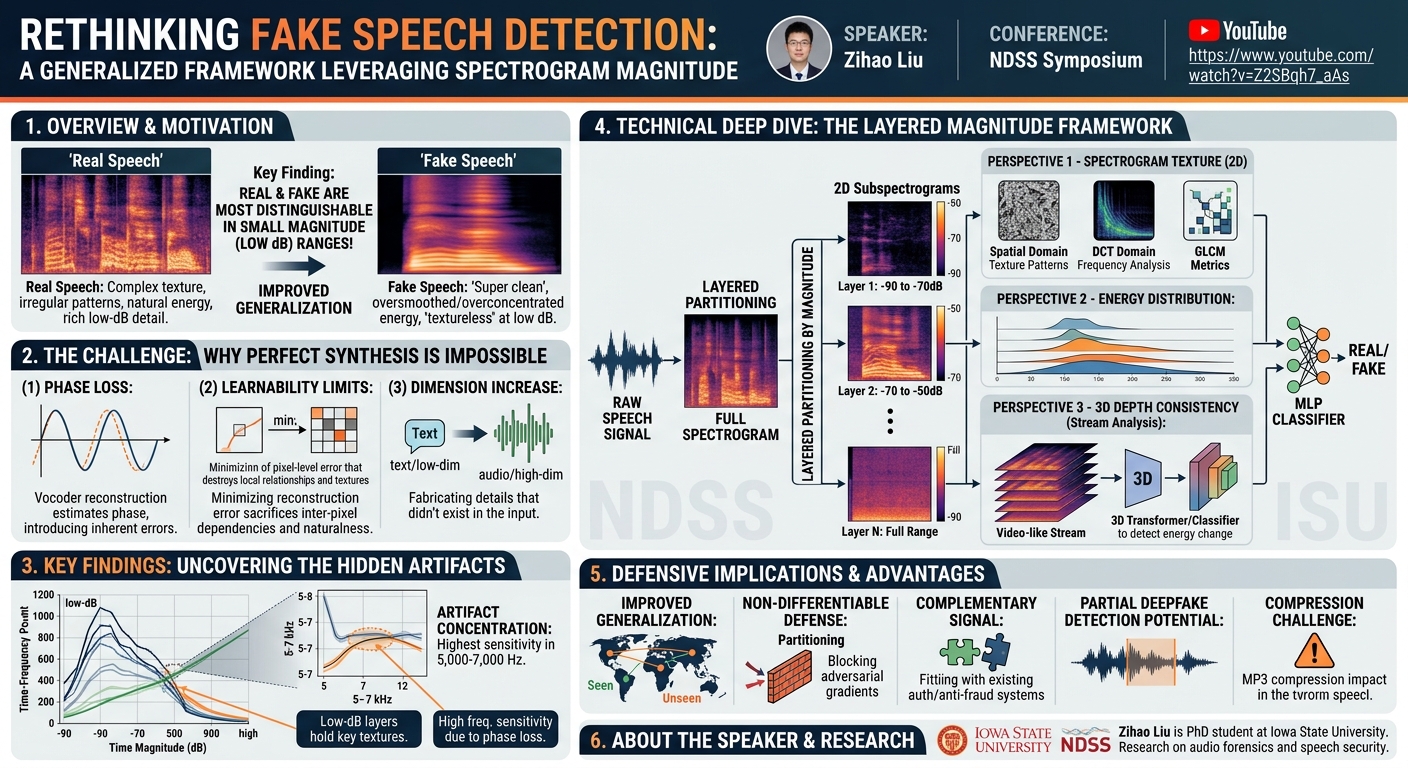
This talk presents a novel approach to deepfake speech detection that leverages a previously overlooked signal: spectrogram magnitude distributions across different decibel ranges. The researchers from Iowa State University discovered that real and fake speech are most distinguishable in small magnitude (low dB) ranges, where real speech exhibits more texture complexity, irregular patterns, and natural energy distribution, while synthetic speech appears "super clean" with oversmoothed or overconcentrated energy.
Key moments
- 0:00 Speech synthesis pipeline: vocoders, spectrograms, and deepfake voice risks
- 2:30 Live demo: voice clone of the speaker reading English text
- 4:00 Three research questions: why synthesis can't be perfect
- 6:00 Key insight: artifacts in spectrogram magnitude, especially low dB ranges
- 8:00 Visual comparison: real vs fake speech texture in small magnitude ranges
- 10:00 Quantified texture metrics and high-frequency sensitivity (5-7 kHz)
- 12:00 Framework: layered 2D/3D spectrogram analysis with DCT
- 14:00 Results: improved generalization in leave-one-out and leave-most-out scenarios
Rethinking Fake Speech Detection: A Generalized Framework Leveraging Spectrogram Magnitude
Speakers: Zihao Liu
Conference: NDSS Symposium
YouTube: https://www.youtube.com/watch?v=Z2SBqh7_aAs
Overview
This talk presents a novel approach to deepfake speech detection that leverages a previously overlooked signal: spectrogram magnitude distributions across different decibel ranges. The researchers from Iowa State University discovered that real and fake speech are most distinguishable in small magnitude (low dB) ranges, where real speech exhibits more texture complexity, irregular patterns, and natural energy distribution, while synthetic speech appears "super clean" with oversmoothed or overconcentrated energy.
The framework partitions spectrograms into layered 2D subspectrograms by magnitude range and analyzes them in both spatial and DCT domains, then forms them into 3D video-like spectrogram streams for consistency analysis. This approach significantly improves generalization across unseen voice synthesis models in both leave-one-out and leave-most-out evaluation scenarios, and shows strong results against real-world web-based voice cloning APIs.
Background
▶ Watch: Speech synthesis pipeline: vocoders, spectrograms, and deepfake voice risks (0:00)
Voice-driven services are pervasive, and speech synthesis technology has matured to the point where cloned voices can successfully deceive victims into transferring money from bank accounts. Deep learning-based speech synthesis uses two main approaches: voice conversion (converting one speaker's voice to another's) and text-to-speech (generating speech from text in a target speaker's voice). Both use a similar pipeline: speaker encoder for identity, content encoder for linguistics, and a decoder to generate synthetic speech.
Spectrograms and vocoders play central roles in speech synthesis. The Short-Time Fourier Transform (STFT) provides joint time-frequency representation, and vocoders reconstruct waveforms from magnitude-only spectrograms. This process inherently introduces artifacts because phase information is typically estimated rather than preserved.
Existing defenses focus on finding optimal combinations of acoustic features and neural architectures, or detecting liveness cues (microphone traces, heartbeat, breathing). These approaches suffer from limited generalization to unseen synthesis models and require labeled training data from specific generators. Unlike image deepfakes which have visual cues (shadow mismatches, lip sync errors), audio signals are more complex, and artifacts are harder to describe and identify.
Key Findings
▶ Watch: Three research questions: why synthesis can't be perfect (4:00)
Synthetic speech cannot achieve perfection for three fundamental reasons:
- Phase information loss: During vocoder reconstruction, phase is estimated rather than preserved, inherently introducing errors
- Naturalness is not explicitly learnable: Synthesis models minimize reconstruction error between ground truth and generated spectrograms at the pixel level, but this destroys inter-pixel dependencies and logical relationships, causing distortion
- Dimension-increasing process: Speech synthesis fabricates details that didn't exist in the input, leaving identifiable traces
Artifacts concentrate in small magnitude ranges: Statistical analysis of time-frequency point counts shows real and fake speech have very similar distributions across the full magnitude range. However, in small magnitude (low dB) ranges, clear differences emerge. Real speech shows more irregular patterns, texture complexity, and energy clusters; fake speech appears over-smooth and over-concentrated.
High-frequency sensitivity: Count differences between real and fake speech are most pronounced in the 5,000-7,000 Hz range, where phase information is more sensitive during vocoder reconstruction due to shorter wavelengths.
Layered analysis improves generalization: Partitioning spectrograms by magnitude range and analyzing each layer separately significantly improves detection generalization to unseen synthesis models compared to analyzing full spectrograms.
Non-differentiable partitioning as defense: The layer partitioning process is non-differentiable, making it difficult for attackers to generate adversarial perturbations that are effective across all magnitude layers simultaneously.
Technical Deep Dive
▶ Watch: Visual comparison: real vs fake speech texture in small magnitude ranges (8:00)
The framework operates from three perspectives:
Perspective 1 -- Spectrogram Texture (2D): The original spectrogram is partitioned into layered 2D subspectrograms by magnitude range. Each layer captures a different energy level, from fine details (low dB) to full energy (high dB). These are analyzed using:
- Spatial domain features capturing texture patterns and irregularities
- DCT (Discrete Cosine Transform) domain features, leveraging the proven success of frequency analysis in image-based deepfake detection
- GLCM (Grey Level Co-occurrence Matrix) metrics quantifying pattern variation and dependency
Perspective 2 -- Energy Distribution: The framework analyzes how energy is distributed across different magnitude layers. Real speech shows natural energy distribution influenced by harmonics, reverberation, and acoustic physics, while synthetic speech shows artificially concentrated or smoothed energy patterns.
Perspective 3 -- 3D Depth Consistency: The 2D subspectrograms are stacked into a 3D video-like spectrogram stream, ordered from low-magnitude (detail-only) layers to the full-energy spectrogram. A 3D classifier (e.g., transformer) analyzes energy changes and consistency across layers. This captures whether the transition from fine details to full energy follows natural acoustic physics or shows synthetic inconsistencies.
The final classification uses an MLP that integrates features from all three perspectives to produce a real/fake determination.
Evaluation scenarios:
- Leave-one-out: Train on most vocoders, evaluate on the excluded one
- Leave-most-out: Train on two vocoders, evaluate on all others
- Both scenarios show significant generalization improvement over baselines
- Real-world evaluation: Tested against web-based voice cloning APIs using the most advanced synthesis models, with some degradation attributed to MP3 compression
Demo / Proof of Concept
▶ Watch: Quantified texture metrics and high-frequency sensitivity (5-7 kHz) (10:00)
The speaker demonstrated a voice clone of his own voice reading an English passage, illustrating how convincing modern voice synthesis has become. The evaluation covered multiple real-world English speakers and free voice cloning web APIs, showing that the detector maintains effectiveness against current commercial-grade synthesis systems. The leave-most-out scenario (training on just two vocoders and testing on unseen ones) is particularly challenging and demonstrates strong generalization.
Defensive Implications
▶ Watch: Results: improved generalization in leave-one-out and leave-most-out scenarios (14:00)
This research provides practical insights for organizations defending against voice-based deepfake attacks:
Magnitude-based analysis as complementary signal: The finding that artifacts concentrate in small magnitude ranges provides a new detection dimension that can be integrated into existing voice authentication and anti-fraud systems. The low-dB spectrogram analysis is orthogonal to existing feature-based and liveness-based detection methods.
Improved generalization for deployed systems: The most critical challenge for voice deepfake detection is handling synthesis models not seen during training. The layered magnitude analysis significantly improves generalization, making deployed systems more robust against new and emerging voice synthesis tools.
Non-differentiable defense property: The magnitude-based layer partitioning is non-differentiable, creating a natural defense against gradient-based adversarial attacks. Attackers would need to ensure their synthetic speech appears natural across all magnitude layers simultaneously.
Compression challenge: The MP3 compression artifacts from web APIs degraded detection performance, highlighting that real-world deployment must account for audio encoding and compression in the detection pipeline.
Partial deepfake detection potential: While not the focus of this work, the Q&A discussion noted that the magnitude-based consistency analysis could potentially detect partial deepfakes (where only a few words are replaced) by identifying magnitude inconsistencies at splice points.
Key Takeaways
- Real and fake speech are most distinguishable in small magnitude (low dB) spectrogram ranges, where real speech shows more texture complexity and irregularity
- Three fundamental reasons prevent perfect speech synthesis: phase information loss, naturalness not being explicitly learnable, and dimension-increasing fabrication
- Layered magnitude partitioning with 2D spatial/DCT analysis and 3D consistency checking significantly improves detection generalization
- The non-differentiable layer partitioning creates an inherent defense against gradient-based adversarial attacks
- High-frequency ranges (5,000-7,000 Hz) are most sensitive to synthesis artifacts due to phase reconstruction challenges
- The framework maintains effectiveness against current commercial voice cloning APIs, though MP3 compression causes some degradation
About the Speaker(s)
Zihao Liu is a PhD student at Iowa State University, supervised by Dr. M (name unclear from transcript). The research was conducted collaboratively and addresses the critical intersection of speech synthesis security, audio forensics, and deepfake detection. The work was completed in 2024 and tested against the most advanced synthesis models available at that time.
Reviews
Dr. Zero (Offensive Security Researcher) — SOLID
A well-motivated approach to voice deepfake detection that identifies a genuinely overlooked signal: artifacts concentrating in small magnitude spectrogram ranges. The three fundamental reasons for synthesis imperfection (phase loss, naturalness not learnable, dimension increase) provide solid theoretical grounding. The layered magnitude analysis with 2D/3D consistency checking is technically sound and the generalization improvements are meaningful. However, this is defense-only research with no offensive component, and the adversarial robustness discussion remains speculative.
Heather Calloway (CISO) — STRONG
A practically valuable contribution to voice deepfake detection that addresses the critical generalization challenge with a novel magnitude-based analysis approach. The improved performance on unseen synthesis models and real-world voice cloning APIs makes this directly relevant for organizations defending against voice-based social engineering and fraud. The non-differentiable layer partitioning provides an inherent adversarial defense property.
→ Top-rated talks at Network and Distributed System Security (NDSS) Symposium 2026
All talks from Network and Distributed System Security (NDSS) Symposium 2026