CAT: Can Trust be Predicted with Context-Awareness in Dynamic Heterogeneous Networks?
Jie Wang (CDN University)
Network and Distributed System Security (NDSS) Symposium 2026 · Day 2 · Multimedia Forensics
Overview
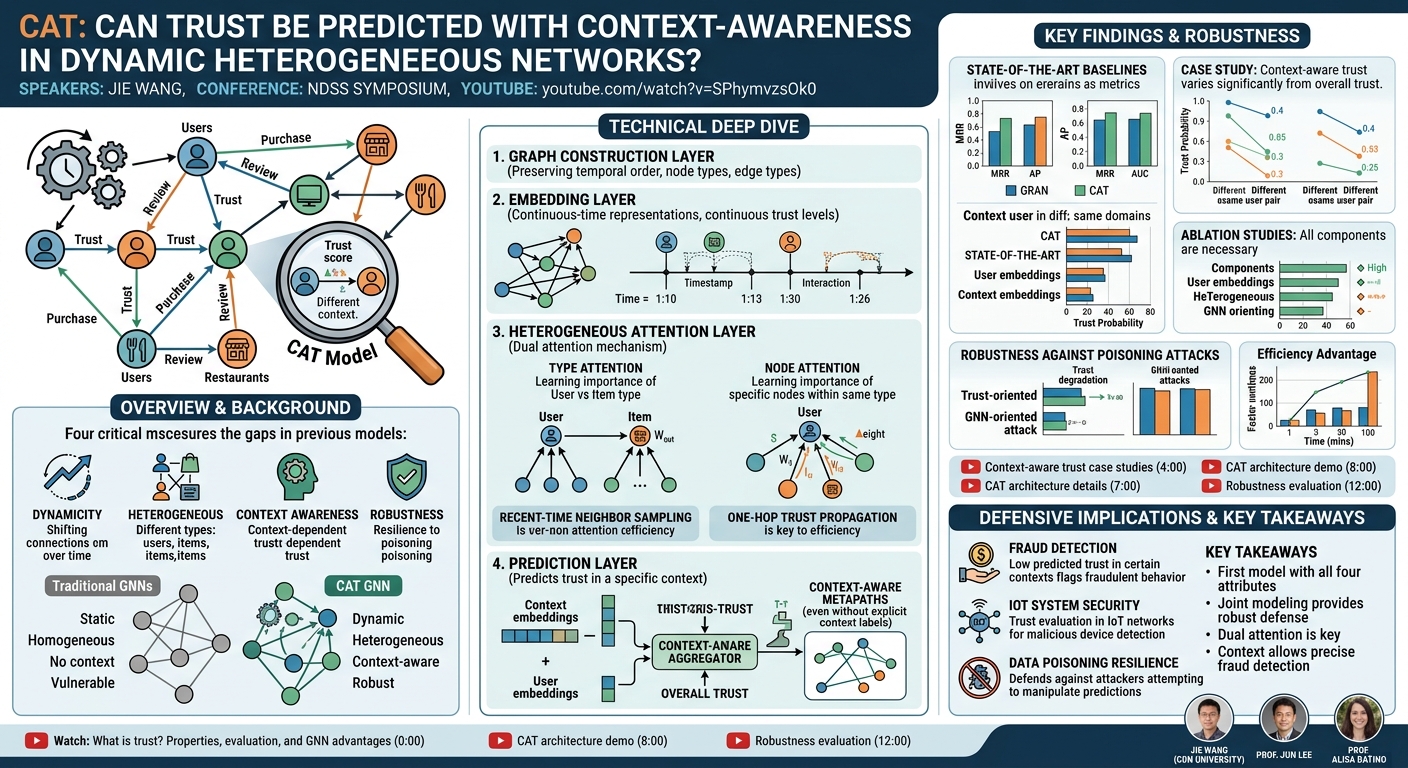
This talk presents CAT (Context-Aware Trust), a graph neural network-based trust prediction model designed for dynamic heterogeneous networks. Unlike existing trust prediction approaches that treat networks as static and homogeneous, CAT addresses four critical aspects simultaneously: dynamicity (trust relationships change over time), heterogeneity (networks contain different types of nodes and edges), context awareness (trust varies by context, such as item categories or task types), and robustness (resilience against data poisoning attacks).
Key moments
- 0:00 What is trust? Properties, evaluation, and GNN advantages
- 2:00 Four gaps in existing work: dynamicity, heterogeneity, context, robustness
- 4:00 Context-aware trust: same user pair, vastly different trust across domains
- 6:00 Addressing scalability with time encoding and one-hop propagation
- 7:00 Dual attention mechanism for heterogeneous graph processing
- 8:00 CAT architecture: four layers from construction to prediction
- 10:00 Results: outperforms baselines with strong cold-start performance
- 12:00 Robustness evaluation: smallest degradation under poisoning attacks
CAT: Can Trust be Predicted with Context-Awareness in Dynamic Heterogeneous Networks?
Speakers: Jie Wang
Conference: NDSS Symposium
YouTube: https://www.youtube.com/watch?v=SPhymvzsOk0
Overview
This talk presents CAT (Context-Aware Trust), a graph neural network-based trust prediction model designed for dynamic heterogeneous networks. Unlike existing trust prediction approaches that treat networks as static and homogeneous, CAT addresses four critical aspects simultaneously: dynamicity (trust relationships change over time), heterogeneity (networks contain different types of nodes and edges), context awareness (trust varies by context, such as item categories or task types), and robustness (resilience against data poisoning attacks).
CAT is the first GNN-based trust prediction model that can predict both context-aware trust and overall trust. Evaluated on three real-world datasets from social networking-based consumer review sites, CAT consistently outperforms state-of-the-art baselines across all metrics and demonstrates superior robustness against both trust-oriented and GNN-oriented data poisoning attacks, including adaptive attackers who specifically target the model's contextual understanding.
Background
▶ Watch: What is trust? Properties, evaluation, and GNN advantages (0:00)
Trust evaluation quantifies the subjective belief held by one entity toward another and has applications in fraud detection, malicious entity identification in social networks and IoT systems, and system security enhancement. Trust has several unique properties: subjectivity (different entities may evaluate trust differently), dynamicity (trust changes over time), and context awareness (trust depends on the specific situation).
Graph neural networks are well-suited for trust prediction because trust relationships naturally form graphs, GNN message passing is compatible with trust's conditional transitivity property, and GNNs provide end-to-end evaluation without complex feature engineering. However, existing GNN-based trust prediction models have significant gaps:
Dynamicity: Most models adopt random train/test splits that violate temporal causality, placing future interactions in training data while testing on earlier relationships.
Heterogeneity: Nearly all models focus on homogeneous user-to-user networks, missing the richer semantic information in user-to-item interactions (which are typically much denser than trust relationships).
Context awareness: Trust relationships vary significantly by context. The talk demonstrates that a user's most trusted peer overall may not be the most trusted in specific contexts -- trust strength varies dramatically across domains.
Robustness: Attackers can inject malicious interactions as data poisoning attacks, targeting either trust prediction specifically (trust-oriented attacks) or GNN learning generally (GNN-oriented attacks). This threat is largely overlooked in existing work.
Key Findings
▶ Watch: Context-aware trust: same user pair, vastly different trust across domains (4:00)
CAT outperforms all baselines across three real-world datasets on MRR, AP, and AUC metrics. The performance advantage is particularly strong on the cold-start problem (predicting trust for users with limited interaction history).
Context-aware trust varies significantly from overall trust: Case studies demonstrate that different contexts contribute differently to trust establishment, and trust probabilities for the same user pair can vary notably across contexts. This aligns with the theoretical definition of context awareness.
All components are necessary: Ablation studies show that removing dynamicity modeling, heterogeneity handling, or context awareness each degrades performance, confirming all three aspects contribute independently to prediction accuracy.
Superior robustness from semantic understanding: When subjected to trust-oriented and GNN-oriented data poisoning attacks, CAT shows the smallest performance degradation. Ablation analysis confirms that both heterogeneity modeling and contextual understanding contribute to robustness. Even adaptive attackers who target contextual differentiation cannot fully defeat the model.
High computational efficiency: CAT achieves significantly faster runtime than the best-performing baseline (HDT), thanks to one-hop trust propagation and recent-time neighbor sampling.
Technical Deep Dive
▶ Watch: Dual attention mechanism for heterogeneous graph processing (7:00)
CAT's architecture consists of four layers:
Graph Construction Layer: Builds a dynamic heterogeneous graph from the interaction sequence, preserving temporal ordering, node types (users, items), and edge types (trust relationships, reviews, purchases).
Embedding Layer: Initializes embeddings for nodes, time (using time encoding), and edge attributes (including trust levels). The continuous-time representation preserves fine-grained temporal information.
Heterogeneous Attention Layer: Addresses the challenge of extracting key information from heterogeneous graphs using a dual attention mechanism:
- Type attention: Learns the importance of each node type (users vs. items) for trust propagation
- Node attention: Learns the importance of each individual node within the same type
This selective propagation ensures relevant information is emphasized while irrelevant signals are suppressed.
Prediction Layer: Predicts trust relationships between any two users under a specific context. Three types of embeddings are constructed and fed into the prediction module. A context-aware aggregator links context-specific trust with overall trust, avoiding reliance on context-specific trust labels (which are unavailable in existing datasets).
Scalability solutions:
- Recent-time neighbor sampling: Focus on recent, critical interactions rather than the full history
- One-hop trust propagation: Restrict propagation to immediate neighbors, dramatically reducing computational cost while maintaining prediction quality
Context-aware metapath: A new notion introduced to encode contextual information into node embeddings, enabling the model to differentiate trust across different domains (e.g., a user trusted for electronics recommendations may not be trusted for restaurant reviews).
Robustness analysis: Joint modeling of heterogeneity and context awareness forces attackers to consider multiple factors simultaneously for a successful attack. Removing either capability significantly reduces robustness, confirming both contribute to the defense.
Demo / Proof of Concept
▶ Watch: CAT architecture: four layers from construction to prediction (8:00)
The evaluation used three real-world datasets from social networking-based consumer review sites, with binary trust labels (trust/distrust). Key results:
- CAT outperforms four types of baselines varying in dynamicity and heterogeneity support across all three datasets and all evaluation metrics (MRR, AP, AUC)
- Context-aware trust case studies show trust probabilities varying significantly for the same user pair across different contexts
- Ablation studies confirm all five unique components contribute to performance
- Runtime comparison shows pronounced efficiency advantage over the best baseline (HDT)
- Robustness evaluation against increasing perturbation rates shows CAT has the smallest degradation
- Adaptive attacks targeting contextual differentiation are more disruptive but CAT remains robust
Defensive Implications
▶ Watch: Robustness evaluation: smallest degradation under poisoning attacks (12:00)
CAT has practical applications for security and fraud detection in networked systems:
Fraud detection on social platforms: Low predicted trust probability for specific user pairs in certain contexts can indicate potentially fraudulent behavior, enabling platforms to warn users or restrict activities. Context-aware trust prediction is more precise than overall trust because fraudulent behavior often concentrates in specific domains.
IoT system security: Trust evaluation in IoT networks can identify compromised or malicious devices. The dynamic and heterogeneous modeling capabilities make CAT suitable for IoT environments where device types vary and trust relationships evolve rapidly.
Data poisoning resilience: The model's robustness against both trust-oriented and GNN-oriented attacks is important for deployment in adversarial environments where attackers actively try to manipulate trust predictions. The finding that contextual understanding and heterogeneity modeling contribute to robustness provides guidance for building resilient trust systems.
Current limitations: The model has not been deployed in a real-world system -- evaluation is on real-world data rather than in production. The binary trust labels (trust/distrust) available in current datasets are a simplification; real-world trust has multiple levels. Future work on textual information (user profiles, reviews) and evasion attacks (testing phase) would strengthen practical applicability.
Key Takeaways
- CAT is the first GNN-based trust prediction model supporting dynamicity, heterogeneity, context awareness, and robustness simultaneously
- Trust varies significantly by context -- overall trust rankings can be completely different from context-specific trust rankings for the same users
- Dual attention mechanism (type attention + node attention) enables selective trust information propagation in heterogeneous graphs
- Joint heterogeneity and context awareness modeling provides inherent robustness against data poisoning attacks
- Recent-time neighbor sampling and one-hop propagation achieve high efficiency without sacrificing prediction quality
- Context-aware trust prediction enables more precise fraud detection by identifying domain-specific anomalies
About the Speaker(s)
Jie Wang (introduced as "Jang") is from CDN University. The research was conducted jointly with Professor Jun Lee and Professor Alisa Batino. The work focuses on the intersection of graph neural networks, trust evaluation, and network security, with applications in social network fraud detection and IoT security.
Reviews
Dr. Zero (Offensive Security Researcher) — WEAK
A competent ML paper that combines dynamicity, heterogeneity, context awareness, and robustness in a GNN-based trust prediction model. The context-aware trust insight is valid and the architecture is well-designed. However, this is fundamentally a graph ML paper with a thin security veneer. There are no attacks, no exploits, no vulnerability discoveries -- the 'security' application (fraud detection) is speculative and unvalidated. The robustness evaluation against synthetic data poisoning is standard ML adversarial evaluation, not security research.
Heather Calloway (CISO) — PASS
A well-designed GNN-based trust prediction model that addresses real limitations in existing approaches, but the practical security applications remain entirely hypothetical. The context-aware trust prediction concept has potential value for fraud detection and IoT security, but the lack of real-world deployment or security-specific evaluation makes it difficult to assess the actual impact for security operations. More relevant to ML researchers than to security practitioners.
→ Top-rated talks at Network and Distributed System Security (NDSS) Symposium 2026
All talks from Network and Distributed System Security (NDSS) Symposium 2026