From Perception to Protection: A Developer-Centered Study of Security and Privacy Threats in Extended Reality (XR)
Kunlin Cai
Network and Distributed System Security (NDSS) Symposium 2026 · Day 2 · Wireless Security
Overview
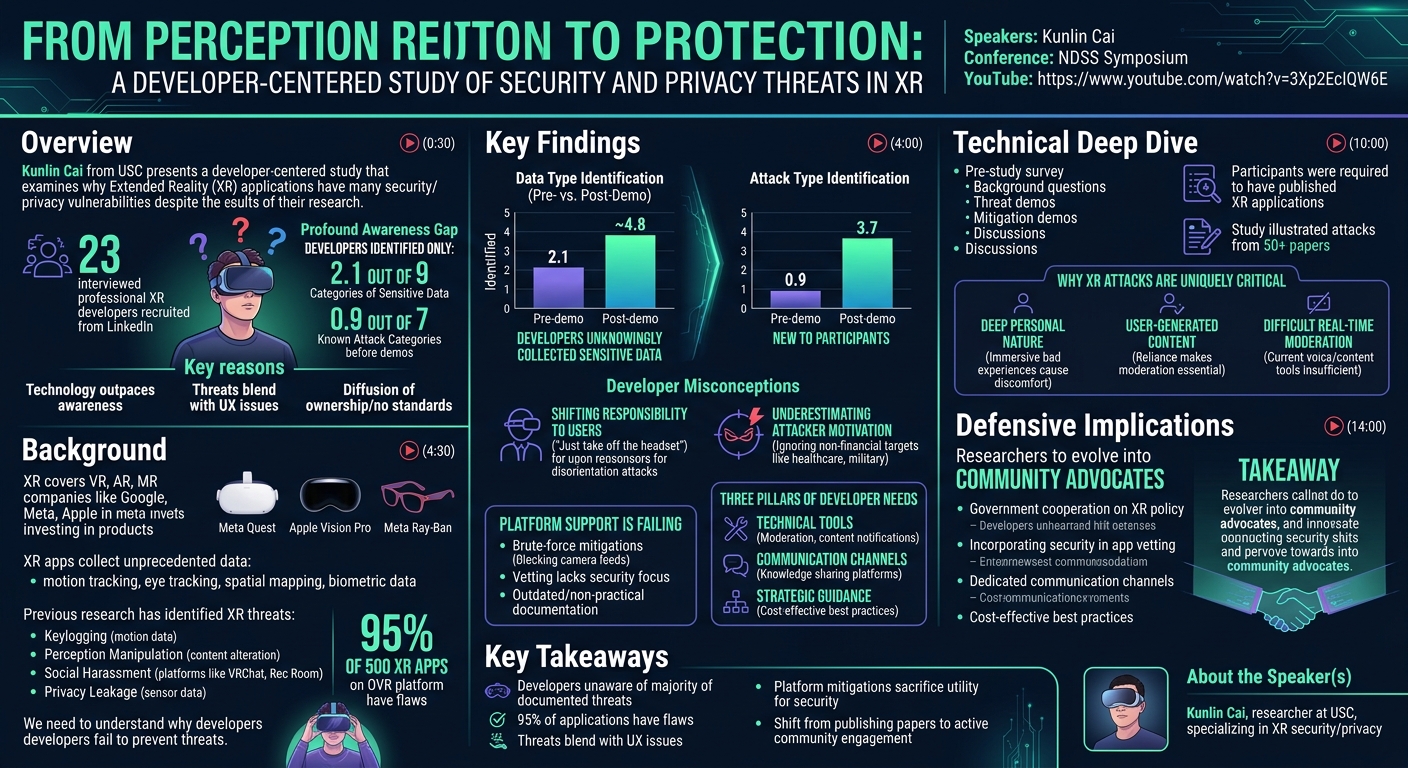
Kunlin Cai from USC presents a first-of-its-kind developer-centered study examining why XR (Extended Reality) applications remain riddled with security and privacy vulnerabilities despite growing academic research on XR threats. Through semi-structured interviews with 23 professional XR developers recruited from over 400 LinkedIn candidates, the study reveals a profound awareness gap: developers could only identify 2.1 out of 9 categories of sensitive data types collected by their own applications and 0.9 out of 7 known attack categories before being shown demonstrations. The research finds that XR threats persist not because developers are careless, but because the technology evolves faster than developer awareness, threats blend with UX issues making them easy to overlook, and there is a massive diffusion of ownership with no clear standards or guidance.
Key moments
- 0:30 Introduction: XR ecosystem and security/privacy landscape
- 2:30 Research motivation: 95% of XR apps have security flaws
- 4:00 Study methodology: semi-structured interviews with 23 developers
- 6:00 Key finding: developers identify only 2.1 of 9 data types
- 8:00 Why XR attacks are uniquely critical: immersion and user-generated content
- 10:00 Developer misconceptions: shifting responsibility and underestimating attackers
- 12:00 Platform failures: brute-force mitigations and outdated documentation
- 14:00 Takeaway: researchers must become community advocates
From Perception to Protection: A Developer-Centered Study of Security and Privacy Threats in Extended Reality (XR)
Speakers: Kunlin Cai
Conference: NDSS Symposium
YouTube: https://www.youtube.com/watch?v=3Xp2EcIQW6E
Overview
Kunlin Cai from USC presents a first-of-its-kind developer-centered study examining why XR (Extended Reality) applications remain riddled with security and privacy vulnerabilities despite growing academic research on XR threats. Through semi-structured interviews with 23 professional XR developers recruited from over 400 LinkedIn candidates, the study reveals a profound awareness gap: developers could only identify 2.1 out of 9 categories of sensitive data types collected by their own applications and 0.9 out of 7 known attack categories before being shown demonstrations. The research finds that XR threats persist not because developers are careless, but because the technology evolves faster than developer awareness, threats blend with UX issues making them easy to overlook, and there is a massive diffusion of ownership with no clear standards or guidance.
Background
▶ Watch: Introduction: XR ecosystem and security/privacy landscape (0:30)
Extended Reality encompasses virtual reality (VR), augmented reality (AR), and mixed reality (MR), with major companies like Google, Meta, and Apple investing heavily in products such as Meta Ray-Ban glasses, Meta Quest, and Apple Vision Pro. XR applications span education, healthcare, social interaction, and retail. These devices collect unprecedented amounts of sensitive data to deliver immersive experiences -- motion tracking, eye tracking, spatial mapping, and biometric data.
Prior research has identified numerous XR-specific threats: keylogging attacks using side channels like motion data to recover passwords and credit card information, perception manipulation attacks that alter virtual content without user awareness, social harassment in platforms like VRChat and Rec Room, and privacy leakage from the extensive sensor data these devices collect. A recent study found that 95% of 500 XR applications collected from the OVR platform had security or privacy flaws. Yet academic research has primarily focused on identifying new threats rather than understanding why developers fail to prevent them in practice.
Key Findings
▶ Watch: Study methodology: semi-structured interviews with 23 developers (4:00)
Awareness gap is severe: Before demonstrations, developers identified only 2.1 of 9 sensitive data categories and 0.9 of 7 attack types. After demonstration, developers recognized that approximately 4.8 data types were actually collected by their own applications -- meaning they were unknowingly collecting sensitive data. For attacks, 3.7 out of 7 attack types were completely new to participants.
Developers are willing but unsupported: Despite the knowledge gap, all 23 developers expressed strong positive attitudes toward security awareness and indicated they wanted to learn more. The problem is not developer apathy but systemic failure in knowledge transfer.
Dangerous misconceptions exist: Some developers shift responsibility to users (e.g., "just take off the headset" for disorientation attacks, which essentially constitutes a denial-of-service against the application's utility). Others underestimate attacker motivation, assuming attacks lack financial incentive without considering healthcare, military, and other critical XR applications.
Platform support is failing: Developers reported that platform-level mitigations use brute-force approaches (e.g., Apple Vision Pro blocking camera feeds entirely), application review processes lack security consideration, and official documentation is outdated, lacks detail, or offers no practical guidance.
Three pillars of developer needs: Technical tools (better moderation and content-aware notification systems), communication channels (dedicated platforms for XR security knowledge sharing), and strategic guidance (cost-effective best practices considering that most XR developers are individuals or small companies).
Technical Deep Dive
▶ Watch: Why XR attacks are uniquely critical: immersion and user-generated content (8:00)
The study employed a rigorous five-step methodology: pre-study survey, background verification questions, threat demonstrations with feedback collection, mitigation and best practice demonstrations with feedback, and forward-looking discussion on challenges. Participants were required to have published at least one application on XR platforms and to be actively working in XR development. The 23 participants represented 15+ application types across 12 different XR platforms with varying levels of experience.
The threat demonstration phase was particularly revealing. Researchers presented attacks from over 50 XR security and privacy papers, walking developers through actual attack scenarios. The fact that experienced, professional developers with published applications had not heard of the majority of documented attacks underscores the gap between academic research and industry practice.
Three core reasons emerged for why XR attacks are uniquely critical: the deeply personal nature of immersive technology (bad experiences can cause psychological discomfort), reliance on user-generated content (making real-time moderation essential but technically complex), and the difficulty of real-time moderation in XR environments (existing technical solutions for voice and content moderation are insufficient).
Demo / Proof of Concept
▶ Watch: Developer misconceptions: shifting responsibility and underestimating attackers (10:00)
Rather than a technical exploit demonstration, this work's "proof of concept" lies in its methodology and findings. The researchers demonstrated real XR threats to professional developers during interviews and documented their reactions and awareness levels. The gap between what developers knew (0.9 of 7 attack types) and what threatens their applications (all 7 categories) serves as the empirical proof that the research-to-practice pipeline is broken in XR security.
Defensive Implications
▶ Watch: Takeaway: researchers must become community advocates (14:00)
The research calls for a fundamental shift in the security research community's approach to XR. Researchers must evolve from vulnerability finders into community advocates, actively sharing knowledge with developers through their conferences (such as AWE, the largest XR conference) rather than expecting developers to seek out academic security papers. Specific recommendations include: government cooperation on XR security policies, incorporating security requirements into application vetting processes, establishing dedicated communication channels between security researchers and XR developers, and developing cost-effective security best practices that account for the economic constraints of small developers and individual creators.
Key Takeaways
- Professional XR developers with published applications are unaware of the majority of documented security threats against their own platforms
- 95% of XR applications on major platforms have security or privacy flaws, driven by awareness gaps rather than developer negligence
- XR threats blend with UX issues (perceived as hardware glitches or poor design), making them easy to dismiss
- Platform-level mitigations frequently sacrifice utility for security in a brute-force manner, frustrating developers
- The XR security research community must shift from publishing papers to actively engaging with the developer ecosystem through their channels and conferences
About the Speaker(s)
Kunlin Cai is a researcher at the University of Southern California (USC) specializing in XR security and privacy. The work represents a collaboration with a broader research team focused on understanding the developer perspective in emerging technology security, moving beyond traditional system-centered or user-centered approaches.
Reviews
Dr. Zero (Offensive Security Researcher) — WEAK
A developer survey study that quantifies what most security researchers already intuit: XR developers do not know about XR security threats. No new vulnerabilities, no exploitation, no technical depth. The finding that developers identified 0.9 of 7 known attacks is interesting as a data point but the contribution is sociological rather than technical.
Heather Calloway (CISO) — USEFUL
A valuable study that quantifies the security awareness gap among XR developers, providing concrete data points that CISOs can use to justify XR security programs. The finding that 95% of XR applications have security flaws and that developers cannot identify the majority of threats against their own platforms is directly relevant for organizations evaluating XR adoption risk.
→ Top-rated talks at Network and Distributed System Security (NDSS) Symposium 2026
All talks from Network and Distributed System Security (NDSS) Symposium 2026