PIRANHAS: PrIvacy-Preserving Remote Attestation in Non-Hierarchical Asynchronous Swarms
Jonas Hofmann
Network and Distributed System Security (NDSS) Symposium 2026 · Day 2 · Privacy Systems
Overview
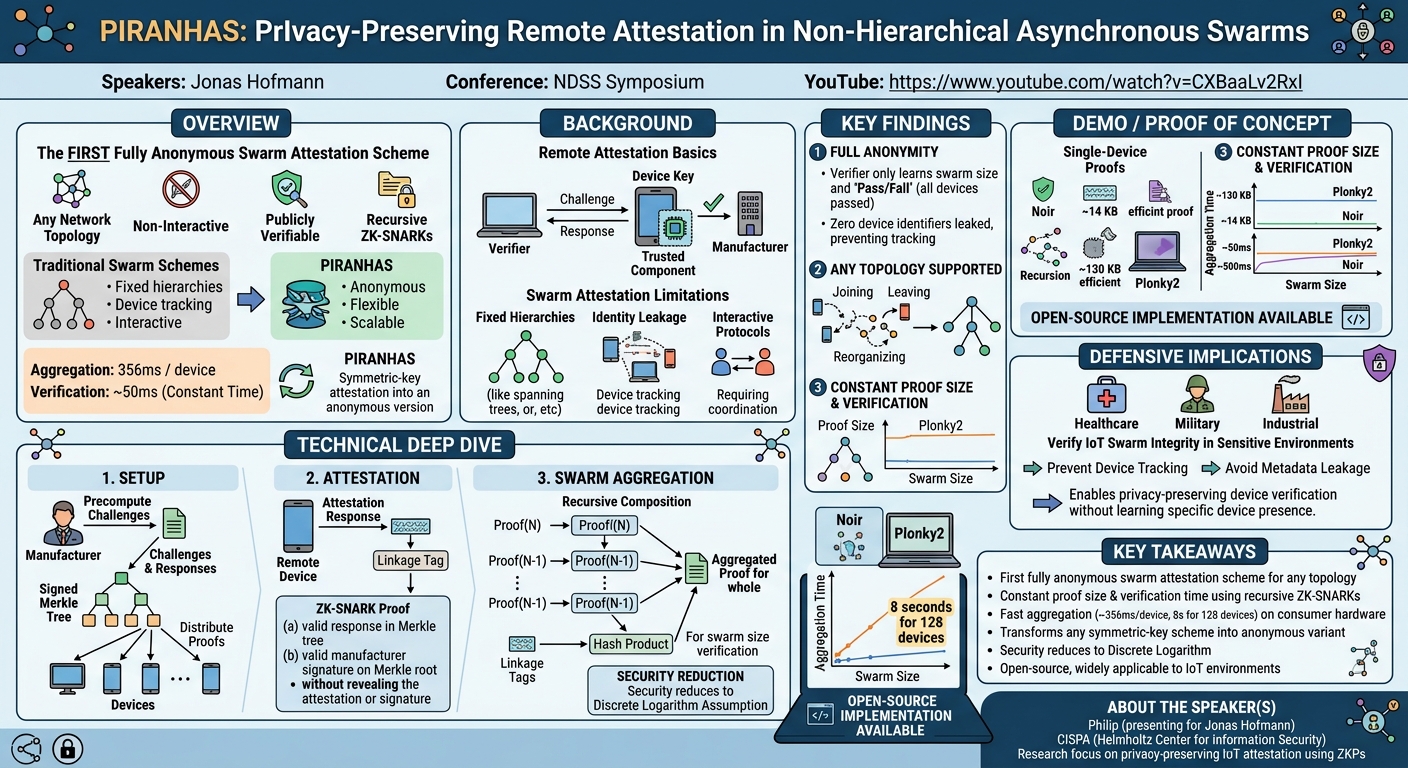
Philip (presenting for Jonas Hofmann) from CISPA introduces PIRANHAS, the first fully anonymous swarm attestation scheme that supports any network topology, is non-interactive, and publicly verifiable. Remote attestation verifies that IoT devices run untampered firmware before trusting them with sensitive data. Existing swarm attestation schemes require fixed hierarchies or topologies and leak device identifiers, enabling tracking. PIRANHAS uses recursive zero-knowledge SNARKs to aggregate attestation proofs across arbitrary swarm topologies, achieving an aggregation runtime of only 356 milliseconds per device on a consumer laptop (using Plonky2) and verification in approximately 50 milliseconds regardless of swarm size. The framework transforms any symmetric-key remote attestation scheme into an anonymous, publicly verifiable variant while maintaining constant proof size and verification time as the swarm scales.
Key moments
- 0:15 Remote attestation basics: verifying device firmware integrity
- 2:00 Problem: existing swarm schemes leak identifiers and require hierarchies
- 4:00 PIRANHAS: first scheme with full anonymity, any topology, public verifiability
- 6:00 Setup phase: Merkle tree accumulation of precomputed attestations
- 8:00 Recursive ZK-SNARKs: aggregating proofs across the swarm
- 10:00 Linkage tags: determining swarm size without revealing identities
- 11:00 Benchmarks: 356ms per device, 50ms verification on Raspberry Pi
- 13:00 Q&A: revocation trade-offs and multi-vendor support
PIRANHAS: PrIvacy-Preserving Remote Attestation in Non-Hierarchical Asynchronous Swarms
Speakers: Jonas Hofmann
Conference: NDSS Symposium
YouTube: https://www.youtube.com/watch?v=CXBaaLv2RxI
Overview
Philip (presenting for Jonas Hofmann) from CISPA introduces PIRANHAS, the first fully anonymous swarm attestation scheme that supports any network topology, is non-interactive, and publicly verifiable. Remote attestation verifies that IoT devices run untampered firmware before trusting them with sensitive data. Existing swarm attestation schemes require fixed hierarchies or topologies and leak device identifiers, enabling tracking. PIRANHAS uses recursive zero-knowledge SNARKs to aggregate attestation proofs across arbitrary swarm topologies, achieving an aggregation runtime of only 356 milliseconds per device on a consumer laptop (using Plonky2) and verification in approximately 50 milliseconds regardless of swarm size. The framework transforms any symmetric-key remote attestation scheme into an anonymous, publicly verifiable variant while maintaining constant proof size and verification time as the swarm scales.
Background
▶ Watch: Remote attestation basics: verifying device firmware integrity (0:15)
Remote attestation allows a verifier to confirm that a remote device is running expected, untampered firmware before trusting it with sensitive operations. In a traditional scheme, a verifier sends a challenge, the device's trusted component computes a response using a stored device key, and the manufacturer verifies the response using its knowledge of all device keys. Swarm attestation extends this to groups of IoT devices, aiming to verify multiple devices faster than individual attestation.
Existing swarm schemes have significant limitations: they require fixed topologies (spanning trees, hierarchies, or pub-sub), leak device identifiers (enabling tracking by verifiers and third parties), and often require interactive challenge-response protocols. Prior anonymous schemes (SPARK and PREY) only achieve anonymity against external verifiers (not within the swarm) and have proof sizes and verification times that grow linearly with swarm size.
Key Findings
▶ Watch: PIRANHAS: first scheme with full anonymity, any topology, public verifiability (4:00)
First fully anonymous swarm attestation: The verifier learns only the size of the swarm and whether all devices passed attestation -- nothing else. Anonymity holds even within the swarm.
Any topology supported: Unlike prior work requiring hierarchies or spanning trees, PIRANHAS works with any network topology. Devices can freely join and leave the swarm.
Constant proof size and verification time: Using recursive ZK-SNARKs, the final proof size and verification time remain nearly constant regardless of swarm size (130 KB with Plonky2, 14 KB with Noir).
356ms aggregation per device: Each recursive aggregation step takes approximately 356 milliseconds on Plonky2, with a full 128-device swarm attestation completing in approximately 8 seconds.
50ms verification on Raspberry Pi: Plonky2-based proofs verify in approximately 50 milliseconds even on a Raspberry Pi 4, independent of swarm size. Noir-based proofs take approximately 500 milliseconds.
Generic transformation: The framework transforms any symmetric-key remote attestation scheme without requiring access to the attestation mechanism itself (which runs in an isolated trusted component).
Technical Deep Dive
▶ Watch: Recursive ZK-SNARKs: aggregating proofs across the swarm (8:00)
The construction operates in three phases. During setup, the manufacturer samples a large set of challenges (approximately 1 million), precomputes attestation responses for each device using its key, accumulates all responses in a Merkle tree (or other cryptographic accumulator), and signs the Merkle root. Each device receives the signature and its Merkle path.
During attestation, triggered by challenge publication on a public bulletin board, each device retrieves the current challenge, has its trusted component compute the attestation response, and generates a ZK-SNARK proof demonstrating: (1) it knows a valid attestation response contained in a Merkle tree, and (2) it knows a valid signature on that Merkle tree for the manufacturer's public key -- all without revealing the attestation, the Merkle tree, or the signature.
For swarm aggregation, devices recursively compose proofs. Device N generates its individual proof, sends it to Device N-1, which generates a new proof verifying both its own attestation and Device N's proof. This recursive composition continues until a single aggregated proof represents the entire swarm. Linkage tags (computed using a PRF on the challenge) are aggregated as hash products to enable verifiers to determine the swarm size without learning device identities.
Security reduces to the discrete logarithm assumption in the random oracle model -- an adversarial swarm cannot claim more devices than actually participated without breaking discrete logarithm.
Demo / Proof of Concept
▶ Watch: Linkage tags: determining swarm size without revealing identities (10:00)
The implementation uses two ZK-SNARK frameworks: Noir (efficient for single-device proofs, ~14 KB, but higher verification time at ~500ms) and Plonky2 (optimized for recursion, ~130 KB proof size, ~50ms verification). Benchmarks on a consumer laptop show 356ms per recursive aggregation step with Plonky2 and 8 seconds for a 128-device swarm. The open-source implementation is publicly available.
Defensive Implications
▶ Watch: Q&A: revocation trade-offs and multi-vendor support (13:00)
PIRANHAS enables privacy-preserving verification of IoT device integrity in sensitive environments such as hospitals, military installations, and industrial facilities. Organizations can verify that all devices in a swarm run approved firmware without learning which specific devices are present, preventing device tracking and metadata leakage. The support for any topology and asynchronous operation makes it deployable in real-world IoT environments where devices frequently join, leave, and reorganize.
Key Takeaways
- First fully anonymous swarm attestation scheme supporting any network topology
- Recursive ZK-SNARKs enable constant proof size (~130 KB) and verification time (~50ms) regardless of swarm size
- 356ms per device aggregation on consumer hardware, 8 seconds for 128 devices
- Transforms any symmetric-key remote attestation scheme into an anonymous, publicly verifiable variant
- Security reduces to discrete logarithm assumption; open-source implementation available
- Applicable to healthcare, military, and industrial IoT environments requiring privacy-preserving device integrity verification
About the Speaker(s)
Philip presented on behalf of Jonas Hofmann from CISPA (Helmholtz Center for Information Security). The research focuses on privacy-preserving attestation protocols for IoT swarms, combining zero-knowledge proof systems with remote attestation to enable anonymous device verification at scale.
Reviews
Dr. Zero (Offensive Security Researcher) — SOLID
A clean cryptographic construction that achieves the first fully anonymous swarm attestation with any-topology support using recursive ZK-SNARKs. The 356ms per-device aggregation and 50ms verification on Raspberry Pi are practical numbers. Not offensive research, but the anonymous attestation primitive could be useful for verifying device integrity in adversarial environments without revealing fleet composition.
Heather Calloway (CISO) — USEFUL
An advanced cryptographic protocol for privacy-preserving IoT device attestation that enables organizations to verify device integrity without revealing fleet composition. Primarily relevant to military, healthcare, and critical infrastructure environments where both device integrity and fleet privacy are requirements. Too specialized for general enterprise security application.
→ Top-rated talks at Network and Distributed System Security (NDSS) Symposium 2026
All talks from Network and Distributed System Security (NDSS) Symposium 2026