Cease at the Ultimate Goodness: Towards Efficient Website Fingerprinting Defense via Iterative Mutual Information Minimization
Rong Wang
Network and Distributed System Security (NDSS) Symposium 2026 · Day 2 · Malware & RE · Malware & RE
Overview
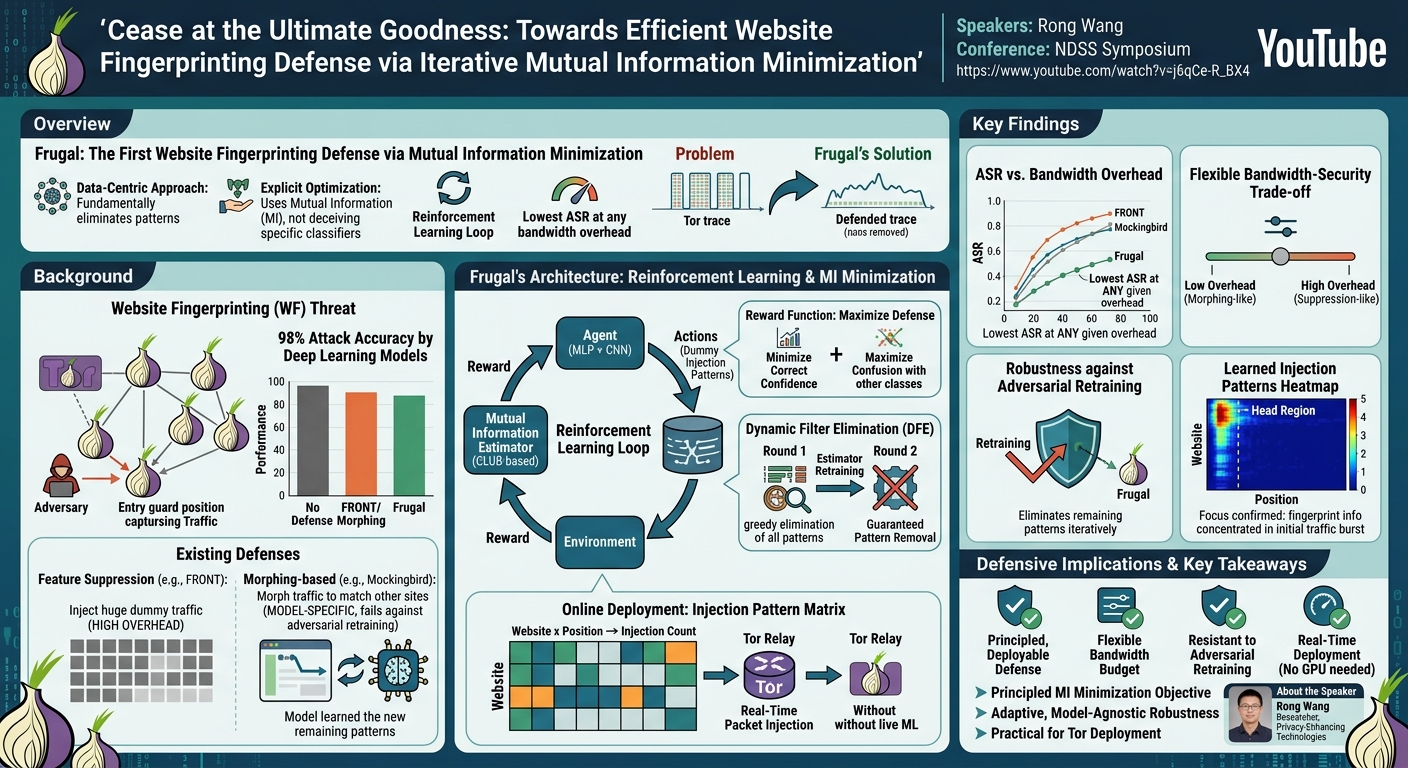
Rong Wang presents Frugal, the first website fingerprinting defense framework that uses mutual information minimization as an explicit optimization objective rather than focusing on deceiving specific attack classifiers. Website fingerprinting attacks on Tor can achieve over 98% accuracy using deep learning models that exploit traffic patterns. Existing defenses either inject massive amounts of dummy traffic (feature suppression, like FRONT, with high bandwidth overhead) or morph traffic to deceive specific classifiers (fusion-based, like Mockingbird, which fails against unknown or retrained attackers). Frugal takes a data-centric approach: instead of deceiving classifiers, it fundamentally eliminates identifiable patterns from the traffic itself. Using a reinforcement learning loop with a mutual information estimator as the reward function, Frugal achieves the lowest attack success rate (ASR) at any given bandwidth overhead compared to all prior methods, maintains robustness against adversarial retraining, and supports real-time online deployment.
Key moments
- 0:15 Website fingerprinting threat: 98% accuracy against Tor users
- 2:00 Two defense categories: feature suppression vs morphing, both flawed
- 4:00 Key insight: minimize mutual information rather than deceive classifiers
- 6:00 RL loop: agent injects packets, environment estimates mutual information
- 8:00 CLUB-based reward: minimize correct confidence, maximize confusion
- 10:00 Dynamic Filter Elimination: robustness against adversarial retraining
- 12:00 Results: lowest ASR at every bandwidth overhead level
- 14:00 Injection heatmaps confirm head-region focus aligns with prior research
Cease at the Ultimate Goodness: Towards Efficient Website Fingerprinting Defense via Iterative Mutual Information Minimization
Speakers: Rong Wang
Conference: NDSS Symposium
YouTube: https://www.youtube.com/watch?v=j6qCe-R_BX4
Overview
Rong Wang presents Frugal, the first website fingerprinting defense framework that uses mutual information minimization as an explicit optimization objective rather than focusing on deceiving specific attack classifiers. Website fingerprinting attacks on Tor can achieve over 98% accuracy using deep learning models that exploit traffic patterns. Existing defenses either inject massive amounts of dummy traffic (feature suppression, like FRONT, with high bandwidth overhead) or morph traffic to deceive specific classifiers (fusion-based, like Mockingbird, which fails against unknown or retrained attackers). Frugal takes a data-centric approach: instead of deceiving classifiers, it fundamentally eliminates identifiable patterns from the traffic itself. Using a reinforcement learning loop with a mutual information estimator as the reward function, Frugal achieves the lowest attack success rate (ASR) at any given bandwidth overhead compared to all prior methods, maintains robustness against adversarial retraining, and supports real-time online deployment.
Background
▶ Watch: Website fingerprinting threat: 98% accuracy against Tor users (0:15)
Website fingerprinting (WF) is a critical privacy threat to Tor users. Despite Tor's multi-layer encryption, an adversary at the entry position can observe traffic patterns (packet sizes, timing, direction sequences) and use trained deep learning classifiers to predict which website a user is visiting, achieving over 98% accuracy. This breaks the anonymity that Tor provides.
Existing defenses fall into two categories. Feature suppression methods like FRONT inject large amounts of dummy packets to obliterate all traffic patterns. This is effective but impractical due to extreme bandwidth overhead. Morphing-based methods like Mockingbird transform traffic to match patterns of other websites, deceiving specific attack models. However, these are not attack-model-agnostic -- they fail against classifiers they were not designed to deceive. Worse, they are vulnerable to adversarial retraining: if the attacker obtains defended traces and retrains their classifier, the defense collapses because the remaining patterns (those the defense did not target) become the new fingerprint.
Key Findings
▶ Watch: Key insight: minimize mutual information rather than deceive classifiers (4:00)
Lowest ASR at any bandwidth budget: Frugal consistently achieves the lowest attack success rate compared to all prior methods at every tested bandwidth overhead level. This holds in both closed-world and open-world evaluation settings.
Flexible bandwidth-security trade-off: Unlike prior methods that impose fixed overhead, Frugal allows the operator to specify a desired bandwidth budget and automatically provides the best possible defense at that budget. At low budgets, it behaves like a morphing-based method; at high budgets, it approaches feature suppression.
Robust against adversarial retraining: The Dynamic Filter Elimination (DFE) technique iteratively retrains the mutual information estimator to shift focus to remaining patterns after each injection round, provably eliminating all identifiable patterns over multiple rounds rather than just the most obvious ones.
Real-time online deployment: The offline-learned injection patterns are distilled into an injection pattern matrix (website x position -> injection count) that enables real-time packet injection without running the RL agent during live traffic. This makes Frugal practical for actual Tor deployment.
Head-region focus confirmed: Visualization of learned injection policies shows that Frugal consistently injects packets in the head region (beginning) of traffic traces rather than the tail, aligning with prior research finding that most fingerprinting information is concentrated in the initial traffic burst.
Technical Deep Dive
▶ Watch: CLUB-based reward: minimize correct confidence, maximize confusion (8:00)
Frugal's architecture is a reinforcement learning loop with two components. The agent (a simple two-layer MLP with a CNN actor network) takes traffic traces as input, encodes them into a state representation, and outputs positions for dummy packet injection. The environment is a mutual information estimator based on the CLUB (Contrastive Log-ratio Upper Bound) method that quantifies the remaining identifiable information in the defended traffic.
The reward function has two components: minimizing confidence in the correct website class (reducing the probability that the estimator correctly identifies the website) and maximizing confusion with other classes (increasing the probability of misclassification to other websites). This combined objective drives the agent to inject packets that maximally reduce distinguishability.
The Dynamic Filter Elimination (DFE) technique addresses the adversarial retraining vulnerability. After each round of packet injection, the mutual information estimator is retrained on the defended traffic. This causes it to focus on whatever patterns remain (the conditional mutual information given the previously injected packets). The agent then targets these residual patterns in the next round. Theoretically, this greedy iterative process guarantees elimination of all identifiable patterns.
For deployment, the learned injection policies are converted into an injection pattern matrix: rows represent websites, columns represent positions within the traffic trace, and cell values indicate how many dummy packets to inject at each position. During online operation, the system looks up the website being visited, consults the matrix, and injects the specified number of dummy packets at the specified positions. This requires no neural network inference during live traffic, enabling real-time, low-latency deployment.
Demo / Proof of Concept
▶ Watch: Dynamic Filter Elimination: robustness against adversarial retraining (10:00)
Frugal was evaluated against multiple deep learning-based WF attack models in both closed-world and open-world settings. It was compared against all previous defense methods including FRONT, Mockingbird, and others. The evaluation metrics included attack success rate (ASR) at various bandwidth overhead levels and robustness against adversarial retraining (where the attacker retrains their model on defended traces). Real-world generalization experiments confirmed consistent performance advantages. Heatmap visualization of learned policies confirmed the head-region injection focus.
Defensive Implications
▶ Watch: Injection heatmaps confirm head-region focus aligns with prior research (14:00)
Frugal provides Tor operators and privacy-focused network administrators with a principled, deployable defense against website fingerprinting. The key advantages over prior approaches are flexibility (choose your bandwidth budget) and robustness (resistant to adversarial retraining). The mutual information minimization objective is fundamentally more robust than classifier-specific evasion because it targets the information content of the traffic rather than the decision boundary of a specific model.
The injection pattern matrix enables deployment without GPU infrastructure or real-time ML inference, making it suitable for the resource-constrained environment of Tor relays. The configurable bandwidth-security trade-off allows operators to balance privacy protection against performance impact based on their specific deployment constraints.
Key Takeaways
- Frugal is the first WF defense to optimize mutual information minimization as an explicit objective rather than classifier evasion
- Achieves the lowest ASR at any bandwidth overhead compared to all prior methods in both closed and open-world settings
- Dynamic Filter Elimination provides provable robustness against adversarial retraining by iteratively eliminating all identifiable patterns
- Flexible bandwidth budget: operators choose their overhead level, and Frugal provides the best defense at that budget
- Real-time deployment via injection pattern matrix requires no live ML inference
- Blurs the line between suppression and morphing: at low budgets it morphs, at high budgets it suppresses
About the Speaker(s)
Rong Wang is a researcher working on privacy-enhancing technologies for anonymous communication networks. The research focuses on principled, data-centric approaches to website fingerprinting defense that are robust against adaptive adversaries and practical for real-world deployment in the Tor network.
Reviews
Dr. Zero (Offensive Security Researcher) — SOLID
A principled WF defense that replaces classifier evasion with mutual information minimization as the optimization objective. The DFE technique providing robustness against adversarial retraining addresses the main weakness of morphing-based defenses. The injection pattern matrix enabling real-time deployment without live ML inference is a practical engineering contribution. Clean work that advances the defensive side of the WF arms race.
Heather Calloway (CISO) — USEFUL
A practical defense against website fingerprinting attacks on Tor that provides a configurable bandwidth-security trade-off and real-time deployment capability. Relevant for organizations that rely on or operate anonymous communication infrastructure. The principled mutual information minimization approach is more robust than previous classifier-specific defenses.
→ Top-rated talks at Network and Distributed System Security (NDSS) Symposium 2026
All talks from Network and Distributed System Security (NDSS) Symposium 2026