Automating Function-Level TARA for Automotive Full-Lifecycle Security
Yuqiao Yang
Network and Distributed System Security (NDSS) Symposium 2026 · Day 2 · Malware & RE · Malware & RE
Overview
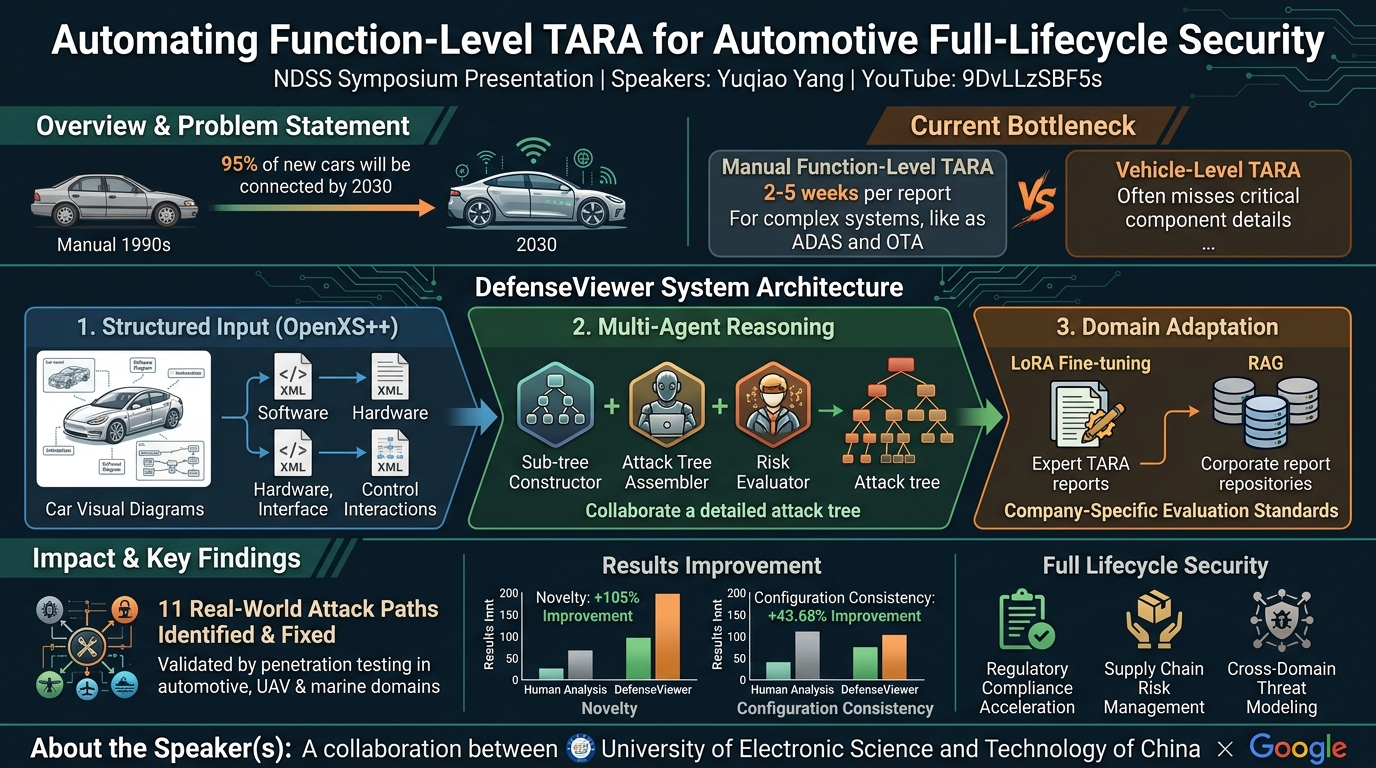
As connected vehicles are projected to represent 95% of new cars by 2030, the automotive attack surface is expanding dramatically through autonomous driving, OTA updates, and ADAS systems. The industry relies on Threat Analysis and Risk Assessment (TARA) as a mandatory regulatory requirement for OEMs and suppliers, but the process remains largely manual -- taking teams two to five weeks per report. This talk presents DefenseViewer, a system that automates function-level TARA by combining structured vehicle configuration representations, a multi-agent LLM framework for attack path reasoning, and LoRA fine-tuning with RAG for domain adaptation.
Key moments
- 0:00 Background: 95% of new cars will be connected by 2030
- 2:00 Vehicle-level vs function-level TARA and regulatory requirements
- 4:00 DefenseViewer system overview and three key components
- 6:00 Multi-agent framework: sub-tree constructor, assembler, and risk evaluator
- 8:00 LoRA fine-tuning and RAG for company-specific evaluation standards
- 10:00 Results: 105% improvement in novelty over human analysts
- 10:30 11 real-world attack paths validated through penetration testing
- 11:30 Deployed at seven enterprises including OEMs and Tier-1 suppliers
Automating Function-Level TARA for Automotive Full-Lifecycle Security
Speakers: Yuqiao Yang
Conference: NDSS Symposium
YouTube: https://www.youtube.com/watch?v=9DvLLzSBf5s
Overview
As connected vehicles are projected to represent 95% of new cars by 2030, the automotive attack surface is expanding dramatically through autonomous driving, OTA updates, and ADAS systems. The industry relies on Threat Analysis and Risk Assessment (TARA) as a mandatory regulatory requirement for OEMs and suppliers, but the process remains largely manual -- taking teams two to five weeks per report. This talk presents DefenseViewer, a system that automates function-level TARA by combining structured vehicle configuration representations, a multi-agent LLM framework for attack path reasoning, and LoRA fine-tuning with RAG for domain adaptation.
Deployed across seven enterprises including OEMs, Tier-1 suppliers, and professional security evaluation organizations, DefenseViewer identified 11 real-world attack paths validated through penetration testing and subsequently confirmed and fixed by the corresponding manufacturers. The system achieves a 105% improvement in novelty and 43.68% improvement in configuration consistency compared to human expert analysis.
Background
▶ Watch: Background: 95% of new cars will be connected by 2030 (0:00)
The rapid advancement of vehicle intelligence and connectivity technologies has fundamentally reshaped the automotive industry's security landscape. Technologies like autonomous driving, over-the-air (OTA) software updates, and Advanced Driver Assistance Systems (ADAS) deliver significant improvements in user experience but also dramatically expand the attack surface.
To ensure comprehensive security analysis, the automotive industry widely adopts TARA methodology, which is a mandatory regulatory compliance requirement for both OEMs and their suppliers. TARA analysis comes in two forms: vehicle-level TARA, which analyzes the entire vehicle and identifies overarching threats but often overlooks specific implementation details of individual components, and function-level TARA, which focuses on specific components such as battery management systems or individual ECUs, considering their interactions, hardware configurations, software versions, and communication interfaces.
Function-level TARA is explicitly required by regulations and is critical for supply chain risk management, as vulnerabilities in third-party components may compromise vehicle security. However, existing automation approaches based on data-flow models primarily focus on vehicle-level TARA, leaving a critical gap at the function level. Current approaches also rely on predefined threat libraries that lack the granularity needed for component-specific threats and are difficult to maintain in a rapidly evolving cybersecurity landscape.
Key Findings
▶ Watch: DefenseViewer system overview and three key components (4:00)
- 11 real-world attack paths identified: DefenseViewer discovered genuine attack paths across four automotive security projects and two non-automotive domains (UAV systems and marine navigation systems), all validated through penetration testing and subsequently fixed by OEMs and suppliers.
- 105% improvement in novelty: Compared to human security analysts, DefenseViewer generates significantly more novel attack paths by overcoming common human limitations such as difficulty adapting to new system configurations and overlooking unconventional attack strategies.
- 43.68% improvement in configuration consistency: The system produces attack paths that more accurately reflect the specific vehicle configuration being analyzed, reducing the subjective assumptions that human analysts often introduce.
- Cross-domain applicability: Beyond automotive, DefenseViewer successfully generated attack paths for UAV systems and marine navigation systems, demonstrating the approach generalizes across connected device domains.
- Configuration-specific analysis: For similar components across different vehicles, DefenseViewer generates unique, practical attack paths tailored to each vehicle's specific configuration rather than applying generic templates.
- Comprehensive coverage: The system identifies attack vectors across peripheral devices and cloud services, enabling broader identification of potential attack vectors that human analysts may miss.
Technical Deep Dive
▶ Watch: LoRA fine-tuning and RAG for company-specific evaluation standards (8:00)
DefenseViewer consists of three key technical components:
Structured Vehicle Configuration Representation (OpenXS++): Vehicle configurations are traditionally represented as visual diagrams that are intuitive for humans but difficult for LLMs to comprehend. DefenseViewer introduces OpenXS++, an XML-based structured representation method that formally describes software details, hardware configurations, interfaces, and component interactions. This textual representation enables LLMs to fully understand the vehicle architecture and facilitates subsequent attack path analysis.
Multi-Agent Framework for Attack Path Reasoning: Function-level TARA considers detailed component implementations and inter-component interactions, creating highly complex information flows. Directly tasking an LLM with this analysis would cause attention dilution from overly long inputs. DefenseViewer decomposes the problem using three specialized agents:
- Sub-tree Constructor: Analyzes each sub-goal and generates local attack paths for individual components
- Attack Tree Assembler: Integrates sub-trees into complete attack paths and returns issues for regeneration if inconsistencies are detected
- Risk Evaluator: Assesses the complete attack path against relevant risk criteria
LoRA Fine-Tuning with RAG: General-purpose LLMs lack sufficient domain expertise for TARA analysis, and different companies adopt different evaluation standards for the same threats. DefenseViewer addresses this through LoRA fine-tuning on expert TARA reports and accumulated corporate TARA reports to enhance the LLM's capability in generating professional attack paths. Additionally, RAG techniques over company-specific TARA report repositories enable the system to apply different evaluation standards according to each company's requirements.
When vehicle components are updated, users only need to update the configuration to quickly re-conduct the TARA process, ensuring full lifecycle security without starting from scratch.
Demo / Proof of Concept
▶ Watch: Results: 105% improvement in novelty over human analysts (10:00)
DefenseViewer was deployed in four real-world automotive security projects and two non-automotive domains including UAV systems and marine navigation systems. In these deployments, the system successfully identified 11 real-world attack paths that were validated through penetration testing and subsequently confirmed and fixed by the corresponding OEMs and suppliers.
The system demonstrated several advantages over human expert analysis across six evaluation scenarios. Human analysts struggled to adapt to new system configurations, overlooked unconventional attack strategies, introduced incorrect elements due to subjective assumptions, and failed to fully account for system-specific differences. DefenseViewer consistently outperformed manual attack tree generation, though the researchers note that redundancy slightly increased -- a tradeoff that also reflects the system's thoroughness in exploring potential attack paths.
The system is currently deployed at seven enterprises including OEMs, Tier-1 suppliers, and professional security evaluation organizations.
Defensive Implications
▶ Watch: Deployed at seven enterprises including OEMs and Tier-1 suppliers (11:30)
DefenseViewer has significant implications for automotive and IoT security governance:
- Regulatory compliance acceleration: By automating function-level TARA that takes human teams 2-5 weeks, organizations can meet regulatory requirements more efficiently and respond to component changes or new threat intelligence without lengthy manual re-analysis cycles.
- Supply chain risk management: Function-level analysis of third-party components enables OEMs to systematically evaluate the security posture of supplier-provided ECUs, software stacks, and communication modules rather than relying on supplier self-assessments.
- Full lifecycle security: The ability to quickly re-conduct TARA analysis when vehicle configurations change supports continuous security assessment throughout the vehicle lifecycle, from design through end-of-life.
- Cross-domain threat modeling: The successful application to UAV and marine navigation systems suggests the approach can be generalized to any connected device domain facing similar regulatory and security analysis requirements.
- Knowledge preservation: By encoding expert TARA knowledge into fine-tuned models and RAG repositories, organizations can preserve institutional security expertise and apply it consistently across projects and teams.
Key Takeaways
- Manual TARA analysis takes 2-5 weeks per report, creating a bottleneck as vehicle complexity and connectivity increase
- DefenseViewer automates function-level TARA using structured configuration representations, multi-agent LLM reasoning, and domain-adapted models
- The system identified 11 real-world attack paths validated through penetration testing across automotive, UAV, and marine navigation domains
- A 105% improvement in novelty over human analysts demonstrates that LLM-driven analysis can overcome human cognitive biases in threat modeling
- LoRA fine-tuning combined with company-specific RAG enables adaptation to different corporate evaluation standards
- Currently deployed at seven enterprises including OEMs and Tier-1 suppliers for production security assessments
About the Speaker(s)
The presentation was delivered on behalf of the paper's authors, Yuqiao Yang and collaborators, who could not attend due to visa issues. The research is a joint effort between the University of Electronic Science and Technology of China and Google. The work represents a practical bridge between academic LLM research and industrial automotive security requirements.
Reviews
Dr. Zero (Offensive Security Researcher) — WEAK
An LLM-powered automation tool for automotive threat modeling that replaces manual TARA report writing with multi-agent prompt chaining. While the enterprise deployment numbers are real, the security content is thin -- it's fundamentally a workflow automation paper dressed up as security research. No novel attack techniques, no deep reversing of automotive systems, and the 11 'real-world attack paths' are never described in enough detail to evaluate their actual sophistication.
Heather Calloway (CISO) — USEFUL
DefenseViewer addresses a real operational pain point in automotive security governance: the 2-5 week manual TARA process that bottlenecks compliance with automotive cybersecurity regulations. The deployment across seven enterprises and validation of 11 attack paths through penetration testing demonstrates practical value. However, the lack of detail on actual attack paths and the self-defined evaluation metrics make it difficult to assess true security impact versus report-writing efficiency.
→ Top-rated talks at Network and Distributed System Security (NDSS) Symposium 2026
All talks from Network and Distributed System Security (NDSS) Symposium 2026