Anota: Identifying Business Logic Vulnerabilities via Annotation-Based Sanitization
Meng Wang (CISPA)
Network and Distributed System Security (NDSS) Symposium 2026 · Day 2 · Program Analysis
Overview
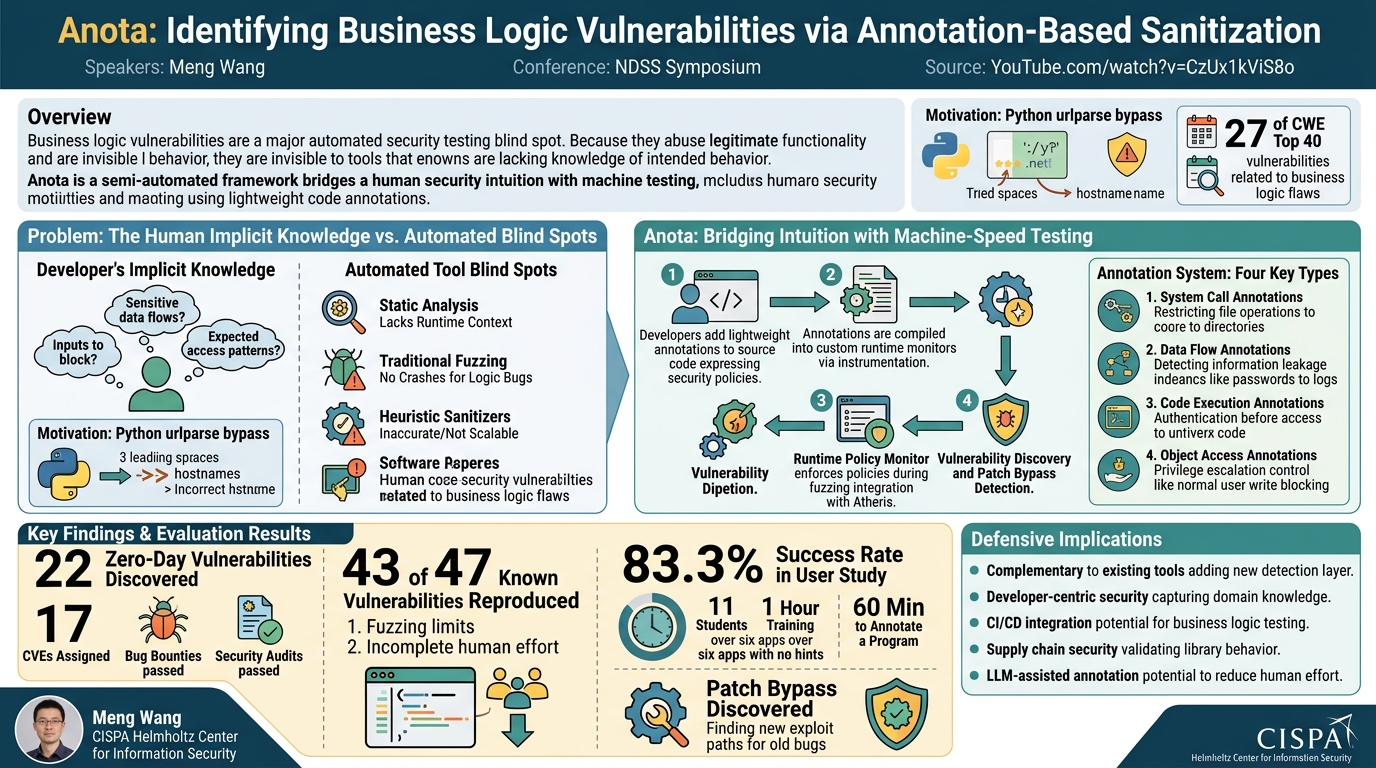
Business logic vulnerabilities represent a critical blind spot in automated security testing. Unlike memory corruption or injection flaws, these bugs abuse legitimate functionality and are invisible to tools that lack understanding of the developer's intended behavior. This talk presents Anota, a semi-automated framework that bridges human security intuition with machine-speed testing by allowing developers to add lightweight annotations to source code that express security policies. These annotations are then enforced at runtime through custom instrumentation, turning any fuzzer into a business logic vulnerability detector.
Key moments
- 0:00 Motivation: Python urlparse bypass with leading whitespace
- 2:00 Why existing tools fail: 27 of CWE Top 40 are business logic flaws
- 4:00 Four annotation types covering the vulnerability space
- 6:00 Annotation examples: network, file upload, data flow, access control
- 8:00 22 zero-day vulnerabilities and CVE patch bypass discovered
- 10:00 User study: 83.3% success rate with one hour of training
- 12:00 Real-world developer feedback on adoption barriers
- 14:00 Q&A: comparison with assertions and LLM-assisted annotation
Anota: Identifying Business Logic Vulnerabilities via Annotation-Based Sanitization
Speakers: Meng Wang
Conference: NDSS Symposium
YouTube: https://www.youtube.com/watch?v=CzUx1kViS8o
Overview
Business logic vulnerabilities represent a critical blind spot in automated security testing. Unlike memory corruption or injection flaws, these bugs abuse legitimate functionality and are invisible to tools that lack understanding of the developer's intended behavior. This talk presents Anota, a semi-automated framework that bridges human security intuition with machine-speed testing by allowing developers to add lightweight annotations to source code that express security policies. These annotations are then enforced at runtime through custom instrumentation, turning any fuzzer into a business logic vulnerability detector.
Anota's approach is validated across 47 known vulnerabilities (reproducing 43), and more significantly, the tool discovered 22 zero-day vulnerabilities with 17 CVEs assigned across actively maintained open-source projects -- including one with an annual security audit that had just completed before testing. A user study with 11 students demonstrated that even non-experts can learn the annotation system in one hour and achieve an 83.3% vulnerability detection success rate.
Background
▶ Watch: Motivation: Python urlparse bypass with leading whitespace (0:00)
Business logic vulnerabilities are among the most challenging security issues to detect because they arise from flaws in design and implementation rather than from technical coding errors. They abuse legitimate functionality -- as demonstrated in the talk's motivating example, where Python's urlparse library returns an incorrect hostname when a URL contains three leading whitespace characters, allowing an attacker to bypass URL scheme and host filtering.
Examining the CWE Top 40 vulnerabilities, the researchers found that 27 out of 40 are related to business logic vulnerabilities in some form. Yet existing automated tools have fundamental blind spots. Static analysis lacks runtime context information needed to understand intended behavior. Traditional fuzzing relies on crashes as bug oracles, but business logic bugs abuse legitimate functionality that does not crash. Recently proposed heuristic-based sanitizers like Argos attempt to detect such vulnerabilities by instrumenting language-level functionality and using hardcoded rules, but these are inaccurate and do not scale across diverse applications.
The core insight is that developers have implicit knowledge about intended behavior -- what inputs should be blocked, what resources should be accessed, what data flows are acceptable. Anota makes this implicit knowledge explicit and machine-enforceable through a lightweight annotation syntax.
Key Findings
▶ Watch: Four annotation types covering the vulnerability space (4:00)
- 22 zero-day vulnerabilities discovered with 17 CVEs assigned across actively maintained open-source projects on GitHub, four of which had active bug bounties and one with a recently completed annual security audit.
- 43 out of 47 known vulnerabilities reproduced, with only 4 failure cases -- 2 due to fuzzing limitations (requiring very specific trigger conditions) and 2 due to incomplete annotation by non-maintainer users.
- Patch bypass discovered: During fuzzing with file upload restrictions, Anota found an exploitation path that bypasses an existing CVE patch, demonstrating the tool's ability to find variants of known vulnerabilities.
- 27 of CWE Top 40 vulnerability types are related to business logic flaws, highlighting the scope of the problem that automated tools currently miss.
- 83.3% success rate in user study with 11 students who had only one hour of training, demonstrating the annotation system is accessible to non-experts.
- Four annotation types cover the vulnerability space: system call usage (path traversal, unrestricted file upload), data flow tracking (information leakage), code execution monitoring (authentication bypass), and object access control (privilege escalation).
- Approximately 60 minutes required for a student to complete annotation of a program, establishing a practical time baseline for the human effort involved.
Technical Deep Dive
▶ Watch: 22 zero-day vulnerabilities and CVE patch bypass discovered (8:00)
Anota's framework consists of three core components:
Annotation System: Rather than attempting to infer business logic from heuristics, Anota asks developers to express their security intentions through four types of annotations:
- System call annotations: Restrict file system operations to specific directories or block specific network access patterns (e.g., preventing path traversal by constraining file operations to an upload directory)
- Data flow annotations: Track sensitive data propagation through the program to detect leakage (e.g., ensuring passwords are only stored in hashed form, never printed to logs)
- Code execution annotations: Define conditions under which code execution is expected or unexpected (e.g., ensuring authentication must precede access to protected endpoints)
- Object access annotations: Specify fine-grained permissions on objects -- read, write, own, execute -- enabling privilege control validation (e.g., normal users can only read objects, not write or execute them)
Runtime Policy Monitor: Annotations are compiled into runtime monitors that intercept and validate program behavior during execution. The prototype is built on CPython, with the interpreter's C code modified internally to track object propagation through the bytecode interpreter. For system call monitoring, an eBPF module collaborates with the instrumented CPython interpreter to track operating system interactions. This approach is significantly faster than external monitoring tools like DynaMoRIO, which would be too slow for fuzzing scenarios.
Fuzzing Integration: The annotation-based monitors integrate with standard Python fuzzing infrastructure (specifically Atheris) without modification. When a runtime policy violation is detected, the monitor throws a fault signal that the fuzzer interprets as a crash, enabling standard coverage-guided fuzzing to discover business logic violations. Policies can be switched at runtime for different code regions, allowing context-specific security enforcement.
The user study revealed interesting behavioral patterns: participants tended to write blocklist-style annotations rather than allowlist-style, finding them more comfortable because they produce fewer false positives and align more naturally with the explicit security intentions visible in source code.
Demo / Proof of Concept
▶ Watch: User study: 83.3% success rate with one hour of training (10:00)
The evaluation proceeds in three stages. First, rediscovery of known bugs: 47 applications with recently disclosed vulnerabilities across diverse CWE types were annotated and fuzzed. Anota successfully reproduced 43 of 47 vulnerabilities. The four failures included two that required very specific trigger conditions (a fuzzing limitation, not a sanitizer limitation -- manual triggering confirmed the sanitizer detected them) and two where the annotator lacked sufficient understanding of the application's complex privilege control mechanism to write adequately fine-grained annotations.
Second, zero-day discovery: Targeting actively maintained open-source projects on GitHub, Anota discovered 22 new vulnerabilities with 17 CVEs assigned. Four of the targeted projects had active bug bounties, and one had just completed an annual security audit -- yet Anota still found vulnerabilities the audit missed. Notably, a patch bypass was discovered for an existing CVE related to file upload functionality.
Third, user study: 11 graduate and undergraduate students with varying security backgrounds were given one hour of training on the annotation syntax, then asked to annotate six applications. They received only documentation and source code with no hints about vulnerability types or locations. The 83.3% success rate demonstrates the annotation system is learnable and practical. Feedback from real-world developers indicated that while they all encounter business logic vulnerabilities in their work and currently rely on manual code review or expensive penetration testing, they expressed willingness to adopt the tool despite concerns about learning curve, CI/CD integration, and code readability impact.
Defensive Implications
▶ Watch: Q&A: comparison with assertions and LLM-assisted annotation (14:00)
Anota provides a practical path toward detecting vulnerability classes that have been largely immune to automated testing:
- Complementary to existing tools: Rather than replacing static analysis or traditional fuzzing, Anota adds a new detection layer for business logic flaws that these tools inherently miss, creating a more comprehensive testing pipeline.
- Developer-centric security: By having developers express security intentions through annotations, the system captures domain knowledge that no automated tool can infer, while the runtime enforcement provides machine-speed validation.
- CI/CD integration potential: The annotation-based approach integrates with standard fuzzing infrastructure, suggesting a path toward incorporating business logic testing into continuous integration pipelines alongside traditional fuzzing.
- Supply chain security: The ability to annotate and test third-party library behavior (as demonstrated with Python's
urlparse) enables organizations to validate that dependencies behave according to expected security contracts. - LLM-assisted annotation: While not yet implemented, the Q&A discussion identified the possibility of using LLMs to generate annotations automatically, which could reduce the human effort barrier and enable wider adoption.
Key Takeaways
- Business logic vulnerabilities account for 27 of the CWE Top 40 and are a fundamental blind spot for existing automated security testing tools
- Anota turns implicit developer security intentions into explicit, machine-enforceable runtime policies through four annotation types
- 22 zero-day vulnerabilities discovered with 17 CVEs assigned, including in projects with active bug bounties and recent security audits
- Non-expert users can learn the annotation system in one hour and achieve 83.3% vulnerability detection success rate
- The prototype instruments CPython at the interpreter level with eBPF for system call monitoring, enabling efficient fuzzing integration
- Patch bypasses for existing CVEs were discovered, demonstrating value for regression testing of security fixes
About the Speaker(s)
Meng Wang is a researcher at the CISPA Helmholtz Center for Information Security. The presentation demonstrated strong command of both the theoretical framework and practical evaluation, with confident engagement during Q&A on topics ranging from comparison with assertion-based approaches (Luke from Carnegie Mellon University) to potential LLM integration (from New Mexico State University) and instrumentation implementation details.
Reviews
Dr. Zero (Offensive Security Researcher) — STRONG ACCEPT
A practical and well-validated approach to finding business logic vulnerabilities -- the class of bugs that consistently escapes automated tools. The 22 zero-days with 17 CVEs including a patch bypass demonstrate real offensive value. The key innovation isn't the runtime monitoring itself but the insight that four annotation types can cover 27 of the CWE Top 40, making the human effort tractable. The eBPF + modified CPython instrumentation is technically solid.
Heather Calloway (CISO) — STRONG ACCEPT
Anota addresses one of the most persistent gaps in application security programs: business logic vulnerabilities that escape automated scanning. The finding that 27 of the CWE Top 40 are business logic related quantifies what every AppSec team has experienced. The developer-centric annotation approach aligns well with shift-left security practices, and the 22 zero-day findings including in recently audited software validate the practical impact.
→ Top-rated talks at Network and Distributed System Security (NDSS) Symposium 2026
All talks from Network and Distributed System Security (NDSS) Symposium 2026