Preempt: Sanitizing Sensitive Prompts for LLMs
Amrita Roy Chowdhury
Network and Distributed System Security (NDSS) Symposium 2026 · Day 3 · Privacy & Measurement · Privacy & Measurement
Overview
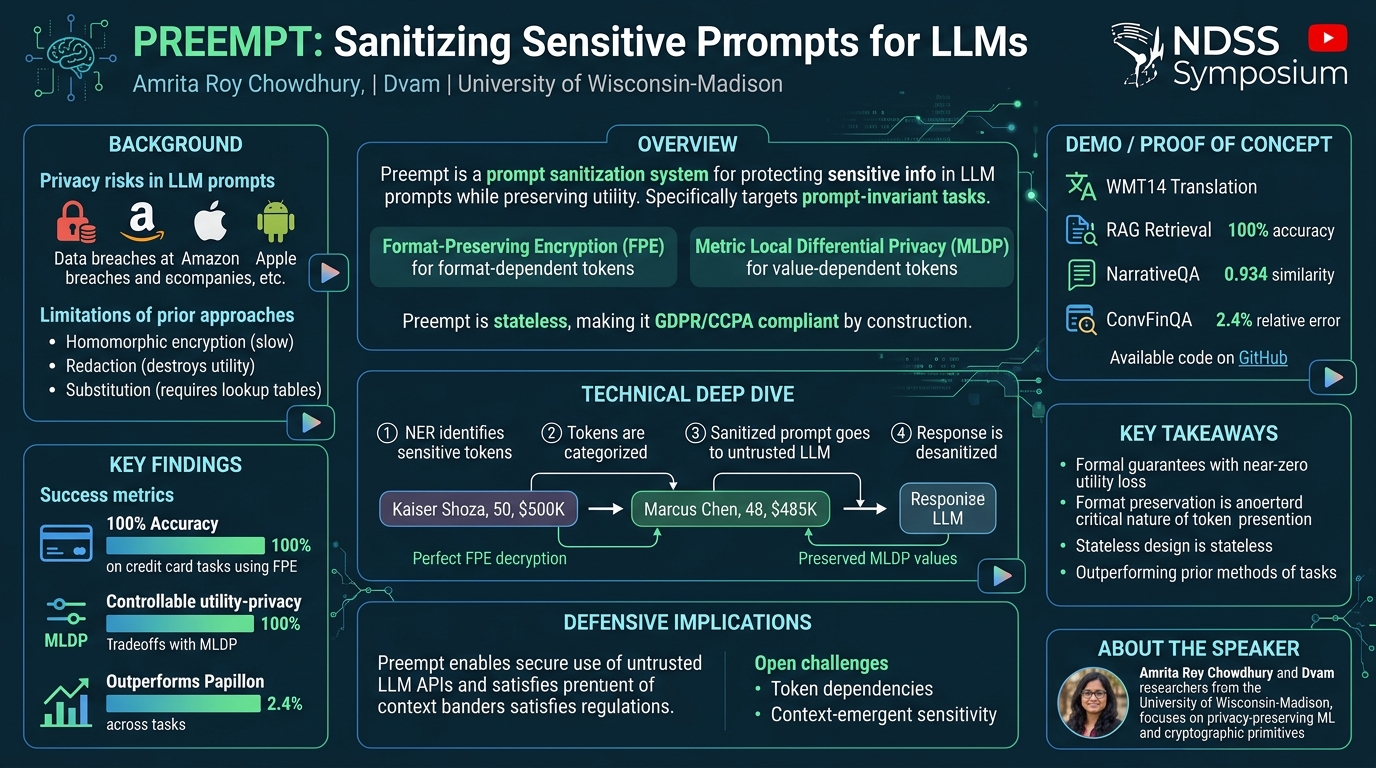
Preempt is a prompt sanitization system that protects sensitive information in LLM prompts while preserving utility. It targets prompt-invariant tasks (translation, RAG, financial advice) where the LLM's response doesn't depend on exact sensitive values. The system uses two complementary techniques: Format-Preserving Encryption (FPE) for format-dependent tokens (names, SSNs, credit card numbers) and Metric Local Differential Privacy (MLDP) for value-dependent tokens (age, salary, balances). Preempt is stateless (only requires a secret key, no lookup tables), making it GDPR/CCPA compliant by construction.
Key moments
- 0:00 Privacy risks in LLM prompts and limitations of prior approaches
- 2:00 Design goals: formal guarantees, high utility, statelessness
- 4:00 Two-category sanitization: FPE for format, MLDP for values
- 6:00 End-to-end walkthrough: Kaiser Shoza becomes Marcus Chen
- 8:00 Formal privacy guarantee via cryptographic distinguishability game
- 10:00 Results: 100% RAG accuracy, 0.934 QA similarity, 2.4% financial error
- 12:00 Open problems: token dependencies and context-emergent sensitivity
Preempt: Sanitizing Sensitive Prompts for LLMs
Speakers: Amrita Roy Chowdhury
Conference: NDSS Symposium
YouTube: https://www.youtube.com/watch?v=l6MOLNArMtY
Overview
Preempt is a prompt sanitization system that protects sensitive information in LLM prompts while preserving utility. It targets prompt-invariant tasks (translation, RAG, financial advice) where the LLM's response doesn't depend on exact sensitive values. The system uses two complementary techniques: Format-Preserving Encryption (FPE) for format-dependent tokens (names, SSNs, credit card numbers) and Metric Local Differential Privacy (MLDP) for value-dependent tokens (age, salary, balances). Preempt is stateless (only requires a secret key, no lookup tables), making it GDPR/CCPA compliant by construction.
Evaluations show nearly identical performance to unsanitized baselines: Blue scores drop negligibly in translation, 100% accuracy in RAG tasks, 0.934 semantic similarity in long-context QA (vs. 0.854 for the best competing approach), and 2.4% median relative error in financial QA -- comparable to human accuracy.
Background
▶ Watch: Privacy risks in LLM prompts and limitations of prior approaches (0:00)
LLM prompts frequently contain sensitive information (PII, proprietary data, in-context learning examples with real data). Privacy breaches have caused companies like Amazon and Apple to ban proprietary LLM use. Prior approaches face tradeoffs: homomorphic encryption takes 16+ minutes per inference; redaction destroys utility; substitution requires growing lookup tables; LLM-based obfuscation lacks formal guarantees; DP-based token noising causes type mismatches.
Key Findings
▶ Watch: Two-category sanitization: FPE for format, MLDP for values (4:00)
- FPE for format-dependent tokens achieves 100% accuracy on credit card processing (vs. 77% random substitution, 71% AES)
- MLDP for value-dependent tokens provides controllable privacy-utility tradeoff: at epsilon=2.0, median relative error is just 2.4%
- Stateless design requires only a secret key -- no lookup tables, no state from prior sessions
- Outperforms Papillon (LLM-based sanitization) across all tasks by significant margins
- Fine-tuned universal NER model matches or outperforms GPT-4.1 and Gemini 2.5 on PII detection across 3 languages
- Formal privacy guarantees via cryptographic game with bounded adversary advantage
Technical Deep Dive
▶ Watch: End-to-end walkthrough: Kaiser Shoza becomes Marcus Chen (6:00)
The pipeline: (1) NER identifies sensitive tokens and annotates types, (2) tokens are categorized as format-dependent (FPE) or value-dependent (MLDP), (3) sanitized prompt goes to untrusted LLM, (4) response is desanitized -- FPE tokens are perfectly decrypted, MLDP values stay as-is. The key insight: for prompt-invariant tasks, "Kaiser Shoza, 50, $500K" and "Marcus Chen, 48, $485K" produce effectively identical LLM responses.
Demo / Proof of Concept
▶ Watch: Results: 100% RAG accuracy, 0.934 QA similarity, 2.4% financial error (10:00)
Evaluated on 4 tasks: WMT14 English-German translation, RAG numerical/factual retrieval, NarrativeQA long-context QA, and ConvFinQA multi-turn financial QA. Code available on GitHub.
Defensive Implications
▶ Watch: Open problems: token dependencies and context-emergent sensitivity (12:00)
Preempt enables organizations to use untrusted LLM APIs without exposing PII. The stateless design satisfies GDPR/CCPA data deletion requirements by construction. However, open challenges remain: handling token dependencies (France/Paris), protecting context-emergent sensitivity, and preventing utility loss on non-invariant tasks.
Key Takeaways
- FPE + MLDP provides formal privacy guarantees for LLM prompts with near-zero utility loss on invariant tasks
- Format preservation is critical: LLMs depend on token format to process structured data correctly
- Stateless design with just a secret key enables practical deployment and regulatory compliance
- Outperforms all prior prompt sanitization approaches across diverse task benchmarks
- Open challenges: token dependencies, context-emergent sensitivity, non-invariant task support
About the Speaker(s)
Dvam (presenting on behalf of first author Amrita Roy Chowdhury) is a third-year PhD student at the University of Wisconsin-Madison. Research focuses on privacy-preserving machine learning, differential privacy, and cryptographic primitives for LLM security.
Reviews
Dr. Zero (Offensive Security Researcher) — SOLID
A well-engineered prompt sanitization system combining FPE and metric DP that achieves near-zero utility loss on prompt-invariant tasks. The formal privacy guarantees and stateless design are clean contributions, and the finding that format preservation is critical for LLM processing is practically valuable. However, the restriction to invariant tasks limits applicability, and the open problems (token dependencies, context-emergent sensitivity) are significant gaps.
Heather Calloway (CISO) — STRONG ACCEPT
A deployable solution for organizations that need to use commercial LLM APIs without exposing PII. The combination of format-preserving encryption and metric differential privacy achieves near-zero utility loss while providing formal privacy guarantees and GDPR/CCPA compliance by design. Immediately actionable for translation, RAG, and financial advisory use cases.
→ Top-rated talks at Network and Distributed System Security (NDSS) Symposium 2026
All talks from Network and Distributed System Security (NDSS) Symposium 2026