Small Cell, Big Risk: A Security Assessment of 4G LTE Femtocells in the Wild
Yaru Yang (Tinhu University)
Network and Distributed System Security (NDSS) Symposium 2026 · Day 3 · AI & Web Security · AI & Web Security
Overview
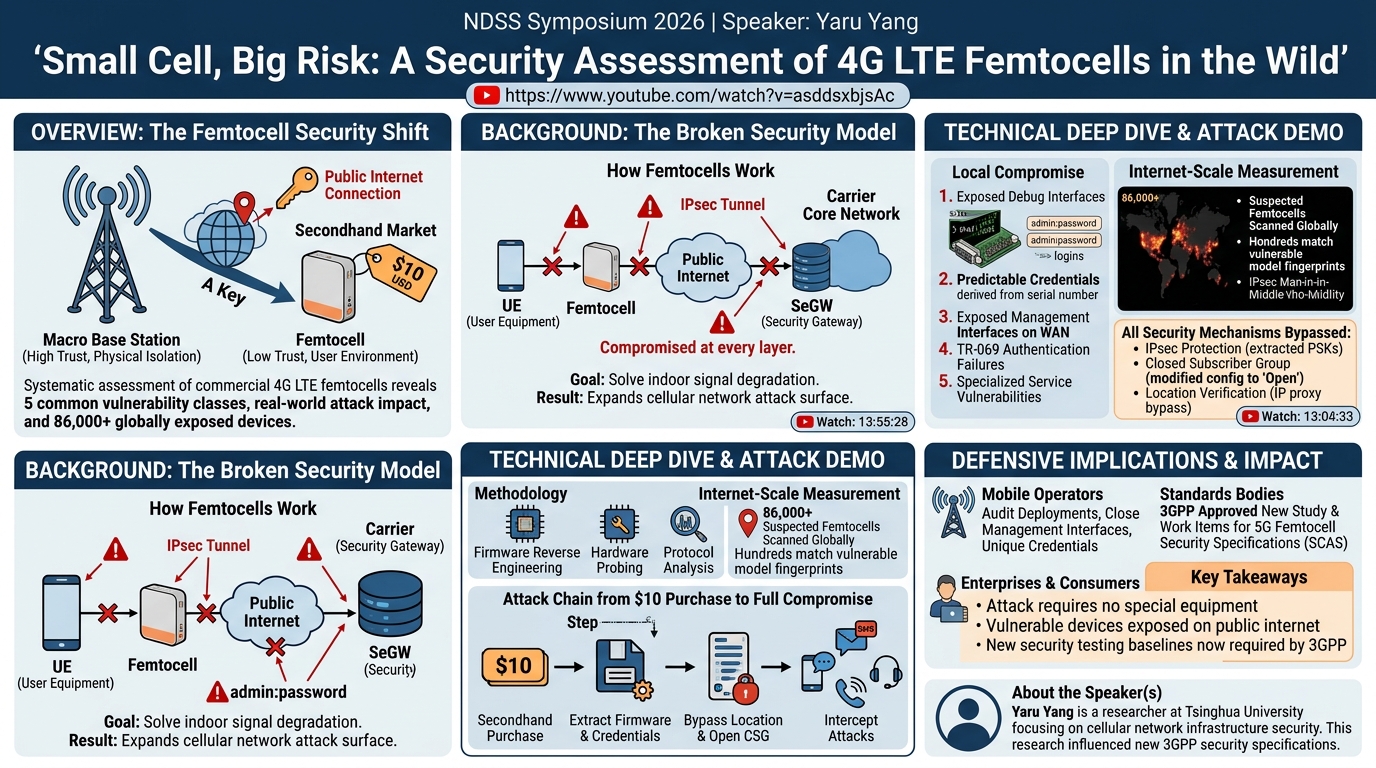
As mobile networks evolve and data demand surges, operators have turned to femtocells -- small, low-cost base stations designed for indoor deployment in homes and offices -- to extend cellular coverage. But this convenience comes with a dramatic shift in the trust boundary of cellular infrastructure. Unlike traditional macro base stations protected by physical isolation and dedicated links, femtocells sit in user-accessible environments, connect to the core network over the public internet, and can be purchased on the secondhand market for as little as $10 USD. This talk presents a systematic security assessment of commercial 4G LTE femtocells, revealing five common vulnerability classes across six (later eight) commercial devices from different vendors, demonstrating real-world attack impact on both user equipment and core network integrity, and conducting an internet-scale measurement that identified over 86,000 suspected femtocells globally -- hundreds of which matched the fingerprints of known vulnerable models.
Key moments
- 1:30 Why femtocells shift the trust boundary of cellular networks
- 3:30 Three research questions and systematic assessment methodology
- 5:30 Five common vulnerability classes across commercial femtocells
- 7:30 SMS eavesdropping and traffic hijacking demonstrations
- 8:30 IPsec pre-shared key extraction and man-in-the-middle attack
- 10:30 End-to-end attack chain: from $10 purchase to full compromise
- 11:30 Internet-scale scan reveals 86,000+ exposed femtocells globally
- 14:00 3GPP approves new security specifications for 5G femtocells
Small Cell, Big Risk: A Security Assessment of 4G LTE Femtocells in the Wild
Speakers: Yaru Yang
Conference: NDSS Symposium 2026
YouTube: https://www.youtube.com/watch?v=asddsxbjsAc
Overview
As mobile networks evolve and data demand surges, operators have turned to femtocells -- small, low-cost base stations designed for indoor deployment in homes and offices -- to extend cellular coverage. But this convenience comes with a dramatic shift in the trust boundary of cellular infrastructure. Unlike traditional macro base stations protected by physical isolation and dedicated links, femtocells sit in user-accessible environments, connect to the core network over the public internet, and can be purchased on the secondhand market for as little as $10 USD. This talk presents a systematic security assessment of commercial 4G LTE femtocells, revealing five common vulnerability classes across six (later eight) commercial devices from different vendors, demonstrating real-world attack impact on both user equipment and core network integrity, and conducting an internet-scale measurement that identified over 86,000 suspected femtocells globally -- hundreds of which matched the fingerprints of known vulnerable models.
The research fundamentally challenges the assumption that cellular networks are inherently secure. By showing that an attacker with a cheap secondhand femtocell can intercept SMS messages, hijack voice calls, redirect data traffic, and potentially inject malicious control-plane messages into the core network, the work exposes a systemic weakness in 4G infrastructure that has prompted 3GPP to approve both a study item and a work item for improved femtocell security specifications in 5G.
Background
▶ Watch: Why femtocells shift the trust boundary of cellular networks (1:30)
Femtocells were introduced to solve a practical problem: indoor signal degradation. Traditional macro base stations transmit powerful signals outdoors, but walls and building structures attenuate those signals indoors. Rather than deploying more expensive macro infrastructure, operators embraced femtocells -- devices roughly the size of a home router that provide localized cellular coverage and connect back to the carrier's core network via the public internet.
The architecture is straightforward: user equipment (UE) connects wirelessly to the femtocell, which bridges traffic to the core network through an IPsec tunnel to a Security Gateway (SeGW). The core network then handles mobility management, billing, and interconnection with external networks. In theory, the IPsec tunnel protects the connection. In practice, as this research demonstrates, every layer of that security model can be compromised.
The 4G femtocell ecosystem is the focus because, at the time of writing, 5G femtocell standards had only just been finalized, and 4G femtocells represent the vast majority of deployed small cells worldwide. The researchers obtained six commercial devices from different vendors, later expanding to eight, and conducted both firmware-level reverse engineering and hardware-level testing.
Key Findings
▶ Watch: Five common vulnerability classes across commercial femtocells (5:30)
The assessment uncovered five common vulnerability classes across the tested devices:
Local compromise vulnerabilities (2 classes): These require physical access to the femtocell. The first involves exposed debug interfaces (UART, JTAG) that should have been disabled before production sale but were left active, allowing direct shell access. The second involves predictable credentials -- login credentials for local management services that are either static (same username/password across vendors), or follow predictable patterns such as being derived from the last four digits of the device serial number.
Remote compromise vulnerabilities (3 classes): These can be exploited over the network without physical access. The researchers found management services exposed on the WAN interface, exploitable TR-069 authentication failures (TR-069 is the protocol used for remote management between femtocells and the core network), and other specialized service vulnerabilities.
The impact validation on three devices that successfully connected to live networks confirmed: SMS eavesdropping, voice call interception, data traffic hijacking, and theoretical attacks against core network functions via malicious GTP-U or S1-AP control messages.
Critically, all existing security mechanisms were found to be bypassable:
- IPsec protection: Pre-shared keys were retrievable directly from device firmware
- Closed Subscriber Group (CSG): Attackers could modify the configuration via web interfaces to accept all subscribers
- Location verification: Based solely on IP address geolocation, trivially bypassed with a proxy
Technical Deep Dive
▶ Watch: IPsec pre-shared key extraction and man-in-the-middle attack (8:30)
The research methodology combined firmware reverse engineering, hardware interface probing, and protocol-level analysis across all tested devices.
For firmware analysis, the researchers extracted and analyzed the firmware images to identify hardcoded credentials, cryptographic key material, and service configurations. The most critical finding here was that IPsec pre-shared keys used to establish the secure tunnel to the core network's Security Gateway were embedded directly in the firmware. This means any attacker with physical access to a femtocell -- or even just its firmware image -- can recover the keys needed to perform a man-in-the-middle attack on the IPsec tunnel, effectively intercepting and modifying all traffic between the femtocell and the core network.
The credential analysis revealed a systematic failure across vendors. Rather than implementing per-device unique credentials provisioned during manufacturing, vendors used either static credentials shared across all devices of the same model, or credentials derived from predictable device identifiers like serial numbers. The researchers documented the specific derivation patterns, enabling credential prediction for devices that an attacker has never physically touched.
For the internet exposure measurement, the researchers developed a multi-protocol fingerprinting methodology using three protocol-level indicators: IKEv2 (used by femtocells to establish IPsec tunnels), TR-069 (the remote management protocol), and HTTP/TLS-based web management interfaces. They crafted both positive indicators (keywords like "femto") and negative indicators (keywords like "router") to classify scanned hosts. Scanning the global IPv4 address space, they identified over 86,000 suspected femtocells, with more than 50,000 classified as high-confidence matches. Hundreds of these exactly matched the fingerprints of the vulnerable models analyzed in the study.
The end-to-end attack chain is remarkably simple: purchase a femtocell for approximately $10 from a secondhand market, extract credentials to obtain root access, bypass location verification with an IP proxy, open the CSG to accept all subscribers, and begin intercepting SMS, calls, and data from any UE that connects.
Demo / Proof of Concept
▶ Watch: End-to-end attack chain: from $10 purchase to full compromise (10:30)
The researchers validated multiple real-world attack scenarios using their own controlled user equipment connected to three femtocells that successfully registered with live carrier networks. The demonstrated attacks included SMS eavesdropping (intercepting text messages sent to a victim's device), voice call interception, and data traffic hijacking (redirecting a user's internet traffic through attacker-controlled infrastructure). For ethical reasons, no attacks were conducted against the live core network itself, but passive traffic analysis and theoretical evaluation confirmed that a compromised femtocell could inject malicious GTP-U and S1-AP messages to interfere with core network functions such as mobility management and subscriber tracking. The IPsec man-in-the-middle attack was also validated on the researchers' own test infrastructure, confirming that extracted pre-shared keys could successfully decrypt and modify tunnel traffic.
Defensive Implications
▶ Watch: 3GPP approves new security specifications for 5G femtocells (14:00)
This research exposes a fundamental gap in cellular network security architecture. The deployment of femtocells effectively moved a critical piece of carrier infrastructure -- the base station -- from a physically secured, operator-controlled environment into the hands of end users and, by extension, attackers. The security mechanisms specified in 3GPP standards for 4G femtocells proved inadequate across the board.
For mobile operators, the immediate concern is the exposure of deployed femtocells on the public internet. The discovery of over 86,000 suspected femtocells globally, with hundreds matching known vulnerable models, means that the attack surface is not theoretical -- it is actively present in production networks. Operators should audit their femtocell deployments for exposed management interfaces, implement per-device unique credentials, and ensure IPsec key material is not extractable from firmware.
For standards bodies, the work has already had direct impact. The researchers reported their findings to the GSMA, which helped notify member operators, and presented at multiple 3GPP SA3 meetings. As a result, 3GPP approved both a study item for 5G femtocell security and a work item to define Security Assurance Specifications (SCAS) for 4G and 5G femtocells -- baseline security test cases that vendors must satisfy before bringing products to market. Prior to this research, no such SCAS testing existed for femtocells, despite existing for other network functions like gNodeBs, AMFs, and UPFs.
For enterprises and consumers, the key takeaway is that femtocells represent a potential interception point for cellular communications. Organizations in sensitive environments should consider whether femtocells in or near their facilities could be compromised, and whether their threat models account for cellular-layer attacks.
Key Takeaways
- Commercial 4G femtocells from multiple vendors share common vulnerability patterns including exposed debug interfaces, predictable credentials, and extractable IPsec keys
- A complete attack chain from $10 secondhand purchase to SMS/call/data interception requires no specialized equipment or expertise
- Over 86,000 suspected femtocells are exposed on the public internet globally, with hundreds matching known vulnerable device fingerprints
- All existing security mechanisms (IPsec, Closed Subscriber Group, location verification) can be bypassed
- IPsec pre-shared keys embedded in firmware enable man-in-the-middle attacks on the femtocell-to-core-network tunnel
- The research directly prompted 3GPP to approve new security specification work items for femtocell SCAS testing in both 4G and 5G
- 5G femtocell standards are now incorporating security testing baselines that did not previously exist
About the Speaker(s)
Yaru Yang is a researcher at Tsinghua University whose work focuses on the security of cellular network infrastructure. This research was conducted in collaboration with researchers from Tsinghua University, Qihoo Labs, KAIST (Korea Advanced Institute of Science and Technology), and other institutions. The team has engaged directly with 3GPP SA3 working groups and the GSMA CVD program, and their findings have influenced the development of new security specifications for femtocell devices.
Reviews
Dr. Zero (Offensive Security Researcher) — STRONG ACCEPT
A thorough, hands-on security assessment of commercial 4G LTE femtocells that reveals five vulnerability classes across eight devices from different vendors, demonstrates practical SMS/call/data interception, and backs it up with an internet-scale scan finding 86,000+ exposed devices. This is real-world offensive research with tangible impact on 3GPP standards.
Heather Calloway (CISO) — STRONG
A comprehensive security assessment of 4G LTE femtocells that reveals systemic vulnerabilities across multiple vendors, demonstrates practical interception of SMS, calls, and data, and quantifies the global exposure with an internet-scale scan finding 86,000+ devices. The research has already driven changes to 3GPP security specifications, making it highly relevant for any organization with cellular infrastructure in their threat model.
→ Top-rated talks at Network and Distributed System Security (NDSS) Symposium 2026
All talks from Network and Distributed System Security (NDSS) Symposium 2026