Revealing The Secret Power: How Algorithms Can Influence Content Visibility on Twitter/X
Alessandro Galeazzi
Network and Distributed System Security (NDSS) Symposium 2026 · Day 3 · Web Security
Overview
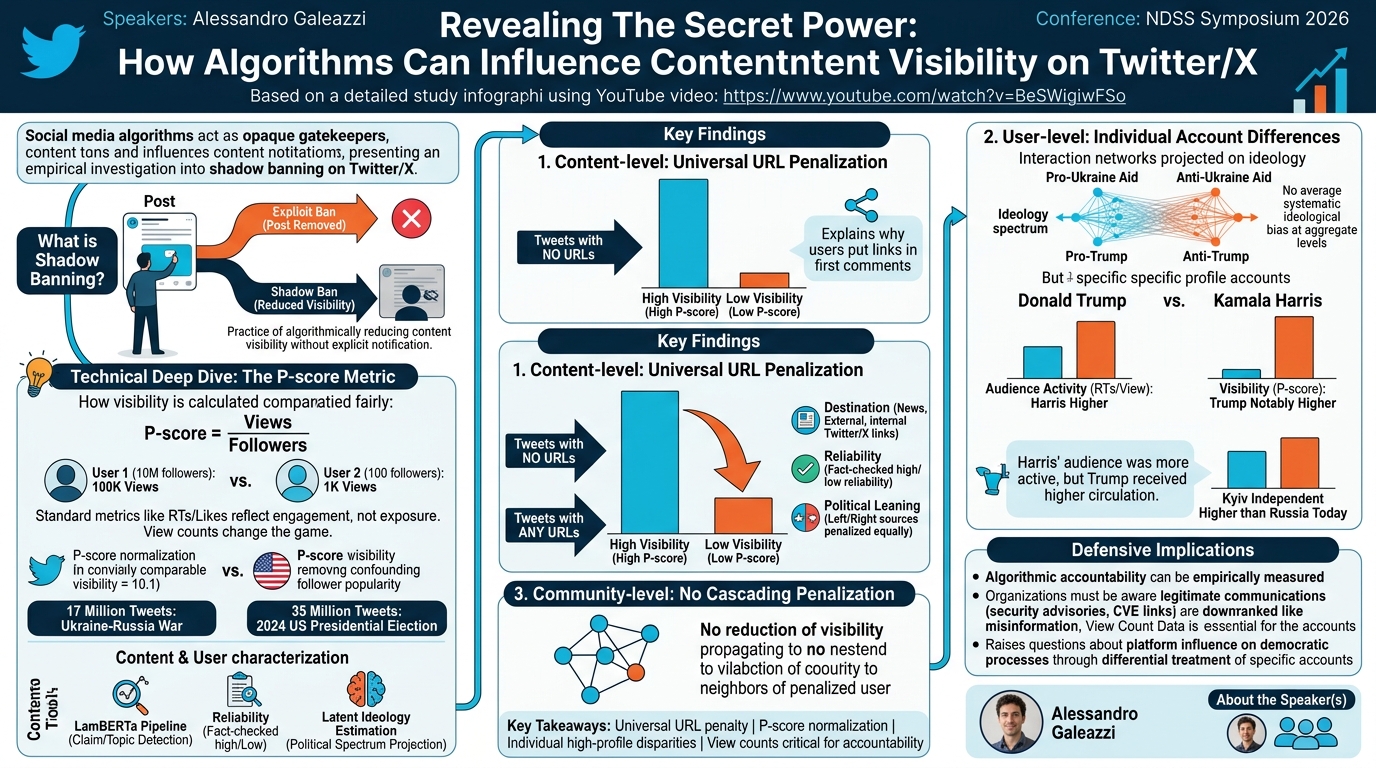
Social media algorithms operate as opaque gatekeepers, deciding what content appears in users' timelines without transparent disclosure of their ranking criteria. This talk presents an empirical investigation into shadow banning on Twitter/X -- the practice of reducing the visibility of specific content or users without explicit notification. Using two large-scale datasets (17 million tweets on the Ukraine-Russia war and 35 million tweets on the 2024 US presidential election), the researchers develop a novel metric called the P-score that normalizes content visibility by author popularity to enable fair comparisons. The findings reveal that Twitter/X systematically penalizes all content containing URLs regardless of the link's destination, reliability, or political leaning -- even links pointing back to Twitter itself. At the user level, no systematic bias was found across political ideologies, but specific high-profile accounts showed significant visibility differences, with Donald Trump receiving notably higher visibility than Kamala Harris despite lower audience engagement.
Key moments
- 2:30 Shadow banning concept and how to test for it empirically
- 4:00 Datasets: 17M tweets on Ukraine-Russia, 35M on US 2024 election
- 5:30 P-score metric: normalizing views by follower count
- 7:30 All URLs penalized equally regardless of reliability or political leaning
- 9:00 Trump vs Harris visibility comparison with audience activity control
- 10:30 Community-level analysis: no cascading penalization effects
- 12:30 Discussion on whether URL penalization is about platform engagement retention
Revealing The Secret Power: How Algorithms Can Influence Content Visibility on Twitter/X
Speakers: Alessandro Galeazzi
Conference: NDSS Symposium 2026
YouTube: https://www.youtube.com/watch?v=BeSWigiwFSo
Overview
Social media algorithms operate as opaque gatekeepers, deciding what content appears in users' timelines without transparent disclosure of their ranking criteria. This talk presents an empirical investigation into shadow banning on Twitter/X -- the practice of reducing the visibility of specific content or users without explicit notification. Using two large-scale datasets (17 million tweets on the Ukraine-Russia war and 35 million tweets on the 2024 US presidential election), the researchers develop a novel metric called the P-score that normalizes content visibility by author popularity to enable fair comparisons. The findings reveal that Twitter/X systematically penalizes all content containing URLs regardless of the link's destination, reliability, or political leaning -- even links pointing back to Twitter itself. At the user level, no systematic bias was found across political ideologies, but specific high-profile accounts showed significant visibility differences, with Donald Trump receiving notably higher visibility than Kamala Harris despite lower audience engagement.
Background
▶ Watch: Shadow banning concept and how to test for it empirically (2:30)
Shadow banning refers to the practice of algorithmically reducing the visibility of a user's content without informing them or removing the content outright. Unlike explicit banning, which prevents posting entirely, shadow banning leaves the content accessible but ensures it appears in far fewer timelines. This technique has been alleged on various platforms, but empirically detecting it requires both appropriate data and methodology.
The fundamental challenge is separating algorithmic visibility decisions from organic popularity differences. A tweet from a user with 10 million followers will naturally receive more views than one from a user with 100 followers, even without any algorithmic intervention. Previous studies attempted to measure visibility using proxies like retweet counts or likes, but these metrics reflect user engagement rather than content exposure -- a user must actively interact with content, not merely see it.
Twitter/X's introduction of view counts as a visible metric changed the research landscape. View counts capture how many times content appeared on screens, providing a direct measure of algorithmic distribution rather than an indirect proxy through user engagement. This makes it possible, for the first time, to study visibility alterations at scale with a metric that reflects actual content circulation.
Key Findings
▶ Watch: P-score metric: normalizing views by follower count (5:30)
The research produced three primary findings across content, user, and community levels:
Content-level: URLs are universally penalized. Tweets containing any URL receive significantly lower visibility compared to tweets without links. This penalization applies regardless of whether the link points to a news outlet, an arbitrary external domain, or even Twitter itself. Furthermore, the penalization is independent of source reliability (whether the outlet is rated as highly reliable or unreliable by fact-checking organizations like Media Bias/Fact Check) and independent of political leaning (left-leaning and right-leaning sources are penalized equally). This finding explains the widespread practice among social media users of placing links in the first comment rather than the main post.
User-level: No systematic ideological bias, but individual account differences exist. When users were classified by ideology using latent ideology estimation (a technique that projects interaction networks onto a unidimensional political spectrum), no statistically significant difference in average P-scores was found between pro-military-aid vs. anti-military-aid users (Ukraine-Russia) or pro-Trump vs. anti-Trump users (US election). However, comparisons between specific comparable accounts revealed significant disparities: Kyiv Independent received significantly higher visibility than Russia Today, and Donald Trump received significantly higher visibility than Kamala Harris.
Community-level: No cascading penalization. When examining whether visibility penalties propagate through interaction networks -- whether neighbors of penalized users also experience reduced visibility -- no such effect was detected in either dataset.
Technical Deep Dive
▶ Watch: All URLs penalized equally regardless of reliability or political leaning (7:30)
The methodology centers on the P-score, defined as the number of views a piece of content receives divided by the number of followers of the content's author. This normalization is conceptually simple but critically important: it removes the confounding effect of account popularity, enabling comparisons between users with vastly different follower counts. Without this normalization, any visibility analysis would be dominated by organic popularity differences rather than algorithmic intervention.
For content characterization, the researchers used the LamBERTa pipeline to detect claims and topics within tweets, enabling topic-level visibility analysis. For political leaning and reliability classification of linked sources, they used external databases including Media Bias/Fact Check and AllSides, which maintain curated lists of news domains classified by political leaning and factual reliability.
For user characterization, the team employed latent ideology estimation, a technique that projects the network of user interactions (specifically, retweet relationships with political influencers) into a unidimensional ideological space. This assigns each user a numerical position on a political spectrum based on whom they engage with, rather than relying on self-reported political identity.
The audience activity metric was introduced to control for a potential confound in user-level analysis. When comparing Trump and Harris visibility, one might argue that Trump's higher visibility simply reflects more active audience engagement. The researchers quantified audience activity as the number of retweets per view. For the Ukraine-Russia dataset, audience activity was comparable across groups. For the US election, Harris's audience was actually more active (higher retweets per view) than Trump's -- yet Trump's content still received higher visibility, ruling out audience engagement as an explanation.
The two datasets were chosen specifically because they contain Twitter's view count data and sufficient interaction information for network analysis. The Ukraine-Russia dataset contains 17 million tweets and the US election dataset contains 35 million tweets, providing substantial statistical power for the analyses.
Demo / Proof of Concept
▶ Watch: Community-level analysis: no cascading penalization effects (10:30)
The empirical evidence is presented through distributional comparisons of P-scores across content types, user groups, and communities. The URL penalization finding is particularly robust: it holds across both datasets (geopolitical conflict and domestic election), across all URL types (news, external, internal Twitter links), and is independent of both reliability ratings and political leaning classifications. The Trump-Harris visibility comparison is controlled for audience activity, with marginal distribution analysis showing that despite lower audience engagement, Trump's content achieved significantly higher platform circulation. The community-level null result -- no cascading penalization through interaction networks -- was consistent across both debate contexts.
Defensive Implications
▶ Watch: Discussion on whether URL penalization is about platform engagement retention (12:30)
For platform transparency and governance, this research demonstrates that algorithmic content moderation decisions can be empirically detected and measured, even when platforms do not disclose their ranking algorithms. The universal URL penalization has direct implications for any organization or individual that uses social media to distribute content with external links -- which includes virtually all news organizations, corporate communications, security advisories, and research dissemination.
For security teams and threat intelligence, the finding that all URLs are penalized equally regardless of reliability is counterintuitive and potentially harmful. It means that a legitimate security advisory linking to a CVE database or vendor patch receives the same visibility penalty as a link to a misinformation site. Organizations that rely on social media for security communication should be aware that their linked content is systematically downranked.
For election security and information operations, the finding that specific accounts receive differential visibility treatment -- independent of audience engagement or ideological grouping -- raises questions about platform influence on democratic processes. While the researchers explicitly avoid claiming causality (they cannot determine whether visibility differences are intentional design choices or emergent properties of algorithm-user interactions), the empirical evidence of differential treatment is itself significant.
The broader implication is that view count data is essential for accountability. Without access to visibility metrics, none of these analyses would be possible. Platforms that remove or restrict access to view count data effectively eliminate the ability to audit their algorithmic decisions.
Key Takeaways
- Twitter/X systematically penalizes all content containing URLs, regardless of destination, reliability, or political leaning
- The P-score metric (views divided by followers) enables fair cross-user visibility comparisons by normalizing for account popularity
- No systematic ideological bias was found at the aggregate user or community level
- Individual high-profile accounts show significant visibility differences: Trump received higher visibility than Harris despite lower audience engagement
- Shadow banning effects do not cascade through interaction networks to penalize neighboring users
- View count data is critical for algorithmic accountability -- without it, visibility auditing is impossible
- The research cannot establish causality (intentional design vs. emergent behavior) but provides robust empirical evidence of differential treatment
About the Speaker(s)
Alessandro Galeazzi is a researcher whose work focuses on computational social science, algorithmic accountability, and the dynamics of information spread on social media platforms. This research was conducted in collaboration with Pushpadevi Maronti, De Christopher, and Stringhini, combining expertise in network analysis, natural language processing, and platform governance. The work applies quantitative methods to study the societal impact of opaque algorithmic systems.
Reviews
Dr. Zero (Offensive Security Researcher) — WEAK
An empirical study of algorithmic visibility manipulation on Twitter/X using view count data. Confirms that URLs are universally penalized and finds differential visibility for specific accounts. Methodologically sound but far from offensive security -- this is social science with statistical tools, not a security talk.
Heather Calloway (CISO) — USEFUL
Empirical evidence that Twitter/X universally penalizes URL-containing content and provides differential visibility to specific accounts. Relevant for organizations that use social media for security communications, threat intelligence sharing, or corporate communications, though the security implications are indirect.
→ Top-rated talks at Network and Distributed System Security (NDSS) Symposium 2026
All talks from Network and Distributed System Security (NDSS) Symposium 2026