LOKI: Proactively Discovering Online Scam Websites by Mining Toxic Search Queries
Pujan Paudel (Boston University)
Network and Distributed System Security (NDSS) Symposium 2026 · Day 3 · Attacks
Overview
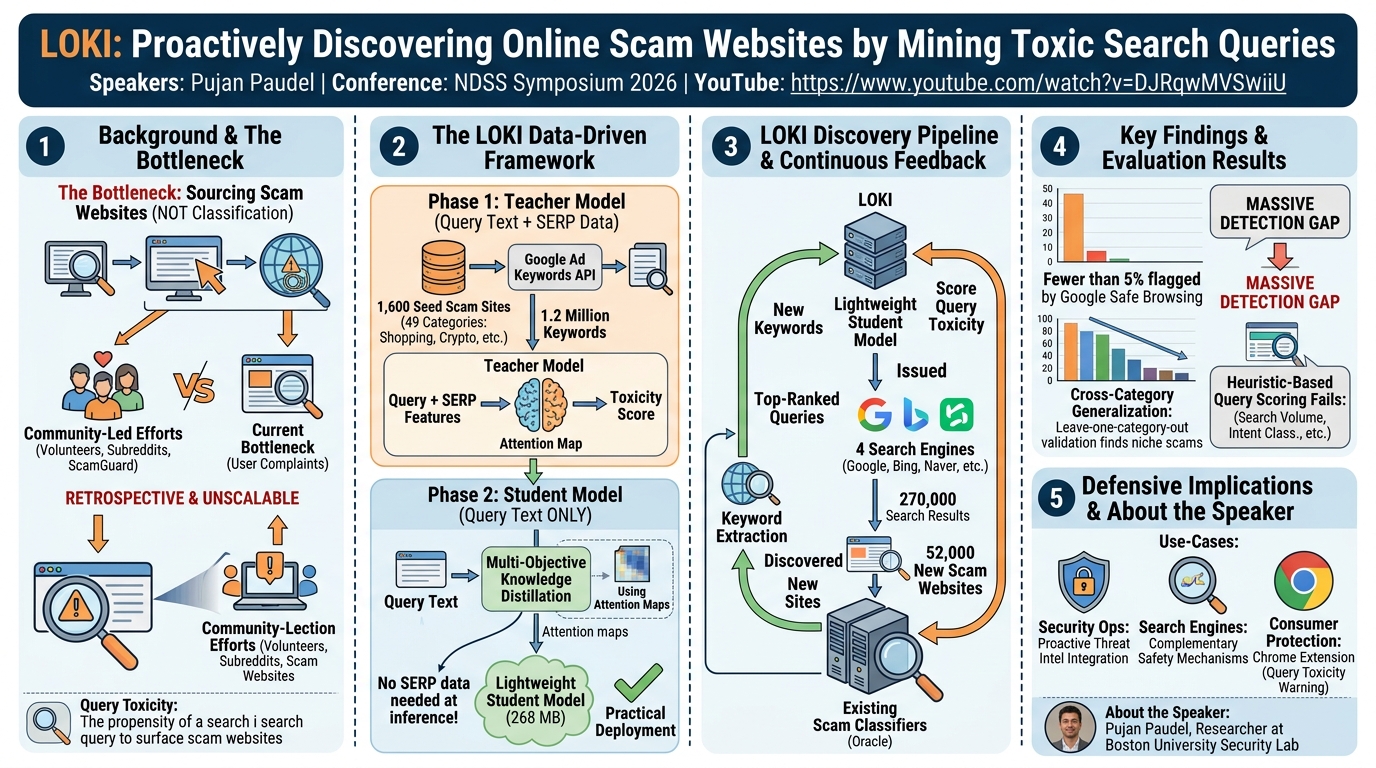
Online scams cause mounting financial losses worldwide, yet the discovery pipeline for scam websites has a critical bottleneck: while sophisticated classifiers can identify scam sites once found, sourcing candidate websites for analysis remains largely reactive, relying on user complaints and community-maintained lists. This talk presents LOKI, a data-driven framework that flips the discovery model from reactive to proactive by identifying toxic search queries -- search engine queries that disproportionately surface scam websites in their results. Starting from 1,600 known scam websites, LOKI extracts 1.2 million keywords via the Google Ad Keywords API, trains a teacher-student distillation model to score query toxicity, and uses the top-ranked queries to discover 52,000 new scam websites from 270,000 search results across four search engines (Google, Bing, Naver). Remarkably, fewer than 5% of these scam websites were flagged by Google Safe Browsing, highlighting a massive gap in current platform-level protections.
Key moments
- 1:30 The bottleneck: sourcing scam websites, not classifying them
- 3:30 Defining query toxicity: benign vs toxic search queries compared
- 5:30 LOKI pipeline: from 1,600 seed sites to 1.2 million keywords
- 7:30 Why heuristic-based query scoring fails across categories
- 10:00 Teacher-student distillation: transferring SERP knowledge to query-only model
- 12:30 52,000 scam websites discovered with less than 5% Google Safe Browsing overlap
- 16:00 Practical applications: browser extensions and security pipeline integration
LOKI: Proactively Discovering Online Scam Websites by Mining Toxic Search Queries
Speakers: Pujan Paudel
Conference: NDSS Symposium 2026
YouTube: https://www.youtube.com/watch?v=DJRqwMVswiU
Overview
Online scams cause mounting financial losses worldwide, yet the discovery pipeline for scam websites has a critical bottleneck: while sophisticated classifiers can identify scam sites once found, sourcing candidate websites for analysis remains largely reactive, relying on user complaints and community-maintained lists. This talk presents LOKI, a data-driven framework that flips the discovery model from reactive to proactive by identifying toxic search queries -- search engine queries that disproportionately surface scam websites in their results. Starting from 1,600 known scam websites, LOKI extracts 1.2 million keywords via the Google Ad Keywords API, trains a teacher-student distillation model to score query toxicity, and uses the top-ranked queries to discover 52,000 new scam websites from 270,000 search results across four search engines (Google, Bing, Naver). Remarkably, fewer than 5% of these scam websites were flagged by Google Safe Browsing, highlighting a massive gap in current platform-level protections.
Background
▶ Watch: The bottleneck: sourcing scam websites, not classifying them (1:30)
The traditional scam detection pipeline follows a two-stage process: first, source candidate websites (from social media, user complaints, community directories like ScamGuard, or manual search queries), then classify them using machine learning models. The classification stage has reached high accuracy with modern deep learning approaches, but the sourcing stage remains the bottleneck.
Community-led efforts like subreddit reports, ScamDirectory, and ScamGuard compile scam website lists through volunteer contributions. These are inherently retrospective -- someone must be scammed first -- and unscalable because maintaining comprehensive lists requires continuous volunteer effort.
Prior automated discovery approaches used topic modeling or TF-IDF methods on seed sets of known scam sites to identify representative keywords, then issued those keywords as search queries. Others curated domain-specific queries manually. Both approaches suffer from limited coverage and poor generalization across scam categories.
The key insight behind LOKI is that not all search queries are equal in their propensity to surface scam websites. A query like "best ways to buy crypto" returns mostly authoritative results, while "double my bitcoin quickly" disproportionately surfaces scam sites. This propensity -- the fraction of search results that are scams -- is what LOKI defines as query toxicity.
Key Findings
▶ Watch: LOKI pipeline: from 1,600 seed sites to 1.2 million keywords (5:30)
Heuristic-based query scoring fails: The researchers first evaluated whether simple heuristics -- search volume, competition level, query intent classification (informational vs. transactional vs. commercial), or query segmentation (modifiers, price, occasion) -- could reliably identify toxic queries. None produced consistent results across scam categories, and none were scalable or generalizable.
Data-driven toxicity scoring outperforms all baselines: LOKI's teacher model, which uses both query text and search engine result page (SERP) data as inputs, significantly outperforms all heuristic baselines. The auxiliary SERP information provides a meaningful signal boost for toxicity estimation.
Knowledge distillation preserves performance: The student model, which uses only the query text (no SERP data needed at inference time), achieves performance nearly identical to the teacher model across all scam categories. This is critical for practical deployment, as scoring millions of queries would require issuing millions of search requests if SERP data were needed.
Cross-category generalization: Validated through leave-one-category-out cross-validation, the model trained on known scam categories generalizes to unseen categories, enabling discovery of scam websites in niche verticals like education and marketing scams.
Massive detection gap in search engines: Of 52,000 identified scam websites, fewer than 5% were flagged by Google Safe Browsing. Prior research found the overlap as low as 1.4% in 2024. This suggests a fundamental disconnect between Google Safe Browsing's model of malicious websites and the reality of how scam websites operate.
Technical Deep Dive
▶ Watch: Why heuristic-based query scoring fails across categories (7:30)
LOKI operates in two phases corresponding to teacher and student model training.
Phase 1 (Teacher Model): Starting from approximately 1,600 known scam websites across 49 categories (shopping, fashion, pet scams, cryptocurrency, gambling, tech support, pharmacy, education, marketing, etc.), the system extracts 1.2 million keywords using the Google Ad Keywords API. This API provides not just content-based keywords but data on actual search traffic patterns -- how users are reaching these sites through search engines. For a subset of these keywords, LOKI retrieves actual search engine result pages from four engines. The teacher model takes both the query text and SERP data as inputs, using dual modalities to estimate toxicity scores. An attention map between query tokens and SERP features captures which aspects of search results are most informative for toxicity prediction.
Phase 2 (Student Model): Since SERP data cannot be obtained for millions of queries at scale (it would require issuing millions of search requests), LOKI uses multi-objective knowledge distillation to transfer the teacher's knowledge to a student model that takes only query text as input. The attention maps learned by the teacher are used as feature distillation targets -- the student learns to approximate the teacher's internal representations without access to SERP data. The student model has a memory footprint of just 268 MB, making it deployable alongside existing security systems without requiring GPU infrastructure.
Discovery Pipeline: The top 20 queries per category (approximately 1,000 total) are issued across four search engines, yielding 270,000 candidate URLs. These are passed through existing state-of-the-art scam classifiers (treated as an oracle), identifying 52,000 scam websites. The system supports a continuous feedback loop: newly discovered scam sites can be fed back to extract additional keywords, score them, and discover more scams.
Demo / Proof of Concept
▶ Watch: 52,000 scam websites discovered with less than 5% Google Safe Browsing overlap (12:30)
The evaluation demonstrates LOKI's effectiveness across multiple dimensions. The cross-category validation confirms generalization: models trained on known scam categories successfully identify toxic queries for unseen categories. The discovery pipeline identified 52,000 scam websites from 270,000 candidates across 49 categories, with strong representation in cryptocurrency, shopping, and fashion scams, as well as niche verticals. The comparison with Google Safe Browsing revealed fewer than 5% overlap, demonstrating that LOKI discovers scam websites that existing platform protections miss entirely. The lightweight student model (268 MB) enables practical deployment as a Chrome extension or integration into existing security pipelines.
Defensive Implications
▶ Watch: Practical applications: browser extensions and security pipeline integration (16:00)
For security operations teams, LOKI provides a proactive discovery mechanism that can be integrated into existing threat intelligence pipelines. Rather than waiting for user reports or community discoveries, teams can use toxic query scoring to continuously discover new scam websites targeting their users or brand. The feedback loop architecture enables ongoing discovery as the scam landscape evolves.
For search engine operators, the finding that fewer than 5% of discovered scam websites are flagged by Google Safe Browsing is a significant gap. The researchers note that scam websites operate differently from phishing sites -- they may require multi-step interactions before the scam becomes apparent, making initial-page-level detection difficult. However, LOKI's query-level approach could complement existing safety mechanisms by identifying queries whose results are disproportionately scam-laden.
For consumer protection and fraud teams, the cross-category generalization means LOKI can be deployed to discover scams in emerging categories without requiring category-specific training data. As new scam types emerge (AI-generated content scams, deepfake-based services, etc.), the framework can adapt by scoring queries in new domains.
A potential consumer-facing application is a browser extension that alerts users when their search queries are associated with high scam toxicity, providing warnings before they visit potentially malicious results.
Key Takeaways
- The bottleneck in scam website detection is discovery (sourcing candidates), not classification
- Query toxicity -- the propensity of a search query to surface scam results -- can be learned and predicted from query text alone
- A teacher-student distillation approach transfers SERP-informed toxicity knowledge to a lightweight query-only model (268 MB)
- The framework generalizes across scam categories, enabling discovery in niche verticals
- 52,000 scam websites discovered from 270,000 candidates across four search engines
- Fewer than 5% of discovered scam sites were flagged by Google Safe Browsing, revealing a massive detection gap
- The system supports continuous feedback loops for ongoing scam discovery
About the Speaker(s)
Pujan Paudel is a researcher at the Boston University Security Lab, working under his adviser on online fraud detection and web security. The research focuses on the intersection of natural language processing, search engine analysis, and scam detection, applying data-driven methods to proactively identify emerging threats in the online ecosystem.
Reviews
Dr. Zero (Offensive Security Researcher) — SOLID
A practical scam website discovery framework that uses data-driven query toxicity scoring to proactively find scam sites via search engines. The finding that Google Safe Browsing misses 95%+ of discovered scams is the most compelling result. Not offensive security, but useful intelligence tradecraft for anyone tracking fraud infrastructure.
Heather Calloway (CISO) — STRONG
LOKI addresses a critical gap in scam website discovery with a practical, deployable framework that discovered 52,000 scam sites -- 95% of which were missed by Google Safe Browsing. Highly relevant for fraud prevention teams, consumer protection programs, and any organization concerned about brand impersonation or customer-facing scam exposure.
→ Top-rated talks at Network and Distributed System Security (NDSS) Symposium 2026
All talks from Network and Distributed System Security (NDSS) Symposium 2026