Mapping the Cloud: A Mixed-Methods Study of Cloud Security and Privacy Configuration Challenges
Sumair Ijaz Hashmi
Network and Distributed System Security (NDSS) Symposium 2026 · Day 3 · Connectivity & Privacy · Connectivity & Privacy
Overview
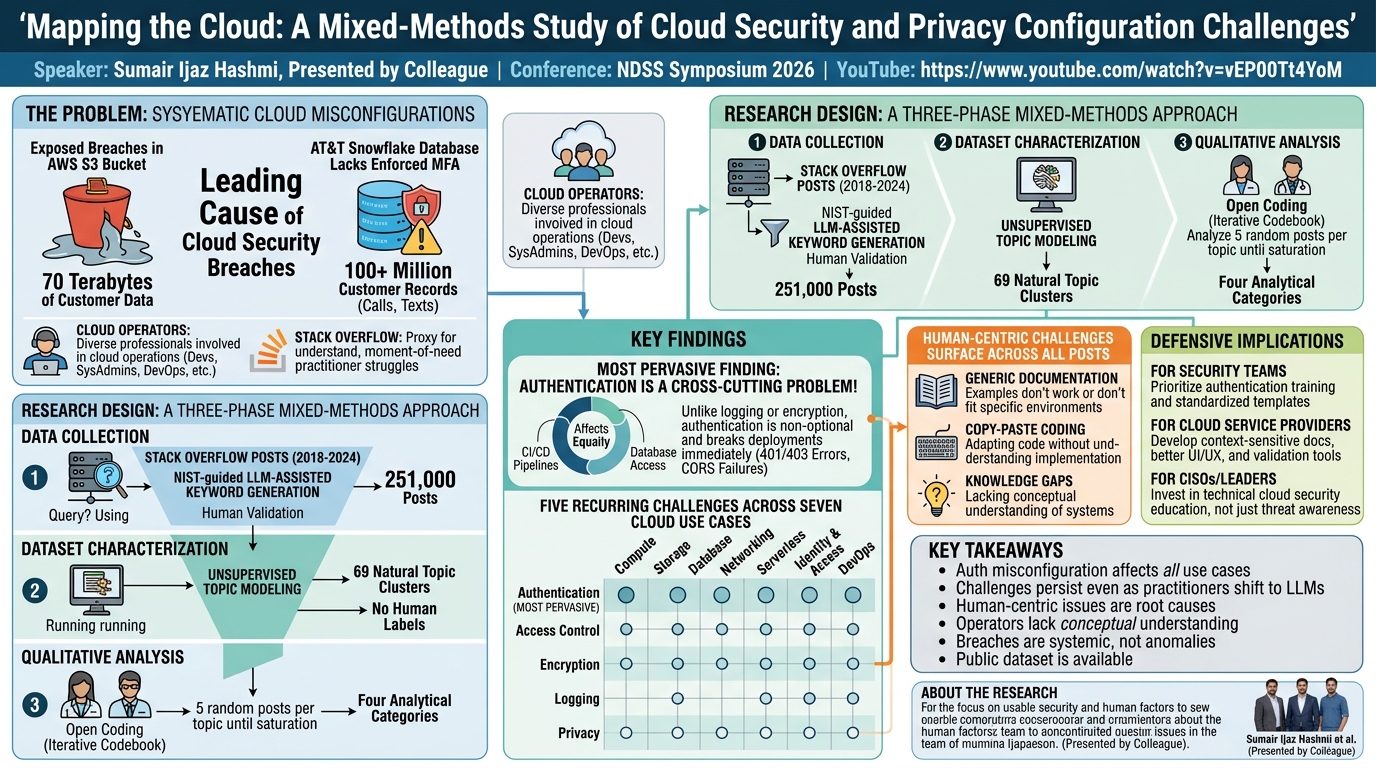
Cloud misconfigurations have repeatedly been identified as the leading cause of cloud security breaches, from exposed AWS S3 buckets leaking 70 terabytes of customer data to AT&T's Snowflake databases lacking enforced MFA that exposed call and text records of over 100 million customers. This talk presents a large-scale mixed-methods study of 251,000 Stack Overflow posts from 2018 to 2024, identifying the security and privacy configuration challenges that cloud operators face across the ecosystem. The analysis uncovers seven cloud use cases, five recurring security and privacy configuration challenges, and multiple human-centric challenges including generic documentation, tooling usability issues, copy-paste coding, and fundamental knowledge gaps. The most pervasive finding: authentication misconfiguration is a cross-cutting problem affecting every cloud use case, likely because unlike optional features like logging or encryption, authentication must be configured before anything else works, and even small mistakes break deployments.
Key moments
- 0:30 Motivating breaches: AWS S3 buckets and AT&T Snowflake databases
- 2:00 LLM-assisted keyword generation for security post identification
- 4:00 Unsupervised topic modeling of 251K Stack Overflow posts
- 6:00 Seven cloud use cases and five configuration challenges matrix
- 7:30 Authentication as the most pervasive cross-cutting challenge
- 9:30 Human-centric challenges: documentation, tooling, knowledge gaps
- 11:30 Answer strategies: explanations, code changes, and documentation referrals
Mapping the Cloud: A Mixed-Methods Study of Cloud Security and Privacy Configuration Challenges
Speakers: Sumair Ijaz Hashmi
Conference: NDSS Symposium 2026
YouTube: https://www.youtube.com/watch?v=vEP00Tt4YoM
Overview
Cloud misconfigurations have repeatedly been identified as the leading cause of cloud security breaches, from exposed AWS S3 buckets leaking 70 terabytes of customer data to AT&T's Snowflake databases lacking enforced MFA that exposed call and text records of over 100 million customers. This talk presents a large-scale mixed-methods study of 251,000 Stack Overflow posts from 2018 to 2024, identifying the security and privacy configuration challenges that cloud operators face across the ecosystem. The analysis uncovers seven cloud use cases, five recurring security and privacy configuration challenges, and multiple human-centric challenges including generic documentation, tooling usability issues, copy-paste coding, and fundamental knowledge gaps. The most pervasive finding: authentication misconfiguration is a cross-cutting problem affecting every cloud use case, likely because unlike optional features like logging or encryption, authentication must be configured before anything else works, and even small mistakes break deployments.
Background
▶ Watch: Motivating breaches: AWS S3 buckets and AT&T Snowflake databases (0:30)
Cloud misconfigurations are not one-off incidents but systematic issues in the cloud ecosystem. The term "cloud operators" encompasses the diverse professionals involved in cloud operations: developers, system administrators, network engineers, and DevOps practitioners. These professionals seek and share practical guidance through informal information sources like Stack Overflow, which prior research has shown shapes how security is understood and implemented.
The study explores three research questions: (1) what security and privacy configuration challenges do cloud operators face, (2) what human-centric challenges are associated with these tasks, and (3) what solution strategies do accepted answers provide. Stack Overflow serves as a proxy for understanding real-world cloud security struggles because it captures the moment when practitioners encounter problems they cannot solve independently.
The researchers used a three-phase mixed-methods approach: data collection (querying and filtering Stack Overflow posts), dataset characterization (unsupervised topic modeling), and qualitative analysis (open coding with iterative codebook development). An LLM-assisted keyword generation approach, guided by NIST standards and validated through human review, was used to identify security and privacy relevant posts within the broader cloud computing landscape.
Key Findings
▶ Watch: Unsupervised topic modeling of 251K Stack Overflow posts (4:00)
Authentication is the most pervasive challenge: Authentication misconfiguration appears across every cloud use case identified in the study. The researchers hypothesize this is because authentication is not optional -- it must be configured before anything else works -- and even minor errors can break CI/CD pipelines, database access, and API integrations. Common symptoms include HTTP 401 and 403 errors and CORS (Cross-Origin Resource Sharing) failures.
Five recurring security and privacy configuration challenges were identified across seven cloud use cases, forming a matrix of prevalence. The specific challenges include authentication, access control, encryption, logging, and privacy-related configurations. The matrix reveals that some challenges are concentrated in specific use cases while authentication is uniformly distributed.
Human-centric challenges surfacing across all posts include:
- Generic documentation: Existing help resources fail to provide tailored guidance for specific use cases, with examples that don't work or don't fit specific environments
- Tooling usability issues: Complex tools with poor visual interfaces from cloud service providers
- Copy-paste coding: Operators adapt code examples without understanding underlying implementation details
- Knowledge gaps: Operators lack conceptual understanding of the systems they work with, asking questions about how services work or what best practices exist
Answer strategies in accepted posts follow three patterns: explanations of the underlying problem (sometimes recommending entirely different services), specific code changes (editing attributes, configuring parameters, API usage guidance), and references to official documentation or external resources for self-directed learning.
Temporal persistence: Comparing posts from 2008-2022 and 2022-2024, the same high-level challenges persist in newer posts, though post volume has decreased as practitioners increasingly turn to LLMs for guidance.
Technical Deep Dive
▶ Watch: Seven cloud use cases and five configuration challenges matrix (6:00)
The methodology combines quantitative and qualitative approaches at scale. The initial dataset was constructed by querying Stack Overflow databases for posts containing cloud-related keywords and prominent hosting provider names, then filtering to the security/privacy intersection using an LLM-assisted keyword generation pipeline. The LLM was used in a human-in-the-loop process: prompts were overseen by researchers, generated keywords were validated for relevance, and keyword selection was guided by NIST security standards.
The resulting 251,000 posts were analyzed using unsupervised topic modeling to identify 69 naturally occurring topic clusters without human-assigned labels. This technique identifies word clusters that co-occur across posts, revealing naturally emerging themes in cloud security discussions.
For qualitative analysis, two researchers independently coded 5 random posts per topic using a bottom-up open coding approach, resolved disagreements to produce an initial codebook, then iteratively coded additional posts until saturation was reached per topic. This produced four analytical categories: cloud use cases, security and privacy configuration challenges, human-centric challenges, and answer strategies.
The extrapolation methodology from topic-level coding back to the full dataset provides an upper-bound estimate of challenge prevalence across use cases, acknowledging that posts may be double-counted across categories. The researchers validated temporal stability by comparing pre-2022 and post-2022 subsets.
Demo / Proof of Concept
▶ Watch: Human-centric challenges: documentation, tooling, knowledge gaps (9:30)
The study provides concrete examples from real Stack Overflow posts. One highlighted case shows an operator unable to access an AWS S3 bucket due to insufficient IAM privileges, expressing confusion over policy rules. The authentication bypass examples include misconfigured token scopes, incorrect environment-specific credentials, and improperly configured programmatic access to backend services. The real-world validation of findings is through the documented breaches -- the exposed AWS S3 buckets and the AT&T Snowflake incident -- which directly correspond to the configuration challenge categories identified in the study. The dataset and analysis artifacts are publicly available for future research.
Defensive Implications
▶ Watch: Answer strategies: explanations, code changes, and documentation referrals (11:30)
For cloud security teams, the finding that authentication is the most pervasive misconfiguration challenge should inform training and tooling priorities. If your team is struggling with authentication configuration, they are not alone -- this is a systemic problem across the cloud ecosystem. Investing in authentication-specific training, standardized configuration templates, and automated configuration validation could yield significant security improvements.
For cloud service providers (AWS, Azure, GCP), the documentation and usability findings point to concrete improvement opportunities. Generic documentation that fails to address specific use cases, visual interfaces that confuse operators, and APIs that are prone to copy-paste errors all contribute to misconfigurations. Providers should invest in context-sensitive documentation, improved UI/UX for security configuration, and validation tools that catch common misconfigurations before deployment.
For CISOs and security leaders, the knowledge gap finding is perhaps the most important. Operators are not just making mistakes -- they frequently lack the conceptual understanding to make informed decisions. This suggests that traditional security awareness training focused on threat awareness is insufficient; what is needed is technical cloud security education that builds genuine understanding of IAM, network security groups, encryption configuration, and service-specific security models.
The shift to LLMs for cloud security guidance introduces a new variable. If practitioners are moving from Stack Overflow to ChatGPT for configuration help, the quality and security of LLM-generated cloud configuration advice becomes a critical concern for the security community.
Key Takeaways
- Authentication misconfiguration is the most pervasive cloud security challenge, affecting every cloud use case
- Five recurring configuration challenges persist across the 2018-2024 timeframe, even as practitioner behavior shifts from Stack Overflow to LLMs
- Human-centric issues -- generic documentation, tooling usability, copy-paste coding, knowledge gaps -- are root causes of misconfigurations
- Cloud operators frequently lack conceptual understanding of the systems they configure, not just specific implementation knowledge
- The AT&T and AWS S3 breaches are not anomalies but symptoms of systematic cloud configuration challenges
- Answer strategies combine explanations, code changes, and documentation references, but rarely address underlying knowledge gaps
- The dataset of 251K posts is publicly available for further research
About the Speaker(s)
Sumair Ijaz Hashmi and co-authors were unable to attend due to visa issues; the talk was presented by a colleague. The research team focuses on usable security, cloud security, and human factors in security engineering. Their mixed-methods approach combines large-scale quantitative analysis with rigorous qualitative coding, producing both broad ecosystem mapping and detailed insight into practitioner challenges.
Reviews
Dr. Zero (Offensive Security Researcher) — WEAK
A large-scale study of cloud security misconfiguration challenges based on Stack Overflow posts. Confirms what everyone already knows -- cloud misconfigurations are prevalent and authentication is hard -- but provides no novel technical insights, no exploits, and no actionable offensive tradecraft.
Heather Calloway (CISO) — USEFUL
A comprehensive mapping of cloud security configuration challenges that quantifies what many security leaders intuitively know: authentication is the most pervasive problem, and human factors -- poor documentation, tooling usability, knowledge gaps -- are root causes. Useful for justifying training and tooling investments, but findings are more confirmatory than revelatory.
→ Top-rated talks at Network and Distributed System Security (NDSS) Symposium 2026
All talks from Network and Distributed System Security (NDSS) Symposium 2026