Icarus: Achieving Performant Asynchronous BFT with Only Optimistic Paths
Xiaohai Dai
Network and Distributed System Security (NDSS) Symposium 2026 · Day 3 · Applied Cryptography
Overview
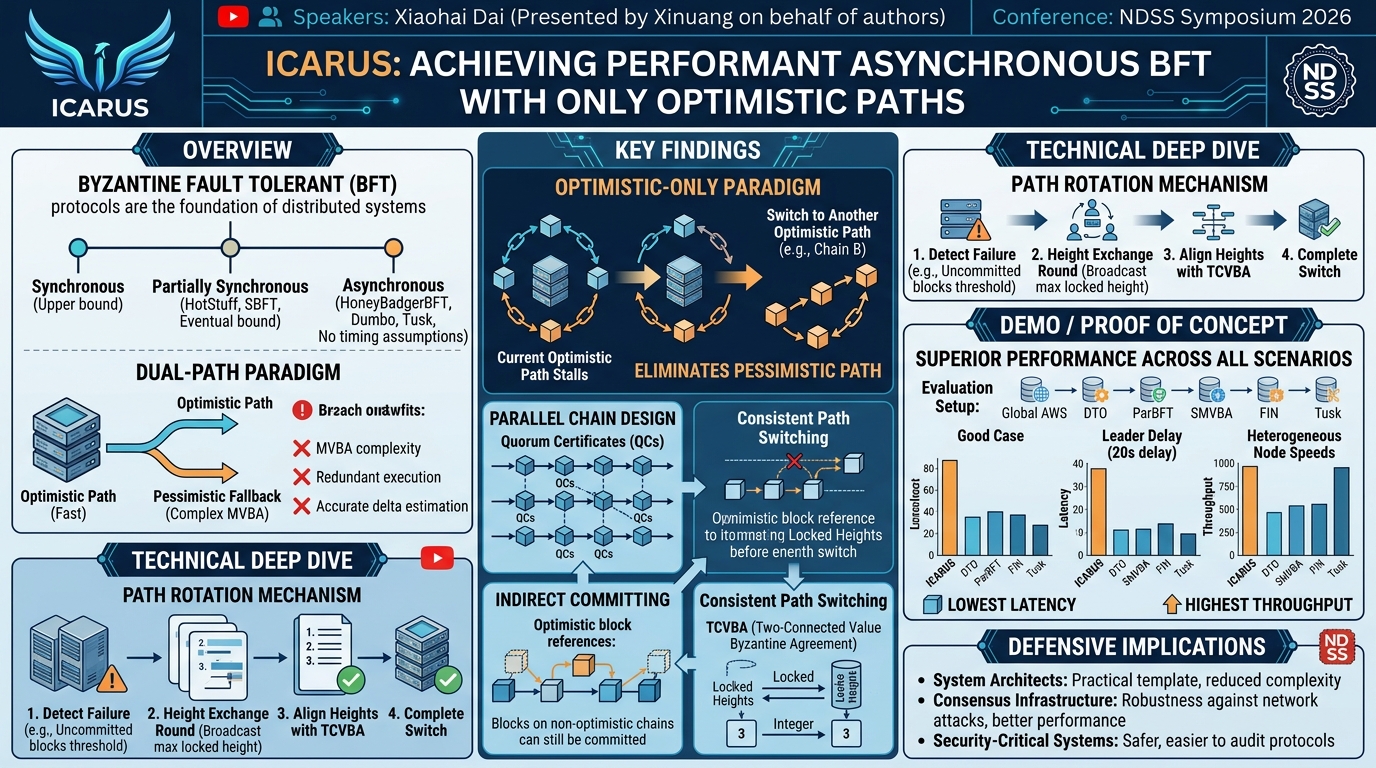
Byzantine Fault Tolerant (BFT) consensus protocols are foundational to distributed systems that must remain correct even when some nodes behave maliciously. Asynchronous BFT protocols offer the strongest robustness guarantees by making no timing assumptions about the network, but they traditionally suffer from low efficiency compared to partially synchronous alternatives. The current approach to improving asynchronous BFT efficiency uses a dual-path paradigm: an optimistic path leveraging a faster partially synchronous protocol, with a pessimistic fallback path using a complex asynchronous protocol like MVBA (Multi-Value Byzantine Agreement). This talk presents Icarus, which eliminates the pessimistic path entirely by introducing a new paradigm that runs only optimistic paths. When one optimistic path fails, the system switches to another optimistic path rather than falling back to a complex pessimistic protocol. Evaluated on AWS across five global regions, Icarus achieves the lowest latency and highest throughput compared to existing dual-path protocols (DTO, ParBFT), purely asynchronous protocols (SMVBA, FIN), and DAG-based protocols (Tusk).
Key moments
- 1:00 Background: synchronous, partial synchronous, and asynchronous BFT
- 2:30 Dual-path paradigm limitations: serial vs parallel approaches
- 4:00 TCVBA: key primitive for consistent path switching
- 5:30 Multi-chain architecture with direct and indirect committing
- 7:30 Height exchange and path rotation mechanism
- 9:30 Evaluation setup: AWS five regions, three baseline categories
- 11:00 Performance under leader delay and heterogeneous node speeds
Icarus: Achieving Performant Asynchronous BFT with Only Optimistic Paths
Speakers: Xiaohai Dai
Conference: NDSS Symposium 2026
YouTube: https://www.youtube.com/watch?v=bUaT3Z99Yr8
Overview
Byzantine Fault Tolerant (BFT) consensus protocols are foundational to distributed systems that must remain correct even when some nodes behave maliciously. Asynchronous BFT protocols offer the strongest robustness guarantees by making no timing assumptions about the network, but they traditionally suffer from low efficiency compared to partially synchronous alternatives. The current approach to improving asynchronous BFT efficiency uses a dual-path paradigm: an optimistic path leveraging a faster partially synchronous protocol, with a pessimistic fallback path using a complex asynchronous protocol like MVBA (Multi-Value Byzantine Agreement). This talk presents Icarus, which eliminates the pessimistic path entirely by introducing a new paradigm that runs only optimistic paths. When one optimistic path fails, the system switches to another optimistic path rather than falling back to a complex pessimistic protocol. Evaluated on AWS across five global regions, Icarus achieves the lowest latency and highest throughput compared to existing dual-path protocols (DTO, ParBFT), purely asynchronous protocols (SMVBA, FIN), and DAG-based protocols (Tusk).
Background
▶ Watch: Background: synchronous, partial synchronous, and asynchronous BFT (1:00)
In distributed systems, consensus protocols enable a group of independent servers (nodes) to act as a single reliable system. Byzantine Fault Tolerance handles the worst-case scenario where some nodes may behave arbitrarily (maliciously or erroneously). Based on timing assumptions, consensus protocols are classified as: synchronous (known upper bound on message delivery), partially synchronous (eventual known bound), or asynchronous (no timing assumptions).
Partially synchronous protocols like PBFT, HotStuff, and SBFT are more efficient but vulnerable to network attacks that violate timing assumptions. Asynchronous protocols like HoneyBadgerBFT, Dumbo, and Tusk are more robust but traditionally slower.
The dual-path paradigm attempts to combine the best of both: an optimistic path runs a fast partially synchronous protocol, while a pessimistic path provides an asynchronous fallback. In serial-path variants (DumboBooster, Transformer, DTO), the two paths run sequentially. In parallel-path variants (ParBFT, ABaxis), both paths run simultaneously. However, both variants suffer from: (1) the structural complexity and overhead of MVBA in the pessimistic path reducing throughput, (2) serial-path types requiring accurate delta estimation, and (3) parallel-path types wasting resources on redundant pessimistic path execution when the optimistic path succeeds.
Key Findings
▶ Watch: TCVBA: key primitive for consistent path switching (4:00)
Optimistic-only paradigm eliminates the pessimistic path: Icarus introduces a new diagram where the system runs only optimistic paths. When one optimistic path fails, it switches to another optimistic path rather than falling back to MVBA. This eliminates the structural complexity and overhead of the pessimistic path entirely.
Parallel chain design improves throughput: Each node continuously broadcasts a chain linked by Quorum Certificates (QCs). Chains take turns serving as the optimistic path. When the current optimistic path stalls, another chain becomes the new optimistic path. Blocks on non-optimistic chains can still be committed through indirect committing -- when a block on the optimistic path references and commits a block from another chain.
TCVBA enables consistent path switching: A key technical challenge is that different nodes may detect path failure at different heights. TCVBA (Two-Connected Value Byzantine Agreement), a variant of ABA that takes two connected integer values as input, aligns locked heights across nodes before switching, ensuring consistency.
Superior performance across all scenarios: On AWS with nodes spanning five regions, Icarus achieves the lowest latency and highest throughput compared to all baselines, including under leader delay scenarios (20-second delays) and heterogeneous node speed scenarios.
Technical Deep Dive
▶ Watch: Multi-chain architecture with direct and indirect committing (5:30)
Icarus employs a multi-chain architecture where each of N nodes maintains its own chain of blocks linked by Quorum Certificates. At any given time, one chain serves as the optimistic path, and blocks on this path can be committed through a two-phase commit rule (direct committing).
Path rotation mechanism: When the current optimistic path fails to advance (the leader is slow or Byzantine), the system initiates a path switch. The challenge is that nodes observe failure at different blockchain heights. To resolve this, Icarus conducts a height exchange round where each node broadcasts the largest height of its locked block. All nodes update to the maximum observed height. Then TCVBA aligns the locked heights and commits any pending blocks before the switch completes.
Indirect committing for throughput: Each block can reference blocks from other chains. When a block on the optimistic path is committed, its referenced blocks from other chains are also committed (indirect committing). This means work done on non-optimistic chains is not wasted, significantly improving throughput compared to dual-path designs where only optimistic path blocks are committed.
Failure detection: A non-optimistic chain triggers path rotation when it accumulates a threshold number of uncommitted blocks, indicating the current optimistic path is not progressing.
The protocol is implemented in Rust using a unified framework that also implements all baseline protocols for fair comparison.
Demo / Proof of Concept
▶ Watch: Evaluation setup: AWS five regions, three baseline categories (9:30)
The evaluation on AWS instances spanning five global regions tests three scenarios. In the good case (no faults, stable network), Icarus achieves the lowest latency and highest throughput among all protocols. Under leader delay (each optimistic leader delayed by 20 seconds), Icarus maintains the highest throughput because other chains continue growing unaffected, and it achieves the lowest latency by immediately committing on the new optimistic path. Under heterogeneous node speeds (one node generates blocks faster), Icarus quickly switches to the faster node's chain as the optimistic path, maintaining consistently high throughput and low latency. All baselines including DTO (serial dual-path), ParBFT (parallel dual-path), SMVBA and FIN (purely asynchronous), and Tusk (DAG-based) show inferior performance across all scenarios.
Defensive Implications
▶ Watch: Performance under leader delay and heterogeneous node speeds (11:00)
For distributed system architects, Icarus provides a practical template for building high-performance asynchronous BFT systems. The elimination of the pessimistic path reduces implementation complexity while improving performance, which is relevant for any system requiring Byzantine fault tolerance without timing assumptions.
For blockchain and consensus infrastructure, the performance improvements are directly applicable. Asynchronous BFT is increasingly preferred for its robustness against network-level attacks, but adoption has been limited by performance concerns. Icarus narrows this gap significantly.
For security-critical distributed systems, the key insight is that optimistic-only designs can provide the same safety guarantees as dual-path designs while avoiding the complexity and overhead of MVBA-based pessimistic paths. Simpler protocols are generally easier to audit and less prone to implementation bugs.
Key Takeaways
- The dual-path paradigm (optimistic + pessimistic) in asynchronous BFT has inherent efficiency limitations due to MVBA complexity
- Icarus eliminates the pessimistic path entirely, switching between optimistic paths when failures occur
- Parallel chain architecture with indirect committing ensures no work is wasted across chains
- TCVBA enables consistent path switching across nodes that detect failure at different heights
- Achieves lowest latency and highest throughput across all tested scenarios on AWS
- Implemented in Rust with unified framework for fair comparison against five baseline protocols
About the Speaker(s)
Xiaohai Dai is affiliated with the research team, with the talk presented by Xinuang from Shaanxi University on behalf of the authors who could not attend due to visa issues. The research focuses on Byzantine fault tolerant consensus protocols and distributed systems performance optimization.
Reviews
Dr. Zero (Offensive Security Researcher) — HARD PASS
A consensus protocol optimization that eliminates the pessimistic path in asynchronous BFT by switching between optimistic paths. Pure distributed systems engineering with zero security content -- no attacks, no vulnerabilities, no defensive insights.
Heather Calloway (CISO) — PASS
An optimization to asynchronous BFT consensus protocols relevant primarily to blockchain infrastructure and distributed systems. Limited applicability to enterprise security governance unless your organization is building or deploying consensus-based distributed systems.
→ Top-rated talks at Network and Distributed System Security (NDSS) Symposium 2026
All talks from Network and Distributed System Security (NDSS) Symposium 2026