Looma: A Low-Latency PQTLS Authentication Architecture for Cloud Applications
Xinshu Ma (University of Edinburgh)
Network and Distributed System Security (NDSS) Symposium 2026 · Day 3 · Cloud Security
Overview
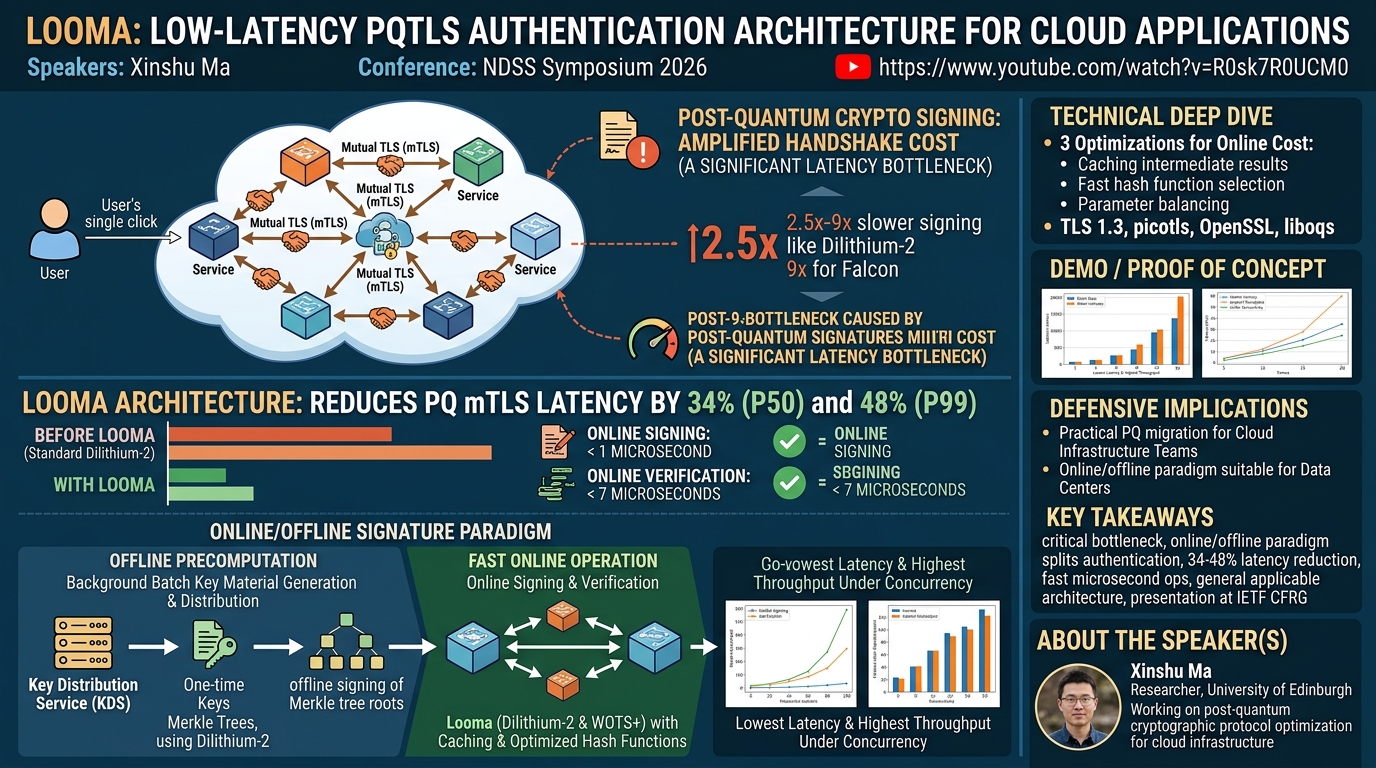
Cloud applications built from microservices create many internal network connections, each requiring mutual TLS (mTLS) authentication. As the industry transitions to post-quantum cryptography, the heavier signing operations of post-quantum algorithms (2.5x-9x slower than ECDSA) amplify the handshake cost, creating a significant latency bottleneck for cloud workloads. This talk presents Looma, an architecture that reduces post-quantum mTLS handshake latency by 34% at P50 and 48% at P99 compared to Dilithium-2 (the fastest PQ signature algorithm) by splitting authentication into offline precomputation and fast online operations using an online/offline signature paradigm. Online signing completes in under 1 microsecond and verification in under 7 microseconds. The approach is general, applying to different PQ signature schemes and TLS-like protocols including QUIC and PSP, and will be presented at the IETF CFRG session.
Key moments
- 1:00 Microservice architecture: one click, five services, five TLS handshakes
- 3:00 Post-quantum signature overhead: 2.5x-9x slower than ECDSA
- 5:30 Gap: no solution targeting PQ authentication latency under mTLS
- 7:00 Online/offline signature paradigm: precompute heavy part, fast online ops
- 9:30 Looma architecture: Key Distribution Service and TLS integration
- 11:30 Performance: 34% P50, 48% P99 latency reduction over Dilithium-2
- 13:30 Scalability under concurrent connections and IETF presentation planned
Looma: A Low-Latency PQTLS Authentication Architecture for Cloud Applications
Speakers: Xinshu Ma
Conference: NDSS Symposium 2026
YouTube: https://www.youtube.com/watch?v=R0sk7R0UCM0
Overview
Cloud applications built from microservices create many internal network connections, each requiring mutual TLS (mTLS) authentication. As the industry transitions to post-quantum cryptography, the heavier signing operations of post-quantum algorithms (2.5x-9x slower than ECDSA) amplify the handshake cost, creating a significant latency bottleneck for cloud workloads. This talk presents Looma, an architecture that reduces post-quantum mTLS handshake latency by 34% at P50 and 48% at P99 compared to Dilithium-2 (the fastest PQ signature algorithm) by splitting authentication into offline precomputation and fast online operations using an online/offline signature paradigm. Online signing completes in under 1 microsecond and verification in under 7 microseconds. The approach is general, applying to different PQ signature schemes and TLS-like protocols including QUIC and PSP, and will be presented at the IETF CFRG session.
Background
▶ Watch: Microservice architecture: one click, five services, five TLS handshakes (1:00)
Modern cloud applications decompose into microservices, each with its own IP address. A single user click can trigger multiple internal service-to-service connections. These connections require mTLS (both parties authenticate), creating handshake overhead at every hop. In data centers where round-trip times are 10-15 microseconds (vs. 10ms on the internet), cryptographic computation dominates handshake cost. Post-quantum signatures like Dilithium-2 (2.5x slower signing) and Falcon (9x slower) amplify this further. Existing acceleration approaches target hardware offloading (helps throughput, not latency), round-trip reduction (helps internet, not data center where crypto dominates), or faster key exchange (doesn't address authentication).
Key Findings
▶ Watch: Gap: no solution targeting PQ authentication latency under mTLS (5:30)
Online/offline signature paradigm suits data centers: Pre-generating one-time keys and constructing Merkle trees offline allows online signing and verification to be extremely fast. Data centers are ideal for this because services talk to a small, relatively stable set of peers, enabling key pre-distribution. A Key Distribution Service (KDS) handles background key material exchange.
34-48% handshake latency reduction: Looma reduces P50 mTLS latency by 34% and P99 by 48% compared to Dilithium-2, cutting both median and tail latency. Online signing completes in under 1 microsecond; verification in under 7 microseconds.
Scalable under concurrency: Under increasing load, Looma maintains the lowest latency and highest throughput compared to baselines, demonstrating good scalability.
Technical Deep Dive
▶ Watch: Online/offline signature paradigm: precompute heavy part, fast online ops (7:00)
Looma combines Dilithium-2 (for offline signing of Merkle tree roots) with WOTS+ (Winternitz One-Time Signature) for fast online operations. Three optimizations reduce online cost: caching intermediate hash results, selecting the fastest hash function through benchmarking, and choosing parameters that balance signature size and computational overhead. Background key generation runs asynchronously on a dedicated core, with batch key generation triggered when the count of valid keys drops below a threshold. The architecture integrates into TLS 1.3 via the picotls library with OpenSSL backend and liboqs for PQ algorithms.
Demo / Proof of Concept
▶ Watch: Performance: 34% P50, 48% P99 latency reduction over Dilithium-2 (11:30)
End-to-end benchmarks show Looma as the lowest-latency option across all test configurations. Under concurrent connections (many clients to one server), Looma stays lowest in latency and sustains the highest throughput.
Defensive Implications
▶ Watch: Scalability under concurrent connections and IETF presentation planned (13:30)
For cloud infrastructure teams planning PQ migration, Looma provides a practical path to post-quantum mTLS without the latency penalty. For protocol designers, the online/offline signature paradigm, previously used mainly for IoT, translates well to data center environments. The upcoming IETF CFRG presentation suggests potential standardization.
Key Takeaways
- Post-quantum mTLS handshake latency is a critical bottleneck for cloud microservice architectures
- Online/offline signature splits authentication into precomputation (offline) and fast operation (online)
- 34% P50 and 48% P99 latency reduction over Dilithium-2 baseline
- Online signing under 1 microsecond, verification under 7 microseconds
- General architecture applicable to different PQ signature schemes and protocols (TLS, QUIC, PSP)
- Being presented at IETF CFRG for potential standardization
About the Speaker(s)
Xinshu Ma is a researcher at the University of Edinburgh working on post-quantum cryptographic protocol optimization for cloud infrastructure. The work bridges applied cryptography with cloud systems performance engineering.
Reviews
Dr. Zero (Offensive Security Researcher) — WEAK
A post-quantum TLS optimization for cloud mTLS that reduces handshake latency through online/offline signature precomputation. Solid crypto engineering for the PQ migration challenge, but no offensive security content and limited relevance outside cloud infrastructure performance optimization.
Heather Calloway (CISO) — USEFUL
A practical architecture for reducing post-quantum TLS authentication latency in cloud environments. Relevant for organizations planning post-quantum migration, particularly those with latency-sensitive microservice architectures.
→ Top-rated talks at Network and Distributed System Security (NDSS) Symposium 2026
All talks from Network and Distributed System Security (NDSS) Symposium 2026