From Buffer Overflows to Breaking AI: Two Decades of ZDI Vulnerability Research
Brian Gorenc (Vice President of Threat Research · Trend Micro)
POC2025 (Power of Community) · Main Stage
Overview
In this keynote address at Power of Community (POC), Brian Gorenc, Vice President of Threat Research at Trend Micro, delivered a compelling retrospective on two decades of vulnerability research, primarily through the lens of the Zero Day Initiative (ZDI) program and the Pwn2Own hacking competition. Gorenc, acting as an "exploit historian," chronicled the evolution of attack surfaces, exploitation techniques, and the critical role ZDI has played in pushing security forward since its inception in 2005. The talk highlights how ZDI and Pwn2Own have adapted to shifting technological landscapes, from foundational browser and desktop vulnerabilities to the complex challenges posed by industrial control systems (ICS), the Internet of Things (IoT), automotive systems, and most recently, artificial intelligence (AI).
Key moments
- 4:40 ZDI's 20-year journey: foundational to AI
- 11:30 Pwn2Own competition founded in 2007
- 16:00 Vupin's Chrome exploit abusing clipboard deserialization
- 22:00 Complex multi-stage browser-to-host virtualization escape
- 27:00 Microsoft on Pwn2Own's mitigation improvements
- 42:00 Live demonstration: Tesla Model 3 Wi-Fi exploit
- 47:00 AI's role in finding vulnerabilities and future
From Buffer Overflows to Breaking AI: Two Decades of ZDI Vulnerability Research
Speakers: Brian Gorenc, Vice President of Threat Research, Trend Micro
Conference: POC
YouTube: https://www.youtube.com/watch?v=_eem7AVAMpI
Overview
In this keynote address at Power of Community (POC), Brian Gorenc, Vice President of Threat Research at Trend Micro, delivered a compelling retrospective on two decades of vulnerability research, primarily through the lens of the Zero Day Initiative (ZDI) program and the Pwn2Own hacking competition. Gorenc, acting as an "exploit historian," chronicled the evolution of attack surfaces, exploitation techniques, and the critical role ZDI has played in pushing security forward since its inception in 2005. The talk highlights how ZDI and Pwn2Own have adapted to shifting technological landscapes, from foundational browser and desktop vulnerabilities to the complex challenges posed by industrial control systems (ICS), the Internet of Things (IoT), automotive systems, and most recently, artificial intelligence (AI).
The presentation underscores the profound impact ZDI has had on the security ecosystem, not just by acquiring and disclosing vulnerabilities, but by fostering a global community of researchers and directly influencing vendor mitigation strategies. By analyzing thousands of submitted bugs and Pwn2Own exploits, ZDI has provided invaluable threat intelligence, driving significant improvements in software security across diverse industries. Gorenc’s journey through ZDI’s "phases"—foundational, transformational, ICS, IoT, automotive, and AI—illustrates a relentless pursuit of understanding and securing the ever-expanding digital frontier.
This article delves into the technical specifics and strategic insights shared by Gorenc, detailing the types of vulnerabilities discovered, the ingenuity of the exploits, and the defensive lessons learned over two decades. It provides a comprehensive overview of how a vendor-agnostic bug bounty program has shaped the modern cybersecurity landscape, emphasizing the continuous arms race between attackers and defenders.
Background
▶ Watch: ZDI's 20-year journey: foundational to AI (4:40)
The Zero Day Initiative (ZDI) was launched in 2005 as a vendor-agnostic bug bounty program, a pioneering effort to crowdsource vulnerability intelligence from researchers worldwide. Its core mission was, and remains, to acquire vulnerabilities, reverse-engineer submissions to understand attack surfaces, and responsibly disclose them to affected vendors, free of charge, to foster a more secure ecosystem. Initially, ZDI was part of 3Com, feeding threat intelligence into the TippingPoint IPS platform, which continues to benefit from ZDI's research under Trend Micro. In its inaugural year, ZDI disclosed just one vulnerability—a format string vulnerability in Veritas NetBackup—a stark contrast to the hundreds of bugs disclosed annually today.
During its foundational years (2005-2011), ZDI played a crucial role in defining early vulnerability research methodologies. Pedram Amini, a key figure in ZDI’s early days, significantly contributed to the field of fuzzing, even authoring a seminal book on the topic. The release of the Sulley fuzzing framework around 2008 showcased early network-based fuzzing, where Python scripts mutated protocol packets to uncover crashes and vulnerabilities. This period also saw the inception of the Pwn2Own competition in 2007, born from a challenge by Drako, the organizer of CanSecWest, who sought to debunk the perceived invulnerability of Mac OS X. ZDI provided the initial $10,000 prize, which Dino Dai Zovi claimed by exploiting a vulnerability in QuickTime on a MacBook, marking the birth of a competition that would become a global benchmark for exploit development. Pwn2Own quickly became a mechanism for ZDI to acquire high-quality, fully functional exploits, offering unique insights into attacker capabilities and driving significant security advancements.
The program's evolution continued through a transformational period (2012-2018), coinciding with Gorenc taking the helm and ZDI's transition to HP, and subsequently Trend Micro. This era saw a significant ramp-up in vulnerability disclosures and the global expansion of Pwn2Own, with competitions held in Vancouver, Berlin (co-hosted with OffensiveCon), Amsterdam, Tokyo, Toronto, Austin, and Ireland, alongside specialized events targeting mobile, ICS, and automotive systems. This expansion reflected ZDI's commitment to understanding and addressing the security challenges of an increasingly complex and interconnected digital world.
Key Findings
▶ Watch: Vupin's Chrome exploit abusing clipboard deserialization (16:00)
ZDI's two decades of vulnerability research have yielded several critical findings regarding the evolution of software security and exploitation techniques across various attack surfaces:
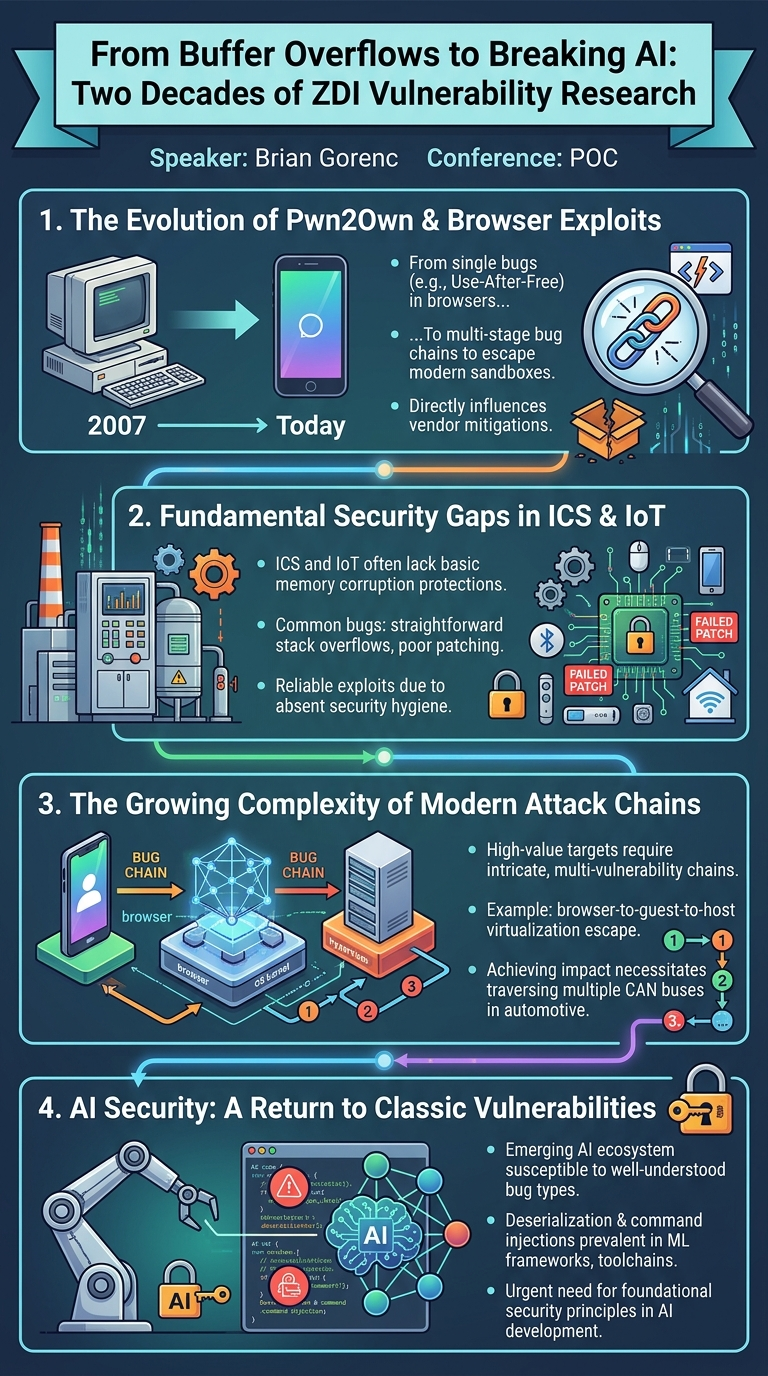
- The Browser Exploitation Arms Race: Pwn2Own vividly demonstrated the rapid evolution of browser security. Early exploits often relied on single vulnerabilities like use-after-frees (UAFs) in rendering engines to achieve code execution. However, the introduction of sandboxes by vendors forced attackers to develop sophisticated sandbox escape techniques, transitioning from OS-based protections (Windows station, job objects, mandatory integrity controls) to complex IPC (Inter-Process Communication) mechanism abuses and exploitation of undocumented features. Later, the shift moved from UAFs to JIT (Just-In-Time) compiler exploitation, significantly increasing the complexity and bug chain length required for successful attacks. This continuous escalation highlights the effectiveness of robust mitigation strategies in raising the bar for attackers.
- Lack of Basic Mitigations in Critical Infrastructure: When ZDI ventured into the Industrial Control Systems (ICS) and Internet of Things (IoT) spaces, a striking finding was the pervasive lack of fundamental security mitigations. Unlike mature client-side software, ICS and IoT products frequently exhibited vulnerabilities like straightforward stack-based buffer overflows, insecure default configurations, and poor credential management. Exploits in these environments were often 100% reliable due to the absence of modern memory corruption protections. This exposed a critical gap where basic security hygiene was largely absent, leaving vital infrastructure vulnerable to relatively unsophisticated attacks.
- Patch Quality and Regionality Challenges: Research in ICS and IoT also revealed persistent issues with patch quality, with many "failed patches" that either didn't fully resolve the vulnerability or introduced easily discoverable variants. This created a lucrative avenue for researchers to re-exploit previously "fixed" issues. Furthermore, the regionality of hardware—where devices with the same model number might have different internal chipsets depending on their target market—posed significant challenges for exploit development and reliability, often leading to exploit failures in Pwn2Own due to hardware variations.
- The Complexity of Modern Attack Chains: As attack surfaces diversified, so did the complexity of successful exploitation. High-value targets like virtualization platforms and automotive systems necessitated intricate bug chains. Examples include browser-to-guest OS kernel-to-hypervisor escapes, requiring multiple vulnerabilities to traverse security boundaries. In automotive, achieving meaningful impact often required pivoting across multiple CAN buses after initial code execution in embedded devices. The most complex chains observed involved up to 15 distinct bugs, showcasing the ingenuity of top-tier researchers.
- AI Security: A Return to Basics in a New Ecosystem: ZDI's most recent focus on AI security has revealed a surprising trend: many vulnerabilities in the emerging AI ecosystem are not novel, but rather a recurrence of classic bug types like deserialization vulnerabilities and command injections. These are prevalent in Machine Learning (ML) frameworks, AI toolchains, and Multi-Party Computation (MPC) implementations. This suggests that while AI technologies are cutting-edge, the underlying software infrastructure supporting them often lacks fundamental defense-in-depth and sandboxing, making them susceptible to well-understood attack vectors. This finding emphasizes the urgent need for foundational security principles to be applied rigorously in AI development.
Technical Deep Dive
▶ Watch: Complex multi-stage browser-to-host virtualization escape (22:00)
ZDI's 20-year retrospective provides a rich tapestry of technical evolution in vulnerability research, categorizing its journey into distinct phases, each defined by the prevailing attack surfaces and exploitation techniques.
Foundational Years (2005-2011)
In its early days, ZDI focused on traditional client-side and server-side applications. The very first advisory in 2005 targeted a format string vulnerability in Veritas NetBackup, highlighting a common class of bugs allowing memory manipulation and potential code execution. This era was characterized by the nascent stages of automated vulnerability discovery, with fuzzing gaining prominence. Pedram Amini's contributions to fuzzing methodologies and the release of tools like the Sulley fuzzing framework (a network-based fuzzer written in Python) were instrumental. Researchers would define network protocols and then mutate packets to trigger application crashes, which were then analyzed for exploitable conditions. Exploitation often involved direct memory corruption leading to remote code execution (RCE).
Transformational Years (2012-2018)
This period marked a significant shift, largely driven by the Pwn2Own competition, focusing on hardening browsers and operating systems.
- Browser Sandbox Evolution: The primary battleground was browser security. Initial exploits often leveraged single bugs like use-after-frees (UAFs) in rendering engines (e.g., in Internet Explorer) to achieve RCE. As browsers implemented sandboxes (e.g., Chrome's sandbox, leveraging Windows mechanisms like Windows station desktop isolation, job object limitations, mandatory integrity controls, and later App Containers), attackers were forced to develop sandbox escape techniques. This involved finding bugs in IPC mechanisms between the sandboxed renderer and the privileged broker process.
- Undocumented Features and System Behaviors: A notable exploit from Vupin against Chrome demonstrated abusing an undocumented Windows feature. After achieving code execution in the renderer process, the exploit serialized a COM object and placed it on the clipboard. Every subsequent access to the clipboard would trigger deserialization and code execution outside the sandbox, a technique that Google and Microsoft initially struggled to comprehend as a security boundary bypass. ZDI's internal research also led to a similar technique for Internet Explorer, where a UAF in the browser would spin up a web server on
localhostand redirect the browser to it. Since locally hosted pages were not sandboxed at the time, this allowed for sandbox escape, a design choice Microsoft never officially "fixed." - JIT Exploitation: Towards the end of this period, the focus shifted from UAFs to vulnerabilities in JavaScript JIT compilers. Samuel from Project Zero demonstrated a significant Safari JIT exploit at Pwn2Own 2018, showcasing the advanced techniques required to achieve code execution in increasingly hardened environments.
Virtualization and Mobile Exploitation
As attack surfaces diversified, Pwn2Own expanded to hypervisors and mobile devices.
- Hypervisor Escapes: Competitors frequently targeted virtualization products like Oracle VirtualBox and VMware Workstation. Early VirtualBox exploits often leveraged bugs in 3D acceleration components, which were later removed from the competition rules due to their abundance. VMware Workstation exploits, such as those targeting its "backdoor" code, demonstrated rapid guest-to-host escapes, challenging the notion of virtualization as a robust security boundary.
- Complex Bug Chains: The pinnacle of this era was the demonstration of multi-stage exploit chains. A particularly complex Pwn2Own entry involved compromising Microsoft Edge (via a JIT vulnerability), escaping its sandbox, escalating privileges in the guest Windows 10 kernel (using a kernel bug), and finally breaking out of VMware Workstation to achieve RCE on the host operating system, often by exploiting vulnerabilities in components like the VGA code. This required months of research and multiple distinct bugs.
- Mobile Persistence: Mobile targets, predominantly Apple iPhones and Samsung devices, also saw sophisticated attacks. Keen Lab demonstrated an exploit against a fully patched iPhone via Safari, which installed an application outside the App Store and maintained persistence across reboots, highlighting the challenges of securing embedded mobile platforms.
ICS Space
ZDI's foray into Industrial Control Systems (ICS) revealed a stark contrast in security maturity.
- Domain-Specific Language Exploitation: Products like Cogent Data Hub, a Human-Machine Interface (HMI) solution, exposed domain-specific languages over network services. Exploits leveraged these languages, not memory corruption, to achieve RCE on the server with 100% reliability, demonstrating how application-level logic flaws could be just as devastating as traditional memory corruption.
- Classic Memory Corruption: Other ICS products, such as Advantech Web Access, an HMI heavily used in IoT and ICS, were vulnerable to classic stack-based buffer overflows in their RPC endpoints, leading to easy RCE at
SYSTEMprivileges. This underscored the absence of basic exploit mitigations in these critical systems. - Specification-Level Vulnerabilities: Collaborations with spec manufacturers, notably for OPC UA, revealed vulnerabilities at the protocol level. An exploit bypassed all OPC UA security by targeting a flaw in its certificate implementation, allowing access to sensitive data like boiler temperatures and potentially enabling their manipulation.
IoT and Embedded Systems
The IoT space presented unique challenges, from firmware acquisition to platform diversity.
- Firmware Extraction: Gaining access to firmware was often the first hurdle. ZDI's hardware team developed glitching rigs to extract encrypted firmware from devices like EV chargers to facilitate static analysis.
- Emulated Exploitation: A significant trend emerged where researchers developed exploits for embedded devices using emulated hardware and firmware, never interacting with the physical device until the Pwn2Own competition itself.
- Device Diversity and Regionality: The same IoT device model could have different internal chipsets based on its region (e.g., European vs. US versions), leading to exploit failures. Rolling updates also meant devices might not be on the latest firmware, requiring exploits to target older versions.
- Common Targets: Pwn2Own Ireland showcased numerous exploits against printers, Ubiquiti UniFi AC AI Pro cameras, and Philips Hue bridges. The Hue bridge, in particular, saw 13 unique exploits in a single competition, demonstrating a wealth of undiscovered vulnerabilities. Canon devices were also targeted, allowing researchers to display custom images and gain shells.
- Emerging IoT: ZDI is also exploring future IoT targets like the Unitree robot dog, analyzing the attack surface of hybrid AI/robotics systems.
Automotive Systems
Automotive systems combine embedded challenges with complex network architectures and cloud connectivity.
- In-Vehicle Infotainment (IVI) and CAN Bus Pivoting: IVI systems were common targets, with exploits leading to code execution (e.g., installing Doom). However, achieving critical impact often required pivoting from the compromised IVI system across multiple CAN buses to access sensitive vehicle functions.
- EV Charger Exploitation: ZDI has extensively researched EV chargers, compromising virtually every type. Exploits included Bluetooth vulnerabilities in ChargePoint devices (allowing display manipulation), PHP vulnerabilities in prosumer Autel chargers, and flashing SOS signals on Phoenix Contact real-time embedded operating systems to demonstrate RCE. A particularly impactful finding was the ability to compromise a local EV charger and then pivot into its cloud infrastructure, potentially gaining control over an entire global grid of chargers.
- Tesla Wi-Fi Exploit: A notable exploit against a Tesla Model 3 leveraged a 1-byte overwrite vulnerability in its Wi-Fi system, allowing researchers to take control of the car remotely from outside the vehicle.
AI Era
The latest frontier for ZDI is AI security, which surprisingly reintroduces classic vulnerability types.
- Ecosystem Vulnerabilities: ZDI focuses on vulnerabilities within the broader AI ecosystem, including Multi-Party Computation (MPC) implementations, ML frameworks, AI toolchains, and AI workflow orchestration systems.
- Classic Bug Types: Despite the advanced nature of AI, common vulnerabilities are deserialization bugs and command injections. Examples include Isaac Root, an NVIDIA framework for AI/robotics, where deserialization of pickle files led to root access. Similarly, MLflow, an ML pipeline tool, was vulnerable to an authentication bypass combined with a deserialization flaw, resulting in RCE.
- AI-Assisted Vulnerability Discovery: Ironically, ZDI is now leveraging AI to find these vulnerabilities, indicating a future where AI will be both a target and a powerful tool in security research. The discussion around cyber reasoning systems (like OpenAI's Aardvark) suggests a shift from traditional fuzzing to AI-driven code analysis for pre-deployment vulnerability detection, though a blend of both approaches is likely.
Demo / Proof of Concept
▶ Watch: Live demonstration: Tesla Model 3 Wi-Fi exploit (42:00)
The talk was rich with demonstrations of various exploits, showcasing the evolution of attack complexity and targets over the years. These proofs of concept (PoCs) were pivotal in illustrating ZDI's journey and the impact of Pwn2Own.
- Vupin's Chrome Undocumented Feature Exploit: A striking example of browser sandbox escape was Vupin's Chrome exploit. After achieving code execution in the sandboxed renderer process, the exploit would serialize a COM object and place it onto the Windows clipboard. Subsequently, every time a user right-clicked on the desktop, accessing the clipboard, the object would deserialize, leading to calculator pop-ups outside the browser sandbox. This demonstrated a novel method of abusing system behaviors rather than direct sandbox bypasses.
- ZDI's Internet Explorer Localhost Redirect: An internally developed exploit for Internet Explorer showcased a clever sandbox escape. It leveraged a use-after-free vulnerability to spin up a web server on
localhostfrom within the compromised browser process. The browser was then redirected to thislocalhostaddress. Because local web pages were not subject to the same sandbox restrictions as remote ones at the time, this redirection allowed the exploit to execute arbitrary code outside the sandbox.
- Samuel's Safari JIT Exploit (Pwn2Own 2018): This demonstration highlighted the shift towards JIT exploitation. Samuel from Project Zero successfully achieved code execution within the Safari sandbox, illustrating the increasingly complex techniques required as browser mitigations matured.
- Oracle VirtualBox Escape: A Pwn2Own entry from a Chinese team demonstrated a guest-to-host escape in Oracle VirtualBox. While specific technical details were not fully elaborated in the talk, this represented a common class of vulnerabilities challenging the isolation promises of virtualization.
- VMware Workstation Escape: Another Chinese team's exploit against VMware Workstation showcased a rapid guest-to-host escape, believed to leverage a bug in VMware's "backdoor" code. The speed of the exploit underscored the critical implications of breaking hypervisor boundaries.
- Browser-to-VM Escape Chain (Edge, Windows 10, VMware Workstation): This was arguably the most complex demonstration. Starting from a JIT vulnerability in fully patched Microsoft Edge within a Windows 10 guest OS, the exploit chain involved:
- Breaking out of the Edge sandbox.
- Escalating privileges within the Windows 10 guest kernel using a kernel bug.
- Finally, escaping the VMware Workstation hypervisor (likely via a vulnerability in the VGA code) to achieve RCE on the host machine, culminating in a calculator pop-up. This multi-stage attack highlighted extreme ingenuity.
- Keen Lab iPhone Persistence: This mobile PoC, though initially failing at Pwn2Own, was later demonstrated via video. It involved a Safari vulnerability on a fully patched iPhone, which allowed the installation of an application outside the App Store. Crucially, the application maintained persistence across reboots, demonstrating a significant bypass of iOS security mechanisms.
- Cogent Data Hub HMI Exploitation: In the ICS space, an exploit against Cogent Data Hub, a Human-Machine Interface (HMI), used its domain-specific language exposed over a network service. This allowed for information disclosure and ultimately remote code execution, resulting in multiple calculator windows appearing on the SCADA HMI, without relying on traditional memory corruption.
- Advantech Web Access Stack-Based Overflow: An exploit against Advantech Web Access, another HMI product, utilized a classic stack-based buffer overflow in its RPC endpoints to achieve easy code execution on the server, again leading to calculator pop-ups.
- OPC UA Certificate Bypass: A Pwn2Own entry against OPC UA, a critical ICS interoperability framework, demonstrated a bypass of all security by exploiting a vulnerability in its certificate implementation. This allowed access and potential modification of critical industrial parameters, such as boiler temperatures.
- IoT Device Exploits (Printers, Cameras, Hue Bridge, Canon): The IoT section featured numerous PoCs from Pwn2Own Ireland:
- Shells gained on printers.
- Exploits against the UniFi AC AI Pro camera.
- Multiple unique exploits against the Philips Hue bridge.
- Custom images and shells on Canon devices.
- In-Vehicle Infotainment (IVI) Doom Install: An exploit by NCC Group against an IVI system demonstrated code execution by installing and playing Doom directly on the car's display.
- EV Charger Exploits:
- David from Synacktiv demonstrated a Bluetooth vulnerability in a ChargePoint device, allowing him to change the display colors to the French flag.
- PHP hooligans compromised an Autel prosumer EV charger.
- Exploits against Phoenix Contact OEM components in chargers, which run real-time embedded operating systems, demonstrated code execution by flashing SOS signals on the device's lights, as a traditional shell was not feasible.
- Cena's exploit against a Ubiquiti device rickrolled the audience, notably by enabling screen and camera features that were not yet officially activated by Ubiquiti.
- Tesla Model 3 Wi-Fi Exploit: One of the most visually impactful demos was an exploit against a Tesla Model 3. Researchers leveraged a 1-byte overwrite vulnerability in the car's Wi-Fi system to gain control of the vehicle remotely, causing its doors to open and close, much to the nervous applause of Tesla engineers present.
- Isaac Root Deserialization Exploit: In the AI space, an internal ZDI exploit targeted NVIDIA's Isaac Root framework. It leveraged a deserialization vulnerability in pickle files to achieve root access on the Groot system, demonstrating RCE in an AI/robotics platform.
- MLflow Authentication Bypass + Deserialization: Another AI ecosystem exploit targeted MLflow, an ML pipeline orchestration tool. This involved an authentication bypass followed by a deserialization vulnerability to achieve code execution.
These demonstrations collectively illustrate the ingenuity of researchers and the evolving landscape of cybersecurity, from simple desktop exploits to complex, multi-stage attacks on critical infrastructure and emerging AI technologies.
Defensive Implications
▶ Watch: AI's role in finding vulnerabilities and future (47:00)
The two decades of ZDI's vulnerability research offer critical insights for defenders across various sectors:
- Embrace Defense-in-Depth for All Systems: The transition from simple browser exploits to complex sandbox escapes and multi-stage bug chains in virtualization highlights the effectiveness of layered security. For any new technology, especially AI, basic defense-in-depth principles, including robust sandboxing, privilege separation, and secure IPC mechanisms, are non-negotiable. The initial lack of these in ICS, IoT, and early AI systems led to easily exploitable vulnerabilities.
- Prioritize Fundamental Security Practices: The prevalence of classic vulnerabilities like deserialization bugs and command injections in cutting-edge AI ecosystems is a strong indicator that foundational security practices are often overlooked in the rush to innovate. Developers in these emerging fields must re-emphasize secure coding guidelines, input validation, output encoding, and proper configuration management to prevent these well-understood attack vectors.
- Improve Patch Quality and Management: The recurring issue of "failed patches" and vulnerability variants in ICS and IoT underscores the need for more rigorous patch development and testing processes. Vendors must ensure that fixes are comprehensive and address the root cause of vulnerabilities, not just the immediate exploit vector. For defenders, this means validating patches thoroughly and being aware of potential variants, possibly by analyzing vendor patch diffs. Additionally, the challenges of rolling updates and regional hardware differences in IoT and automotive necessitate a flexible patching strategy that accounts for device heterogeneity and ensures older versions are also secured.
- Harden Undocumented Features and System Behaviors: The Vupin exploit abusing an undocumented Windows feature via the clipboard serves as a powerful reminder that attackers will exploit any available system behavior, documented or not. OS and application developers must proactively identify and secure such implicit attack surfaces, ensuring that unintended interactions do not lead to security bypasses.
- Secure the Ecosystem, Not Just the Core Product: In the AI space, the focus should extend beyond just the AI models themselves to the entire ecosystem: MPC implementations, ML frameworks, AI toolchains, and workflow orchestration systems. These peripheral components often present the weakest links. Similarly, in automotive, securing not just the in-vehicle systems but also the cloud infrastructure that vehicles connect to is paramount, given the demonstrated ability to pivot from a single compromised device to an entire fleet.
- Leverage Advanced Tools for Proactive Security: The discussion around AI-assisted reasoning systems for vulnerability discovery points to a future where defenders can proactively identify and eliminate bugs in source code before deployment. Integrating such tools into the software development lifecycle (SDLC) can significantly reduce the attack surface, complementing traditional fuzzing and manual review.
- Participate in and Learn from Security Research and Competitions: ZDI and Pwn2Own have directly influenced vendor security, with companies like Microsoft explicitly using Pwn2Own findings to implement mitigations (e.g., CFG, removal of Flash, win32k API hardening). Defenders should actively monitor findings from such competitions and research programs, internalizing the disclosed techniques and vulnerabilities to harden their own systems and inform their threat models.
Key Takeaways
- ZDI and Pwn2Own are critical drivers of security advancement: Over two decades, these programs have directly influenced vendor security, forcing the implementation of significant mitigations and raising the bar for attackers across various platforms.
- Exploitation complexity scales with defense: As systems become more hardened (e.g., browser sandboxes, hypervisors), attackers develop increasingly sophisticated, multi-stage bug chains to achieve their objectives.
- Fundamental vulnerabilities persist in new technologies: Cutting-edge fields like ICS, IoT, and AI are often plagued by classic bug types such as deserialization and command injection, highlighting a recurring need for basic security hygiene.
- Ecosystem-wide security is paramount: Attackers target the weakest link, whether it's an undocumented OS feature, an EV charger's cloud backend, or an AI toolchain, demonstrating the need to secure the entire interconnected environment, not just core components.
- Patching quality and device diversity are ongoing challenges: Especially in embedded and industrial systems, issues with incomplete patches, vulnerability variants, and regional hardware differences complicate defensive efforts and require robust patch management strategies.
- AI is both a target and a tool for security: While AI ecosystems present new attack surfaces, AI-assisted reasoning systems are emerging as powerful tools for proactive vulnerability discovery, shifting the paradigm of security research.
About the Speaker(s)
Brian Gorenc is the Vice President of Threat Research at Trend Micro. He is most widely recognized for his leadership of the Zero Day Initiative (ZDI) program, one of the world's largest vendor-agnostic bug bounty programs, and for organizing and adjudicating the globally renowned Pwn2Own hacking competitions. With a tenure spanning over a decade at ZDI, Gorenc has become an "exploit historian," providing unique insights into the evolution of vulnerability research and exploitation techniques across diverse technological landscapes. His work at Trend Micro and through ZDI has significantly contributed to advancing cybersecurity by fostering a global research community and driving essential security improvements in software and hardware products worldwide.
Reviews
Dr. Zero (Offensive Security Researcher) — STRONG ACCEPT
A genuinely valuable retrospective from someone who's seen more exploit submissions than almost anyone alive. Gorenc delivers real signal on how attack surfaces shifted, which mitigations actually worked, and where vendors consistently fumbled. Not novel research, but irreplaceable institutional knowledge from the ZDI archives.
Heather Calloway (CISO) — SOLID
A valuable institutional history of how exploit complexity has evolved over two decades, useful for calibrating expectations about patch cycles, attack surface expansion, and where your next surprise is coming from. Worth watching if you're new to the role or need to brief a board on why 'we patched it' isn't the end of the story.