(Sploit)Lights, Camera, Action! Exploiting Spotlight to Bypass TCC and Leak Data from Apple Intelligence
Christine Fossaceca (Senior Security Researcher · Microsoft)
POC2025 (Power of Community) · Main Stage
Overview
In this insightful talk, Christine Fossaceca, a Senior Security Researcher at Microsoft, unveiled two critical vulnerabilities, dubbed "Sploitlight 1.0" and "Sploitlight 2.0," demonstrating how Apple's Spotlight indexing service can be exploited to bypass Transparency, Consent, and Control (TCC) and exfiltrate sensitive user data. Fossaceca, collaborating with fellow researchers Jonathan Bar Or and Alexia Wilson, detailed a novel approach that leverages custom, unsigned Spotlight plugins to gain unauthorized access to TCC-protected files, including the newly generated and highly sensitive caches produced by Apple Intelligence.
Key moments
- 0:00 Introduction and talk agenda
- 2:30 Understanding TCC: Transparency, Consent, Control
- 11:49 Spotlight: Mac OS indexing service explained
- 18:18 MD worker's TCC entitlements and sandboxing
- 22:20 How custom Spotlight plugins enable exploitation
- 30:52 Sploit Light 1 demo: Leaking TCC-protected photos
- 32:44 Apple Intelligence: New data leak implications
- 44:00 Sploit Light 2.0: Covert channel after patch
(Sploit)Lights, Camera, Action! Exploiting Spotlight to Bypass TCC and Leak Data from Apple Intelligence
Speakers: Christine Fossaceca, Senior Security Researcher, Microsoft
Conference: POC
YouTube: https://www.youtube.com/watch?v=CbCuXnSTbls
Overview
In this insightful talk, Christine Fossaceca, a Senior Security Researcher at Microsoft, unveiled two critical vulnerabilities, dubbed "Sploitlight 1.0" and "Sploitlight 2.0," demonstrating how Apple's Spotlight indexing service can be exploited to bypass Transparency, Consent, and Control (TCC) and exfiltrate sensitive user data. Fossaceca, collaborating with fellow researchers Jonathan Bar Or and Alexia Wilson, detailed a novel approach that leverages custom, unsigned Spotlight plugins to gain unauthorized access to TCC-protected files, including the newly generated and highly sensitive caches produced by Apple Intelligence.
The talk is particularly timely given the increasing integration of generative AI features, such as Apple Intelligence, into operating systems. These AI capabilities, while enhancing user convenience, inadvertently create new repositories of highly enriched and summarized personal data. The research highlights that a TCC bypass, once achieved, gains access not only to traditional sensitive files (photos, documents) but also to these new, potent data caches, which can contain granular details like precise geolocation, biometric recognition, and summarized private communications.
The implications of this research are profound for both Apple's security model and user privacy. It exposes a fundamental architectural weakness within Spotlight, exacerbated by a permissive plugin ecosystem and insufficient sandboxing. The ability to persistently bypass TCC, even after Apple's initial patch, underscores the difficulty of securing complex systems where powerful entitlements intersect with user-extensible components. This work serves as a stark reminder for users to exercise extreme caution with application permissions and for developers to rigorously re-evaluate security boundaries in the age of pervasive AI.
Background
▶ Watch: Introduction and talk agenda (0:00)
To fully grasp the significance of the Sploitlight exploits, an understanding of Apple's core security mechanisms, TCC and entitlements, is crucial, alongside the architecture of the Spotlight service itself.
Transparency, Consent, and Control (TCC) is a fundamental privacy and security framework introduced by Apple across its operating systems (macOS, iOS, iPadOS, tvOS, watchOS, visionOS). Its primary purpose is to govern and restrict access to sensitive user data and system resources, such as location information, contacts, calendars, photos, microphone, camera, screen recording, and full disk access. Users typically interact with TCC through system preference panes or consent pop-ups, where they grant or deny applications access to these protected services. Under the hood, TCC services are managed by the TCCD daemon, which modifies a preferences database, TCCDB. There are both per-user and system-wide TCCDB files; the latter is additionally protected by System Integrity Protection (SIP), Apple's rootless security mechanism. A TCC bypass occurs when an attacker can access TCC-protected data without triggering a user prompt or obtaining explicit consent.
TCC bypasses are categorized into two types: partial and complete. A complete TCC bypass grants arbitrary access to any TCC service, often by directly manipulating the TCCDB. An example cited was the 2022 "PowerDur" vulnerability, which allowed planting a fake TCCDB. In contrast, a partial TCC bypass grants access only to a subset of TCC services, typically by exploiting an application that already possesses those specific entitlements. The 2023 "HM Surf" vulnerability, a Safari TCC bypass, is an example, as Safari inherently has access only to services like browsing history, camera, and microphone, and the exploit couldn't add new services.
Entitlements are another critical security mechanism, designed to tightly couple specific features or permissions with digitally signed binaries. In a perfect world, modifying entitlements would invalidate a binary's signature, preventing unauthorized privilege escalation. However, historical exploits have shown that implementation flaws can allow entitlement theft or misuse. Entitlements can be public (available to third-party developers, e.g., for network access), partner (issued per vendor, e.g., for endpoint security frameworks), or private (intended only for internal Apple processes). Private entitlements like com.apple.system.task_ports and com.apple.private.TCC.allow are particularly attractive targets for attackers, as the latter explicitly exempts a binary from TCC checks for enumerated services. Modern exploitation often focuses on binaries that already possess these powerful TCC-bypassing entitlements.
Spotlight is macOS's ubiquitous indexing and search service, enabling users to quickly find files, applications, and information across their machine and the internet. It operates continuously in the background, indexing file names and, crucially, file contents. The command-line utility MDFind provides a direct interface to its capabilities. Spotlight has a long history as an "attack-rich surface," with vulnerabilities dating back to at least 2014, and has been a subject of interest for security researchers like Patrick Wardle. Its complex architecture makes it prone to security oversights.
The Spotlight architecture involves several key binaries:
MDS: The orchestrator, responsible for launchingMDWorkerandMDWorkerSharedwithin a sandbox.MDWorkerandMDWorkerShared: These are the core indexer binaries, responsible for parsing file contents.spotlight-v100files: Where the indexed data is stored, and these files themselves are TCC-protected.CoreSpotlightd: Another daemon for interaction.- Command-line utilities:
MDFind,MDUtil, andMDImportallow direct interaction and testing.
A critical aspect of Spotlight's design is its extensibility through plugins, known as MDimporters. These plugins allow Spotlight to understand and index arbitrary file types. Apple provides numerous system-level MDimporter files for common types (e.g., Application.mdimporter, Archives.mdimporter). However, Apple also permits anyone to write and install their own MDimporter plugins into ~/Library/Spotlight. These custom plugins do not require digital signatures, nor do they need root privileges to install or run. This permissive design choice, intended to support third-party vendors (e.g., Microsoft writing a DOCX parser), creates a significant attack vector.
Crucially, the MDWorkerShared binary, responsible for executing these plugins, possesses powerful TCC-bypassing entitlements, including kTCCServiceSystemPolicyAllFiles (full disk access), as well as access to the address book, calendar, and reminders. While MDWorkerShared is theoretically sandboxed by MDS to restrict network access and forking, its flags none entitlement indicates a lack of hardened runtime protections. This combination of powerful entitlements, a permissive plugin loading mechanism, and insufficient runtime protections forms the bedrock for the Sploitlight exploits.
Key Findings
▶ Watch: Spotlight: Mac OS indexing service explained (11:49)
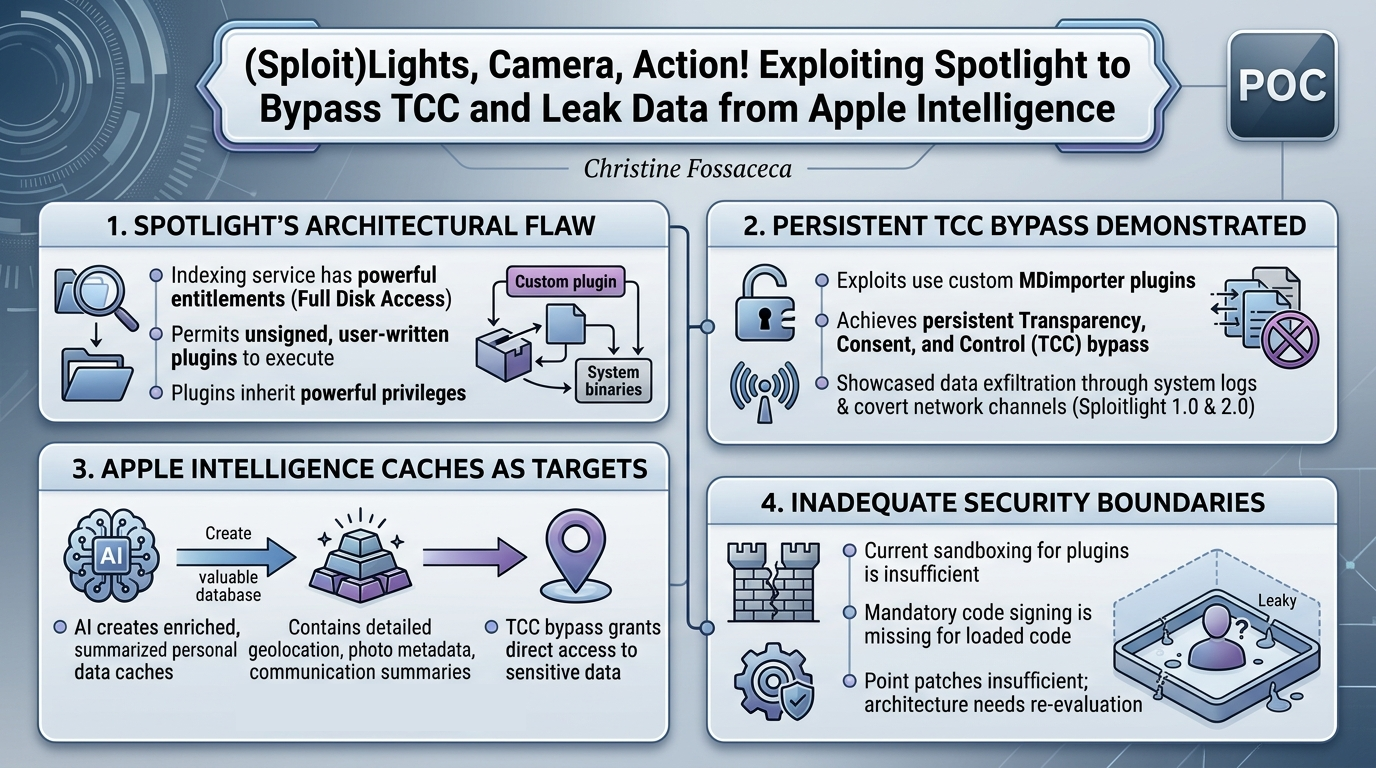
The central discovery of the Sploitlight research is the ability to leverage a seemingly innocuous feature – custom Spotlight plugins – to achieve a powerful TCC bypass, primarily due to architectural flaws and entitlement misconfigurations within Apple's macOS.
- Exploitable Entitlements in Sandboxed Process: The
MDWorkerSharedbinary, responsible for indexing files and executing Spotlight plugins, operates within a sandbox but is endowed with critical TCC-bypassing entitlements, most notablykTCCServiceSystemPolicyAllFiles, which grants full disk access. This means that any code executed withinMDWorkerSharedeffectively inherits this powerful privilege. - Unsigned, User-Controllable Plugins: Users can easily deploy their own Spotlight plugins (MDimporters) into
~/Library/Spotlight. These plugins do not require code signing, nor do they need elevated privileges (like root) to be installed or run. This allows an attacker to inject arbitrary code into the highly privileged, albeit sandboxed,MDWorkerSharedprocess. - Sploitlight 1.0: Data Exfiltration via System Log: The initial exploit demonstrated that a custom
MDimporterplugin could read the contents of any TCC-protected file (due toMDWorkerShared's full disk access entitlement) and then write that data directly to the system log. While the console log truncates large outputs, the researchers devised a method to chunk the data, allowing for complete file exfiltration. This bypass was patched by Apple under logging. - Sploitlight 2.0: Persistent Bypass via Covert Channel: Following Apple's patch for Sploitlight 1.0, the researchers discovered a variant. Although direct writing to the log was mitigated, failed network connection attempts by a sandboxed process still log the port number. This allowed the creation of a covert channel where each byte of sensitive data was encoded as a port number in a failed connection attempt, enabling byte-by-byte data exfiltration, albeit slower. Apple subsequently patched this as well.
- Apple Intelligence as a High-Value Target: The research highlighted that the rise of Apple Intelligence creates new, highly attractive targets for TCC bypasses. Apple Intelligence generates and caches vast amounts of enriched, summarized, and often duplicated sensitive data (e.g., detailed photo metadata, message summaries, email content, precise geolocation, user activity logs) in specific databases like
syndication.photoslibrary.database/photos.sqliteandKnowledgeCDB. A TCC bypass allows attackers to access these consolidated repositories of personal information, making targeted data exfiltration significantly easier and more impactful. - Inadequate Security Design: The overall findings point to fundamental design flaws in Spotlight's security architecture, including insufficient sandboxing for a process with such powerful entitlements, a lack of digital signature enforcement for loaded code, and the inherent difficulty of variant analysis for TCC bypasses, leading to persistent vulnerabilities.
Technical Deep Dive
▶ Watch: How custom Spotlight plugins enable exploitation (22:20)
The Sploitlight exploits hinge on the intersection of Spotlight's powerful entitlements, its extensible plugin architecture, and subtle channels for data exfiltration.
MDWorkerShared's Entitlements and Sandbox Limitations
The core of the vulnerability lies within MDWorkerShared, the binary responsible for parsing and indexing files. Examination of its entitlements reveals com.apple.private.TCC.allow, which explicitly enumerates several TCC services that MDWorkerShared can access without user consent. The most critical of these is kTCCServiceSystemPolicyAllFiles, granting the process full disk access. Other listed services include access to the address book, calendar, and reminders.
Despite these powerful entitlements, MDWorkerShared is designed to run within a sandbox, enforced by the MDS launcher. The sandbox profile aims to restrict typical exploitation techniques, preventing network access, arbitrary forking, and direct external data leakage. However, a crucial detail highlighted in the talk is the flags none designation for MDWorkerShared, indicating a lack of hardened runtime protections that would typically be applied to sensitive system binaries. This means that while sandboxed, the process lacks additional hardening measures against memory corruption or code injection.
Custom Spotlight Plugins (MDimporters)
The Achilles' heel of this architecture is the ability for any user to install custom MDimporter plugins. These plugins are simply bundles (.mdimporter extension) placed within ~/Library/Spotlight. They do not require a digital signature, nor do they need root privileges to operate. This allows an attacker to introduce arbitrary code that MDWorkerShared will execute.
A basic MDimporter plugin requires:
info.plist: Defines the Uniform Type Identifiers (UTIs) of the file types the plugin is designed to parse.schema.xml: Contains similar metadata about the data types.getMetadataForFilemethod: The core function where the plugin's logic resides. This method is called byMDWorkerSharedwhen it encounters a file matching the plugin's defined UTIs.
The research leveraged Chaba Fitzell's prior work on Spotlight plugins as a persistence mechanism to construct their own MDimporter.
Sploitlight 1.0: Exfiltrating Data via the Standard Log
The first iteration of the exploit, Sploitlight 1.0, focused on using the getMetadataForFile method to read TCC-protected files and then write their contents to the standard system log.
Exploitation Steps:
- Plugin Deployment: The malicious
MDimporterbundle, containing custom code within itsgetMetadataForFilefunction, is placed in~/Library/Spotlight. - File Reading: Inside
getMetadataForFile, the plugin points to a target file (e.g., a TCC-protected photo fromPhotos.photoslibrary). TheMDWorkerSharedprocess, due to itskTCCServiceSystemPolicyAllFilesentitlement, can read this file without any TCC prompt. - Data Leakage: The read file contents are then written to the system log. Initially, the researchers found that the console truncated output at 40 bytes. To overcome this, they implemented a chunking mechanism, reading and logging the file byte-by-byte or in small segments.
- Forced Triggering: To prevent waiting for Spotlight's background indexing, the
mdimportcommand-line utility was used.mdimport -t <plugin_path> -f <target_file_or_directory>forces Spotlight to load and execute the specified plugin against the target, immediately triggering the data exfiltration. - Arbitrary UTI Handling: To leak arbitrary file types, the
info.plistandschema.xmlwere modified to include a broad range of UTIs. Tools likeUTTypeorMDLScan identify a file's UTI. The researchers noted the existence of "dynamic types" (dyn.) for undefined file types, which, while changing across machines, could still be leveraged by dynamically adapting the plugin'sinfo.plistwithout recompilation.
The demo for Sploitlight 1.0 vividly showed ls failing on Photos.photoslibrary (Operation not permitted) but then the exploit successfully indexing and leaking photo data to the console.
Sploitlight 2.0: Covert Channel via Failed Network Connections
Apple patched Sploitlight 1.0 by addressing the logging mechanism, preventing MDimporter plugins from writing arbitrary data to the system log. The patch was surprisingly broad, affecting iOS, iPadOS, VisionOS, and macOS. However, the underlying architectural flaw persisted.
Jonathan Bar Or conceived Sploitlight 2.0. The core idea was to find another channel that, despite the sandbox, would still log information that could be controlled by the plugin. He discovered that failed network connection attempts by a sandboxed process would still log the port number of the failed connection.
Exploitation Steps (Sploitlight 2.0):
- Re-purposed
getMetadataForFile: Instead of writing to the log, thegetMetadataForFilefunction was modified. - Byte-by-Byte Encoding: For each byte of the target TCC-protected file, the plugin would attempt to open a network socket to a non-existent local address, using the byte's value (plus an offset, e.g., 1000, to ensure it was a valid port number) as the port.
- Covert Channel: When the connection failed (as expected, due to sandbox restrictions or no listening service), the operating system would log the attempted port number. By reading these logged port numbers, an attacker could reconstruct the original file's contents byte by byte. This created a slower but effective covert channel for data exfiltration.
This second exploit confirmed that merely patching the immediate exfiltration method (logging) was insufficient without addressing the fundamental ability of unsigned, user-controlled code to run with powerful TCC bypass entitlements within the Spotlight architecture.
Apple Intelligence and New Data Targets
The advent of Apple Intelligence dramatically increases the impact of these TCC bypasses. Apple Intelligence, designed as a "personal AI assistant," creates and caches vast amounts of enriched data across the system:
- Assistive Writing & Summaries: Mail, Notes, notifications, and smart replies generate summaries of communications, which can contain the full content of short messages or key excerpts of longer ones.
- Enhanced Photo Search: Beyond basic facial recognition, AI tags photos with highly detailed metadata, such as specific dog breeds or objects in an image. This data is stored in databases like
syndication.photoslibrary.database/photos.sqlite, which can contain geolocation, user activity, and even deleted photo information. - Audio Transcription: Transcriptions of audio recordings.
KnowledgeCDB: An "events database" logging nearly all user activity, including app openings, interactions, and more.- iMessage and Email Content: While iMessages are encrypted, AI summaries of these messages, if generated, might expose their contents. Similarly, email summaries can reveal sensitive information.
- Weather Data: Extremely precise latitude/longitude information, typically locked down by specific entitlements, can be leaked.
All this AI-generated data, even if TCC-protected, becomes directly accessible through a Spotlight TCC bypass. This means an attacker can bypass traditional file-by-file searching and instead target consolidated, pre-summarized repositories of highly sensitive information, significantly streamlining data discovery and exfiltration. The synchronization of this data across devices via iCloud further compounds the privacy risk if a user logs into multiple machines (e.g., work and personal) with the same account.
Demo / Proof of Concept
▶ Watch: Sploit Light 1 demo: Leaking TCC-protected photos (30:52)
The talk included a clear demonstration of the Sploitlight 1.0 exploit, showcasing its ability to bypass TCC protection for the Photos library.
The demonstration began by attempting to list the contents of the Photos.photoslibrary directory using the ls command. As expected for a TCC-protected directory, the command failed with an "Operation not permitted" error. This visually confirmed that the directory was indeed protected by TCC.
Next, the exploit was executed. The process involved:
- Deployment: The custom
MDimporterplugin, designed to read file contents and log them, was copied to the~/Library/Spotlightdirectory. - Triggering: The
mdimportutility was invoked, forcing Spotlight to load and run the malicious plugin. The plugin was specifically pointed to thePhotos.photoslibrarydirectory. - Exfiltration: As the video played, the system console log began to fill with output. This output consisted of the metadata and, critically, the contents (or at least significant portions of the contents) of the photos stored within the TCC-protected library. The visual evidence of photo data being dumped to the log, despite the earlier "operation not permitted" error, unequivocally demonstrated the successful TCC bypass and data leakage.
The demonstration effectively conveyed how effortlessly an attacker could leverage this vulnerability to gain unauthorized access to deeply personal and TCC-protected information, highlighting the severity of the architectural flaws. While Sploitlight 2.0 (the covert channel) was not demonstrated live, its mechanism was thoroughly explained as a proof-of-concept for circumventing Apple's initial patch.
Defensive Implications
▶ Watch: Sploit Light 2.0: Covert channel after patch (44:00)
The Sploitlight research carries significant defensive implications for both end-users and Apple as the platform vendor. The core message is that TCC, in its current implementation, is not a sufficient bulwark against data leakage, especially with the proliferation of AI-generated sensitive data.
For End-Users: Heightened Vigilance and Awareness
- Extreme Caution with Permissions: Users must exercise extreme caution when granting permissions, particularly "Full Disk Access," to any third-party application. The talk emphasized that a user might innocently grant access to an AI avatar app, unaware that this could expose not just a few photos but also deeply enriched metadata, precise geolocation, and even inferred personal details from their entire photo library and other TCC-protected data. The implications of AI-generated summaries (e.g., iMessage, email) also mean that granting access to messaging or mail apps can expose content that would otherwise be considered private.
- Understand AI Data Generation: Users need to understand that AI features, while convenient, generate and cache new repositories of highly sensitive, often summarized, personal data. This data becomes a prime target for TCC bypasses. What was once scattered across many files is now consolidated and enriched, making it easier for an attacker to find valuable information.
- Avoid iCloud Cross-Contamination: The synchronization of Apple Intelligence data via iCloud poses a significant risk. Users should avoid logging into work computers with personal iCloud accounts, or vice-versa, to prevent unintended cross-contamination and indexing of sensitive data between professional and personal spheres.
- Privacy Settings Review: Regularly review and restrict app access in privacy settings. While a TCC bypass circumvents these, minimizing the attack surface is always a best practice.
For Apple and Platform Developers: Architectural Rethink
- Re-evaluate TCC Efficacy: The persistent bypasses demonstrate that TCC, despite its intent, is not robust enough against determined attackers, especially when combined with powerful entitlements and design flaws. Apple's increased bounty for TCC bypasses acknowledges their criticality, but deeper architectural changes are needed.
- Secure Spotlight Architecture: Spotlight's design as an "attack-rich surface" requires a fundamental overhaul. Key areas for improvement include:
- Strict Entitlement Management: Re-evaluate the necessity of
kTCCServiceSystemPolicyAllFilesfor a component that executes user-supplied code. Least privilege principles should be rigorously applied. - Mandatory Code Signing for Plugins: The ability to run unsigned
MDimporterplugins from a user-writable directory (~/Library/Spotlight) is a critical vulnerability. All code executed by privileged system services should be signed and verified. - Enhanced Sandboxing: The existing sandbox for
MDWorkerSharedproved insufficient. A more restrictive sandbox, potentially combined with hardened runtime protections, is necessary to prevent data exfiltration channels, even indirect ones like logging or network connection failures. - Hardened Runtime: The
flags nonestatus ofMDWorkerSharedindicates a lack of modern runtime protections. Implementing hardened runtime would add layers of defense against code injection and other exploitation techniques.
- Protect AI-Generated Data: The new caches created by Apple Intelligence represent a high-value target. Apple must ensure that these data stores are not only TCC-protected but also employ additional layers of encryption and access control that are resilient to TCC bypasses. The aggregation and enrichment of data, while convenient for AI, also centralizes sensitive information, making it more attractive for attackers.
- Address Variant Analysis Challenges: The difficulty of variant analysis, as highlighted by the Sploitlight 2.0 bypass, suggests that point-in-time patches for specific exfiltration channels are insufficient. A more holistic, architectural approach is needed to prevent future bypasses that exploit similar underlying flaws.
- Transparency and User Education: Apple should consider more transparent communication with users about the types of data AI features collect, generate, and store, and the security implications. Relying solely on a generic TCC prompt is insufficient for the complex landscape of AI privacy.
Key Takeaways
- Spotlight's Architectural Flaws: Apple's Spotlight service, despite its utility, possesses fundamental architectural weaknesses, including powerful entitlements for its indexing processes (
MDWorkerShared) and a permissive plugin loading mechanism (unsignedMDimporters), making it a persistent "attack-rich surface." - TCC Bypasses via Custom Plugins: Attackers can craft and deploy unsigned
MDimporterplugins to inject arbitrary code intoMDWorkerShared, leveraging itskTCCServiceSystemPolicyAllFilesentitlement to bypass TCC and gain full disk access without user consent. - Persistent Data Exfiltration: The research demonstrated two distinct TCC bypasses: Sploitlight 1.0, which leaked arbitrary file contents to the system log, and Sploitlight 2.0, a covert channel that exfiltrated data byte-by-byte via failed network connection log entries, proving the difficulty of patching the underlying vulnerability.
- Apple Intelligence as a High-Value Target: The rise of Apple Intelligence creates new, highly enriched caches of sensitive user data (e.g., detailed photo metadata, message summaries, precise geolocation). A TCC bypass grants direct access to these consolidated repositories, significantly amplifying the impact of data leakage.
- Inadequate Security Controls: The current sandboxing and digital signature enforcement for Spotlight plugins are insufficient. Apple needs to implement stricter controls, including mandatory code signing and robust runtime protections, to prevent unauthorized code execution within privileged contexts.
- User Vigilance is Paramount: Users must exercise extreme caution when granting permissions, especially "Full Disk Access," to third-party applications, particularly those offering AI features, as this can expose vast amounts of personal and enriched data.
About the Speaker(s)
Christine Fossaceca is a Senior Security Researcher at Microsoft. She recently joined Microsoft's Threat Intelligence team, bringing extensive experience from her previous role working on Defender for iOS and macOS. Her work at Microsoft also includes contributing to Security Copilot, where she helped ship its file analyzer. Christine has collaborated with Microsoft Threat Intelligence on tracking in-the-wild exploitation and has presented with organizations such as Citizen Lab and Amnesty International. Her background includes iOS exploit development, which she transitioned from when joining Microsoft.
Christine's co-researchers for this project were Jonathan Bar Or and Alexia Wilson. Jonathan Bar Or, affectionately described by Christine as someone whose touch "turns to CVE," is recognized as an incredible researcher with deep knowledge across various platforms. Alexia Wilson is another highly skilled security researcher and developer, who has contributed to the Defender engine team by writing code for macOS.
Reviews
Dr. Zero (Offensive Security Researcher) — SOLID
Solid TCC bypass research with a real exploit chain, good demo, and timely Apple Intelligence angle. Not paradigm-shifting, but the work is original, the bugs are real (CVEs issued, patches shipped), and the Apple Intelligence data aggregation point is underappreciated. Would've been a 5 with deeper variant analysis or architectural recommendations beyond 'Apple should fix this.'
Heather Calloway (CISO) — STRONG ACCEPT
This is exactly the kind of research every CISO with Apple in their fleet should understand. A TCC bypass via unsigned Spotlight plugins that grants full disk access — and now, with Apple Intelligence, that means access to consolidated AI-generated summaries of messages, photos with precise geolocation, and user activity logs. The attack surface just got richer, and the data exposure got worse.