Everything You Need to Know About Cyber
Liam (Executive Director · CyberCX)
purplecon 2024 · Day 1 · Main Room
Overview
In his purplecon talk, "Everything You Need to Know About Cyber," Liam, an Executive Director specializing in offensive security at CyberCX, delivered a comprehensive, high-level overview of the vast and ever-evolving cybersecurity landscape. Acknowledging the impossibility of any single individual mastering every facet of the field, Liam’s presentation aimed to provide attendees with a foundational understanding of its diverse domains, from defensive operations and incident response to offensive techniques, application security, and strategic governance.
Key moments
- 0:00 Introduction to Cyber's vast and evolving landscape
- 3:15 Security Operations: Emphasizing people over tools and processes
- 7:00 Incident Response: Critical importance of preparation and communication
- 12:00 Understanding Red, Blue, and effective Purple Teaming exercises
- 14:00 Application Security: Pushing security left in development lifecycle
- 17:00 Identity and Access Management: The critical foundation for security
- 21:30 GRC and Strategy: Why a people-centric approach is vital
- 24:00 Conclusion: Nobody knows everything, but teamwork provides all answers
Everything You Need to Know About Cyber
Speakers: Liam, Executive Director, CyberCX
Conference: purplecon
YouTube: https://www.youtube.com/watch?v=y7RoA0eF-Bw
Overview
In his purplecon talk, "Everything You Need to Know About Cyber," Liam, an Executive Director specializing in offensive security at CyberCX, delivered a comprehensive, high-level overview of the vast and ever-evolving cybersecurity landscape. Acknowledging the impossibility of any single individual mastering every facet of the field, Liam’s presentation aimed to provide attendees with a foundational understanding of its diverse domains, from defensive operations and incident response to offensive techniques, application security, and strategic governance.
The talk underscored a critical overarching theme: the paramount importance of people in cybersecurity, followed by processes, and then technology. Liam argued that while tools are often the initial focus, it is the human element—their decisions, training, and collaboration—that ultimately determines an organization's security posture. His presentation served as a valuable primer for anyone navigating the complexities of modern cyber defense and offense, emphasizing that collective expertise is the only viable path forward in an industry characterized by constant change.
Background
▶ Watch: Introduction to Cyber's vast and evolving landscape (0:00)
The evolution of the cybersecurity domain is marked by a shift in terminology and scope. Liam, drawing on his extensive experience, noted the transition from the narrower "information security" to the expansive and somewhat ambiguous term "cyber." This rebranding reflects the dramatic growth and diversification of the field, encompassing an incredibly broad array of disciplines and technologies. The speaker candidly admitted that no one, including himself, can be an expert in all areas of cyber, a reality that necessitates a "wide, not deep" approach for an introductory talk of this nature.
The inherent complexity of cybersecurity also gives rise to a multitude of terminologies and conceptual models, which can sometimes overlap or even compete. Liam emphasized that different ways of categorizing and understanding these domains are valid, and his presentation offered one particular framework for navigating this intricate landscape. The underlying problem this talk addresses is the sheer scale of modern cyber threats and defensive requirements, which demands a holistic yet structured approach to understanding and managing risk across an organization. It sets the stage for recognizing that effective cybersecurity is not merely a technical challenge but a multifaceted endeavor involving strategic planning, human factors, and continuous adaptation.
Key Findings
▶ Watch: Incident Response: Critical importance of preparation and communication (7:00)
Liam's talk, while broad in scope, delivered several critical findings and recurring themes that are fundamental to effective cybersecurity.
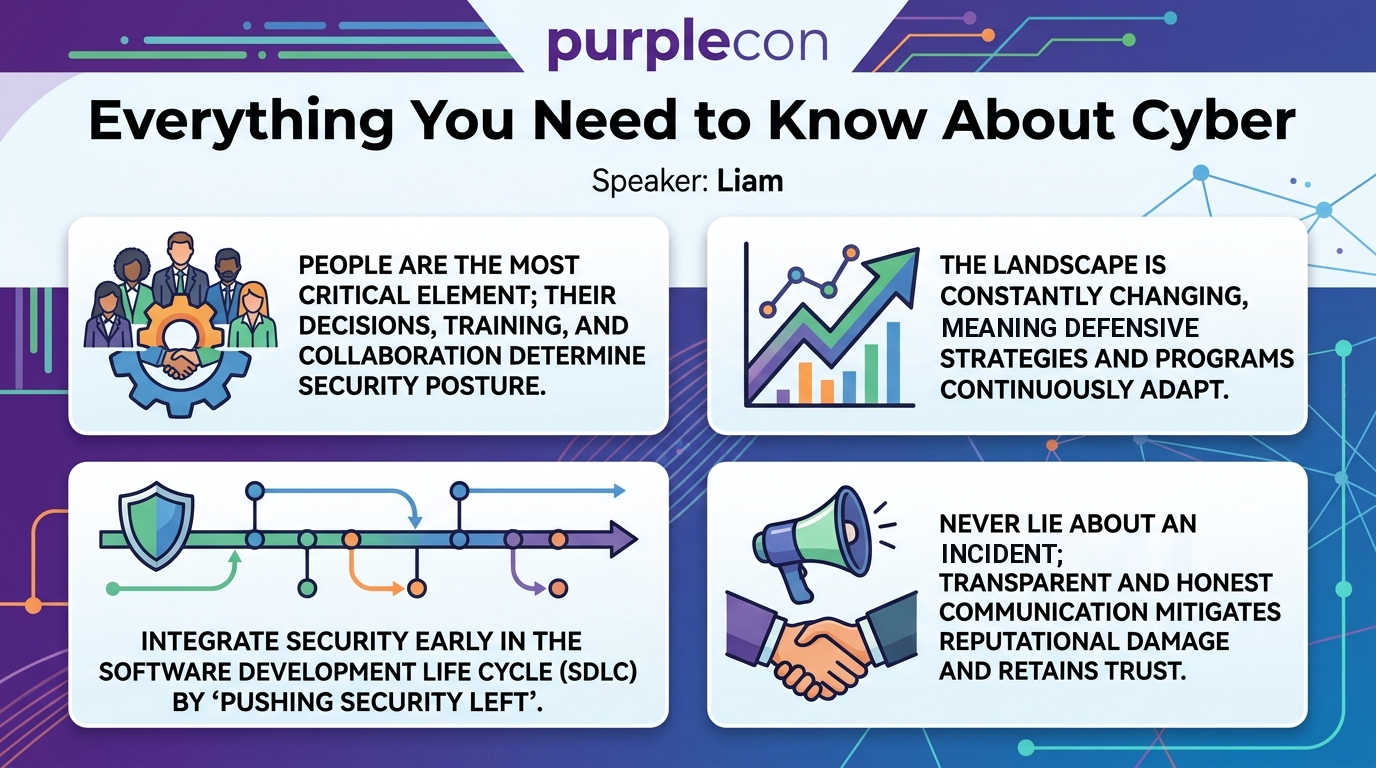
Firstly, the most consistent characteristic of the cyber security landscape is constant change. Threats, technologies, and defensive strategies are in perpetual flux, making continuous learning and adaptation indispensable. This dynamic environment means that what is effective today may be obsolete tomorrow, necessitating flexible and resilient security programs.
Secondly, and perhaps most importantly, Liam asserted that people are the most important element in cyber security. This principle is consistently highlighted across various domains discussed, from security operations to governance. He argued that good people can overcome deficiencies in processes and technology, but even the most advanced technology cannot compensate for poorly trained, disempowered, or disengaged personnel. This emphasizes the need for significant investment in human capital, including training, empowerment, and fostering a security-aware culture.
A related key finding pertains to incident communication: never lie about an incident. Liam stressed that while a technically flawless response is desirable, poor public communications can completely undermine an organization's recovery and reputation. Conversely, transparent and honest communication can mitigate the damage of a less-than-perfect technical response. The public's trust is paramount, and deception inevitably erodes it.
Furthermore, the concept of "pushing security left" emerged as a critical architectural and developmental principle. Integrating security considerations early in the Software Development Life Cycle (SDLC) or broader development lifecycle (including Infrastructure as Code) is far more effective and less costly than attempting to bolt security on at the end. This proactive approach minimizes vulnerabilities from the outset and builds security into the very fabric of systems and applications.
Finally, the talk implicitly revealed that collaboration and specialized expertise are non-negotiable. Given that no single individual can master "everything in cyber," effective security relies on teams of specialists working together, each contributing their deep knowledge to a collective defense. This collaborative spirit is exemplified in practices like purple teaming, where offensive and defensive teams work openly to enhance an organization's security posture.
Technical Deep Dive
▶ Watch: Application Security: Pushing security left in development lifecycle (14:00)
Liam's presentation meticulously segmented the cybersecurity domain into several key areas, providing technical insights into each.
Security Operations (Blue Team)
The Blue Team forms the core of an organization's defensive posture, tasked with detecting and responding to threats. Their work primarily revolves around tools, processes, and people. Common tools include Endpoint Detection and Response (EDR) solutions (e.g., CrowdStrike, Microsoft Defender) that monitor endpoints for malicious activity. These often feed into Security Information and Event Management (SIEM) systems (e.g., Splunk), which aggregate and correlate logs from various sources to identify potential incidents. However, Liam emphasized that merely having tools is insufficient; robust processes are essential for analyzing signals, triaging alerts, identifying trends, and ensuring proper log retention. Crucially, people are the ultimate decision-makers, providing "24/7 eyes on glass" and interpreting data that machines alone cannot.
Adjacent to core SecOps are specialized functions like Threat Hunting and Incident Response. Threat hunting involves proactive, hypothesis-driven searches for undetected threats that might bypass traditional log-based detection. This contrasts with the often reactive nature of SecOps, which relies heavily on predefined alerts. Incident Response (IR) is a dedicated function for when a significant security event occurs, ensuring that the primary SecOps team isn't overwhelmed and can continue monitoring.
Digital Forensics and Incident Response (DFIR)
When security incidents escalate, DFIR teams take over. Digital Forensics focuses on understanding "what has happened," often answering human-centric questions about attacker actions and intent, rather than just technical details. This can involve meticulous evidence collection, maintaining a chain of custody, and preparing for potential legal proceedings. Incident Response, on the other hand, is about managing the crisis "right now." Liam outlined typical IR phases: preparation, identification, containment, eradication, recovery, and lessons learned. Preparation is critical and often overlooked, encompassing technical aspects like high-quality logs and a robust asset inventory, as well as non-technical elements such as pre-signed legal contracts with external IR firms, executive tabletop exercises, and clear communication plans. Lying about incidents was specifically highlighted as a disastrous communication strategy.
Cyber Threat Intelligence (CTI)
Cyber Threat Intelligence is far more than just a list of Indicators of Compromise (IoCs). It involves a deep understanding of adversaries: "what bad people are trying to do to our systems, what they're actually doing, why they're doing it, and what they do when they succeed." This intelligence is dynamic, constantly changing, and vital for informing all other areas of cybersecurity. CTI helps security operations teams anticipate future attacks, allows for proactive defense, and provides context for risk assessments, moving organizations beyond reactive flailing.
Offensive Security
Offensive security disciplines proactively identify vulnerabilities and assess defensive capabilities.
- Penetration Testing (Pentesting): This involves a limited-scope, time-bound exercise to find and exploit vulnerabilities within a defined system or organization. Pentests are typically "noisy," designed to uncover as many weaknesses as possible within the timeframe, and are not an effective test of an organization's ability to detect and respond to a real, stealthy adversary.
- Red Teaming: Distinct from pentesting, red teaming simulates the Tactics, Techniques, and Procedures (TTPs) of real-world adversaries. It takes a "whole-of-organizational" approach, and critically, the blue team is often unaware that an exercise is underway. This allows for a genuine assessment of detection, containment, and eradication capabilities. Red teams are significantly more effort and time-intensive, often lasting "months plus."
- Purple Teaming: This collaborative approach involves red and blue teams working together openly. The red team executes specific TTPs, and the blue team immediately verifies whether their tools blocked the action, generated an alert, or logged the activity. This "open book" method is highly effective for rapidly improving the blue team's maturity and fine-tuning defensive controls without the overhead of a full red team exercise.
Application Security (AppSec)
AppSec embodies the "push security left" mantra, integrating security throughout the entire Software Development Life Cycle (SDLC). While traditionally focused on applications, modern AppSec extends to areas like Infrastructure as Code (e.g., securing Terraform scripts that define cloud infrastructure). Key AppSec activities include:
- Threat Modeling: Early in the design phase, this involves systematically identifying potential threats to a system based on known adversary TTPs and defining security requirements to mitigate them.
- Secure Components and Supply Chain Security: Ensuring that all components and libraries used in development are known good and free from vulnerabilities.
- Static Application Security Testing (SAST) and Dynamic Application Security Testing (DAST): Automated tools that analyze code for vulnerabilities (SAST) or test running applications for weaknesses (DAST).
- Security Training and Champions: Educating developers and project managers on secure coding practices and fostering internal security advocates.
While there's some debate, Product Security (ProdSec) is often considered a specialized extension of AppSec for larger organizations.
Identity and Access Management (IAM)
IAM is foundational to all security, addressing "who is someone, and how do we prove it?" It encompasses processes and mechanisms for consistently managing digital identities and their access rights. This includes authentication factors (e.g., Multi-Factor Authentication (MFA), phishing-resistant methods) and the critical need for dedicated identity management systems, especially across multiple applications. IAM also covers the complexities of privileged access management (PAM) for high-risk administrative accounts, as well as robust processes for joiners, movers, and leavers within an organization. A key governance consideration within IAM is identifying and preventing "toxic combinations," where a single individual has access to conflicting functions (e.g., accounts payable and accounts receivable) that could lead to fraud.
Governance, Risk, and Compliance (GRC)
GRC provides the overarching framework for an organization's security posture. It defines:
- Policy: "What we do" (high-level rules).
- Standards and Procedures: "How we do it" (detailed implementation guidelines).
- Risk: The "why" behind security decisions, informed by Business Impact Analysis (BIA) to identify critical assets and the potential impact of their compromise.
- Compliance: Adherence to external regulations and industry frameworks. Examples include Payment Card Industry Data Security Standard (PCI DSS) for handling credit card data, ISO 27001 (International Standards Organization Information Security Management Systems requirements), the NIST Cybersecurity Framework (NIST CSF), and Australia's ACS Essential 8. Liam humorously noted the Essential 8's true complexity, comprising "35 different controls dressed up in trench coats."
Again, the importance of people is paramount: policies that clash with how people want to work will be circumvented, leading to failure.
Cyber Strategy
Cyber Strategy is the domain of high-level executives like CISOs (Chief Information Security Officers) and CSOs (Chief Security Officers). Their role is to answer questions like "Are we doing cyber enough? Are we doing it in the right places?" without overspending. This involves conducting Business Impact Analysis (BIA) to identify critical business processes and their underlying assets, determining their importance (e.g., availability, integrity), and then aligning security investments to protect these priorities. The strategy must balance security goals with business objectives, avoiding the vendor-driven trap of "more, more, more." Ultimately, a successful strategy hinges on empowering and training people, as even the best technology and processes will fail without competent human execution.
Demo / Proof of Concept
▶ Watch: Identity and Access Management: The critical foundation for security (17:00)
Given the broad, high-level nature of this "everything in cyber" overview, the talk did not include a specific technical demonstration or proof of concept. Its purpose was to survey the vast landscape rather than delve into the specifics of tool usage or exploit techniques.
Defensive Implications
▶ Watch: Conclusion: Nobody knows everything, but teamwork provides all answers (24:00)
Liam's comprehensive overview provides several critical implications for defenders seeking to bolster their security posture:
- Prioritize People and Processes Over Technology: Defenders must recognize that human talent, training, and well-defined operational procedures are more impactful than any single security product. Invest in empowering and educating your teams, and design processes that work with, not against, human behavior.
- Embrace Proactive IR Preparation: Beyond technical incident response plans, organizations must engage in non-technical preparation. This includes pre-negotiating legal contracts with external IR providers, conducting executive-level tabletop exercises, and developing robust, transparent communication plans for crisis management.
- Leverage Cyber Threat Intelligence (CTI): Move beyond simple IoC consumption. Actively use CTI to understand adversary TTPs, motivations, and targeting. This intelligence should inform defensive strategies, threat hunting efforts, and the prioritization of security controls.
- Adopt Purple Teaming for Maturity Growth: Instead of relying solely on traditional pentests or resource-intensive red teams, implement purple teaming exercises. This collaborative approach efficiently identifies gaps in detection, logging, and response capabilities, rapidly enhancing the blue team's effectiveness.
- Shift Security Left with AppSec/DevSecOps: Integrate security early and continuously into the development lifecycle for all applications and infrastructure-as-code. Implement threat modeling, secure design principles, and automated SAST/DAST to identify and remediate vulnerabilities before deployment, significantly reducing technical debt and risk.
- Strengthen Identity and Access Management (IAM): Recognize IAM as a foundational security control. Implement robust authentication (especially phishing-resistant MFA), centralized identity stores, and rigorous Privileged Access Management (PAM). Pay close attention to joiner/mover/leaver processes and actively identify and mitigate "toxic combinations" to prevent insider fraud.
- Align GRC with Business Objectives: Ensure that governance policies and compliance efforts are informed by a clear understanding of business risk and impact. Choose appropriate frameworks (e.g., NIST CSF, ISO 27001) but adapt them to fit the organization's context, ensuring policies are practical and people-centric rather than bureaucratic.
- Develop a Strategic Cybersecurity Roadmap: CISOs and security leaders must focus on a high-level cyber strategy driven by Business Impact Analysis (BIA). This ensures that security investments are aligned with critical business assets and processes, optimizing resource allocation and preventing overspending on less impactful areas.
Key Takeaways
- People First: The human element—trained, empowered, and collaborative individuals—is the most critical component of any successful cybersecurity program, outweighing processes and technology.
- Constant Evolution: Cybersecurity is a dynamic field where threats and defenses continuously change, demanding ongoing learning, adaptation, and a proactive approach to intelligence.
- Proactive Security is Paramount: Integrating security early in development (AppSec), preparing meticulously for incidents (IR preparation), and understanding adversaries (CTI) are vital for effective defense.
- Offensive Insights for Defense: Red and purple teaming provide invaluable, realistic assessments of defensive capabilities, highlighting blind spots and areas for improvement in detection and response.
- Strategic GRC is Essential: Effective governance, risk management, and compliance frameworks, tailored to business needs and supported by people-centric policies, are crucial for sustainable security.
- Transparency in Crisis: During security incidents, honest and transparent communication is non-negotiable, as it directly impacts public trust and the long-term reputation of an organization.
About the Speaker(s)
Liam is an Executive Director at CyberCX, specializing in offensive security. His extensive experience in the cybersecurity field spans many years, having witnessed the evolution of the domain from its earlier focus on "information security" to the current expansive "cyber" landscape. His expertise lies in understanding how adversaries operate and leveraging that knowledge to help organizations identify and remediate their vulnerabilities.
Reviews
Dr. Zero (Offensive Security Researcher) — WEAK
A 101-level survey of cybersecurity domains that belongs in an onboarding deck, not a conference slot. The 'people > process > technology' framing is fine but has been said ten thousand times. Nothing here a practitioner couldn't get from skimming a NIST CSF explainer and a CrowdStrike sales PDF.
Heather Calloway (CISO) — WEAK
A survey course dressed up as a conference talk. If your leadership team needs a glossary of security domains, this covers the waterfront. If they need to make a decision, allocate budget, or understand a specific risk — there's nothing here.