Burnout: From Recognition to Recovery
Ash (Engineer, Incident Response and Product Security)
purplecon 2024 · Day 1 · Main Room
Overview
In a landscape often dominated by discussions of exploits, vulnerabilities, and defensive architectures, Ash, an Engineer in Incident Response and Product Security, delivered a vital and introspective talk at purplecon titled "Burnout: From Recognition to Recovery." While explicitly stating that the topic was "not about security at all," Ash masterfully navigated the challenging subject of professional burnout, offering a critical human perspective that resonates deeply within the high-stress, always-on world of cybersecurity. The presentation served as a crucial reminder that the most sophisticated security systems are ultimately built and maintained by people, and their well-being is paramount to the industry's sustained effectiveness.
Key moments
- 0:00 Introduction to burnout and 'This is Fine' meme
- 2:00 Real-life examples of burnout (Kai, Frank, Louisa)
- 6:30 The three official symptoms of burnout (WHO definition)
- 8:00 First step to recovery: recognizing burnout in yourself
- 8:50 Seeking professional help and leveraging social networks
- 10:10 Detaching, reviewing, and repeating the recovery journey
- 12:00 Question Hound's recovery and the 'Be Excellent' closing
Burnout: From Recognition to Recovery
Speakers: Ash, Engineer, Incident Response and Product Security
Conference: purplecon
YouTube: https://www.youtube.com/watch?v=fy-AeEyF2vA
Overview
In a landscape often dominated by discussions of exploits, vulnerabilities, and defensive architectures, Ash, an Engineer in Incident Response and Product Security, delivered a vital and introspective talk at purplecon titled "Burnout: From Recognition to Recovery." While explicitly stating that the topic was "not about security at all," Ash masterfully navigated the challenging subject of professional burnout, offering a critical human perspective that resonates deeply within the high-stress, always-on world of cybersecurity. The presentation served as a crucial reminder that the most sophisticated security systems are ultimately built and maintained by people, and their well-being is paramount to the industry's sustained effectiveness.
The talk aimed to demystify burnout, moving beyond anecdotal understanding to a structured approach for recognition and recovery. Ash leveraged relatable anecdotes, popular culture references, and medically backed definitions to illustrate the insidious nature of burnout and provide actionable strategies for individuals to reclaim their well-being. By sharing amalgamations of real-life stories and a practical recovery framework, the presentation underscored the pervasive impact of burnout across diverse professional and personal circumstances, challenging attendees to confront a reality that many silently endure.
This discussion is particularly pertinent for the cybersecurity community, where long hours, the constant threat of attack, and the pressure to maintain vigilance can create fertile ground for burnout. Ash’s background in Incident Response and Product Security lends significant weight to the insights shared, as it stems from direct experience in a field known for its intense demands. The talk’s emphasis on self-awareness, professional support, and iterative recovery offers a powerful counter-narrative to the often-celebrated culture of relentless productivity, advocating instead for sustainable practices that prioritize individual health and, by extension, the resilience of the entire security workforce.
Background
▶ Watch: Introduction to burnout and 'This is Fine' meme (0:00)
The problem of burnout is not new, but its prevalence and recognition have grown significantly, especially in demanding professions. In the cybersecurity industry, factors such as the 24/7 nature of threats, the constant need for skill adaptation, the high stakes of potential breaches, and often understaffed teams contribute to an environment ripe for chronic stress and exhaustion. Despite its widespread impact, burnout often remains an unspoken challenge, masked by a culture that can sometimes equate overwork with dedication and success.
Ash began by acknowledging a formal, medically recognized tool, the Maslach Burnout Inventory, a questionnaire with 16 to 22 questions used by medical professionals to assess burnout severity. However, the speaker, explicitly disclaiming any medical professional qualifications, pivoted from this clinical tool to a more accessible and relatable exploration. This immediate disclaimer set the tone: the talk would offer practical, personal insights and strategies, not clinical diagnoses or medical advice.
The cultural touchstone for many in the audience, the "this is fine" dog comic, officially known as Question Hound, served as a powerful metaphor for the initial stages of burnout. The image of a dog calmly sipping coffee in a burning room, uttering "This is fine," perfectly captures the denial and detachment that often precede full-blown burnout. Ash highlighted that while the meme is widely recognized, the later panels depicting the dog melting are less common, symbolizing the often-unseen, detrimental progression of unaddressed burnout. This setup underscored the core challenge: recognizing that things are not fine, even when external appearances suggest otherwise, and understanding why those "fires" are burning. The talk sought to provide context and practical steps for individuals to move beyond this state of denial and towards recovery.
Key Findings
▶ Watch: The three official symptoms of burnout (WHO definition) (6:30)
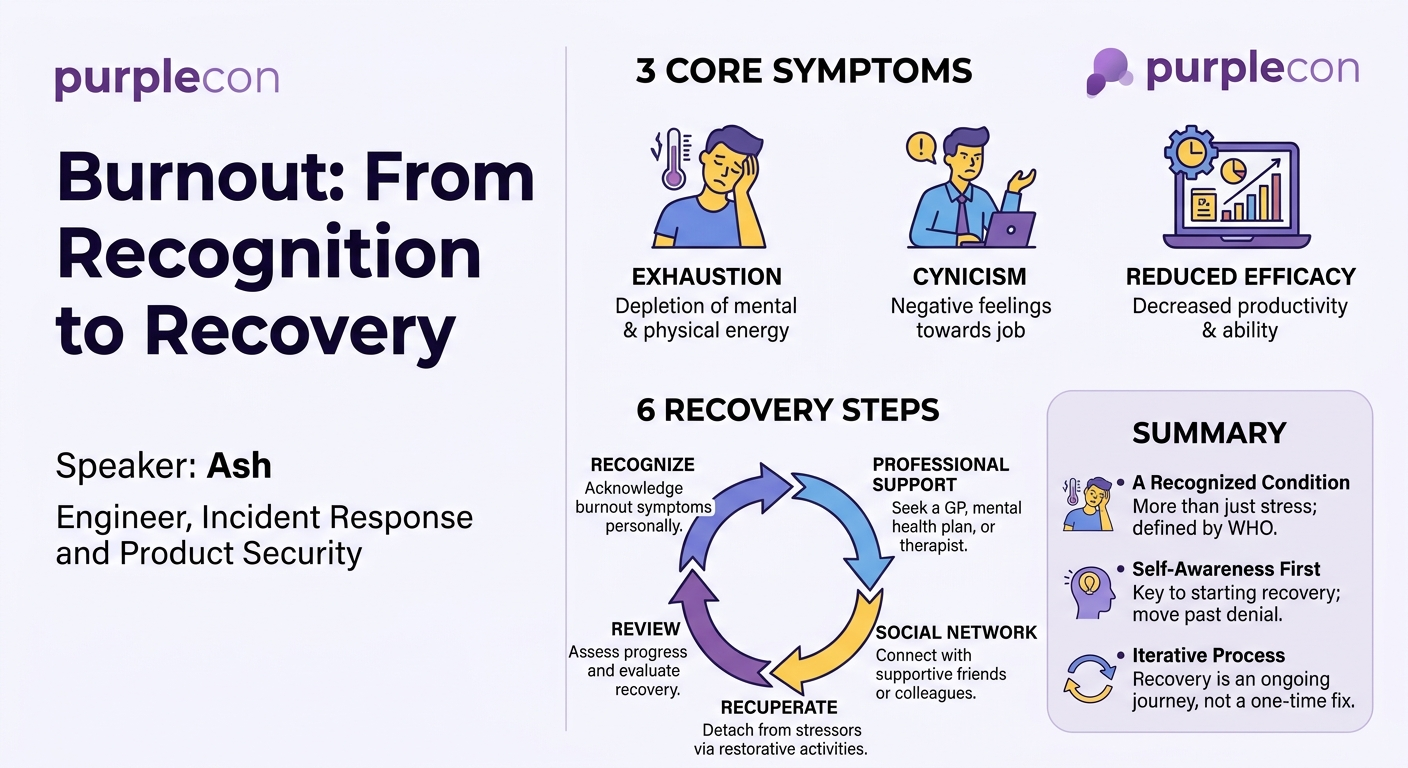
Ash's talk crystallized the understanding of burnout by grounding it in both relatable human experience and a globally recognized definition. The central revelation was the formal definition of burnout as classified by the World Health Organization (WHO), which outlines three core symptoms:
- Exhaustion: This is more than just feeling tired; it's a profound sense of depletion of mental and physical energy. As illustrated by the stories shared, Kai, the university student, experienced exhaustion from pulling all-nighters; Frank, grappling with a chronic medical condition, felt physically drained despite increasing his exercise; and Louisa, the senior manager, found herself too tired to manage her personal and professional caregiving responsibilities. This pervasive fatigue impacts all aspects of life, making even routine tasks feel insurmountable.
- Negativity or Cynicism: This symptom manifests as increased mental distance from one's job, or feelings of negativism or cynicism related to one's job. For Kai, this meant questioning their belonging in computer science and withdrawing from social events that once brought joy. Frank began to doubt his value to his team, despite no evidence to support this. Louisa found herself grumpy, questioning why she had to step up, and struggling to celebrate her team's successes. This negativity can extend to oneself, one's work, or even one's life circumstances, leading to a loss of enjoyment in previously fulfilling activities.
- Reduced Professional Efficacy/Productivity: This refers to a decrease in professional effectiveness and a struggle to meet deadlines or perform duties that were once easily managed. All three characters in Ash's stories — Kai, Frank, and Louisa — experienced difficulties in maintaining their usual levels of performance, whether in academic work, part-time employment, or senior management roles. This reduction in productivity is a direct consequence of the overwhelming exhaustion and cynicism, creating a vicious cycle that further exacerbates feelings of inadequacy.
A crucial finding from the talk's interactive element was the widespread experience of these symptoms within the audience. When asked to raise hands if they had witnessed at least one of these symptoms in themselves, "most people in the room" responded affirmatively, with some even raising both hands. This demonstrated the pervasive nature of burnout, highlighting that individuals are "not alone in feeling these really big feelings" and underscoring the universal relevance of the topic. The talk established that recognizing these three interconnected symptoms is the foundational step toward addressing and recovering from burnout.
Technical Deep Dive
▶ Watch: First step to recovery: recognizing burnout in yourself (8:00)
While "Burnout: From Recognition to Recovery" does not delve into technical security protocols or architectural designs, it offers a deeply structured and analytical framework for understanding and addressing a critical human factor: burnout. This "technical deep dive" section will explore the methodology and detailed steps presented by Ash, which, in their systematic approach, provide a robust model for personal and professional resilience.
Ash initiated the deep dive by illustrating the multifaceted nature of burnout through three composite case studies:
- Kai, a full-time computer science student, grappled with the triple challenge of academic rigor, new adult responsibilities (living independently, managing finances), and part-time work. Kai's experience highlighted imposter syndrome, a common feeling in competitive fields, leading to social withdrawal and a loss of joy in university events. This story exemplified the early stages of exhaustion and negativity, manifesting as self-doubt and isolation.
- Frank, a security professional with five years of experience, faced a new chronic medical condition. Despite moving to part-time work, his desire to maintain an image of an "avid cyclist" led him to double his cycling hours, paradoxically increasing his exhaustion and diminishing his joy in the activity. His story illustrated how external pressures and internal expectations ("I'll just try harder") can exacerbate burnout, even in the face of medical advice to reduce workload. Frank's internal questioning of his value to the team, despite good performance, epitomized the negativity symptom.
- Louisa, a senior manager in a red team with 15 years in the security industry, prided herself on strict work-life boundaries and regular vacations. However, the accumulation of unexpected personal caregiving responsibilities (elderly parent, child's eating issues) combined with a company restructuring pushed her to her limit. Louisa's narrative demonstrated how even individuals with strong coping mechanisms and boundaries can succumb to burnout when multiple stressors converge, leading to irritability and a diminished capacity to support her team.
These stories served to concretely demonstrate the WHO's three symptoms of burnout: exhaustion, negativity/cynicism, and reduced productivity. Ash meticulously connected each character's struggles to these core definitions, moving beyond abstract concepts to tangible, relatable experiences.
The core of Ash's "technical" solution was a six-step recovery framework, presented as a cyclical, rather than linear, journey:
- Recognize Burnout: This is the foundational step. It involves not only understanding the general symptoms (as defined by WHO) but critically, recognizing what burnout looks like in oneself. Ash emphasized that this self-awareness is highly personal and cannot be taught in a talk. It requires introspection to identify individual triggers, early warning signs, and specific manifestations of exhaustion, negativity, and reduced efficacy. The crucial shift is moving from "this is fine" to acknowledging that "things are not fine."
- Find Professional Support: Once recognized, the next step is to seek expert help. In Australia, this typically begins with a General Practitioner (GP) to create a mental health plan. This involves a 30-minute consultation and questionnaires, leading to referrals to qualified mental health professionals like psychologists or therapists. Ash stressed the importance of professional guidance, distinguishing it from casual advice.
- Reach Out to Social Network: Burnout often leads to isolation, making problems feel larger and more overwhelming. Counteracting this, individuals are encouraged to connect with "champions" – friends, family, or colleagues who can offer support, encouragement ("say that you're doing awesome when things are going wrong"), and practical assistance (e.g., helping make appointments). The shared experience of burnout among the audience underscored the power of collective support.
- Take Time to Recuperate: This involves actively detaching from the source of stress, be it work, university, or caregiving. Ash highlighted that the specific activity isn't as important as its effect: creating space and distance from the stressor. Examples included gentle walks, karate, jogging, sitting in a park, climbing mountains, or dancing. The key is finding an activity that genuinely allows for mental and emotional disengagement.
- Review: After taking steps towards recovery, it's essential to assess progress. This involves checking in with oneself to understand how feelings and symptoms are evolving. Ash cautioned against the expectation of a linear, upward recovery path, acknowledging that it's often messy.
- Repeat: This is the crucial, often overlooked, sixth step. Ash clarified that "repeat" does not mean repeating burnout, but rather repeating the recovery steps. Recovery is an iterative process; strategies may need to be adjusted (e.g., finding a different medical professional, rebalancing hobbies). This cyclical nature emphasizes that managing burnout is an ongoing journey, not a one-time fix.
To address the immediate emotional "fires" that can arise from recognizing burnout, Ash introduced a simplified, actionable checklist from Bingo of the animated show Bluey: "Have a cry, pick yourself up, dust yourself off, and keep going." For burnout recovery, "keep going" was interpreted as taking "one step at a time towards recovery," reinforcing the iterative and manageable nature of the process. This detailed framework, while not technical in the traditional sense, provides a rigorous, step-by-step methodology for personal well-being, making it a powerful "deep dive" into human resilience.
Demo / Proof of Concept
▶ Watch: Detaching, reviewing, and repeating the recovery journey (10:10)
While this talk did not feature a traditional technical demonstration of security vulnerabilities or tools, Ash effectively used relatable narratives and cultural touchstones to illustrate the pervasive nature and insidious progression of burnout. The presentation itself served as a conceptual "proof of concept" for the talk's central thesis: burnout is a common, definable, and recoverable condition.
The primary "demonstrations" were the three composite stories of Kai, Frank, and Louisa. These detailed, amalgamated human experiences functioned as vivid case studies, allowing the audience to see the WHO's symptoms of exhaustion, negativity, and reduced productivity played out in realistic scenarios. By presenting these diverse characters—a student, an experienced professional with a chronic condition, and a senior manager—Ash demonstrated that burnout is not confined to a single demographic or career stage, proving its widespread applicability.
Furthermore, the integration of popular memes like Question Hound (the "this is fine" dog) and the Bingo's checklist from Bluey acted as highly effective, relatable visual and conceptual aids. Question Hound served as a powerful metaphor for the denial and initial coping mechanisms of burnout, while Bingo's checklist provided a simple, memorable framework for immediate emotional processing. These elements, though not technical, brilliantly "demonstrated" the emotional and psychological states associated with burnout and offered accessible pathways for initial response.
Defensive Implications
▶ Watch: Question Hound's recovery and the 'Be Excellent' closing (12:00)
For a security conference, a talk on burnout might seem tangential, but its defensive implications for the cybersecurity industry are profound and far-reaching. Burnout directly impacts the human element, which is often cited as the weakest link in any security chain, but also the most critical asset. Ash’s discussion provides a blueprint for strengthening this human layer, offering crucial defensive strategies against the personal and organizational toll of chronic stress.
For Individuals (Self-Defense):
- Early Recognition: The most critical defensive step is recognizing the symptoms of burnout (exhaustion, negativity, reduced productivity) in oneself. Being attuned to these early warning signs allows for proactive intervention before the situation escalates.
- Proactive Boundary Setting: Louisa's story highlighted that even with good boundaries, cumulative stressors can overwhelm. Individuals in security must continuously assess and reinforce boundaries between work and personal life to protect their mental and physical reserves. This includes managing notifications, scheduling actual downtime, and disconnecting from work-related communications.
- Seeking Professional Help: Viewing professional support (GP, therapists) as a form of proactive resilience building rather than a last resort. Just as security professionals seek expert advice for technical vulnerabilities, they should do so for personal well-being.
- Cultivating a Supportive Network: Actively building and leveraging a social network acts as an early warning system and a support structure. Champions can help individuals recognize changes, encourage seeking help, and provide emotional buffering against stress.
For Organizations and Teams (Collective Defense):
- Talent Retention and Recruitment: The security industry faces a significant talent shortage. Burnout is a major driver of attrition. By actively addressing burnout, organizations can improve employee retention and make themselves more attractive to new talent, effectively shoring up their human capital defenses.
- Operational Resilience: A burned-out team is a less effective team. Exhaustion leads to errors, negativity erodes collaboration, and reduced productivity slows response times. Investing in burnout prevention directly contributes to operational resilience and the ability of security teams to effectively detect, respond to, and recover from incidents.
- Fostering a Culture of Well-being: Leaders and managers must create an environment where discussing mental health is normalized and supported. This includes:
- Workload Management: Ensuring realistic expectations and equitable distribution of tasks.
- Encouraging Time Off: Actively promoting and modeling the use of vacation time and breaks.
- Providing Resources: Making mental health resources (EAPs, counseling services) easily accessible and destigmatized.
- Empathetic Leadership: Training managers to recognize signs of burnout in their teams and to respond with empathy and support, rather than judgment.
- Sustainable Practices: Moving away from a culture that glorifies "heroics" and long hours towards one that prioritizes sustainable working practices. This includes promoting continuous learning and development without overwhelming individuals, and celebrating successes in ways that don't add pressure.
Ultimately, preventing and recovering from burnout is a critical defensive strategy for the security industry. It protects the most valuable asset—its people—ensuring they remain sharp, engaged, and capable of defending against ever-evolving threats.
Key Takeaways
- Burnout is a Medically Recognized Condition: Defined by the World Health Organization (WHO) through three core symptoms: exhaustion, negativity/cynicism, and reduced productivity. It is not merely stress but a chronic state of emotional, physical, and mental depletion.
- Self-Recognition is the First Critical Step: Understanding what burnout looks like generally and, more importantly, how it manifests personally, is paramount to initiating recovery. This requires moving beyond denial, as symbolized by the "this is fine" dog.
- Professional and Social Support are Vital: Seeking help from medical professionals (e.g., GP for a mental health plan, therapists) and leaning on a supportive social network (finding "champions") are essential for effective recovery and combating isolation.
- Recovery is an Iterative and Non-Linear Process: The six-step framework (Recognize, Professional Support, Social Network, Recuperate, Review, Repeat) highlights that recovery is not a one-time fix but an ongoing journey that may require adjustments and repeated efforts.
- Proactive Recuperation and Detachment are Essential: Actively taking time to detach from stressors, through activities that provide genuine space and rest, is crucial for recharging and regaining perspective.
- Organizational Culture Plays a Key Role: While the talk focused on individual steps, the implications for the security industry underscore the need for organizations to foster supportive environments that prevent burnout, ensure talent retention, and maintain operational resilience.
About the Speaker(s)
Ash is an Engineer specializing in Incident Response and Product Security. Their professional background places them squarely within the high-pressure, demanding environment of the cybersecurity industry, where the insights shared on burnout are particularly resonant. Working in areas that require constant vigilance, rapid problem-solving, and often unpredictable hours, Ash's firsthand experience lends significant credibility to the challenges of maintaining well-being in such a field. The decision to present a talk on burnout at a security conference underscores a commitment to addressing the human element often overlooked in technical discussions, advocating for the health and sustainability of professionals within the industry.
Reviews
Dr. Zero (Offensive Security Researcher) — SOLID
A well-intentioned mental health talk that belongs at a security conference — burnout is a real problem in this industry. But there's nothing here that wouldn't fit in a 10-minute lightning talk or a blog post. The WHO definition, the 'this is fine' meme, the 'see a therapist' advice — it's all correct and all surface-level.
Heather Calloway (CISO) — SOLID
A competent, well-intentioned talk on workforce sustainability that addresses a real operational risk — attrition and degraded performance in high-stress security teams. Useful for managers thinking about retention and team health, but stops short of giving security leaders concrete organizational interventions or metrics to act on.