Hacking the Xbox One
Markus Gaasedelen (Principal Security Researcher · RET2 Systems)
RE//verse 2026 · Day 2 · Coral Ballroom A
Overview
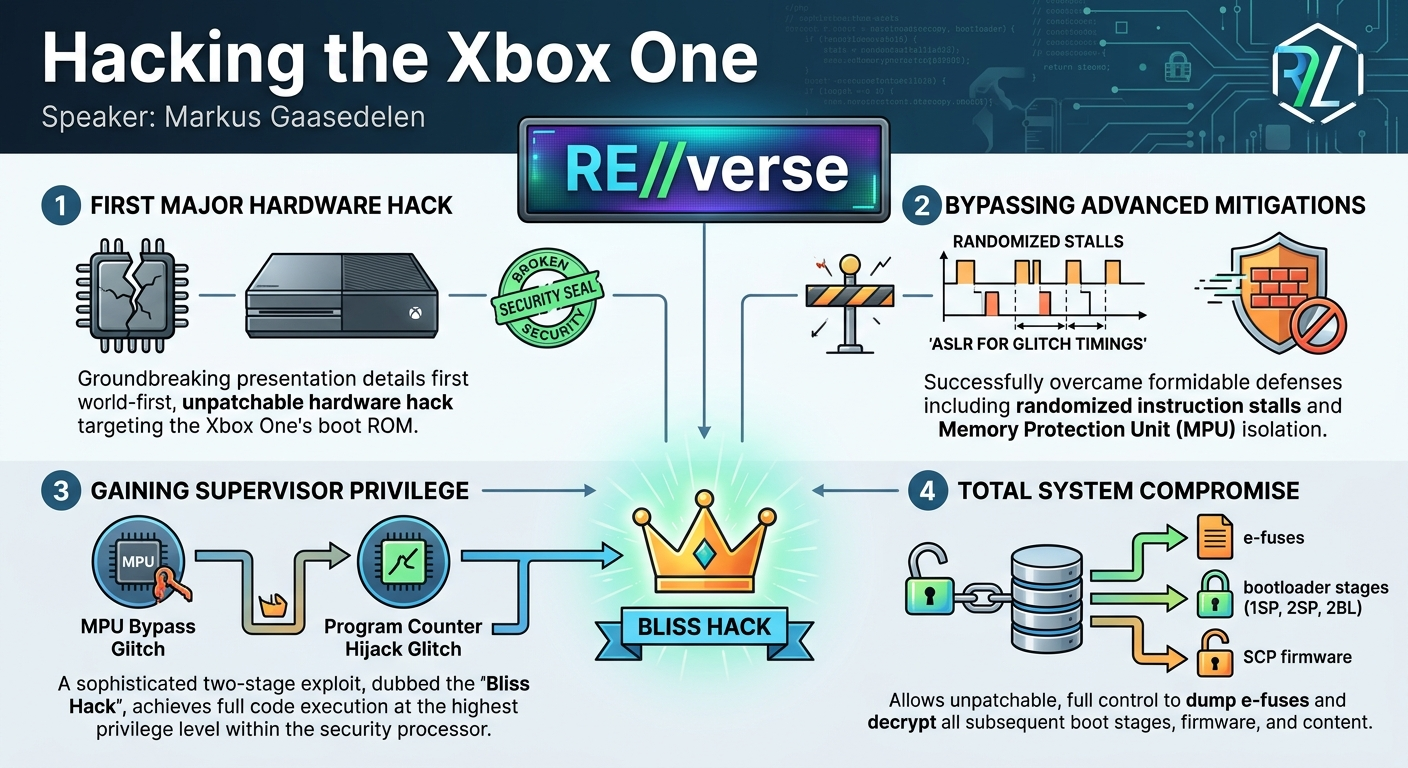
In a groundbreaking presentation at RE//verse, Markus Gaasedelen unveiled a world-first, unpatchable hardware hack targeting the Xbox One's boot ROM. Titled "Hacking the Xbox One," this talk detailed a decade-long mystery surrounding the console's formidable security and presented the culmination of Gaasedelen's dedicated research. The Xbox One, once lauded by Microsoft as potentially their "most secure product ever produced," has finally yielded to a sophisticated fault injection attack, shattering its reputation for impregnability.
Key moments
- 1:40 Xbox One's 'unhackable' reputation and the challenge
- 11:00 Overcoming randomized stalls: ASLR for glitch timings
- 19:40 First meaningful glitch: Enabling fused-off post codes
- 27:30 Achieving arbitrary program counter control via memcpy glitch
- 42:00 Confirming MPU disablement and chaining glitches difficulty
- 44:40 The 'Bliss Hack': Full code execution and decryption
- 48:00 Unpatchable hack's impact: Preservation, repair, full access
- 51:30 Mod chip practicality and minimal hardware setup
Hacking the Xbox One
Speakers: Markus Gaasedelen, Principal Security Researcher, RET2 Systems
Conference: RE//verse
YouTube: https://www.youtube.com/watch?v=FTFn4UZsA5U
Overview
In a groundbreaking presentation at RE//verse, Markus Gaasedelen unveiled a world-first, unpatchable hardware hack targeting the Xbox One's boot ROM. Titled "Hacking the Xbox One," this talk detailed a decade-long mystery surrounding the console's formidable security and presented the culmination of Gaasedelen's dedicated research. The Xbox One, once lauded by Microsoft as potentially their "most secure product ever produced," has finally yielded to a sophisticated fault injection attack, shattering its reputation for impregnability.
Gaasedelen's work not only achieves full code execution at the highest privilege level within the console's security processor but also opens avenues for console preservation and repairability that were previously deemed impossible. This research builds upon his highly acclaimed 2023 REVERSING talk about the original Xbox, positioning this latest disclosure as a spiritual "part two" to his journey in console security. The implications of this "Bliss Hack" are profound, offering unprecedented access to a system that many in the security community had written off as unhackable.
This talk is a testament to the power of persistence and deep technical expertise, showcasing how Gaasedelen meticulously navigated layers of hardware and software defenses, from randomized execution stalls to memory protection units, to ultimately gain control over the console's immutable hardware root of trust. The compromise of the boot ROM means that every subsequent layer of the Xbox One's security chain, from hypervisor to game OS, can now be fully controlled, decrypted, and modified.
Background
▶ Watch: Xbox One's 'unhackable' reputation and the challenge (1:40)
The Xbox One, launched in 2013, was Microsoft's third major game console and a highly anticipated successor to the Xbox 360. However, its initial reception was notably poor, largely due to Microsoft's controversial push for an "always online" DRM model and its positioning of the console as a media center first, alienating its core gaming audience. Despite its market struggles, the Xbox One quickly established a reputation for its robust security. Unlike its predecessors and contemporary consoles from Sony and Nintendo, the Xbox One – and subsequently, its successors – remained unhacked for over a decade. As recently as 2020, Microsoft proudly declared the Xbox One as "the most secure product Microsoft has ever produced."
The architectural backbone of this security was detailed in a 2019 talk by Tony Chen, who helped design the Xbox One's security stack. Chen described a layered security approach, heavily reliant on compartmentalization, virtualization, and revocation. Crucially, the entire chain of trust for the Xbox One ultimately hinged on the integrity of its boot ROM. Chen explicitly stated, "The only software mistake we cannot recover from is a bug in the boot ROM." This statement underscored the critical importance of the boot ROM as the hardware root of trust and the ultimate target for any aspiring console hacker.
The challenge of hacking the Xbox One was amplified by the complete lack of hardware introspection. Researchers had no access to standard debugging tools like UART, JTAG, post codes, or datasheets. There were no development or test chips available to experiment with, making any attempt at fault injection a "glitching totally blind" endeavor. This environment fostered a perception that compromising the Xbox One was an "impossible" task, a dragon that no one could slay. Gaasedelen, driven by curiosity and the sheer difficulty of the problem, embarked on this quest to understand "what kind of black magic" Microsoft had employed to secure the console so effectively, ultimately aiming for nothing less than full code execution on the boot ROM itself.
Key Findings
▶ Watch: First meaningful glitch: Enabling fused-off post codes (19:40)
Markus Gaasedelen's extensive research yielded several critical findings that collectively led to the unprecedented compromise of the Xbox One's boot ROM:
- First Meaningful Glitches: Gaasedelen achieved the first-ever demonstrable and meaningful voltage glitches on the Xbox One's core, breaking the long-held belief that the chip was unhackable.
- Discovery of Randomized Stalls: A significant hurdle was the identification of 37 randomized stalls integrated throughout the boot ROM. These stalls, consuming nearly 50% of the boot ROM's 300,000 instructions, effectively acted as ASLR for glitch timings, making precise fault injection extremely difficult.
- Enabling Fused-Off Post Codes: Through targeted glitching of the GPIO initialization logic within the boot ROM, Gaasedelen successfully enabled the console's internal post codes, which were otherwise permanently disabled by e-fuses. This provided crucial debugging visibility into the boot process.
- Arbitrary Program Counter (PC) Control: By glitching the memcopy routine during the transfer of the SP1 header (the first external bootloader), Gaasedelen achieved arbitrary program counter (PC) control. This was accomplished by corrupting an instruction decode, causing a
popinstruction to be skipped, leaving registers polluted with attacker-controlled data and enabling a jump to a controlled address. - MPU Bypass: A novel eFuse side channel was developed to create a stable timing anchor, enabling a second glitch to bypass the Memory Protection Unit (MPU) enablement loop. This effectively disabled memory isolation, allowing user mode to tamper with supervisor memory and gaining read-write-execute (RWX) permissions for free.
- The "Bliss Hack": The combination of the MPU bypass glitch and the PC hijack glitch, dubbed the "Bliss Hack," resulted in supervisor mode code execution within the boot ROM. This represents the highest level of privilege on the system.
- Full System Compromise: With boot ROM access, Gaasedelen demonstrated the ability to dump e-fuses and decrypt all subsequent stages of the boot process, including 1SP, 2SP, the 2BL, and the Streaming Crypto Processor (SCP) firmware. This provides Oracle access to the crypto co-processor, enabling the decryption of all past, present, and future games, firmware, and content.
- Unpatchable Hardware Attack: As the attack targets the immutable, silicon-based boot ROM, the "Bliss Hack" is unpatchable through software updates.
Technical Deep Dive
▶ Watch: Confirming MPU disablement and chaining glitches difficulty (42:00)
The Xbox One's security architecture centers around a custom System-on-Chip (SOC), co-developed by Microsoft and AMD, fabricated on a 28-nanometer process. At its core lies the Platform Security Processor (PSP), an ARM Cortex-R4 micro-controller, which serves as the hardware root of trust. This PSP, supported by a Crypto Co-Processor (CCP) and a Streaming Crypto Processor (SCP), is responsible for the console's secure boot. Crucially, nestled within the PSP is the boot ROM (also known as SP0), a 64-kilobyte immutable memory region, of which approximately 19 kilobytes are actual executable code, primarily Thumb-2 instructions. Microsoft engineers explicitly wrote this boot ROM firmware, not AMD.
Initial attempts at understanding the SOC's behavior were hampered by a complete lack of hardware introspection. There were no UART, JTAG, post codes, datasheets, or development chips available. Gaasedelen's first step was to identify the correct power rail for the PSP. After experimenting with the 1.8-volt rail, he eventually isolated the Northbridge core rail, where the PSP's power consumption could be observed. This involved removing SMD capacitors and inserting a shunt resistor to perform power side channel analysis.
During power tracing, a significant challenge emerged: randomized stalls. Microsoft had intentionally injected 37 random stall loops throughout the boot ROM, consuming approximately 150,000 out of 300,000 average instructions. These stalls, which varied in duration and timing, acted as a form of ASLR (Address Space Layout Randomization) for fault injection, making it impossible to hardcode glitch timings. Gaasedelen performed extensive data analysis to map these stalls and understand their behavior. He also monitored I2C traffic, observing on-boot diagnostic data containing SOC ID, voltage/thermal/clock monitoring bits, and memory violation flags, though this data proved less critical to the final exploit.
The core of the attack involved crowbar voltage glitching, a technique where the voltage rail is momentarily collapsed to induce instruction corruption. Gaasedelen developed an automated setup using a Teensy microcontroller to cycle the console and trigger glitches. Early attempts were unsuccessful due to glitching the wrong rail and the presence of randomized stalls.
A breakthrough came with the re-discovery of post codes. Although fused off by e-fuses, the boot ROM still contained logic to initialize GPIO pins for post code output about 2,000 instructions after reset. By carefully glitching the logic that determines whether to enable post codes, Gaasedelen successfully forced the console to emit post codes on these previously unused GPIO pads. This provided invaluable digital feedback, confirming that the core was responding to fault injection. The initial post code glitch was approximately 100-200 nanoseconds in duration.
With stable glitching capability, the next target was achieving arbitrary program counter (PC) control. Gaasedelen focused on the transfer of the SP1 header, the first external bootloader, which is meticulously verified by the boot ROM. This 900-byte header is read in 64-byte bursts from NAND flash over an MMC/SDIO bus and then transferred via a faster PCI bus to the PSP. Gaasedelen targeted the memcopy routine responsible for these PCI transfers. Memcopy is a prime target for fault injection because its execution state is often highly polluted with attacker-controlled data. By flashing recognizable pattern data into the eMMC, he aimed to induce a fault that would corrupt a register containing this data.
The desired outcome of such a fault was a fatal error code emitted over the I2C bus. The boot ROM specifically hooks ARM abort modes (like prefetch aborts or data aborts) to output a 32-bit diagnostic D-word containing the faulting address register (IFAR) and fault state register (IFSR). After sweeping the memcopy region with glitches over 100,000 runs, Gaasedelen observed fatal error codes that contained his pattern bytes. Analysis revealed that a glitch could skip a pop instruction at the end of the memcopy routine, leaving registers (like the PC) polluted with attacker-controlled data. This allowed for an arbitrary jump to an address like 0x58585858, achieving arbitrary PC control. This initial PC hijack was anchored off a signal that was zero between two randomized stalls, partially bypassing the timing challenge.
However, a critical defense remained: the Memory Protection Unit (MPU). The Xbox One boot ROM implements "user jails" using ARM supervisor mode and the MPU to compartmentalize risky logic, each with distinct code pages and restricted memory access. To overcome this, Gaasedelen needed to disable the MPU. The MPU initialization occurs very early in boot, before the GPIO init. To precisely time a glitch for this, a new, more stable digital anchor was required.
This led to the development of an eFuse side channel. By cutting a trace on the board and inserting a shunt resistor, Gaasedelen was able to monitor the power draw during eFuse reads. The depth of these analog pulses (only 50mV) correlated with the number of bits blown in an eFuse line, allowing him to visualize "Hamming leaks." These analog dips were then converted into strong 3.3V digital pulses for reliable triggering. This new side channel revealed three pre-boot eFuse reads (for lockdown state and chip-specific entitlements), providing a stable timing anchor with only 175 nanoseconds of jitter, significantly better than the millisecond jitter of the power OK signal.
With this precise anchor, Gaasedelen swept the MPU initialization logic. He discovered a "pocket of crashes" where the GPIO init signal appeared significantly earlier than expected, indicating that the MPU configuration loop was being broken out of prematurely. Further analysis confirmed that this specific glitch caused the MPU enablement branch to be skipped entirely, leaving the MPU disabled.
The final challenge was combining the two glitches: the MPU bypass and the PC hijack. The MPU's state (enabled vs. disabled) fundamentally altered the execution environment, changing the parameters required for the PC hijack glitch. This necessitated a grueling re-sweep, testing millions of boots (a 1-in-100 chance for MPU bypass combined with a 1-in-100 for PC hijack, leading to 10,000 boots per parameter test). This intense testing even caused eMMC chip burnout due to the Southbridge's constant error logging, requiring an upgrade to an industrial-grade eMMC.
The successful combination of these two glitches formed the "Bliss Hack." The first glitch skips MPU enablement, granting user mode the ability to tamper with supervisor memory and effectively providing read-write-execute (RWX) memory access. The second glitch hijacks the program counter, allowing a jump into attacker-controlled shellcode (e.g., the partially read SP1 header) and subsequently corrupting saved supervisor registers to return directly into supervisor mode. This achieves full control over the PSP, the highest privilege level on the console. The entire exploit, from glitching post codes to arbitrary PC control, took approximately one week to develop, with the double glitch optimization taking considerably longer.
Demo / Proof of Concept
▶ Watch: The 'Bliss Hack': Full code execution and decryption (44:40)
Markus Gaasedelen provided a compelling video demonstration of the "Bliss Hack" in action. The video showcased his lab setup, with oscilloscopes displaying the precise voltage glitches and resulting digital signals. Upon triggering the double-glitch sequence, the console successfully executed Gaasedelen's custom code.
The immediate outcome of the exploit was the dumping of the console's e-fuses—one-time programmable fuses containing critical system information and cryptographic keys. Following this, Gaasedelen demonstrated the dumping of the boot ROM itself, clearly displaying Microsoft's copyright string and a humorous, pre-emptive warning against "unlawfully hack[ing], circumvent[ing], reverse engineer[ing], or glitch[ing]."
Crucially, the demo then proceeded to show the decryption of all subsequent stages of the Xbox One's boot chain. This included 1SP (the first stage bootloader), 2SP, the 2BL (second stage bootloader), and the Streaming Crypto Processor (SCP) firmware. This comprehensive decryption capability confirms complete Oracle access to the console's crypto co-processor. This level of access enables the decryption of all games, firmware, content, and updates—both past, present, and future—effectively neutralizing Microsoft's cryptographic protections across the entire platform.
Furthermore, Gaasedelen repurposed the previously glitched GPIO pins (originally intended for fused-off post codes) to establish a custom UART interface. This allowed him to send in payloads and receive data, demonstrating interactive control over the compromised boot ROM. The ability to toggle GPIO pins at will, an action the boot ROM should never perform, served as a clear visual indicator of the successful compromise and execution of arbitrary code within the PSP.
Defensive Implications
▶ Watch: Mod chip practicality and minimal hardware setup (51:30)
The "Bliss Hack" represents a fundamental compromise of the Xbox One's security model, with significant defensive implications due to its nature as an unpatchable hardware attack.
The primary target of this exploit is the Xbox One fat console, specifically the year one revision from 2013. Microsoft did attempt to introduce anti-glitching monitors designed to detect voltage rail fluctuations on the Northbridge core, memory rails, and clock. However, these monitors were deemed unstable and were fused off in the initial 2013 SOCs. By the end of 2014, these monitors were reportedly enabled in later revisions. Gaasedelen believes that the core techniques of the "Bliss Hack" can still be ported to these consoles, potentially by glitching past the monitor enablement logic, even if the monitors themselves are effective.
Later console generations, such as the Xbox One S and Xbox One X, and the most recent Xbox Series S and Series X, have evolved their boot security further, often incorporating dual cores (reset processor and security processor). While Gaasedelen has not extensively researched these newer consoles, he suggests that the techniques developed for the Xbox One could still be relevant for attacking their security processors, assuming similar glitch monitors can be overcome.
The most devastating consequence for Microsoft is the unpatchable nature of this attack. As the exploit targets the immutable, silicon-based boot ROM, it cannot be fixed through software updates or firmware revisions. Any console vulnerable to the "Bliss Hack" will remain perpetually vulnerable.
From a broader perspective, this compromise offers critical opportunities for console preservation. With Oracle access to the crypto co-processor and the ability to decrypt all firmware, games, and content, researchers and enthusiasts can now preserve the Xbox One's digital library, which is increasingly threatened by aging hardware and the eventual shutdown of online services. This addresses a major challenge for a console generation that has lacked robust preservation efforts.
Additionally, the hack has implications for console repairability. The ability to unpair crucial components like NAND flash chips and optical disc drives, which are prone to failure after a decade of use, could significantly extend the lifespan of these consoles and reduce electronic waste.
While some might envision a return to the "glory days" of Xbox modding and piracy, Gaasedelen himself expressed that the timing (12 years post-launch) makes this less likely to be a widespread phenomenon. His motivation was purely the intellectual challenge of hacking an "unhackable" system, rather than enabling piracy. However, the technical foundation for such activities now firmly exists.
Key Takeaways
- The "Unhackable" Xbox One is Compromised: The Xbox One's boot ROM, previously considered Microsoft's most secure product and immune to compromise for over a decade, has been successfully hacked via hardware fault injection.
- Hardware Glitching is Key: Voltage glitching (crowbar technique) proved effective against the Xbox One's security processor, overcoming sophisticated software hardening and physical protections.
- Overcoming Advanced Defenses: The research successfully bypassed advanced mitigations like randomized instruction stalls (acting as "ASLR for glitch timings") and the Memory Protection Unit (MPU) with its "user jails."
- The "Bliss Hack" Achieves Root Privilege: A two-stage exploit, combining an MPU bypass glitch with a program counter hijack, grants full supervisor-level code execution within the boot ROM.
- Unpatchable and Total Control: This hardware attack is unpatchable, providing Oracle access to the crypto co-processor, enabling decryption of all firmware, games, and content, and allowing the execution of unsigned code at every level of the system.
- Preservation and Repair Implications: The hack opens crucial avenues for digital console preservation and improved repairability, addressing long-standing challenges for the Xbox One ecosystem.
About the Speaker(s)
Markus Gaasedelen is a Principal Security Researcher at RET2 Systems, known for his deep expertise in hardware and software security research. His work often involves tackling highly challenging and seemingly "impossible" security problems, particularly in the realm of reverse engineering and fault injection. Gaasedelen's presentation on hacking the Xbox One is a direct follow-up to his highly-rated 2023 REVERSING talk, where he detailed his passion-driven journey into hacking the original Xbox from 2001. This continuity highlights his long-standing engagement with console security and his dedication to understanding the evolution of platform defenses. Notably, Gaasedelen leveraged AI to assist in his research, building an emulator for the Xbox One boot ROM to simulate faults and generate insightful visualizations, showcasing his innovative approach to complex security challenges.
Reviews
Dr. Zero (Offensive Security Researcher) — MUST SEE
Markus Gaasedelen just dismantled a decade of Microsoft's 'unhackable' marketing with an absolute masterclass in voltage glitching. This isn't just another boot ROM dump; it's a brutal, elegant bypass of randomized stalls and MPU jails using an eFuse side channel as a timing anchor. If you want to know what weaponized persistence looks like in hardware hacking, watch this.
Heather Calloway (CISO) — STRONG ACCEPT
An incredible technical teardown of how a 12-year unbroken hardware root of trust finally fell to physical fault injection. While corporate defenders won’t be glitching Xboxes, the strategic lesson is undeniable: immutable silicon trust has an expiration date, and our hardware procurement lifecycles need to account for it.