GlytchC2: C2 & data exfiltration of any kind through live streaming platforms
Anıl Çelik (Cyber Security Engineer · HAVELSAN), Emre Odaman (Cyber Security Engineer · HAVELSAN)
RTV Overflow 2026 (Red Team Village) · Day 1 · Main Stream
Overview
In an era where traditional command and control (C2) channels are increasingly scrutinized and blocked by sophisticated security products, innovative covert communication methods are paramount for red teams and adversaries alike. The "GlytchC2: C2 & data exfiltration of any kind through live streaming platforms" talk, presented by Anıl Çelik and Emre Odaman, cyber security engineers at HAVELSAN, introduced a groundbreaking post-exploitation framework that leverages the ubiquitous nature of live streaming services like Twitch for both C2 and data exfiltration. This research, which made its debut at Def Con 32 Red Team Village, demonstrates a novel approach to bypassing conventional network defenses by embedding malicious commands and sensitive data directly into video streams.
Key moments
- 0:00 Introduction to GlytchC2: C2 via live streaming
- 4:00 Origin: Bypassing LLM filters via image encoding
- 7:00 Technical challenges: Compression, data loss, platform differences
- 10:30 GlytchC2 workflow: Connection, commands, streaming, decoding
- 19:00 Current limitations and future roadmap for GlytchC2
- 24:00 Live Demo: Executing commands and transferring files
- 36:00 Q&A: Use cases and "anything is a C2" philosophy
GlytchC2: C2 & data exfiltration of any kind through live streaming platforms
Speakers: Anıl Çelik (Cyber Security Engineer, HAVELSAN), Emre Odaman (Cyber Security Engineer, HAVELSAN)
Conference: RTV Overflow
YouTube: https://www.youtube.com/watch?v=I2c5ogdVlV8
Overview
In an era where traditional command and control (C2) channels are increasingly scrutinized and blocked by sophisticated security products, innovative covert communication methods are paramount for red teams and adversaries alike. The "GlytchC2: C2 & data exfiltration of any kind through live streaming platforms" talk, presented by Anıl Çelik and Emre Odaman, cyber security engineers at HAVELSAN, introduced a groundbreaking post-exploitation framework that leverages the ubiquitous nature of live streaming services like Twitch for both C2 and data exfiltration. This research, which made its debut at Def Con 32 Red Team Village, demonstrates a novel approach to bypassing conventional network defenses by embedding malicious commands and sensitive data directly into video streams.
The core premise of GlytchC2 is to treat live streaming platforms as high-bandwidth, legitimate proxies for covert communication. By encoding arbitrary data—whether it be shell command outputs or entire files—into individual frames of a video stream, the framework transforms a seemingly innocuous Twitch broadcast into a sophisticated, undetectable data conduit. This presentation is crucial for defenders, as it highlights the expanding attack surface and the limitations of security solutions that rely solely on signature-based detection or protocol analysis. It underscores the critical need for a deeper understanding of behavioral anomalies and the potential for legitimate services to be repurposed for malicious ends, challenging the conventional wisdom of what constitutes a "C2 channel."
Background
▶ Watch: Introduction to GlytchC2: C2 via live streaming (0:00)
The genesis of GlytchC2 stemmed from a penetration test targeting a large language model (LLM) application with code debugging and execution capabilities. While the LLM operated within a sandboxed Docker environment and featured filters to prevent malicious code execution, these filters proved trivial to bypass. The initial challenge for Çelik and Odaman was delivering a payload to gain code execution after the LLM's filtering process. Their inventive solution involved encoding ASCII characters into subpixels of an image, creating a "rainbow-like pattern," and then prompting the LLM to decode and execute the embedded data. This method successfully bypassed the filters because the malicious code was delivered after the filtering mechanism had already processed the input.
Inspired by the success of this image-based payload delivery, the researchers explored expanding this concept into a more robust covert channel. They identified significant limitations with conventional steganography techniques, such as least significant bit (LSB) steganography, which are often easily detected and rely on static local files. Furthermore, modern firewalls, especially those employing signature-based detection, are adept at identifying and blocking suspicious file uploads or known steganographic patterns. Traditional network covert channels, while offering stealth, often suffer from low bandwidth and high latency due to their bitwise transmission methods, rendering them impractical for large-scale data exfiltration or rapid C2 operations.
To overcome these challenges, the idea of utilizing a video channel emerged, promising higher bandwidth potential. Initial experiments with YouTube Live proved difficult due to its aggressive and largely undocumented video compression features, such as chroma subsampling and frame fitting. These compression techniques, designed to reduce video file sizes, inevitably lead to data loss, which is catastrophic for data encoded at the pixel level. The team initially encoded three bytes per pixel using the RGB color space but had to abandon this due to chroma subsampling specifically targeting color information. They pivoted to using grayscale, which, while more resilient to color compression, reduced their encoding capacity to only half a byte (a nibble) per pixel, resulting in a six-fold loss in bandwidth.
The development of GlytchC2 became an iterative process of trial and error. The lack of public documentation for platform-specific codecs, pixel formats, and compression algorithms necessitated extensive testing. The tool had to be designed with robustness and flexibility in mind, allowing for adjustments to parameters like grid size (encoding data into squares of pixels instead of single pixels) or frame stream duration. Through this meticulous experimentation, a "sweet spot" of 10 seconds per frame was identified as optimal for minimizing corruption and latency issues while ensuring reliable data transmission across live streaming platforms.
Key Findings
▶ Watch: Technical challenges: Compression, data loss, platform differences (7:00)
The GlytchC2 research yields several critical findings that challenge conventional cybersecurity paradigms and highlight emerging threats:
- Effective Covert C2 and Data Exfiltration: GlytchC2 unequivocally demonstrates that live streaming platforms, specifically Twitch, can be repurposed as highly effective and covert channels for both command and control and data exfiltration. By embedding data directly into video streams, the framework leverages legitimate network traffic, making detection by traditional security appliances exceptionally difficult.
- Bypassing Traditional Security Controls: The primary strength of GlytchC2 lies in its ability to circumvent common network security measures, including firewalls, intrusion detection systems (IDS), and data loss prevention (DLP) solutions that rely on signature matching or deep packet inspection of known malicious protocols. The traffic generated by GlytchC2 appears as standard video streaming data, blending seamlessly with legitimate user activity.
- Achieving 100% Data Integrity: Despite the inherent challenges of video compression and network latency, GlytchC2 achieves 100% data integrity for transferred files. This is accomplished through several clever techniques, including the use of a dummy frame to absorb initial stream distribution delays and the rigorous elimination of duplicate frames on the attacker's side to ensure correct data reconstruction. This reliability makes it a practical tool for exfiltrating sensitive information.
- The "Anything is a C2" Paradigm: The research serves as a powerful proof of concept for the notion that virtually any legitimate service with sufficient bandwidth and a client-server interaction model can be weaponized for covert communication. This expands the perceived attack surface far beyond traditional C2 protocols and necessitates a broader, more adaptive defensive strategy.
- Undocumented Platform Challenges: The project exposed significant, undocumented challenges associated with live streaming platforms' video processing. Variations in codecs, pixel formats, and compression algorithms across different services require extensive trial-and-error, highlighting a potential blind spot for both attackers and defenders in understanding how these platforms handle data.
- Scalability for Large Data Transfers: While demonstrating command execution, GlytchC2 also proves its capability for transferring large files. The encoding mechanism can handle multi-megabyte files by segmenting them into multiple video frames, each carrying a significant payload, making it suitable for substantial data exfiltration tasks.
Technical Deep Dive
▶ Watch: GlytchC2 workflow: Connection, commands, streaming, decoding (10:30)
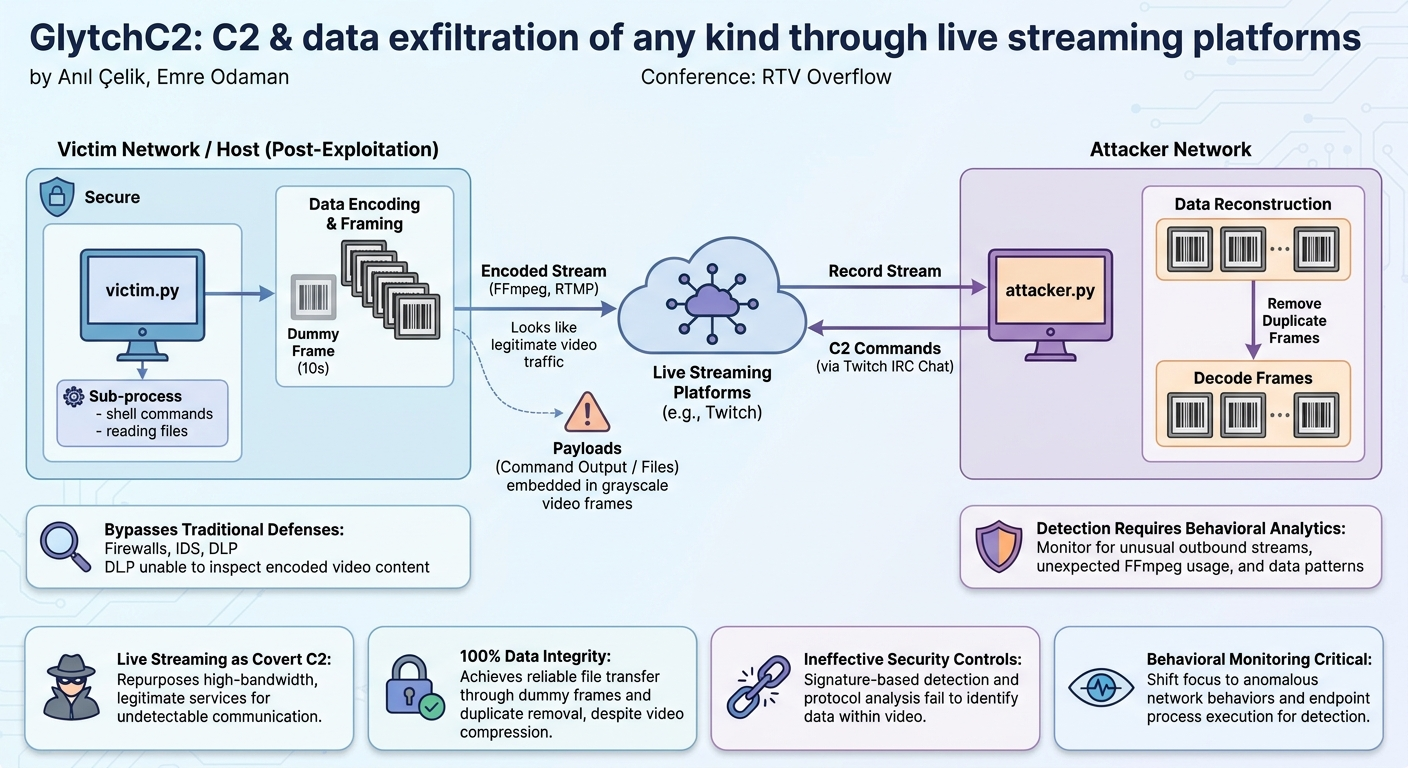
GlytchC2 operates on a sophisticated principle of encoding arbitrary data into video frames, leveraging the high-bandwidth nature of live streaming platforms for covert communication. The framework is primarily built in Python and relies heavily on FFmpeg for video encoding and decoding operations.
The core workflow involves two main components: the victim.py script and the attacker.py script. Both parties must first connect to the same Twitch IRC chat channel. This IRC channel serves as the initial, low-bandwidth command-and-control conduit, allowing the attacker to send commands to the victim and receive status updates.
Encoding Mechanism:
Initially, the researchers attempted to encode data using the RGB color space, embedding three bytes of data into each pixel. However, due to the widespread use of chroma subsampling by streaming platforms (a compression technique that reduces the color detail, particularly for less perceptually significant chrominance components), this method proved unreliable. Any change to the color space during compression would corrupt the encoded data.
The solution was to switch to encoding in grayscale. While more resilient to typical video compression, this came at a significant trade-off: each pixel could now only carry half a byte (a nibble) of data, effectively reducing the bandwidth by a factor of six compared to the initial RGB approach. The data is visually represented as distinct, barcode-like patterns within the video frames, with each thin line or block representing a portion of the encoded data. Header information, such as the filename and size, is embedded in the upper-left corner of the frames during file transfer operations.
Workflow Breakdown:
- Connection Establishment:
- The victim executes
victim.py, providing the Twitch channel name and a stream key. It then sits idle, continuously monitoring the specified Twitch IRC chat for incoming commands. - The attacker executes
attacker.py, providing only the channel name. - Both parties establish a connection to
irc.chat.twitch.tv, typically on port 6667.
- Command Transmission (IRC):
- The attacker inputs a command (e.g.,
whoami,ifconfig) or a file transfer request (file <full_path_to_file>) intoattacker.py. - This command is sent over the IRC channel to the victim. The victim's script performs basic validation on the command.
- Execution and Encoding (Victim Side):
- If a shell command is received, the victim spawns it as a sub-process, captures its output, and writes it to a temporary file.
- If a file transfer is requested, the victim reads the specified file.
- The output (command result or file content) is then encoded into a series of PNG image frames. The maximum payload per image frame is a specific amount of bytes, meaning larger data payloads are segmented across multiple frames. For example, a 10MB file might require 10 data frames plus a dummy frame.
- Video Stream Preparation and Transmission (Victim Side):
- The encoded PNG frames are compressed into a video file using FFmpeg.
- A crucial element is the dummy frame: the very first frame streamed contains no actual data and is streamed for 10 seconds. This is a critical countermeasure against stream distribution delays observed on live platforms (typically 7-8 seconds before viewers receive the live stream). The dummy frame "absorbs" this initial lag, ensuring that the first actual data frame is not lost or corrupted.
- Each subsequent data-carrying frame is also streamed for 10 seconds by default. This extended duration provides robustness against network latency and allows the attacker ample time to record the frame, minimizing the chance of corruption or loss. This duration is adjustable based on network conditions.
- The victim then initiates a live stream to the specified Twitch channel using FFmpeg, pushing the prepared video content.
- Recording and Decoding (Attacker Side):
- Once the victim's stream is ready, a "ready" message is sent via IRC to the attacker.
- The attacker's
attacker.pyscript then fetches the live stream URL and begins recording the video stream. - After the recording is complete, the attacker's script processes the recorded video. The most critical step here is the elimination of duplicate frames. Since each unique data frame is streamed for 10 seconds, the recorded video will contain multiple identical frames for each data segment. Removing these duplicates is essential to reconstruct the data in the correct order and prevent corruption.
- Finally, the attacker decodes the remaining unique frames, reconstructing the original command output or file. For file transfers, the integrity is verified (e.g., via hash comparison) and the file is saved.
The entire process is designed to loop, allowing the attacker to send subsequent commands or file transfer requests without re-establishing the initial connection. The reliance on FFmpeg means that the tool's performance and compatibility with various platforms are directly tied to FFmpeg's capabilities and the specific, often undocumented, compression characteristics of each live streaming service.
Demo / Proof of Concept
▶ Watch: Live Demo: Executing commands and transferring files (24:00)
The capabilities of GlytchC2 were vividly demonstrated during the RTV Overflow live session, building upon its initial debut at Def Con 32 Red Team Village and Demo Labs. The live demonstration meticulously walked through the setup, command execution, and file transfer processes, proving the framework's efficacy and 100% data integrity.
The setup phase began with the configuration of an .env file for Twitch authentication, requiring a nickname and OAuth key. After installing necessary prerequisites and Python requirements, the stage was set for the covert operation.
Command Execution Demonstration:
- Victim Setup: On a Kali Linux virtual machine, the
victim.pyscript was executed, providing the Twitch channel name and stream key. The victim machine then entered an idle state, awaiting commands via the IRC chat. - Attacker Setup: Concurrently, the
attacker.pyscript was run on the attacker's machine, specifying only the Twitch channel name. - IRC Connection: Both scripts successfully connected to
irc.chat.twitch.tv, confirming the initial C2 channel was established. whoamiCommand: The attacker first issued thewhoamicommand. The victim received, executed, and encoded the output ("root") into a single, minimal video frame. This frame, along with the initial 10-second dummy frame, was streamed to Twitch. Due to the small data size, only the dummy frame was visibly prolonged on the Twitch stream. The attacker recorded this brief stream, removed the duplicate dummy frames, and successfully displayed "root" as the output, confirming covert command execution.ifconfigCommand: To demonstrate handling larger command outputs, the attacker then sent theifconfigcommand. The victim processed the more extensive network configuration data, encoded it into multiple frames, and streamed it. The attacker, after recording and processing, accurately displayed the fullifconfigoutput, identical to what would be seen directly on the Kali machine.
File Transfer Demonstration:
- File Identification: To simulate a realistic scenario, the attacker first used
ls -la ~/Desktopto enumerate files on the victim's desktop, identifying a target file:gleeC2_overflow.pptx. - Transfer Request: The attacker initiated the file transfer using the
fileprefix followed by the full path:file /home/kali/Desktop/gleeC2_overflow.pptx. - Encoding and Streaming: The victim's script calculated the necessary number of frames for the approximately 10MB PowerPoint file (resulting in 11 frames: 1 dummy + 10 data frames). It then proceeded to encode the file's content into these frames. During this process, the Twitch stream visibly displayed the "barcode-like" patterns, with distinct changes every 10 seconds as each new data frame was streamed. The upper-left corner of these frames contained header information, including the filename and size, providing visual confirmation of the embedded metadata.
- Recording and Reconstruction: The attacker recorded the extended live stream, which lasted for over a minute due to the 10-second duration per frame. Once the stream concluded, the
attacker.pyscript meticulously removed all duplicate frames, aligning the unique data segments. - Integrity Verification: The crucial part of the file transfer demo was the integrity check. The SHA256 hash of the original
gleeC2_overflow.pptxfile on the victim's machine (ending in2532) was compared against the SHA256 hash of the received file on the attacker's machine. Both hashes matched perfectly, confirming 100% data integrity during the covert transfer. - File Usability: Finally, the transferred PowerPoint file was successfully opened on the attacker's machine, proving its complete and uncorrupted state.
The demonstration underscored GlytchC2's capability to reliably exfiltrate significant amounts of data, even under the compression mechanisms of live streaming platforms, while remaining covert. The explicit emphasis on the dummy frame and duplicate frame elimination highlighted the practical solutions developed to ensure robust data transfer.
Defensive Implications
▶ Watch: Q&A: Use cases and "anything is a C2" philosophy (36:00)
The GlytchC2 framework presents a significant challenge to conventional cybersecurity defenses, necessitating a re-evaluation of current strategies. Its ability to leverage legitimate live streaming platforms for C2 and data exfiltration means that traditional security measures are largely ineffective.
- Bypass of Network Firewalls and IDS/IPS: GlytchC2 traffic appears as standard video streaming data (e.g., RTMP to Twitch servers). This type of traffic is typically allowed by network firewalls, as blocking it would disrupt legitimate user activity. Signature-based intrusion detection/prevention systems (IDS/IPS) are unlikely to have signatures for data encoded within video frames, rendering them blind to the covert communication. Defenders must recognize that allowing common internet services means allowing potential covert channels.
- Ineffectiveness of Traditional Data Loss Prevention (DLP): Current DLP solutions primarily focus on identifying sensitive data in common file types, email, or direct network transfers. Analyzing the content of live video streams for embedded, encoded data is an incredibly complex task, far beyond the capabilities of most existing DLP technologies. This creates a significant blind spot for exfiltration attempts.
- Focus on Behavioral Analytics and Anomaly Detection: Since signature-based methods fail, defenders must shift towards behavioral analytics. This involves monitoring for unusual patterns of network traffic from internal hosts. For example, a server or workstation typically not involved in streaming suddenly initiating outbound connections to Twitch or YouTube, especially with high bandwidth utilization, should raise red flags. Similarly, a host initiating a stream with an unusually static or "barcode-like" visual pattern, even if appearing as video, could indicate malicious activity.
- Egress Filtering and Whitelisting: Stricter egress filtering, moving beyond port-based rules to application-layer whitelisting, can help. If an organization has no legitimate reason for internal systems to stream to public platforms, such connections should be blocked by default. However, this can be challenging in environments where legitimate streaming or collaboration tools are used.
- Endpoint Detection and Response (EDR) and Process Monitoring: While network-level detection is difficult, EDR solutions could potentially detect suspicious activity on the endpoint. The
victim.pyscript executes commands as sub-processes and writes output to files. Monitoring for unusual process spawns (e.g.,ffmpegbeing executed in an unexpected context or by an unusual user), or suspicious file operations (e.g., creation of temporary files with encoded data) could provide detection opportunities. - Supply Chain and LLM Application Security: The origin of this research in an LLM application audit highlights the broader risk of code execution capabilities in modern applications. Defenders must rigorously audit applications, especially those with scripting or debugging features, for potential vulnerabilities that allow for post-filtering payload injection.
- Insider Threat and Air-Gapped Networks: GlytchC2 poses a significant risk for insider threats. An authenticated user or compromised internal system could leverage this technique to exfiltrate data from seemingly secure environments, including potentially air-gapped networks if an initial compromise allows for outbound network access to streaming services.
- Proactive Threat Intelligence: Security teams need to stay abreast of evolving covert channel techniques. Understanding how attackers are adapting to modern defenses, such as by repurposing legitimate services, is crucial for developing proactive countermeasures.
In essence, GlytchC2 forces defenders to think beyond traditional "known bad" indicators and embrace a more comprehensive, behavioral-centric approach to security, recognizing that any seemingly benign channel can be weaponized.
Key Takeaways
- Live streaming platforms are viable covert C2 and exfiltration channels: GlytchC2 demonstrates that services like Twitch can be repurposed for robust command and control and data exfiltration, leveraging their high bandwidth and legitimate traffic profile to bypass traditional security controls.
- Traditional security measures are often ineffective: Firewalls, IDS/IPS, and conventional DLP solutions, relying on signature-based detection or protocol analysis, are largely blind to data encoded within legitimate video streams.
- 100% data integrity is achievable in covert video channels: Despite inherent video compression and network latency, techniques like dummy frames and duplicate frame elimination ensure reliable and complete data transfer, making it practical for sensitive data exfiltration.
- "Anything is a C2" is a practical reality: The research reinforces that creative adversaries can weaponize almost any legitimate service for covert communication, expanding the attack surface beyond traditional C2 protocols.
- Behavioral monitoring is critical for detection: Defenders must shift from signature-based detection to advanced behavioral analytics, looking for anomalous streaming activity, unusual process executions, or unexpected
ffmpegusage on endpoints. - Undocumented platform specifics are a challenge: The varying and often undocumented compression, codec, and pixel format behaviors of different streaming platforms require extensive trial-and-error, complicating both offensive and defensive efforts.
About the Speaker(s)
Anıl Çelik is a Cyber Security Engineer at HAVELSAN, a prominent defense industry company in Turkey. Holding a degree in computer engineering, his primary areas of expertise and work focus on red teaming and purple teaming operations. He is actively involved in pushing the boundaries of offensive security research and can be reached via LinkedIn for further discussion.
Emre Odaman is also a computer engineer and a Cyber Security Engineer, having collaborated with Anıl Çelik for several years. He is currently pursuing a Master's degree in cybersecurity at Sapienza University, demonstrating his commitment to advanced studies in the field. Like Anıl, Emre is accessible on LinkedIn for professional networking and inquiries.
Reviews
Dr. Zero (Offensive Security Researcher) — STRONG ACCEPT
Steganography over video isn't a new concept, but weaponizing Twitch to pull data past enterprise DLP is a beautiful headache. Çelik and Odaman built a highly practical tool that actually survives aggressive stream compression. This is solid red team engineering that turns a theoretical attack into a working, live-demoed nightmare for egress filtering.
Heather Calloway (CISO) — SOLID
This is a clever demonstration of how easily traditional data loss prevention (DLP) and network edge defenses can be bypassed using live streaming platforms like Twitch. While the engineering is impressive, the executive takeaway is simple: network-based exfiltration controls are increasingly blind to modern evasion, and our data protection strategies must pivot accordingly.