Use It Monday: A 5-Step Method for Turning Security Findings Into Stories Executives Act On
Victoria Mosby (Founder · Basilisk Security Advisory)
RVAsec 2026 · Day 2 · Grand Ballroom D/E/F/G
Overview
In the dynamic landscape of cybersecurity, a persistent challenge for security professionals is effectively communicating critical findings to executive leadership. Technical reports, often laden with jargon and raw data, frequently fail to resonate with C-suite executives whose primary focus lies in business risk, financial implications, and strategic decision-making. Victoria Mosby's RVAsec talk, "Use It Monday: A 5-Step Method for Turning Security Findings Into Stories Executives Act On," directly addresses this disconnect, offering a pragmatic and innovative framework designed to bridge the gap between technical truth and executive action.
Key moments
- 0:00 Introduction: Bridging the security-executive communication gap
- 4:00 Cat's Dilemma: Presenting politically charged security findings
- 11:20 Step 1: Identify the 'Big Idea' – the core decision
- 14:30 Step 2: Story archetypes – avoiding political conflict
- 21:30 Steps 3 & 4: Map stakeholders, calibrate story with data
- 32:30 Step 5: Anchor facts, make the actionable budget ask
- 43:50 Full myth example: Adapting storytelling for different audiences
Use It Monday: A 5-Step Method for Turning Security Findings Into Stories Executives Act On
Speakers: Victoria Mosby, Founder, Basilisk Security Advisory
Conference: RVAsec
YouTube: https://www.youtube.com/watch?v=SX5bMfVvRM
Overview
In the dynamic landscape of cybersecurity, a persistent challenge for security professionals is effectively communicating critical findings to executive leadership. Technical reports, often laden with jargon and raw data, frequently fail to resonate with C-suite executives whose primary focus lies in business risk, financial implications, and strategic decision-making. Victoria Mosby's RVAsec talk, "Use It Monday: A 5-Step Method for Turning Security Findings Into Stories Executives Act On," directly addresses this disconnect, offering a pragmatic and innovative framework designed to bridge the gap between technical truth and executive action.
Mosby, drawing from over 16 years of diverse experience across cybersecurity, GRC, and risk management, presents the SAGA framework, a storytelling-based approach to transform complex security findings into compelling narratives that executives can understand, internalize, and act upon. The talk underscores that while data provides the facts, stories provide the context and emotional resonance necessary for leadership to prioritize and fund security initiatives. This method is not merely about translating technical terms but about reframing issues within a business-risk context, enabling security practitioners to move beyond simply identifying problems to proactively influencing strategic outcomes.
The significance of Mosby's method lies in its practical application for security teams struggling with budget approvals, prioritization of remediation efforts, and overall executive buy-in. By adopting a structured storytelling approach, practitioners can navigate the political and bureaucratic hurdles often associated with high-stakes security decisions. The framework equips individuals with the tools to present findings in a way that highlights their business impact, fosters trust, and ultimately drives tangible improvements in an organization's security posture, making it a truly "Use It Monday" actionable strategy.
Background
▶ Watch: Introduction: Bridging the security-executive communication gap (0:00)
The genesis of the "Use It Monday" method stems from a widespread and deeply rooted problem in the cybersecurity industry: the communication chasm between technical security teams and executive leadership. Security professionals, steeped in the intricacies of vulnerabilities, exploits, and compliance frameworks, often present findings with an emphasis on technical accuracy and exhaustive detail. While factually correct, this "flat" presentation style frequently lacks the business context, financial implications, and strategic urgency that resonate with C-suite executives.
Victoria Mosby's extensive career, spanning roles from government contractor to senior sales engineer, has provided her with a unique vantage point—she has consistently sat on "the other side of the table," receiving countless penetration test reports, forensic analyses, and audit findings. She observed firsthand how CISOs, compliance directors, and other leaders struggled to extract actionable decisions from these technical reports. The common refrain, "What do you need me to decide on?" after a lengthy technical presentation, highlighted the core issue: the data was present and truthful, but its translation into business-relevant risk was insufficient to prompt action. This often led to critical issues being deferred, ignored, or becoming politically charged, creating a backlog of unaddressed risks.
Mosby’s prior work, including a talk at Hack Space Con focused on framing technical findings with the "bottom line up front" (e.g., "This RCE targeting a customer-facing system holding 3 million records could lead to $2-8 million in reputational breaches"), laid the groundwork for the SAGA framework. While that approach helped in initial framing, it didn't fully address the political and emotional aspects of executive decision-making. The "Use It Monday" method, therefore, expands on this by integrating elements of storytelling, drawing inspiration from public speaking expert Nancy Duarte's concept of a "big idea" and the timeless human propensity to remember stories over raw facts. The framework acknowledges that executives operate in a sphere where business risk, financial impact, and strategic alignment are paramount, and effective security communication must speak that language.
Key Findings
▶ Watch: Step 1: Identify the 'Big Idea' – the core decision (11:20)
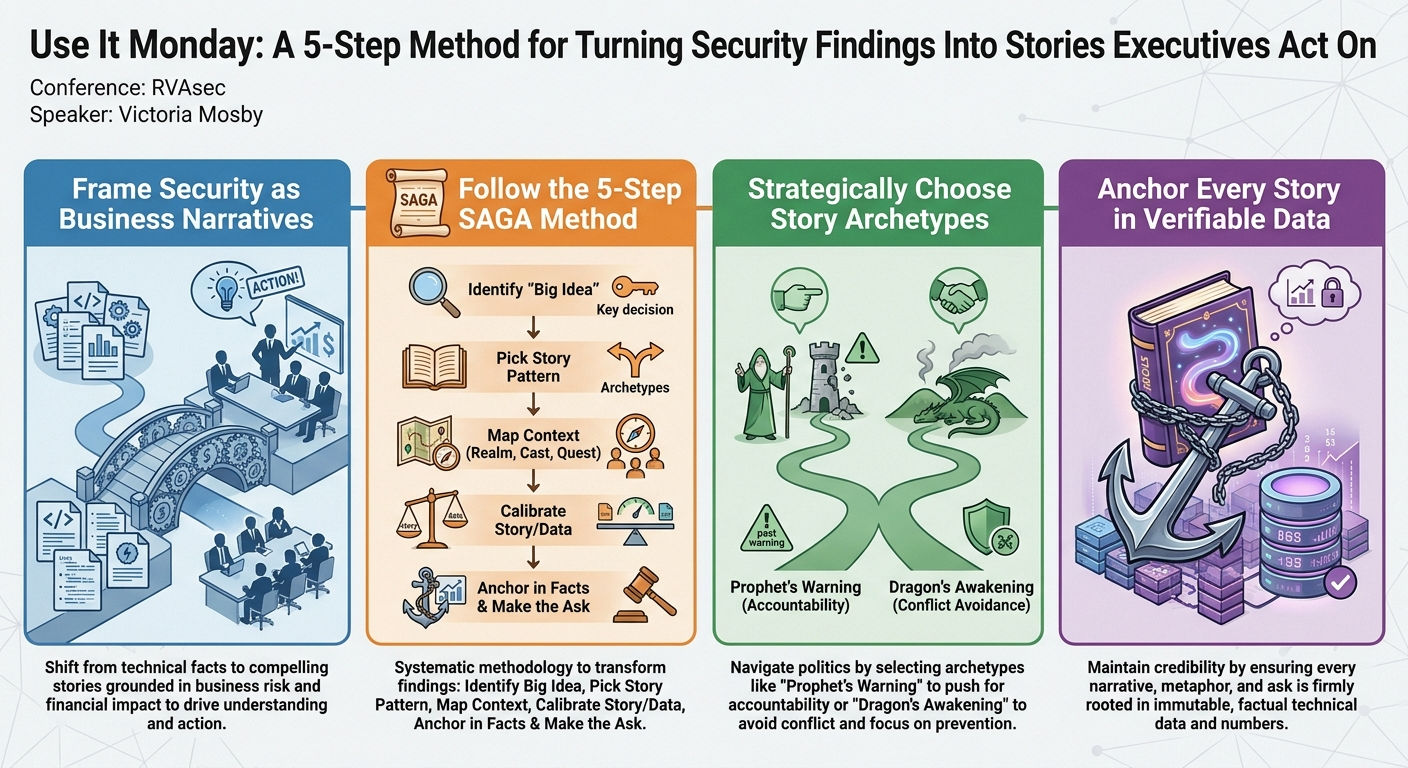
The central contribution of Victoria Mosby's talk is the SAGA framework, a structured, five-step method designed to transform technical security findings into compelling, actionable narratives for executive audiences. The core insight is that while data is essential, it is storytelling that drives understanding, internalization, and ultimately, executive action. This framework is a direct response to the prevalent issue of security findings being ignored or deferred due to a lack of business context and an inability to navigate organizational politics.
The SAGA framework's main discoveries and contributions are:
- Bridging the Communication Gap: It provides a systematic approach to translate complex technical details into a language that aligns with executive priorities—business risk, financial impact, and strategic objectives. This moves beyond mere technical translation to strategic communication.
- The Power of Narrative: The framework posits that people remember stories better than raw facts. By embedding security findings within a narrative structure, executives are more likely to retain the information, understand its implications, and feel compelled to act.
- Actionable Decision-Making: Each step is geared towards crystalizing a clear, single decision point for the executive. This eliminates ambiguity and empowers decision-makers to understand precisely what is being asked of them, including the required resources, timeline, and stakes involved.
- Navigating Organizational Politics: The framework introduces story archetypes that allow practitioners to strategically frame findings to either push for accountability (e.g., Prophet's Warning) or avoid unnecessary conflict and focus on forward action (e.g., Dragon's Awakening). This tactical choice is crucial in politically charged environments.
- Maintaining Credibility: Despite its emphasis on storytelling, the SAGA framework includes crucial guardrails that ensure factual integrity and prevent the approach from becoming "gimmicky." Every story must be anchored in immutable data, ensuring that the core technical truth remains central to the narrative.
- Holistic Contextualization: By mapping the Realm (business context), Cast (stakeholders), and Quest (the ask), the framework encourages a comprehensive understanding of the organizational landscape surrounding a security finding, allowing for more tailored and impactful presentations.
Ultimately, the SAGA framework's key finding is that effective security communication is a strategic skill, not just a technical one. It empowers security professionals to become influential advisors by mastering the art of presenting risk in a way that compels executives to make informed decisions and allocate necessary resources.
Technical Deep Dive
▶ Watch: Step 2: Story archetypes – avoiding political conflict (14:30)
The SAGA framework is a five-step methodology designed to transform security findings into compelling, executive-actionable stories. This framework emphasizes structuring information around a core decision, leveraging narrative archetypes, understanding the organizational context, calibrating the storytelling intensity, and always anchoring the narrative in verifiable data.
Step 1: Identify the Big Idea (The Decision)
The foundational step is to distill the entire ask into a single, concise sentence that clearly states the desired decision and its preventative outcome. Inspired by Nancy Duarte's concept, this "big idea" must encapsulate:
- Action: What needs to be done.
- Amount: The resources (e.g., budget) required.
- Deadline: The timeframe for completion.
- Stakes: What will be prevented or gained.
The structure is typically: "We must decide whether to [action] to prevent [risk]." For instance, in Cat's scenario (the CISO of Meridian Finance), her big idea is: "We must decide whether to fund the $850K to eliminate the standing credentials across the two legacy environments by Q3 to prevent the credential-based breach that has hit three peer firms in 18 months." This sentence provides immediate clarity and a focal point for the executive decision-maker.
Step 2: Pick Your Story Pattern (Archetype)
This step involves selecting a narrative archetype that best suits the finding and the organizational context, particularly the political landscape. The SAGA framework offers seven archetypes:
- Prophet's Warning: A warning that was ignored, pushing for accountability. (e.g., Equifax breach, where a known patch was ignored).
- Dragon's Awakening: A dormant risk yet to surface, focusing on prevention.
- Siege: An active threat hitting the environment (e.g., DDoS, ransomware).
- Quest for Sacred Artifact: Seeking a new tool, initiative, or program.
- Merchant's Journey: Validating a vendor or new third party.
- Alliance Formation: A merger, new partnership, or co-partnership.
- Succession Crisis: Changes in leadership (e.g., CISO departure).
For presenting security findings, Prophet's Warning and Dragon's Awakening are key. The Prophet's Warning highlights past deferrals and can force accountability, but it risks opening politically charged discussions about who ignored the warning previously. The Dragon's Awakening, conversely, frames the issue as a recently identified dormant risk, focusing on current facts and future prevention without assigning blame. This tactical choice allows the presenter to achieve the desired outcome (funding, remediation) without engaging in potentially damaging internal conflicts.
Step 3: Map the Realm, Cast, and Quest (The Three Pillars)
This step involves a deep dive into the context surrounding the finding, broken down into three pillars:
- Realm (Business Understanding): This isn't just the technical environment but its business implications. For instance, legacy Active Directory forests (logical) are tied to client portals (business), making them a revenue line the sovereign won't ignore. This connects the technical to the organizational value.
- Cast (Stakeholders): Identifying key players and their roles.
- Sovereign: The ultimate decision-maker and budget holder (e.g., the CFO, CEO, or IT Director).
- Captain of the Guard: The presenter's counterpart or direct leader (e.g., the CISO, SOC lead).
- Advisors: Other influential figures (e.g., Chief Risk Officer (CRO), General Counsel). Mosby notably highlights the importance of a CISO reporting to the CRO rather than the CIO, arguing that reporting under IT creates a conflict of interest that hinders effective security action.
- Merchants: External vendors or partners (e.g., CyberArk for PAM deployment).
- Quest (The Ask): A detailed articulation of the desired outcome, including the timeline, cost, and specific deliverables. For Cat's example, the quest is "finish the PAM deployment, $850K, 6 months, done with zero standing credentials remaining." This clarifies that the request is often about completing existing initiatives rather than starting new ones.
Step 4: Calibrate the Story vs. the Data (Mythology Dial)
This step dictates the balance between storytelling and raw data based on the audience and context. The Mythology Dial has three modes:
- Conservative: Mostly data, lightly framed. Ideal for formal board meetings where direct, factual communication is expected, unless the board's familiarity with the presenter allows for more narrative.
- Balanced: Story and data share equal footing (50/50). This mode is often achieved through structural changes in presentation rather than heavily narrative language. It's suitable for discussions with a CFO or other executive peers who appreciate context but still require concrete facts. Cat's use of the Dragon's Awakening for Marcus (CFO) is an example of a balanced approach, where the structure avoids blame while presenting facts.
- Full Myth: Story leads the way, anchored in data. This mode is best for cultural events, internal team building, or peer-to-peer discussions where a rich narrative can engage and inspire without the need for immediate, high-stakes decisions. For example, presenting the legacy AD issue as "a dragon has slept beneath this firm since '98... 340 credentials sit unguarded in its lair."
Regardless of the dial setting, the framework emphasizes that the core data must never change, serving as the immutable anchor for any story.
Step 5: Anchor Every Metaphor in a Fact and Make the Ask
The final and most crucial step ensures that all storytelling elements are firmly rooted in factual data, culminating in a clear, actionable request. If the story were stripped away, the underlying ask should still be logical and truthful. Key considerations include:
- Data Integrity: Reiterate specific numbers (e.g., 340 standing credentials, $850K ask, 3 peer firms breached, $8-22 million cost per breach).
- Clear Ask: "Approve this budget for a 6-month timeframe to Q3."
- Accountability & Trust: Offer regular status updates (e.g., quarterly reports to the audit committee), which provides reassurance to the decision-maker and covers their "butt" if questions arise later. This builds trust and demonstrates commitment.
Guardrails for Credibility
Mosby also outlines essential guardrails to prevent the SAGA framework from being perceived as "gimmicky" and to protect the presenter's credibility:
- Anchor every story in data: Data must be consistent and truthful.
- Plain language for executive summaries: Avoid jargon.
- Cast stakeholders respectfully: Even if you disagree with someone, respect their role.
- Use translation strips: Pair every metaphor with its technical equivalent (especially in Balanced mode).
- Avoid theatrics: Distinguish between storytelling and excessive drama.
- Maintain factual integrity: Do not alter facts to fit the narrative.
By meticulously following these steps and adhering to the guardrails, security professionals can craft compelling narratives that not only inform executives but also motivate them to take decisive action, ultimately enhancing an organization's security posture.
Demo / Proof of Concept
▶ Watch: Step 5: Anchor facts, make the actionable budget ask (32:30)
Victoria Mosby illustrates the SAGA framework with a detailed walkthrough of a real-world scenario, using a fictitious company, Meridian Finance, and its CISO, Cat. This serves as the primary "demo" for how the framework translates abstract concepts into actionable communication.
The core problem presented is a politically charged security finding that Cat has been "hiding" within a larger report of 47 findings. The issue involves 340 unaudited admin credentials residing in two legacy Active Directory (AD) forests dating back to 1998. These legacy systems, acquired through mergers, are not isolated; they are trusted by client portals, making them a direct business risk. Cat knows that three peer firms have suffered credential-based breaches from similar legacy system vulnerabilities within the last 18 months, costing them between $8 million and $22 million each. The ask is for $850,000 to remediate this, an issue previously identified in 2022 with a $620,000 ask, but deferred. This deferral makes the current ask a "dangerous" one, as it implicitly questions past decisions.
Here's how Cat applies the SAGA framework:
- Identify the Big Idea:
- Decision: "We must decide whether to fund the $850K to eliminate the standing credentials across the two legacy environments by Q3 to prevent the credential-based breach that has hit three peer firms in 18 months."
- This sentence clearly outlines the action ($850K funding, eliminate credentials), the deadline (Q3), and the stakes (preventing peer-firm-like breaches).
- Pick Your Story Pattern (Archetype):
- Cat considers two archetypes:
- Prophet's Warning: This would highlight that the issue was flagged in 2022 ($620K), deferred, and now three peers have been breached. While factual, this approach pushes for accountability, risking a political fight ("Why did we ignore it the first time?").
- Dragon's Awakening: This frames the issue as a newly surfaced dormant risk. "This assessment found these 340 standing accounts in two inherited forests. One has been unaudited since '98. Three peers have been breached since then... We need $850K to make sure this dragon doesn't wake up." This approach presents the exact same facts but avoids targeting past decisions or individuals, allowing Cat to move forward without picking a fight. Cat chooses the Dragon's Awakening to protect her credibility and achieve her goal without unnecessary conflict.
- Map the Realm, Cast, and Quest:
- Realm: The two legacy AD forests. The business context is crucial: they support client portals, representing a revenue line.
- Cast:
- Sovereign: Marcus, the CFO (holds the budget).
- Captain of the Guard: Cat, the CISO.
- Advisors: Eleanor, the Chief Risk Officer (Cat's boss, on the board, can take the issue to the board directly).
- Merchants: CyberArk (an existing PAM solution that needs full deployment).
- Quest: Fully deploy the existing CyberArk PAM solution over 6 months with $850K, resulting in zero standing credentials and the removal of these risky AD groups/forests.
- Calibrate the Story vs. the Data (Mythology Dial):
- For Marcus, the CFO, Cat opts for a Balanced approach. She won't use full "dragon stirs" narrative language in a board slide. Instead, the "dormant risk just surfaced" framing is conveyed through the structure of the presentation (Dragon's Awakening archetype) rather than overly mythical language. This ensures Marcus gets the necessary facts rooted in business risk while avoiding theatrics inappropriate for a financial decision-maker.
- Anchor Every Metaphor in a Fact and Make the Ask:
- Cat ensures all facts are present: 340 standing credentials, '98 legacy, $850K ask (vs. $620K in 2022, but focusing on today), three peer breaches costing $8-22 million each.
- The Ask: Approval of the $850K budget for a 6-month timeframe to Q3.
- Accountability: Cat promises quarterly status updates to the audit committee, covering Marcus's "butt" and building trust.
Mosby also briefly touches on a second example: a Tidewater migration (a portfolio account platform) requiring $4.2 million over 12 months due to approaching end-of-service, impacting 9% of assets under management (AUM) and military/government clients. This is framed as a Quest for a Sacred Artifact (forward-looking acquisition) and would also use a Balanced dial setting for Marcus, focusing on zero disruption to the customer base. These examples demonstrate the versatility and practical application of the SAGA framework across different types of security and operational challenges.
Defensive Implications
▶ Watch: Full myth example: Adapting storytelling for different audiences (43:50)
The SAGA framework presented by Victoria Mosby offers profound defensive implications for organizations and security professionals. By shifting the paradigm of security communication from purely technical reporting to strategic storytelling, it empowers defenders to significantly enhance their effectiveness in several critical areas:
- Increased Budget Allocation and Prioritization: The most direct defensive implication is the improved ability to secure funding and prioritize critical security initiatives. When findings are presented with clear business context, financial implications (e.g., $8-22 million cost of a breach), and actionable decisions, executives are far more likely to approve budgets and allocate resources. This means faster remediation of vulnerabilities, implementation of vital security controls like PAM deployments, and investment in proactive measures.
- Enhanced Risk Management and Governance: The framework forces security teams to think beyond technical vulnerabilities and articulate risk in terms that resonate with enterprise risk management strategies. By mapping the "Realm" to business understanding and identifying all "Cast" members, security professionals contribute more effectively to the organization's overall risk posture. The framework helps ensure that security risks are not just identified but actively managed at the executive level, integrated into strategic planning rather than being siloed.
- Proactive vs. Reactive Security Posture: By learning to frame issues like the "Dragon's Awakening," security teams can push for proactive remediation of dormant risks before they manifest as costly breaches. This moves organizations away from a reactive, incident-response-driven security culture towards a more mature, preventative stance. The ability to articulate potential future impacts in a compelling narrative allows for foresightful investment.
- Improved CISO Influence and Credibility: For CISOs and security leaders, mastering this communication method elevates their role from technical expert to strategic business partner. By consistently delivering clear, actionable, and contextually rich information, they build a higher level of trust and credibility with the executive team and the board. This trust is invaluable when advocating for difficult decisions or significant investments. Mosby's point about a CISO reporting to a CRO rather than a CIO underscores the importance of organizational structure in facilitating this strategic influence, minimizing conflicts of interest.
- Navigating Organizational Politics and Bureaucracy: The strategic choice of story archetypes (e.g., Prophet's Warning vs. Dragon's Awakening) provides a tactical advantage in navigating complex internal politics. Defenders can choose to push for accountability where appropriate or strategically avoid conflict to ensure forward progress, depending on the organizational culture and specific situation. This pragmatic approach prevents crucial security initiatives from being stalled by internal friction.
- Better Stakeholder Alignment: By explicitly identifying and understanding the "Cast" (Sovereign, Captain of the Guard, Advisors, Merchants), security teams can tailor their message to each stakeholder's perspective and priorities. This fosters better alignment across departments—IT, finance, legal, and operations—ensuring that security is seen as an enabler of business objectives rather than a cost center or impediment.
In essence, the SAGA framework equips security professionals with a powerful tool to translate their deep technical knowledge into strategic business value. This directly strengthens an organization's defensive capabilities by ensuring that critical security issues receive the attention, resources, and executive backing they deserve, ultimately leading to a more resilient and secure enterprise.
Key Takeaways
- Storytelling is a Strategic Security Tool: Technical facts alone are often insufficient to drive executive action. Framing security findings within a compelling narrative, grounded in business risk and financial impact, is crucial for gaining buy-in and securing resources.
- The SAGA Framework Provides Structure: Victoria Mosby's five-step SAGA framework (Identify Big Idea, Pick Story Pattern, Map Realm/Cast/Quest, Calibrate Story/Data, Anchor & Ask) offers a systematic methodology for transforming technical reports into actionable executive communications.
- Tailor Your Message to the Audience: The Mythology Dial (Conservative, Balanced, Full Myth) allows security professionals to adjust the balance between narrative and raw data based on the audience (e.g., board, CFO, peers) and the political context, ensuring maximum impact and credibility.
- Always Anchor Stories in Data: While storytelling is vital, factual integrity is paramount. Every narrative and metaphor must be firmly rooted in verifiable data, numbers, and technical truths to maintain credibility and ensure the underlying ask is logical and defensible.
- Focus on Actionable Decisions and Preventative Outcomes: The "Big Idea" should always distill the complex issue into a clear, single decision required from the executive, explicitly stating the action, amount, deadline, and what will be prevented or gained.
- Navigate Politics Strategically: Choosing the right story archetype, such as Prophet's Warning (for accountability) or Dragon's Awakening (to avoid conflict and focus on future prevention), allows practitioners to strategically navigate organizational politics and achieve desired security outcomes.
About the Speaker(s)
Victoria Mosby is a seasoned cybersecurity professional with over 16 years of experience across various facets of the industry, including cybersecurity, GRC (Governance, Risk, and Compliance), consulting, risk management, and sales. She is the founder of Basilisk Security Advisory, a consultancy that she is actively revitalizing. In her day job, she serves as a senior sales engineer for an unnamed cybersecurity company, bringing a unique blend of technical expertise and business acumen to her roles.
Mosby's diverse career background has seen her wear many "hats," including working as a government employee, a contractor for the government, and on the "other side of the table" where she received and reviewed security reports as a CISO and compliance director. This extensive experience provides her with a deep understanding of the challenges faced by both technical practitioners and executive decision-makers. Beyond her professional work, Victoria Mosby is also a creative writer, known as the "lorekeeper of the Dreaming Tower archives," where she crafts dark fantasy cyber stories. This creative outlet, she notes, significantly influences her approach to the SAGA framework, lending itself to the storytelling methodology presented in her talk.
Reviews
Dr. Zero (Offensive Security Researcher) — SOLID
Mosby's SAGA framework wraps standard executive communication in D&D cosplay, but the underlying mechanics actually work. If you can stomach calling your CFO a 'Sovereign,' the tactical advice on bypassing corporate egos to get your remediation funded is highly pragmatic. It's a solid survival guide for practitioners tired of throwing 200-page Nessus dumps into the void.
Heather Calloway (CISO) — STRONG ACCEPT
A highly pragmatic framework for securing executive buy-in and budget, wrapped in a slightly distracting naming convention. Mosby accurately diagnoses why technical findings die in committee and offers a structural fix for navigating the politics of risk remediation.