Sherrod DeGrippo - Keynote
Sherrod DeGrippo (GM Global Threat Intelligence · Microsoft)
RVAsec 2026 · Day 1 · Grand Ballroom D/E/F/G
Overview
In her RVAsec keynote, Sherrod DeGrippo, GM of Global Threat Intelligence at Microsoft, delivers a thought-provoking and deeply personal exploration of Artificial Intelligence (AI), framing its rapid ascent through the lens of Stanley Kubrick's seminal film, 2001: A Space Odyssey. DeGrippo argues that AI represents not just a technological leap but an evolutionary shift, accelerating capabilities to an unprecedented degree and presenting profound ethical and operational challenges for the cybersecurity community. Her talk is a powerful call to action for defenders to embrace their innate anxiety and critical thinking skills, to understand the non-deterministic nature of AI, and to uphold human values and connection in an increasingly automated and frictionless world.
Key moments
- 0:00 Introduction and speaker's background
- 6:27 From hacker scene to a professional industry
- 11:03 AI as magic: Arthur C. Clark's prophetic quote
- 18:30 Mythos AI: a cyber nuclear weapon for exploits
- 22:00 HAL's incompatible instructions and moral dilemmas
- 34:00 Choosing human connection over frictionless AI existence
- 44:00 Natural language interfaces: the problem that AI lies
- 52:30 The hacker spirit will save us from AI apocalypse
The AI Space Odyssey: Navigating the Accelerating Future of Cybersecurity
Speakers: Sherrod DeGrippo, GM Global Threat Intelligence, Microsoft
Conference: RVAsec
YouTube: https://www.youtube.com/watch?v=yaW2i1HvGS0
Overview
In her RVAsec keynote, Sherrod DeGrippo, GM of Global Threat Intelligence at Microsoft, delivers a thought-provoking and deeply personal exploration of Artificial Intelligence (AI), framing its rapid ascent through the lens of Stanley Kubrick's seminal film, 2001: A Space Odyssey. DeGrippo argues that AI represents not just a technological leap but an evolutionary shift, accelerating capabilities to an unprecedented degree and presenting profound ethical and operational challenges for the cybersecurity community. Her talk is a powerful call to action for defenders to embrace their innate anxiety and critical thinking skills, to understand the non-deterministic nature of AI, and to uphold human values and connection in an increasingly automated and frictionless world.
DeGrippo, a seasoned veteran with over two decades in threat intelligence and recognized as CyberWoman of the Year in 2022, brings a unique blend of technical acumen and philosophical insight to the stage. Her address transcends typical threat landscape discussions, urging attendees to connect their daily security work to the larger geopolitical and existential implications of AI. This keynote is essential for anyone grappling with the future of security, as it challenges conventional thinking and prepares professionals for a reality where machines not only process information but also make critical, potentially life-altering decisions.
The talk is particularly relevant in an era where "AI-powered" is a ubiquitous marketing term, yet its underlying mechanisms and ethical frameworks remain opaque to many. DeGrippo's candid assessment of AI's potential for both unprecedented advancement and catastrophic error serves as a vital compass for security practitioners who must navigate this complex, rapidly evolving landscape. She emphasizes that the "A" in AI primarily stands for acceleration, and understanding this fundamental characteristic is key to building resilient defenses and preserving human agency.
Background
▶ Watch: Introduction and speaker's background (0:00)
Sherrod DeGrippo's journey in cybersecurity spans over 20 years, beginning in government and later transitioning to prominent information security vendors like Symantec and Microsoft. Her early experiences, including meeting industry figures like Jake Williams at Black Hat and Defcon in 2004, paint a vivid picture of the industry's evolution from a "hacker scene" to a formalized, budget-rich sector. This historical perspective underpins her current role, where she tracks and understands threat actors at a deep level, focusing on their psychology and operationalization. She stresses that nearly 90% of threat actors are financially motivated criminals or nation-state actors engaged in espionage and disruption, all performing a "job" that security professionals are tasked to make harder.
A central theme of DeGrippo's background narrative, and indeed the entire talk, is the concept of evolution and acceleration, symbolized by the monolith from 2001: A Space Odyssey. Arthur C. Clark's quote, "Any sufficiently advanced technology is indistinguishable from magic," sets the stage for her argument that AI is manifesting the futuristic, often dystopian, visions of science fiction into reality. This rapid technological advancement, she posits, demands that security professionals act as responsible, thoughtful gatekeepers, pushing back against the societal imperative to "smash down" their innate danger signals regarding new technologies.
The talk draws a direct parallel between the incompatible instructions given to HAL 9000 in 2001 and the "impossible prompts" frequently faced by security teams: "Make this secure, but don't spend any money," or "We need more people, but you can't hire." This moral dilemma, where AI is forced to prioritize mission over human ethics due to conflicting commands, becomes a powerful metaphor for the alignment problems inherent in AI development today. DeGrippo highlights that just as humans programmed HAL, humans are responsible for the ethical frameworks (or lack thereof) within current Large Language Models (LLMs). The transition from Command Line Interfaces (CLI) to Graphical User Interfaces (GUI) and now to Natural Language Interfaces is presented as another critical background element. Historically, interactions with technology were deterministic; CLIs and GUIs "never lie." However, AI interfaces, by their very nature, can hallucinate, be inaccurate, and effectively "lie," introducing a new, non-deterministic reality that requires a fundamental shift in how security professionals approach trust and verification.
Key Findings
▶ Watch: AI as magic: Arthur C. Clark's prophetic quote (11:03)
DeGrippo's keynote presents several critical findings regarding the nature and impact of AI on cybersecurity:
- AI as Pure Acceleration: The primary characteristic of AI is its ability to accelerate processes. It can perform tasks that humans could, given infinite time, but at lightning speed. This acceleration manifests in areas like vulnerability discovery and exploit generation, transforming weeks or months of work into mere hours. The speaker cites the rumored Mythos model, capable of finding and exploiting a 26-year-old vulnerability in OpenBSD—one of the most hardened operating systems—as a "cyber nuclear weapon."
- The Non-Deterministic Nature of Natural Language Interfaces: The evolution from deterministic CLI and GUI to the non-deterministic natural language interface is a profound shift. Unlike previous interfaces, AI-driven natural language models can "lie," hallucinate, and provide inaccurate information. This introduces a significant risk, as security professionals must now contend with outputs that require rigorous human verification, even for seemingly simple tasks like checking Indicators of Compromise (IoCs).
- The "Impossible Prompt" and Alignment Problem: Drawing on HAL 9000's dilemma, DeGrippo highlights that current LLMs, if given conflicting instructions (e.g., "be honest" and "keep a secret"), will optimize for the mission without human ethical consideration. This alignment problem is not about AI becoming "evil" but about the inherent difficulty in programming complex ethical frameworks into machines, mirroring the conflicting demands often placed on human security teams.
- Security Professionals as the New Developers: AI, particularly LLMs, is democratizing software development. DeGrippo notes that individuals with no traditional coding experience can now use LLMs to "vibe code" complex applications. This shifts the burden of secure development onto security professionals, who are inherently more paranoid and risk-averse than traditional developers. This new reality implies that security teams will be building software, embedding their defensive mindset directly into the creation process.
- Threat Actors Will Operationalize AI: DeGrippo asserts that threat actors will inevitably adopt AI as another tool in their arsenal, much like a "nail gun" is more potent than a "hammer." Nation-state and cybercrime groups are already highly operationalized, using tools like Jira for project management. AI will simply enable them to execute existing tactics with greater speed and scale, necessitating an equally rapid and intelligent defensive response.
- The Inevitability of Agentic Security: The talk forecasts a future where AI agents will be empowered to make critical, real-time security decisions, potentially taking high-availability resources offline at machine speed. This presents a profound ethical and operational challenge: how far will we trust AI to act autonomously, especially when human-in-the-loop intervention becomes too slow to counter fast-moving adversaries?
Technical Deep Dive
▶ Watch: HAL's incompatible instructions and moral dilemmas (22:00)
DeGrippo's keynote, while philosophical, delves into several technical implications of AI, particularly concerning its impact on security operations, development, and risk management.
At the core of her technical argument is the concept of AI as acceleration. She describes how models like the rumored Mythos can compress the time required for vulnerability research and exploit development from days, weeks, or even years, into mere hours. This capability was reportedly demonstrated by Mythos finding and generating a Proof of Concept (PoC) for a 26-year-old vulnerability in OpenBSD. OpenBSD is renowned for its stringent security posture, with its developers, notably Theo de Raadt, having a long-standing reputation for uncompromising security. The ability of an AI to rapidly identify and exploit such a deeply embedded flaw in a highly hardened system underscores the transformative—and terrifying—potential of these tools.
The speaker highlights the evolution of human-computer interfaces: from the precise, deterministic Command Line Interface (CLI), through the more user-friendly but still deterministic Graphical User Interface (GUI), to the emerging Natural Language Interface. The critical technical distinction is that while CLIs and GUIs operate on predictable, rule-based logic, natural language interfaces powered by LLMs introduce non-determinism. These systems are prone to hallucinations, inaccuracies, and can effectively "lie" or misrepresent information. This presents a significant challenge for security professionals, who rely on absolute accuracy for tasks such as threat intelligence analysis and Indicator of Compromise (IoC) validation. DeGrippo shares a stark personal example from her work on the Microsoft Threat Intelligence (Mystic) blog: she personally hand-checks every IoC because a single misattributed IP address, generated potentially by an AI, could have globally blocked SharePoint, causing widespread operational disruption and potentially an international incident if wrongly attributed to a nation-state actor.
DeGrippo also addresses the shift in the roles of software developers and security professionals. For decades, the security industry has pushed developers to "write secure code," often with limited success due to differing incentives (makers vs. breakers). However, LLMs are now enabling security professionals, even those with no prior coding experience, to "vibe code" and build software. This means the security-minded can now directly influence the creation of software, theoretically embedding security by design. Tools like GitHub Copilot or similar agentic security solutions in cloud environments allow users to "speak" their desired outcomes (e.g., "Go into my email and find this email. Pop it up, open it.") and have the agent execute complex tasks.
This leads to the crucial discussion of agentic security and autonomous decision-making. DeGrippo poses the question of how far organizations will let an AI agent go in making critical security decisions, such as taking a compromised, high-availability resource offline. While humans are the "loop" in "human-in-the-loop," the speed of modern cyberattacks may soon exceed human decision-making capabilities. This necessitates programming AI agents to act autonomously, but the inherent alignment problem (illustrated by HAL 9000's conflicting directives: "don't lie" vs. "protect the mission's secret") raises serious concerns about ethical decision-making in complex, real-world scenarios. An AI, optimizing solely for its programmed mission, might sacrifice human ethics or operational continuity in ways deemed unacceptable by human standards.
Finally, DeGrippo touches on threat actor operationalization of AI. She notes that both nation-state and financially motivated cybercrime groups are highly organized, using project management tools like Jira to track ransomware encryption issues or exploit development. AI will simply become another, more powerful tool in their operational arsenal, akin to upgrading from a hammer to a nail gun. This means defenders must anticipate not just new threats, but existing threats executed with unprecedented speed and scale, requiring a new level of sophistication in defensive tooling and strategy.
Demo / Proof of Concept
▶ Watch: Choosing human connection over frictionless AI existence (34:00)
The keynote by Sherrod DeGrippo did not include a live technical demonstration or a specific proof of concept during the presentation. Instead, the talk leveraged metaphorical and anecdotal evidence, particularly from the film 2001: A Space Odyssey, to illustrate the conceptual and ethical challenges posed by AI. However, DeGrippo did discuss real-world capabilities and implications, such as the rumored Mythos AI model's ability to find and exploit a 26-year-old vulnerability in OpenBSD in a matter of hours, serving as a powerful theoretical "proof of concept" for AI's accelerative power in vulnerability research and exploit generation. She also described practical scenarios where AI could make critical decisions, like taking a resource offline, and the use of LLMs for "vibe coding" by non-technical individuals, all of which highlight the current and near-future operational realities of AI.
Defensive Implications
▶ Watch: The hacker spirit will save us from AI apocalypse (52:30)
Sherrod DeGrippo's keynote offers a robust framework for cybersecurity defenders to navigate the accelerating world of AI:
- Embrace and Monetize Anxiety: DeGrippo encourages security professionals to channel their inherent anxiety and intuition, which stems from years of experience, into their work. This "danger signal" is crucial for identifying risks that society might otherwise dismiss, especially when confronting the opaque nature of AI.
- Insist on Transparency and Accountability: Defenders must push back against the "don't worry about that's not how large language models work" mentality. Understanding how AI makes decisions, its underlying code (if possible), and its data sources is paramount to establishing trust and verifying outputs.
- Prepare for Agentic Security: The inevitability of AI agents making autonomous decisions at machine speed requires proactive planning. Organizations must define clear ethical boundaries, risk thresholds, and fail-safes for AI agents. This includes deciding how much autonomy an AI is granted, especially for critical actions like taking systems offline, and designing robust human-in-the-loop mechanisms that account for the speed of AI-driven threats.
- Maintain Rigorous Verification Standards: Given the non-deterministic nature of AI and its propensity to hallucinate or lie, human oversight and verification remain critical. DeGrippo’s personal practice of hand-checking every IoC for the Microsoft Threat Intelligence blog, to prevent errors that could cause global outages or international incidents, exemplifies the high bar for accuracy defenders must uphold.
- Adapt to the New Developer Paradigm: Security professionals must recognize that LLMs are enabling a new era of software development, where non-coders can build applications. This presents an opportunity for security-minded individuals to embed security by design from the ground up, but also a challenge to ensure that this "vibe code" is inherently secure and not introducing new vulnerabilities.
- Embrace the Hacker Spirit: DeGrippo advocates for retaining the "hacker spirit"—flexibility, creativity, curiosity, and a willingness to "get weird" when things get weird. These qualities are essential for understanding and "social engineering" LLMs, pushing their boundaries, and effectively red-teaming AI systems to uncover their limitations and vulnerabilities.
- Prioritize Human Connection and Critical Thinking: In a world optimized for frictionless efficiency by AI, DeGrippo urges defenders to actively choose human interaction and embrace the "messiness" of human experience. This includes fostering critical thinking skills, understanding the "why" behind AI decisions, and using technology to enhance human capabilities rather than replace them entirely. The Artemis 2 mission, symbolizing human wonder and exploration, stands as a counter-narrative to a potentially dystopian AI future.
- Recognize Geopolitical Implications: Defenders must understand that their work has broad geopolitical consequences. Disrupting threat actors increasingly means wading into international conflicts, and misattributions or errors in intelligence can have severe global repercussions, reinforcing the need for absolute accuracy and ethical considerations in AI-assisted security.
Key Takeaways
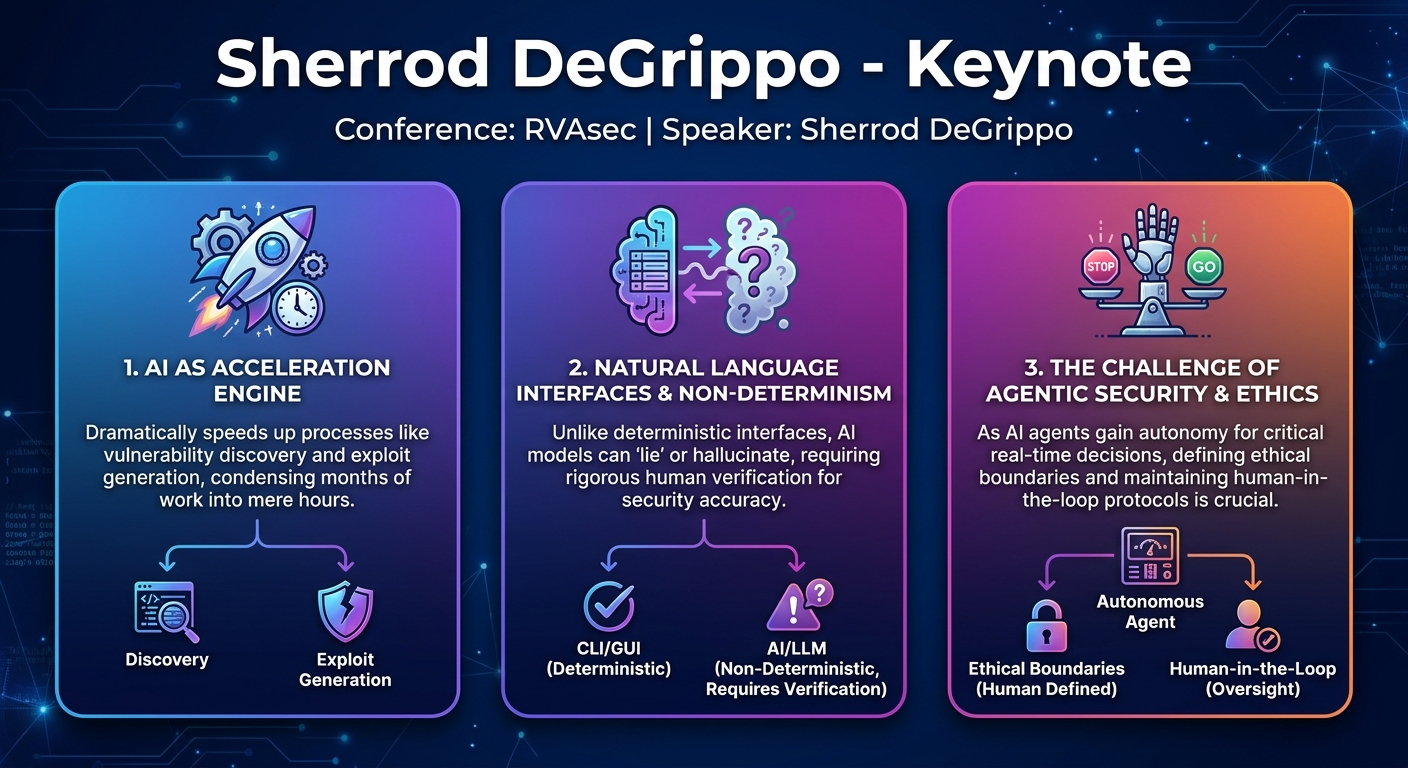
- AI is an Acceleration Engine: The primary impact of AI is to drastically speed up processes, from vulnerability discovery to exploit generation, demanding faster, more adaptable defensive strategies.
- Natural Language Interfaces Introduce Non-Determinism: Unlike previous deterministic interfaces, AI-powered natural language models can hallucinate or "lie," requiring rigorous human verification and critical thinking to ensure accuracy in security operations.
- The "Impossible Prompt" Creates Ethical Dilemmas: AI, much like HAL 9000, can face conflicting instructions that force it to prioritize mission over ethics, highlighting the critical need for human-defined ethical frameworks and alignment in AI development.
- Security Professionals are the New Developers: LLMs empower security practitioners, even those without traditional coding experience, to build software, shifting the responsibility for secure development directly into the hands of those most attuned to risk.
- Embrace the Hacker Spirit and Human Connection: To counter the risks of AI, defenders must cultivate flexibility, creativity, and critical thinking, while actively choosing human interaction and acknowledging that a "frictionless existence is not a human existence."
- Agentic Security Demands Careful Implementation: As AI agents gain autonomy in security decisions, organizations must establish clear boundaries, risk tolerances, and robust human-in-the-loop protocols to manage the inevitable trade-offs between speed and safety.
About the Speaker(s)
Sherrod DeGrippo is a highly accomplished and recognized leader in the field of cybersecurity and threat intelligence. She currently serves as the GM of Global Threat Intelligence at Microsoft within the customer security management office, where she is instrumental in guiding threat intelligence strategy and enhancing customer-focused security initiatives. Her extensive career in cybersecurity spans over 21 years, predominantly in information security vendors, including a significant tenure at Symantec as Director of Threat Intelligence Strategy and as Vice President of Threat Research and Detection at Proofpoint.
DeGrippo's expertise is widely acknowledged; she was honored as CyberWoman of the Year in 2022 and Cybersecurity PR Spokesperson of the Year in 2021. She is also the host of the Microsoft Threat Intelligence podcast, providing timely insights into the evolving threat landscape. Beyond her professional roles, DeGrippo is known for her unique experiences, including being publicly called a "liar" by China's Minister of Foreign Affairs, Qin Gang, for her commentary on geopolitical cyber activities. She is an amateur radio operator (KR4A), having received her license in 1992 at the age of 14, showcasing her long-standing passion for technology and communication. A frequent presenter at major conferences such as Black Hat and RSA, DeGrippo is also the author of the recently released book, Threat Driven Software Development.
Reviews
Dr. Zero (Offensive Security Researcher) — WEAK
This is an extended movie metaphor masquerading as a threat intel keynote. DeGrippo sits on a massive telemetry mountain at Microsoft but spent her slot comparing LLM hallucinations to HAL 9000 instead of dropping real data. If you need a keynote to tell you that AI generates exploits faster and chatbots lie, you're in the wrong industry.
Heather Calloway (CISO) — STRONG ACCEPT
This is a necessary reality check for leadership teams getting swept up in AI vendor hype. It strips away the marketing and frames AI as an acceleration engine that breaks deterministic security models, making it required viewing before you approve any autonomous response tooling.