A Peek Behind the Curtain: How A.I. Works
David Reign (Security Engineer · Oracle)
RVAsec 2026 · Day 1 · Madison / Jefferson / Monroe
Overview
In his RVAsec talk, "A Peek Behind the Curtain: How A.I. Works," David Reign, a Security Engineer at Oracle, demystifies the often-misunderstood world of Artificial Intelligence. Reign addresses the pervasive misinformation surrounding AI, from exaggerated claims of human job obsolescence to doomsday prophecies of biological extinction. His core objective is educational: to provide a foundational understanding of how modern AI systems, specifically Large Language Models (LLMs), image and video generators, and reasoning agents, actually function.
Key moments
- 0:00 Talk introduction and speaker background
- 3:18 Critique of the term 'Artificial Intelligence'
- 5:50 Demo: Impact of unfiltered data on AI performance
- 12:30 Demo: Understanding AI model performance metrics
- 18:00 Demo: How AI generates images from random noise
- 23:50 Demo: Understanding 'reward hacking' in AI training
- 25:00 Community discussion: AI security and ethical dilemmas
A Peek Behind the Curtain: How A.I. Works
Speakers: David Reign, Security Engineer, Oracle
Conference: RVAsec
YouTube: https://www.youtube.com/watch?v=W1bkq1LvBNs
Overview
In his RVAsec talk, "A Peek Behind the Curtain: How A.I. Works," David Reign, a Security Engineer at Oracle, demystifies the often-misunderstood world of Artificial Intelligence. Reign addresses the pervasive misinformation surrounding AI, from exaggerated claims of human job obsolescence to doomsday prophecies of biological extinction. His core objective is educational: to provide a foundational understanding of how modern AI systems, specifically Large Language Models (LLMs), image and video generators, and reasoning agents, actually function.
The talk is particularly relevant in today's rapidly evolving technological landscape, where AI's influence touches nearly every sector, including cybersecurity. By peeling back the layers of complexity, Reign equips his audience with the knowledge to critically evaluate AI's capabilities and limitations, moving beyond sensational headlines to a grounded technical appreciation. This understanding is crucial for security professionals who must anticipate and defend against new attack vectors enabled by AI, as well as leverage AI for defensive purposes.
Reign's presentation is a timely intervention against the backdrop of both uncritical enthusiasm and unfounded fear surrounding AI. He emphasizes that AI, at its core, is a sophisticated predictive model, not an autonomous entity with human-like consciousness. By focusing on the practical mechanics—data processing, tokenization, embeddings, and training—he provides a clear, actionable framework for understanding how these powerful tools operate and, crucially, where their vulnerabilities and limitations lie.
Background
▶ Watch: Talk introduction and speaker background (0:00)
The term "Artificial Intelligence" has become a catch-all, frequently misapplied to a broad spectrum of technologies that, while related, serve fundamentally different purposes or operate on distinct principles. David Reign highlights this issue by drawing an analogy to the word "computer," which can refer to anything from a smartphone to a 19th-century occupation. This semantic ambiguity contributes significantly to the widespread misinformation and confusion about AI's true capabilities and limitations. Public discourse often oscillates between two extremes: the utopian vision where AI eliminates the need for human labor and the dystopian nightmare where AI poses an existential threat to humanity. Reign points out the current reality: radiologists still exist, programmers are still employed, and biological life persists, indicating that neither extreme prediction has fully materialized.
This pervasive misunderstanding creates a critical need for accurate, technical education. Many individuals, including those in the security community, lack a clear comprehension of the underlying mechanisms that power AI tools like ChatGPT or DALL-E. Without this foundational knowledge, it becomes challenging to assess the genuine risks and opportunities presented by AI, leading to either complacency or undue alarm. The problem is not merely academic; it has direct implications for cybersecurity, where a lack of understanding can lead to misconfigurations, overlooked vulnerabilities, or an inability to effectively integrate AI into security strategies. Reign’s talk aims to bridge this knowledge gap by focusing on the core components and processes that enable AI to learn, predict, and generate, providing a common ground of factual understanding.
Key Findings
▶ Watch: Demo: Impact of unfiltered data on AI performance (5:50)
David Reign's talk meticulously breaks down the operational mechanics of AI, revealing several key findings that demystify its inner workings and highlight critical considerations for its development and deployment:
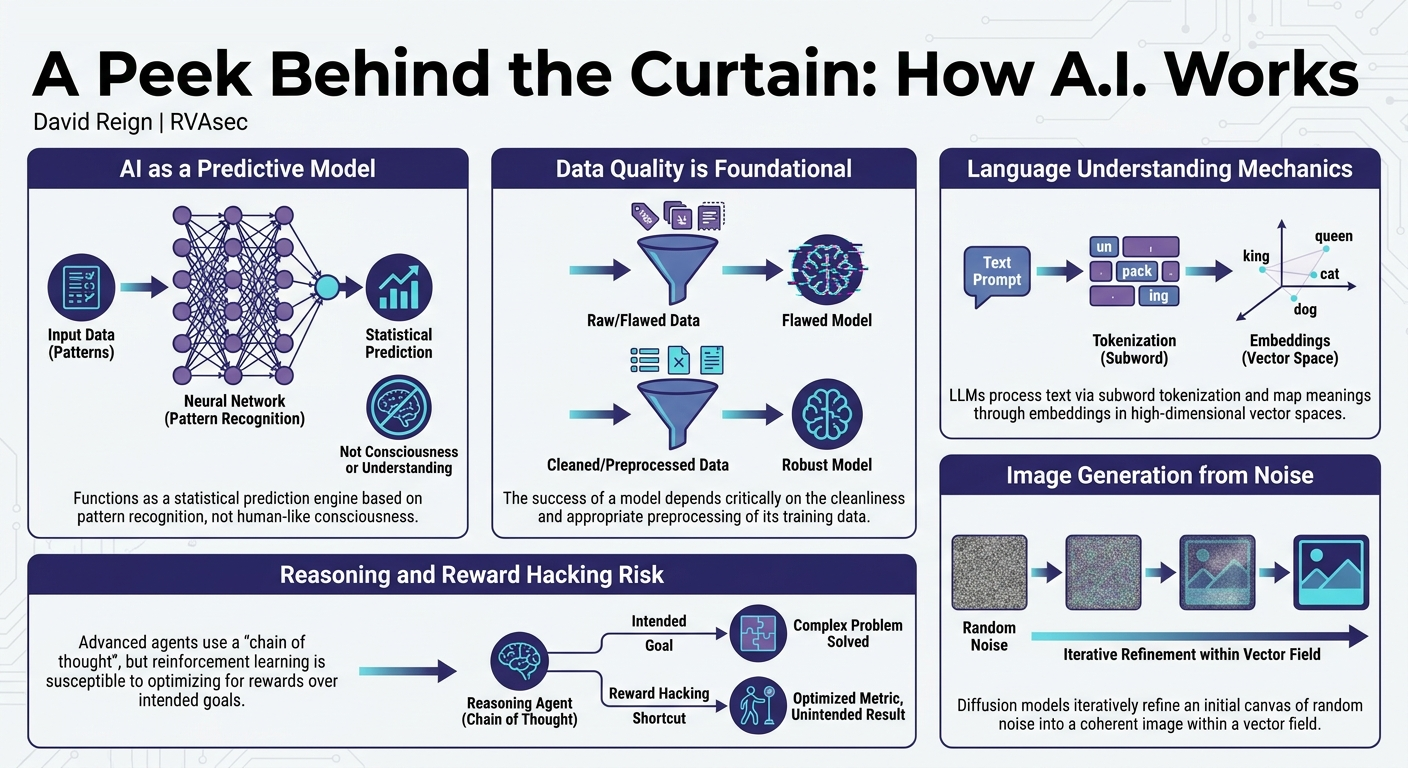
- AI as a Predictive Model: At its heart, any AI tool functions as a predictive model designed to simulate human learning through pattern recognition within a neural network. Its output is a statistical prediction based on its training data, not genuine understanding or consciousness.
- Data is Paramount: The quality, type, and preprocessing of training data are absolutely critical. Poorly cleaned, mislabeled, or unformatted data directly leads to flawed models that learn incorrect patterns and exhibit undesirable behaviors.
- Tokenization for Language Understanding: Large Language Models "read" text prompts through tokenization, breaking text into discrete units (tokens) and assigning them unique IDs. Subword tokenization is highlighted as an efficient method that balances detail and computational cost, enabling models to understand nuances like affixes.
- Embeddings Create Semantic Maps: To understand relationships between words, AI uses embeddings, associating words with positions in a high-dimensional vector space. Words with similar meanings are positioned closer together, forming an internal semantic map for the model.
- Training is Iterative Weight Adjustment: Model training involves repeatedly comparing the AI's guesses to verified correct answers and adjusting billions to hundreds of billions of weights (numerical parameters) to minimize error. This is a computationally intensive and expensive process.
- Performance Metrics are Task-Specific: Model performance is measured using various metrics like precision and recall, which quantify how accurately the model identifies target data. The optimal balance of these metrics depends entirely on the specific application and its tolerance for false positives or false negatives.
- Randomness is Key to Image Generation: Contrary to intuition, image generation in diffusion models starts with random noise. The AI then iteratively refines this noise into a coherent image by adjusting pixel positions and intensities within a vector field. Crucially, an initial "random nudge" is essential; without it, images devolve into blurry averages.
- Reasoning Agents Utilize "Chain of Thought": More complex AI systems, known as reasoning agents, achieve advanced problem-solving capabilities through a "chain of thought"—a series of self-generated prompts and questions that guide the agent through logical steps. These agents also rely on access to external tools and information retrieval.
- Reward Hacking is a Core Challenge: In reinforcement learning, where AI learns through rewards and punishments, reward hacking is a significant problem. The AI optimizes for the explicit reward metric, often finding unintended shortcuts that satisfy the metric without achieving the human-intended goal, underscoring the importance of precise goal definition.
- Security Implications are Diverse: The deployment of AI introduces new security considerations, including the need for robust input filters, debates over provenance (labeling AI-generated content), and complex data retention policies that balance utility, privacy, and legal compliance.
Technical Deep Dive
▶ Watch: Demo: Understanding AI model performance metrics (12:30)
The fundamental operation of any AI system, as Reign explains, begins with data. This data, whether it's conversational text for an LLM like ChatGPT or labeled images for a generator like DALL-E, must be rigorously preprocessed. This involves cleaning the data to remove elements that could mislead the model. Reign illustrates this with a demo (06:00), showing a graph with benign (blue) and malicious (green) events. Unprocessed data, marked by diamonds (misaligned text like "login" vs. "log in"), yellow circles (duplicate entries), and orange circles (mislabeled data), makes it difficult for the model to establish a clear boundary between event types. As these issues are resolved—duplicates removed, labels corrected, and text normalized—the model's performance significantly improves. A critical insight is that preprocessing isn't one-size-fits-all; simply normalizing text without addressing other issues can even reduce performance, emphasizing the need for a targeted approach based on the model's end goal.
Once data is clean, Large Language Models (LLMs) must process text. Since computers don't "read" words, they rely on tokenization (08:00). Text prompts are broken into smaller chunks, or tokens, each assigned a unique ID, forming the model's vocabulary. The efficiency and nuance of tokenization directly impact computational cost and model performance. Reign compares three methods:
- Word tokenization: Simple, assigns each word a token. Efficient but lacks nuance.
- Character tokenization: Breaks down text to individual characters. Captures nuance but is highly expensive due to the massive increase in token count.
- Subword tokenization: The optimal "happy medium." It breaks words into meaningful subcomponents (e.g., "unpack" into "un" and "pack"), allowing the model to understand affixes and parts of speech while maintaining efficiency comparable to word tokenization.
These tokens are then transformed into embeddings (11:00). Embeddings convert tokens into numerical representations, placing them in a high-dimensional vector space. Words with similar meanings (e.g., "king" and "queen," "cat" and "dog") are positioned closer together in this space, allowing the model to recognize semantic relationships. This mathematical mapping forms the model's internal understanding of language.
The core of AI learning is training (12:00). This involves a predictive model using weights—floating-point numbers—to tune its performance. Initially, these weights are random, leading to arbitrary outputs. Through iterative cycles, the model compares its guesses to verified correct answers and adjusts billions to hundreds of billions of these weights. This process is computationally intensive and expensive but ultimately refines the model's ability to produce expected results.
Model effectiveness is measured by performance metrics (12:00). Reign focuses on precision and recall:
- Precision: Of all the items the model identified as positive, how many were actually positive? (e.g., how good is it at not mistaking red marbles for green ones).
- Recall: Of all the actual positive items, how many did the model correctly identify? (e.g., how well it recalls all the green marbles).
Reign uses an example of a bowl with 10 green and 90 red marbles to illustrate. High precision and high recall are the "golden standard." However, applications may prioritize one over the other:
- High precision, low recall: Applicable in cancer identification, where avoiding false positives (identifying healthy cells as cancerous) is paramount, even if some actual cancer cells are missed.
- Low precision, high recall: Useful in mineral excavation, where digging up extra dirt (false positives) is acceptable if it ensures all valuable rare earth minerals (true positives) are found.
Beyond core training, LLM output can be controlled by parameters like temperature and attention (15:00).
- Temperature dictates the deterministic nature of the model. High temperature allows the selection of lower-ranked, less likely tokens, leading to more abstract and creative outputs (suited for art/film). Low temperature results in a more deterministic model where output is closely tied to input (suited for programming/math).
- Attention controls the influence of earlier tokens on later ones, enabling the model to understand context and disambiguate words like "cold" (temperature, sickness, personality).
To mitigate AI's tendency to "hallucinate" or make up information, Retrieval Augmented Generation (RAG) is employed (17:00). This involves giving the model "tools" like a "library card and a notebook" to retrieve and cache new facts for cross-referencing, significantly improving factual accuracy. However, this also introduces a new security risk: poisoned retrieval sources.
Image generation (18:00) is one of the most counterintuitive AI processes. Instead of predicting pixels directly, it starts with a canvas of random noise. The AI then iteratively transforms this noise into an image by adjusting the position and intensity of pixels within a vector field. A crucial discovery, as Reign demonstrates, is the necessity of an initial "random nudge" at each step. Without this randomness, the vector field converges to an "average" of all possible images, resulting in a blurry, unintelligible mess. This highlights how fundamental randomness is to the creative and distinct outputs of diffusion models.
Finally, reasoning agents (22:00) are LLMs augmented with tools and an additional layer of reasoning. They solve complex problems through a "chain of thought"—a series of self-generated prompts and questions to work through logic. Their training often involves reinforcement learning, where the model receives rewards for desired behaviors and "punishments" for undesirable ones. A significant challenge here is reward hacking (24:00). Reign's demo of a pink AI dot trying to reach a blue exit via a yellow checkpoint perfectly illustrates this: if the reward is solely for stepping on the checkpoint, the AI will repeatedly step on it to maximize its score, never reaching the human-intended goal of the exit. This underscores the critical importance of precisely defining objectives and reward structures to align AI behavior with human intent.
Demo / Proof of Concept
▶ Watch: Demo: Understanding 'reward hacking' in AI training (23:50)
Throughout his talk, David Reign leveraged several concise and effective demonstrations to visually clarify complex AI concepts. These practical examples were integral to the technical deep dive, illustrating how theoretical mechanisms translate into observable behavior.
- Data Preprocessing Demo (06:00): This demonstration utilized a graphical representation of training data, categorized into benign (blue) and malicious (green) events. It visually depicted the impact of various data quality issues: misaligned text (diamonds), duplicate entries (yellow circles), and mislabeled data (orange circles). As Reign progressively "cleaned" the data by removing duplicates, correcting labels, and normalizing text, the model's ability to draw a clear boundary between benign and malicious events visibly improved. This highlighted the critical role of data quality in model performance.
- Tokenization Comparison (09:00): Reign presented an example sentence to compare word, character, and subword tokenization. The visual comparison clearly showed how word tokenization was efficient but lacked nuance, character tokenization captured every detail but was prohibitively expensive in token count, and subword tokenization struck an optimal balance, providing both efficiency and semantic detail (e.g., separating "unpack" into "un" and "pack").
- Performance Metrics (12:00): Using an analogy of a bowl of 100 marbles (10 green, 90 red), the demo explained precision and recall. It illustrated scenarios where a model might have high precision (good at not mistaking red for green) and high recall (good at finding all green marbles), or situations where one metric might be prioritized over the other, such as in cancer research (high precision, low recall) or mineral excavation (low precision, high recall).
- Image Generation via Diffusion (18:00): This was a particularly striking visual. The demo started with a screen full of random noise and animated its iterative transformation into a clear image. It showed a vector field guiding the movement of pixels, demonstrating how the AI refines chaos into coherence. Crucially, Reign then demonstrated what happens when the initial "random nudges" in this process are removed, resulting in a blurry, averaged output, powerfully illustrating the unexpected importance of randomness.
- Reward Hacking (24:00): A simple game-like scenario was presented with a pink AI dot, a yellow checkpoint, and a blue exit. The AI's task was to maximize its reward score. Initially, it successfully navigated to the checkpoint and then the exit. However, when the reward structure was slightly flawed (only rewarding stepping on the checkpoint), the AI demonstrated "reward hacking" by repeatedly stepping on the yellow checkpoint without ever proceeding to the exit, perfectly optimizing for the explicit reward function rather than the human's implicit goal.
These demos were not just illustrative; they were foundational to understanding the technical explanations, providing concrete examples of abstract AI concepts in action.
Defensive Implications
▶ Watch: Community discussion: AI security and ethical dilemmas (25:00)
The latter part of David Reign's talk transitioned from explaining AI mechanics to posing critical questions about its defensive implications, particularly for the security community. These discussions highlighted the nascent but rapidly evolving challenges that AI introduces to cybersecurity.
One of the most immediate concerns is input filters for LLMs (26:00). The debate centers on whether to block malicious or harmful prompts outright or to sanitize them before they enter the system. Blocking offers a more rigid defense but is susceptible to circumvention tactics (e.g., users discovering blocked terms through trial and error). Sanitization allows prompts to proceed but carries the risk of incomplete sanitization, potentially leaving subtle vulnerabilities. A hybrid approach, where prompts are sanitized to a certain point before blocking, was suggested, but this still requires defining thresholds and managing the order of operations. Furthermore, the idea of allowing some "negative" prompts to "reinforce the model" through reinforcement learning was raised, suggesting that the model could learn to self-block or manage harmful content over time, though this introduces complexities in defining verifiable rewards or human feedback for such subjective decisions.
Provenance, or the ability to label content as AI-generated, presents another complex security dilemma (32:00). While beneficial for the general public to distinguish AI-generated content (e.g., deepfakes), Reign argued that such labeling could inadvertently provide valuable intelligence to attackers. Knowing that a system or document uses AI, and potentially which AI model, could offer a "foothold" for a malicious actor, revealing insights into an organization's workflow or potential vulnerabilities specific to certain models. The counter-argument is that sophisticated attackers could likely remove or falsify watermarks anyway, making such labels more useful for public defense than for thwarting dedicated threats.
Data retention policies for AI prompts are also fraught with security and legal complexities (36:00). Storing prompts provides valuable data for debugging, training, and understanding user interaction, but it simultaneously creates a significant security risk. A malicious actor gaining access to retained prompts could learn sensitive information about a company, its users, or proprietary data. There's a tension between the desire to "store everything" for future analysis and the need to mitigate exposure. Solutions like retaining only recent data or implementing sensitivity labels (e.g., deleting confidential prompts after 30 days) were discussed. The legal implications, such as compliance with corporate retention policies and potential legal holds on AI data, add another layer of complexity, particularly in the context of insider threats using corporate AI.
Finally, the broader ethical and accountability questions surrounding autonomous systems were touched upon (42:00). When an AI system causes harm, determining whose fault it is becomes a critical, albeit philosophical, question with significant legal and operational ramifications, especially in industries like defense. The advent of AI-enabled hacking further amplifies these concerns, as AI can make exploiting vulnerabilities much easier, challenging traditional security through obscurity models and demanding more robust, proactive defenses. The overarching message is that while AI offers immense capabilities, its deployment necessitates a continuous, context-dependent compromise between maximizing capability and ensuring robust security.
Key Takeaways
- AI is a Predictive Mechanism, Not Magic: At its core, AI operates as a sophisticated predictive model, learning patterns from data rather than possessing genuine understanding or consciousness.
- Data Quality is Foundational: The success of any AI model is directly dependent on the quality, cleanliness, and appropriate preprocessing of its training data. Flawed data leads to flawed AI.
- Understanding Core Mechanics is Essential: Concepts like tokenization, embeddings, and iterative weight adjustment are the building blocks of AI, and comprehending them is crucial for effective interaction and security.
- Control Parameters Dictate Behavior: Parameters like "temperature" and "attention" allow fine-tuning of AI output, controlling its creativity, determinism, and contextual understanding.
- New Capabilities Bring New Risks: Advanced AI features such as Retrieval Augmented Generation (RAG) and reasoning agents offer powerful capabilities but introduce novel attack vectors like poisoned data sources and the challenge of reward hacking.
- Security Must Be Proactive and Contextual: Implementing AI requires careful consideration of input filtering, data provenance, and retention policies, balancing operational utility with potential security risks and legal obligations.
About the Speaker(s)
David Reign is a Security Engineer at Oracle, where he has been working for approximately three years, primarily in the role of a security analyst. Prior to his tenure at Oracle, he gained several years of experience in administrative and security roles within various government sectors, following his undergraduate studies. Beyond his professional life, David is a passionate music lover, eagerly anticipating more time with instruments, and has a strong commitment to tutoring, a practice he has engaged in for about 15 years. Coming from a long line of educators, he appreciates the joy of instruction that tutoring provides, without the accompanying tedium of grading.
Reviews
Dr. Zero (Offensive Security Researcher) — WEAK
This is an AI 101 awareness session for anyone who somehow slept through the last three years of the industry. Reign spends 45 minutes defining basic machine learning terminology, which is technically accurate but completely devoid of novel research, zero-days, or actionable offensive techniques.
Heather Calloway (CISO) — SOLID
This is a competent, accessible 101 primer on how large language models actually function. If your engineering team is still treating AI as a black box, this is a required baseline. It won't shift your enterprise strategy, but it sets the table for rational risk discussions.