Empathy, Not Telepathy: How Embedded Engineering Context Scale Cyber Response
Kyle Flaherty (Head of Cyber Intelligence Engineering · Capital One)
RVAsec 2026 · Day 1 · Grand Ballroom D/E
Overview
In this compelling RVAsec talk, Kyle Flaherty, Head of Cyber Intelligence Engineering at Capital One, articulates a critical shift in cybersecurity strategy: moving from a reactive, investigative paradigm to a proactive, prioritization-driven approach. The core thesis, encapsulated by the talk's title, "Empathy, Not Telepathy," argues that integrating software engineering expertise directly into cyber operations, fueled by a deep understanding of the operational context, is no longer optional but essential for scaling effective cyber response in the age of AI. Flaherty champions the idea that engineers, equipped with the lived experience and challenges faced by analysts, can build truly impactful tools that both reduce analyst toil and expand their capabilities.
Key moments
- 3:30 AI shifts cyber from investigation to prioritization
- 5:30 The 'context gap' and 'submit an intake' wall
- 11:15 Empathy: Proactivity requires proximity, not telepathy
- 20:30 Vision Language Models automate fishing domain triage
- 22:00 Beyond reactive: Shifting to proactive, large-scale disruption
- 26:30 Automating IOC curation for proactive threat disruption
- 31:40 Key takeaways: Build with, start small, momentum compounds
Empathy, Not Telepathy: How Embedded Engineering Context Scale Cyber Response
Speakers: Kyle Flaherty, Head of Cyber Intelligence Engineering, Capital One
Conference: RVAsec
YouTube: https://www.youtube.com/watch?v=wq-v4PZKuY4
Overview
In this compelling RVAsec talk, Kyle Flaherty, Head of Cyber Intelligence Engineering at Capital One, articulates a critical shift in cybersecurity strategy: moving from a reactive, investigative paradigm to a proactive, prioritization-driven approach. The core thesis, encapsulated by the talk's title, "Empathy, Not Telepathy," argues that integrating software engineering expertise directly into cyber operations, fueled by a deep understanding of the operational context, is no longer optional but essential for scaling effective cyber response in the age of AI. Flaherty champions the idea that engineers, equipped with the lived experience and challenges faced by analysts, can build truly impactful tools that both reduce analyst toil and expand their capabilities.
Flaherty underscores the urgency of this transformation by highlighting the dramatic changes brought about by advancements in Artificial Intelligence. Since the advent of models like GPT-3 in 2020, the barrier to entry for threat actors has plummeted, leading to a significant increase in the volume and sophistication of attacks, particularly social engineering and phishing. This surge has overwhelmed traditional security teams, whose hiring rates cannot keep pace with the exponential growth in cyber loss. The talk proposes a practical framework for bridging the historical "context gap" between cyber operations and engineering teams, demonstrating how this collaborative synergy can lead to innovative, scalable solutions that proactively disrupt adversary operations.
Background
▶ Watch: AI shifts cyber from investigation to prioritization (3:30)
The landscape of cyber threats has undergone a fundamental transformation, largely driven by the rapid advancements in Artificial Intelligence. As Flaherty points out, the release of GPT-3 in 2020 marked a pivotal moment, enabling AI models to produce text indistinguishable from human writing (02:00). This technological leap had profound implications for social engineering, historically one of the most persistent and successful threat vectors. Previously, social engineering required a degree of human skill and interaction – a romance scammer needed to be romantic, an executive impersonator had to sound like an executive. AI has effectively eliminated this requirement, democratizing sophisticated social engineering capabilities and making them accessible to virtually anyone (02:30). As Flaherty starkly puts it, even his mother could now leverage AI to become a threat actor.
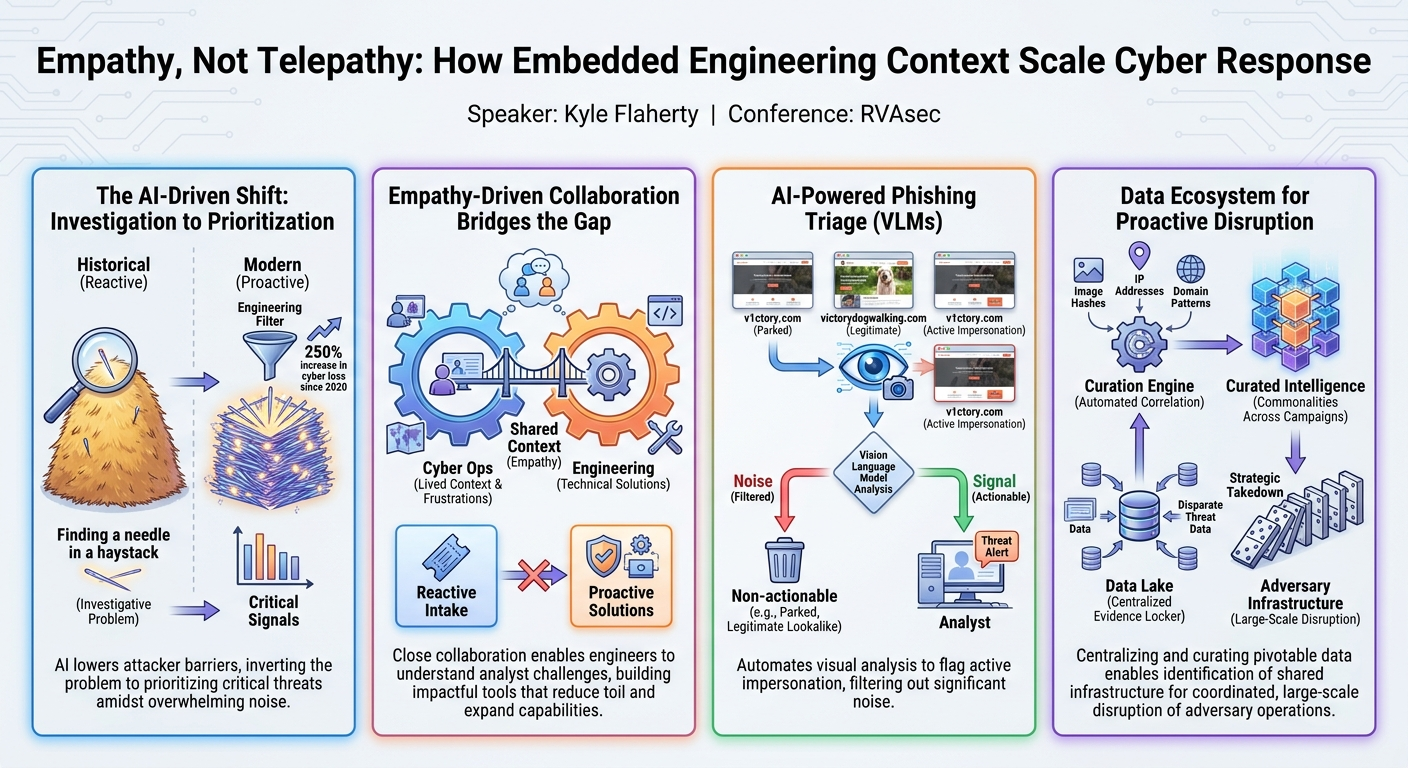
The consequences of this lowered barrier to entry are dire. Since 2020, reported cyber loss has skyrocketed by an astounding 250%, a rate five times faster than the growth in cyber hiring (02:50). This imbalance highlights a critical resource deficit, as security teams struggle to manage an ever-increasing deluge of threats. In 2025 alone, losses from phishing were projected to reach $12.5 billion, a figure that continues to grow (03:15). This exponential growth has fundamentally altered the nature of the cybersecurity problem. Traditionally, security professionals were tasked with "finding a needle in a haystack"—an investigative challenge requiring deep analytical skills. Today, the problem has inverted: teams are confronted with "a stack of needles," and the challenge is to "find the sharpest one" (03:30). This is no longer an investigative problem but a prioritization problem, demanding new approaches and tools to discern critical signal from overwhelming noise.
A significant impediment to effective response has been the context gap between cyber operations and engineering teams. Cyber operations possess invaluable "lived experiences" of attacks, understanding the nuances of threat landscapes, actor behaviors, and the difference between a DOS attack and a vulnerability scan (04:50). Engineers, however, often lack this operational context, making it difficult for them to build truly effective solutions. This gap is exacerbated by organizational silos, often manifested as a "wall" between teams, where interaction is limited to "submit an intake" processes (06:00). Flaherty criticizes this approach, arguing that "ticketing is meant to track accountability; it is not meant to increase ability" (06:40). Such limited communication leads to misunderstandings and suboptimal solutions, akin to an engineer providing "Tylenol for a tumor" when a deeper problem exists. Examples cited include engineers potentially setting the same Time To Live (TTL) for unchanging hashes and dynamic domains, filtering "verify" from logs despite its use in fish kits, or misinterpreting "zero hits" on an Indicator of Compromise (IOC) as a system failure rather than a success (08:50-10:20). The rapid pace of modern exploits, with vulnerabilities being exploited in "negative" or zero days, demands proactivity, and Flaherty concludes that "asking for proactivity without proximity is asking for telepathy" (11:30).
Key Findings
▶ Watch: Empathy: Proactivity requires proximity, not telepathy (11:15)
Kyle Flaherty's presentation delivers several pivotal findings that challenge conventional cybersecurity practices and propose a path forward for scaling cyber response. Central to his argument is the principle of "Empathy, Not Telepathy," which posits that direct, close collaboration between cyber operations and engineering teams is essential to bridge the inherent context gap and foster a proactive security posture (11:30-12:00). This proximity allows engineers to gain "lived context" from analysts, enabling them to build solutions that precisely address operational frustrations and challenges, rather than merely fulfilling intake requests.
A significant discovery highlighted is the profound impact of AI on the threat landscape. Flaherty demonstrates that AI has dramatically lowered the barrier to entry for threat actors, leading to an unprecedented 250% increase in reported cyber loss since 2020 (02:50). This shift transforms cybersecurity from an "investigative problem" (finding a needle in a haystack) into a "prioritization problem" (finding the sharpest needle in a stack of needles), necessitating engineering solutions to filter noise and highlight critical threats (03:30-04:00).
The talk also introduces a crucial concept for effective technology investment: the balancing act of simultaneously reducing analyst toil and expanding their capabilities (14:50). Merely automating tasks without enhancing analytical power is akin to "buying your wife flowers and not setting them up; you didn't give her a gift, you gave her a chore." True scaling requires both efficiency gains and the ability for analysts to tackle more complex, strategic problems.
Technically, Flaherty presents two key solutions:
- Vision Language Models (VLMs) for Automated Phishing Detection: The talk demonstrates how VLMs, by combining large language models with a vision transformer component, can automatically triage phishing domains (19:00). These models analyze screenshots of suspicious sites, determine if they are actively impersonating a brand, and filter out non-actionable "noise" like parked domains or legitimate lookalikes (20:00). This capability significantly reduces the manual toil of screenshot review, allowing analysts to focus only on genuine threats.
- Data Ecosystem and Curation Engine for Proactive Disruption: To move beyond reactive triage, Flaherty advocates for building a centralized data ecosystem (a data lake) that ingests and aggregates all threat intelligence from disparate sources (23:00). On top of this, a curation engine is developed to automatically extract and correlate pivotable information, such as image hashes, IP addresses, and domain name patterns (28:00). This automated curation, informed by the Pyramid of Pain, enables analysts to identify common infrastructure and tactics across multiple campaigns, facilitating large-scale disruption of adversary operations (25:00, 29:00). These findings collectively illustrate how strategic engineering, deeply informed by operational context, can fundamentally transform cyber defense from a reactive struggle to a proactive, disruptive force.
Technical Deep Dive
▶ Watch: Vision Language Models automate fishing domain triage (20:30)
The technical solutions proposed by Kyle Flaherty are designed to address the challenges posed by the evolving threat landscape, particularly the proliferation of phishing domains and typosquatting. Using a fictional brand, "Victory," as a case study, Flaherty outlines a multi-phase engineering approach.
The initial problem presented is the overwhelming volume and manual nature of detecting and responding to typosquatting. Threat actors employ various techniques:
- Homoglyph attacks: Substituting characters with visually similar numbers or symbols (e.g.,
v1ctory.cominstead ofvictory.com) (16:00). - Fat-finger attacks: Adding or removing letters (e.g.,
vitcry.com,vicctory.com) (16:30).
Traditional response is "painfully slow" and toil-ridden (16:50). Analysts must manually monitor domains, and critically, they can only initiate takedown procedures if a domain is actively impersonating the brand. This means constantly playing a "cat and mouse" game, where a parked domain might sit dormant for weeks before being activated for a phishing campaign (17:30). Furthermore, analysts contend with significant false positives, such as legitimate businesses with similar names (e.g., "Victory Dog Walking") or domains that are merely parked (17:50). This results in a low signal-to-noise ratio, often two-thirds noise to one-third signal, wasting valuable analyst time (18:15).
To combat this, the first technical phase involves leveraging Vision Language Models (VLMs) to automate the triage process. Flaherty explains VLMs as an extension of Large Language Models (LLMs), incorporating a vision transformer component (18:50). While LLMs process text inputs to generate text outputs, VLMs take both text and image inputs. When an image, such as a screenshot of a suspicious website, is uploaded, the vision transformer processes it into a format the LLM can understand. The LLM then combines this visual data with a textual query (e.g., "Is this actively impersonating Victory?") to produce an answer (19:00).
In the "Victory" case study, this means:
- A newly detected domain or a domain with a changed webpage is automatically screenshotted.
- The VLM analyzes the screenshot.
- If the VLM determines the site is not actively impersonating (e.g., it's parked or a legitimate "Victory Dog Walking" site), it's filtered out as noise.
- If the VLM confirms active impersonation, the domain is flagged as actionable signal and sent to an analyst (20:00-21:00).
This VLM-driven automation significantly reduces manual triage, freeing analysts from reviewing non-actionable domains and allowing them to focus on genuine threats.
However, Flaherty emphasizes that while VLMs improve triage efficiency, this approach remains reactive (22:00). By the time a VLM detects active impersonation, customers are already being targeted. To move towards proactive large-scale disruption, a more sophisticated data ecosystem is required.
This ecosystem involves:
- Centralized Data Ingestion: Building a data pipeline that aggregates threat intelligence from "disparate vendor sources, internal sources, etc." into a single stream (23:00).
- Data Lake: All raw threat data, including domain information, associated metadata, and VLM outputs, is stored in a central "evidence locker" (23:40). This unified repository allows for aggregate analysis, which is crucial for identifying patterns across multiple attacks.
- Application Output: The data from the data lake is then made accessible to analysts through their primary security applications (24:00).
The next critical component is a curation engine built on top of this data lake (28:00). This engine automates the extraction and correlation of information that analysts typically use for pivoting and proactive investigation. Flaherty frames this in the context of David Bianca's Pyramid of Pain, which categorizes IOCs by their disruptiveness to threat actors (25:00). The most disruptive are Tactics, Techniques, and Procedures (TTPs) and Tools, while the least disruptive (but easiest to find) are Hash Values, IP Addresses, and Domain Names.
The curation engine focuses on automating the collection and correlation of these bottom three layers:
- Hash Values: Automatically gathering image hashes of phishing site components (e.g., logos, templates) (26:30). This allows defenders to proactively search for other domains using the same visual assets, even if the domain name or IP is different.
- IP Addresses: Identifying common IP addresses and Autonomous System Numbers (ASNs) where phishing sites are hosted (27:00). This enables the discovery of entire malicious infrastructures.
- Domain Names: Analyzing patterns in domain name generation (e.g., common prefixes, suffixes, character substitutions) to anticipate future typosquatting attempts (27:00).
By automatically curating these elements, the system transforms raw data into actionable intelligence. Instead of analysts manually mapping information across "eight, nine, 10 vendor tools" in a spreadsheet, the curation engine provides a "flush stack of cash" – correlated, decision-ready intelligence (27:50, 28:50). This enables analysts to find commonalities across seemingly dissimilar sites, allowing a single disruption (e.g., taking down a registrar, CDN, or underlying infrastructure) to effectively dismantle multiple related phishing campaigns "like dominoes" (29:00). This shift moves the security team from a reactive "whack-a-mole" game to a proactive, large-scale disruption strategy.
Demo / Proof of Concept
▶ Watch: Automating IOC curation for proactive threat disruption (26:30)
While the talk did not feature a live coding demonstration or a specific tool walkthrough, Kyle Flaherty presented a compelling conceptual case study using the fictional "Victory" brand to illustrate the proposed engineering solutions in practice. This served as a detailed "proof of concept" for how the principles of empathy-driven engineering could be applied to real-world challenges.
The demonstration began by showcasing the challenges of manual phishing domain triage. Flaherty presented three scenarios (20:00-21:00):
- Parked Domain: A domain like
v1ctory.comthat was initially parked and not actively impersonating the brand. In a manual process, an analyst would spend time reviewing this, only to find it non-actionable. - Legitimate Lookalike: A domain like
victorydogwalking.com, which shares a similar name but is a legitimate business. Again, manual review would consume analyst time for a false positive. - Active Impersonation: A domain that is actively hosting a phishing site visually mimicking the "Victory" brand. This is the true signal.
Flaherty then walked through how a Vision Language Model (VLM) would automate this triage (20:00-21:00). By feeding screenshots of these sites to the VLM with a query like "Is this actively impersonating Victory?", the system would automatically identify the parked domain and the legitimate dog-walking site as "good" (i.e., not requiring immediate analyst action) and correctly flag the active impersonation as a true threat. This conceptual demo effectively highlighted how VLMs could filter out two-thirds noise and present only the critical one-third signal to the analyst, significantly reducing their toil.
Moving beyond reactive triage, Flaherty visually demonstrated the evolution of the data ecosystem (24:00, 28:00). He used the analogy of "dollar bills flying around a parking lot" to represent disparate threat intelligence data that analysts struggle to collect manually. The first step, building a data lake, was depicted as putting these dollar bills into a "money machine," making them accessible in one place. While an improvement, analysts were still "sitting inside a money machine trying to grab money"—a new form of toil. The final stage, the curation engine, was then illustrated as analysts "sitting flush on their stacks of cash," where the data is pre-curated and organized, allowing them to quickly identify patterns and make informed decisions (28:50).
The ultimate "proof" of the proactive approach was showing how disparate, seemingly unrelated phishing sites could be linked through shared image hashes, IP addresses, or domain name patterns (29:00). This conceptual demonstration emphasized that by identifying these commonalities through automated curation, a single strategic disruption of underlying infrastructure could take down multiple related campaigns simultaneously, fundamentally shifting the game from "whack-a-mole" to a more powerful, proactive defense.
Defensive Implications
▶ Watch: Key takeaways: Build with, start small, momentum compounds (31:40)
The insights from Kyle Flaherty's talk offer profound defensive implications for cybersecurity practitioners, urging a fundamental re-evaluation of how security teams are structured and how they leverage technology. The overarching message for defenders is to embrace engineering as a core component of cyber defense and to foster an environment of empathy and collaboration between operational and technical teams.
Firstly, defenders must prioritize bridging the context gap between cyber operations and engineering. This means moving beyond formal "submit an intake" processes and embedding engineers directly with analysts (11:30, 31:00). By sharing proximity and actively listening to analysts' frustrations and daily toil, engineers can gain the "lived context" necessary to build truly effective tools. Flaherty advises starting small, even with "one extremely empathetic engineer" (33:50), to cultivate this collaborative culture.
Secondly, the talk underscores the imperative to shift from reactive investigation to proactive disruption. The era of merely responding to incidents is over, as AI-driven threats make traditional reactive models unsustainable. Defenders must invest in capabilities that enable them to anticipate, identify commonalities, and disrupt adversary infrastructure before attacks reach their targets (22:00, 29:50). This proactive stance requires engineers to develop systems that can identify patterns across multiple campaigns, such as shared image hashes, IP addresses, or domain name generation techniques (26:30-27:00).
Thirdly, security organizations should strategically leverage AI for defense. While AI empowers attackers, it can also be a powerful defensive tool. Implementing Vision Language Models (VLMs) for automated triage of high-volume threats like phishing domains is a prime example (19:00). This allows security analysts to offload mundane, repetitive tasks, freeing them to focus on higher-value, strategic analysis and disruption efforts.
Fourthly, it is critical to build robust data ecosystems. Centralizing disparate threat intelligence sources into a unified data lake is foundational (23:00). On top of this, developing a curation engine that automatically extracts and correlates actionable intelligence is essential. This curated data, informed by frameworks like the Pyramid of Pain, empowers analysts to identify strategic points of disruption, such as shared infrastructure or tools, which are more costly for adversaries to change (25:00, 29:00).
Finally, Flaherty encourages defenders to seek small, compounding wins. The journey to a proactive security posture doesn't require massive, immediate overhauls. Instead, focusing on achieving incremental successes—automating one toil-ridden process, integrating one empathetic engineer—can build momentum that eventually leads to significant, scalable improvements (34:00). By adopting these principles, defenders can move beyond simply reacting to threats and instead gain the ability to strategically disrupt adversary operations at scale.
Key Takeaways
- Proactivity is Empathy, Not Telepathy: Effective cyber response in the AI era demands close collaboration and shared understanding between cyber operations and engineering teams. Engineers must be embedded with analysts to gain the "lived context" necessary to build truly impactful tools that address real-world problems.
- AI Changes the Game: Shift from Investigation to Prioritization: AI has dramatically lowered the barrier to entry for threat actors, leading to a massive increase in attack volume and sophistication. Security teams can no longer investigate every alert; they must leverage engineering to prioritize the most critical threats and identify signal from overwhelming noise.
- Balance Toil Reduction with Capability Expansion: Engineering investments should not only automate manual tasks but also expand analysts' abilities to tackle more complex, strategic problems. Simply reducing toil without enhancing capabilities risks creating new forms of inefficiency.
- Leverage AI for Defense (e.g., VLMs for Triage): Just as AI empowers attackers, it can empower defenders. Tools like Vision Language Models (VLMs) can automate high-volume, manual tasks such as phishing domain triage, freeing up human analysts for higher-value, strategic work.
- Build Data Ecosystems for Proactive Disruption: Centralizing threat intelligence into a data lake and building automated curation engines are critical. These systems should extract pivotable information (e.g., image hashes, IP addresses, domain patterns) to identify commonalities across campaigns, enabling large-scale disruption of adversary infrastructure.
- Start Small, Build Momentum: Transforming security operations doesn't require a massive initial investment. Begin with one empathetic engineer and focus on small, achievable wins that reduce analyst toil or provide new insights. These small successes will compound, building momentum towards a more proactive and scalable defense.
About the Speaker(s)
Kyle Flaherty is the Head of Cyber Intelligence Engineering at Capital One. In this role, he leads a team of software engineers who work in close partnership with cyber intelligence analysts. His team's primary mission is to help analysts understand the complex cyber landscape and, crucially, to build the necessary tools and systems that scale their cyber response capabilities against evolving threats. Flaherty is a passionate advocate for integrating engineering expertise directly into cyber operations to foster a proactive and effective defense strategy.
Reviews
Dr. Zero (Offensive Security Researcher) — SOLID
Flaherty hits the nail on the head regarding SOC dysfunction—Jira is a graveyard for context, and embedding engineers with analysts is the only way out. But when it comes to the technical payload, piping headless browser screenshots into a commodity Vision Language Model API isn't exactly groundbreaking research. It's a solid enterprise defense talk that will help CISOs unfuck their teams, but the reliance on a fictional case study keeps it from hitting harder.
Heather Calloway (CISO) — STRONG ACCEPT
This is a highly pragmatic look at SOC organizational design and automation. Flaherty correctly diagnoses that we cannot hire our way out of AI-scaled attack volumes, and that embedding software engineers directly with analysts is the only way to build automation that actually works.