Gigawatts and Governance: The Data Security Crisis No One Is Talking About
Nancy Coblenz (President · Stellenium)
RVAsec 2026 · Day 1 · Grand Ballroom D/E
Overview
In a compelling RVAsec presentation titled "Gigawatts and Governance: The Data Security Crisis No One Is Talking About," Nancy Coblenz, President of Stellenium, illuminated a critical, under-addressed challenge facing the cybersecurity community: the burgeoning energy crisis driven by the insatiable demand for AI compute and its profound implications for data security and national sovereignty. Coblenz, whose company builds AI data centers and modular power plants, shifted the audience's focus from the familiar application and cloud layers to the foundational yet often overlooked power infrastructure and data center infrastructure layers, arguing that these represent the most significant, yet least understood, vulnerabilities in our interconnected world.
Key moments
- 0:00 Introduction: Gigawatts and governance
- 4:15 Power capacity: The data center bottleneck
- 9:45 Virginia's data center density & community pushback
- 14:00 Vulnerabilities in physical infrastructure and power grid
- 16:00 Massive US power shortage for data centers
- 24:00 Data ownership, jurisdictional laws, and national security
- 33:00 China's accelerated data center buildout and AI race
- 38:20 Q&A: The future impact of quantum computing
Gigawatts and Governance: The Data Security Crisis No One Is Talking About
Speakers: Nancy Coblenz, President, Stellenium
Conference: RVAsec
YouTube: https://www.youtube.com/watch?v=GQjRUIJcgHw
Overview
In a compelling RVAsec presentation titled "Gigawatts and Governance: The Data Security Crisis No One Is Talking About," Nancy Coblenz, President of Stellenium, illuminated a critical, under-addressed challenge facing the cybersecurity community: the burgeoning energy crisis driven by the insatiable demand for AI compute and its profound implications for data security and national sovereignty. Coblenz, whose company builds AI data centers and modular power plants, shifted the audience's focus from the familiar application and cloud layers to the foundational yet often overlooked power infrastructure and data center infrastructure layers, arguing that these represent the most significant, yet least understood, vulnerabilities in our interconnected world.
The talk served as a stark warning, emphasizing that while the cybersecurity industry typically focuses on software, networks, and data at higher layers, the physical underpinnings—the power grid, the physical data center, and the supply chain of hardware—are rapidly becoming the weakest links. As AI compute demands skyrocket, the sheer scale of energy consumption and the inability of existing power grids to meet this demand create unprecedented bottlenecks. This presentation challenged attendees to reconsider their threat models, extending their scope to include the physical and jurisdictional aspects of data housing and power generation, highlighting a looming crisis that could have devastating economic and national security repercussions if left unaddressed.
Coblenz's unique perspective, bridging the worlds of energy infrastructure, finance, and technology, underscored the urgency of integrating security considerations into the earliest stages of data center planning and power generation. She argued that the current trajectory of rapid AI infrastructure buildout, particularly when contrasted with the streamlined processes of geopolitical rivals, presents a clear and present danger. The talk aimed to empower cybersecurity professionals to recognize these foundational vulnerabilities and actively engage with facility owners, utility providers, and policymakers to fortify the critical infrastructure that underpins our digital future.
Background
▶ Watch: Introduction: Gigawatts and governance (0:00)
The evolution of data centers traces back to their origins as telecom hardware elements, primarily supporting telecommunications infrastructure. Over the past two decades, however, the landscape has dramatically transformed, culminating in the current era of AI compute. This shift has brought about an astronomical increase in energy consumption per rack, fundamentally altering the economic and logistical considerations for data center development. Coblenz highlighted that mankind has never consumed less power or compute, and this trend is only accelerating, creating an urgent need for sufficient capacity.
The financial and infrastructural scale of modern data centers is immense. Building even a mid-market data center campus requires a substantial investment of approximately $10 to $15 million per megawatt, excluding the cost of GPUs. Major players like Google, Meta, and Tesla are now constructing gigawatt campuses, underscoring the colossal capital expenditure involved. The cost of power itself is a critical determinant of data center location, with significant disparities across regions. For instance, Texas boasts some of the cheapest power at around 3 cents per kilowatt-hour, while California stands at 26 cents per kilowatt-hour, and Virginia, a major data center hub, ranges from 15 to 20 cents per kilowatt-hour. These cost differences drive business decisions on where to build, often leading to concentrations in specific, energy-rich regions.
Virginia, in particular, serves as a prime example of the challenges and opportunities in this space. Historically, it has been the most dense state for data centers, currently consuming approximately 2.6 gigawatts (GW) of power for compute infrastructure – roughly half the power consumption of Los Angeles. However, projections indicate that Virginia's data center power demand is expected to surge to over 11 GW, necessitating a massive buildout that the current grid capacity may not sustain. Dominion Energy, the primary power provider in the state, contracts about 40 GW for the state, illustrating the significant proportion that data centers now represent. Economically, data centers are a boon for local jurisdictions; in Virginia, 38% of a county's general fund revenue and half of its property taxes can originate from data centers, incentivizing local governments to attract them.
Despite the economic benefits, the rapid expansion of data centers has met with increasing community pushback. Concerns regarding power consumption, water usage, noise pollution, and environmental impact have led to significant local resistance. In response, Loudoun County, Virginia, a major data center hub, eliminated by-right zoning in 2025, mandating that every new data center project undergo a public hearing and secure community approval. This development signifies a growing demand for data center operators to become "good neighbors" and integrate with local communities, moving beyond a "build fast, break fast, fix later" mentality. The critical takeaway from this context is the projected grid capacity shortfall, which could double in the next five years, meaning that only half of the needed data center buildout demand might be met, raising serious questions about the future of AI applications and digital infrastructure.
Key Findings
▶ Watch: Virginia's data center density & community pushback (9:45)
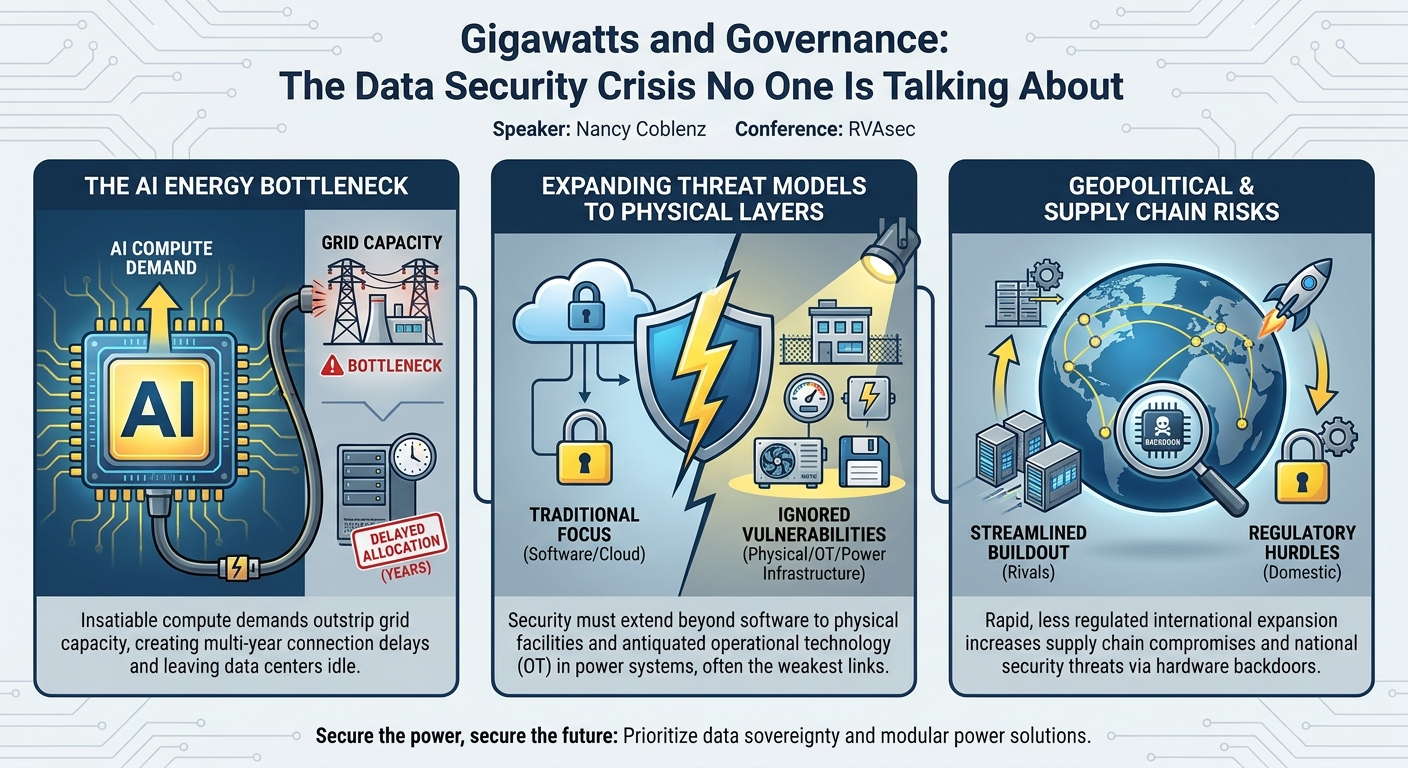
The central and most alarming finding of Coblenz's presentation is the impending power bottleneck that threatens the scalability and security of global data infrastructure, particularly in the context of burgeoning AI compute demands. The United States currently has approximately 1,200 to 1,300 GW of total power capacity in full load. However, a staggering over 2,000 GW are awaiting allocation to be plugged into the grid, highlighting a severe disconnect between power generation and demand. Specifically for US data centers, roughly 100 GW are currently online, but over 700 GW are awaiting allocation, indicating that a massive amount of planned data center capacity simply cannot connect to the grid in a timely manner. This allocation backlog means that newly constructed data center buildings often sit idle for years, awaiting power, rendering their hardware obsolete by the time they can operate.
Another critical finding is the antiquated and vulnerable nature of the national power grid. Coblenz pointed out that the US power grid is old and has not seen significant upgrades, making it a prime target for adversaries. The vulnerability extends beyond the grid to the physical data centers themselves and even down to individual components like GPUs. A poll conducted during the talk revealed that many cybersecurity professionals do not assess threat levels down to the GPU or physical infrastructure, underscoring a significant gap in current security protocols. The audience identified "quirky" vulnerabilities in "dumb tech" such as open HVAC systems, cheap webcams, EMR software, credit card swipers, wireless power meters, and even floppy disk-run power plants, illustrating the pervasive nature of overlooked attack vectors at the operational technology (OT) layer.
Furthermore, the presentation revealed a profound geopolitical dimension to this data security crisis, particularly concerning China. While the US faces immense hurdles in grid connection (minimum 3 years, often 5-7 years in Texas), China is rapidly accelerating its data center buildout. Last year, China had 325 data centers; by next year, it is projected to surpass the US, hitting 50 GW of buildout capacity compared to the US's projected 25 GW of actual on-grid buildout over the next 5-10 years. This rapid expansion is attributed to China's streamlined supply chain, abundant resources (primarily LNG natural gas), and a lack of environmental and bureaucratic constraints that hinder Western development. This imbalance in infrastructure growth poses a significant national security threat, as it increases the potential for vulnerabilities, supply chain compromises (e.g., backdoors in hardware), and attacks on critical data. Coblenz framed this as a new "AI race," mirroring the Cold War space race, where dominance in computational infrastructure signifies a balance of global power.
Technical Deep Dive
▶ Watch: Massive US power shortage for data centers (16:00)
The technical core of the data security crisis, as presented by Nancy Coblenz, lies in the fundamental mismatch between rapidly advancing AI compute technology and the lagging development of power infrastructure. At the data center infrastructure layer, the shift from traditional telecom hardware to high-density AI compute has dramatically increased power requirements. Older data centers typically operate on 240V AC power, but the next generation of GPUs demands 800V DC direct-to-rack power. This renders existing power infrastructure within many data centers obsolete, forcing costly overhauls or new builds. The long waiting times for grid connection (3 to 10+ years) exacerbate this problem, as hardware purchased for a new facility can become outdated before the facility is even operational.
To circumvent the grid bottleneck, Stellenium and similar companies are focusing on behind-the-meter power solutions. This involves building modular power plants directly adjacent to or integrated within data center campuses. These modular units can be deployed much faster, typically within 9 months to 3 years, compared to the multi-year wait times for grid allocation. This approach offers enhanced data sovereignty and security, as the facility owner controls the entire energy layer, reducing reliance on external, potentially vulnerable, grid infrastructure. Current modular solutions primarily utilize natural gas (LNG) as a fuel source due to its relative abundance, though other combustible options like ammonia-based fuels and biomass energy (e.g., from corn husks, coconut husks, sugarcane) are being explored to force innovation and diversify energy sources.
The future of power generation for data centers also includes advanced technologies like Small Modular Reactors (SMRs) and other forms of nuclear energy. While highly anticipated for their potential to provide clean, high-capacity power, Coblenz noted that commercialization is still 2 to 10+ years out, with significant political and logistical hurdles, particularly concerning the acquisition and regulation of uranium.
Beyond power, the talk delved into the myriad of often-overlooked technical vulnerabilities within data centers and their supporting infrastructure. Coblenz emphasized the need to assess threats down to the physical data center level, including key card access systems, fencing, parking, and individual racks. A critical area of neglect is the Operational Technology (OT) layer within power plants and utility infrastructure. Many power plants, surprisingly, still run on outdated systems, some even utilizing floppy disks or CDs for their core operations. The engineers managing these systems are often blue-collar workers trained on specific applications rather than cybersecurity experts, creating a significant security gap.
The speaker's poll highlighted "quirky" vulnerabilities, often found in seemingly innocuous "dumb tech" components:
- Open HVAC systems
- Cheap webcams
- EMR (Electronic Medical Record) software
- Credit card payment devices
- Wireless power meters
- Passwords written on sticky notes
- Telnet modems left open
- Open SMTP servers
- Vulnerable database drivers
These examples illustrate that attack surfaces extend far beyond traditional IT systems to include the physical and OT environments, which are often less secured and understood by cybersecurity professionals. The supply chain for physical equipment—from GPUs to fiber optics—also presents a significant technical vulnerability. The origin of these components, what might be embedded within them, and the trust placed in vendors (especially those using general contractors and sub-contractors) are critical national security concerns. A lack of transparency in the vendor ecosystem means that organizations often "inherit a bunch of trust" without proper auditing, creating potential backdoors and points of compromise within the foundational hardware itself.
Demo / Proof of Concept
▶ Watch: Data ownership, jurisdictional laws, and national security (24:00)
While the presentation extensively discussed real-world scenarios and specific technical challenges, it did not include a live technical demonstration or a proof of concept of a specific exploit. Instead, the speaker engaged the audience through a series of interactive live pulse polls, which served to gauge their understanding, experiences, and opinions on data centers, infrastructure, and security vulnerabilities. These polls provided immediate feedback and allowed the speaker to tailor the conversation, effectively demonstrating the audience's current security posture and identifying common blind spots related to physical and power infrastructure.
Defensive Implications
▶ Watch: Q&A: The future impact of quantum computing (38:20)
The insights shared by Nancy Coblenz offer crucial defensive implications for cybersecurity professionals, urging a paradigm shift in how organizations perceive and protect their digital assets. The core message is to expand the scope of threat assessment beyond traditional IT layers to encompass the physical and power infrastructure that underpins all data.
- Broaden Threat Models to Physical and Power Layers: Defenders must extend their threat models to include the physical data center itself, assessing vulnerabilities related to access control (key cards, fencing, parking, rack access), environmental controls (thermostats), and even individual hardware components like GPUs. Crucially, the power infrastructure layer, including the grid, power plants, and utility operational technology, should be considered a primary target. Given the antiquated nature of many power systems (some still running on floppy disks), these represent significant, often unaddressed, attack surfaces. Security teams should engage with facility owners and utility CISOs to understand and secure these foundational elements.
- Scrutinize Data Location and Jurisdictional Laws: It is paramount to know precisely where data physically resides and under whose laws it operates. This includes understanding international regulations like GDPR, as well as national, state, and even county-level data sovereignty laws. The speaker cited an example of a North African country enacting a law requiring all in-country data to be housed locally, invalidating reliance on US-based cloud providers due to the risk of US subpoenas. This necessitates asking critical questions about data residency, legal compulsion for access, and how these factors impact a client's or company's security posture and redundancy plans.
- Implement Robust Supply Chain Security: The origin of physical equipment (e.g., GPUs, fiber optics) is a critical national security concern. Defenders must question where hardware is manufactured and what potential vulnerabilities (e.g., backdoors) might be embedded. This requires rigorous vendor auditing, going beyond general contractors to understand the full web of subcontractor relationships. The "inherited trust" model with vendors is insufficient; explicit verification and transparency are needed to mitigate risks from compromised components or services.
- Proactive Engagement with Infrastructure Owners and Policymakers: Cybersecurity professionals are uniquely positioned to bridge the knowledge gap between technical threats and infrastructure realities. They should actively collaborate with facility owners from the design phase of data centers to ensure security is built-in, not bolted on. This includes designing physical data centers and GPU racks to be least vulnerable. Additionally, engaging with state and local legislature and government leaders is vital. Policymakers often lack direct access to this level of technical threat intelligence and need input from security experts to develop protective measures and resilient policies for critical infrastructure.
- Address "Dumb Tech" Vulnerabilities: The prevalence of vulnerabilities in seemingly innocuous or "dumb tech" (e.g., old HVAC systems, webcams, printers, thermostats, credit card swipers, outdated modems, sticky notes with passwords) highlights the need for comprehensive auditing of all connected devices and systems, regardless of their perceived criticality or sophistication. These often-overlooked entry points can serve as pathways to more sensitive systems.
- Question Power Supply Ownership and Resilience: Understand who owns the power supply for data centers and what can make it stop. This includes assessing the resilience of the grid, the security of local power generation (e.g., modular plants), and the potential for single points of failure. Direct engagement with power distributors and facility operators' CISOs is necessary to ask these critical questions and incorporate power resilience into overall security planning.
By adopting these defensive strategies, cybersecurity professionals can move beyond reactive measures and proactively address the foundational vulnerabilities that define the current data security crisis, safeguarding critical infrastructure and national interests.
Key Takeaways
- The AI compute boom is creating an unprecedented energy bottleneck, with massive data center power demands vastly outstristripping grid capacity and allocation, leading to multi-year delays and potential hardware obsolescence.
- Cybersecurity threat models must expand to the physical and power infrastructure layers, including data center facilities, the power grid, and operational technology (OT) within power plants, which often harbor significant, overlooked vulnerabilities (e.g., floppy disk-run systems, insecure "dumb tech").
- Geopolitical competition in data center buildout, particularly with China, poses a critical national security threat, as rapid, less regulated expansion abroad increases supply chain vulnerabilities and potential for hardware backdoors.
- Data sovereignty and jurisdictional laws are paramount, requiring organizations to understand where their data physically resides and the legal frameworks governing its access and protection, impacting global business operations and security postures.
- Proactive collaboration is essential, necessitating cybersecurity professionals to engage directly with facility owners during design, scrutinize vendor supply chains, and inform state and local legislators about infrastructure vulnerabilities to build resilience.
- The shift to "behind-the-meter" modular power plants represents a more secure and efficient solution to grid dependency, offering faster deployment and greater control over the energy layer, enhancing data sovereignty and operational security.
About the Speaker(s)
Nancy Coblenz is the Co-founder and President of Stellenium, a company at the forefront of building AI data centers and modular power plants, focusing on the critical infrastructure and power layers. She is also the Co-founder of Family Office Group. With a distinguished career spanning two decades, Coblenz is a four-time exited founder with extensive experience in private equity, where she scaled nine portfolio companies. Her background also includes a significant role as the Head of Marketing and Digital Transformation for the largest minority staffing company in the world, which she helped grow to approximately $6 billion.
Coblenz brings a unique, high-level business and strategic perspective to the complex world of data center infrastructure, emphasizing the broader implications for industry, companies, and business decisions. While she readily admits she is not the technical co-founder of Stellenium (her CEO holds that role), her expertise lies in understanding the macro trends, financial investments, and governance challenges associated with the rapid acceleration of AI and compute infrastructure. Her passion for this field is deeply personal, influenced by her father, who at 96, is the last living lead supervising engineer of Apollo 11, drawing parallels between historical technological races and the current AI infrastructure imperative.
Reviews
Dr. Zero (Offensive Security Researcher) — HARD PASS
This isn't a security briefing. It's a real estate and natural gas pitch for Stellenium wrapped in a national security flag. She's selling modular power plants to bypass grid queues, using 'AI compute' and 'China' as marketing hooks.
Heather Calloway (CISO) — STRONG ACCEPT
Coblenz highlights a massive blind spot in enterprise risk registers: the physical power dependency of AI compute and the geopolitical reality of data center constraints. This is a macro-level briefing on systemic infrastructure risk. It is worth your time if you are forecasting long-term vendor concentration or AI procurement.