No Breach Required: $52 Million in Cybersecurity Fraud Settlements Built on Paperwork, Not Incidents
Max Voldman (Partner · Whistleblower Partners LLP), Michael Roytman (CTO · Empirical Security)
RVAsec 2026 · Day 1 · Grand Ballroom D/E
Overview
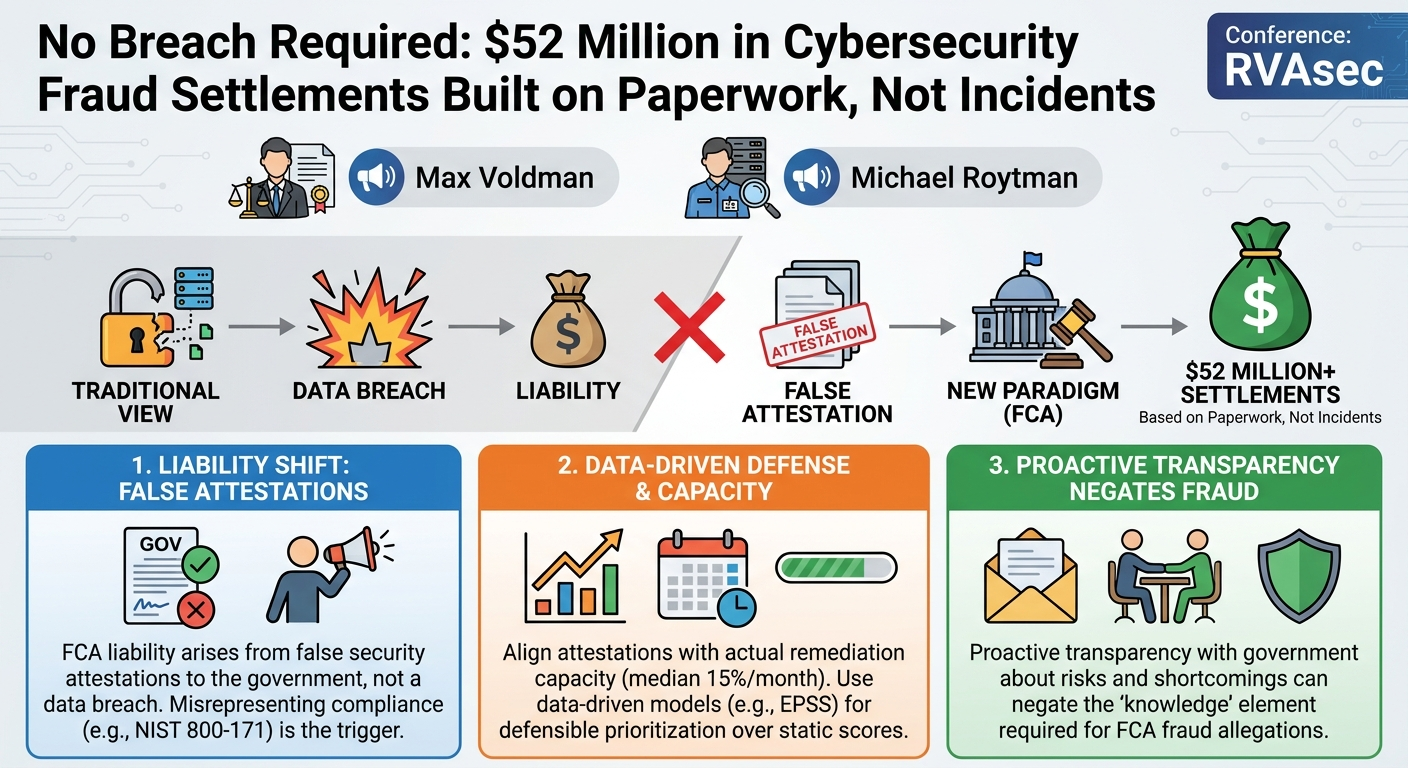
This talk, presented by Max Voldman, an attorney specializing in whistleblower law, and Michael Roytman, a cybersecurity CTO, delves into a critical and emerging area at the intersection of law and cybersecurity: the financial liability stemming from false attestations of security posture, rather than from actual data breaches. Titled "No Breach Required," the session highlights how the False Claims Act (FCA) is increasingly being leveraged by the U.S. Department of Justice (DOJ) to pursue significant settlements against government contractors who misrepresent their cybersecurity compliance. The speakers emphasize that the traditional focus on breach-centric liability is shifting, making accurate self-assessment and transparent reporting paramount.
Key moments
- 0:00 Introduction: Cybersecurity liability without a breach
- 2:00 False Claims Act: Whistleblower law explained
- 4:35 DOJ's cyber initiative and first settlements
- 8:22 Legal 'knowledge' element and transparency requirement
- 13:40 Quantifying risk: Measuring actual exploitation frequency
- 24:20 Organizational remediation capacity and realistic policies
- 36:00 Data-driven adequate security and compliance standards
No Breach Required: $52 Million in Cybersecurity Fraud Settlements Built on Paperwork, Not Incidents
Speakers: Max Voldman (Partner, Whistleblower Partners LLP); Michael Roytman (CTO, Empirical Security)
Conference: RVAsec
YouTube: https://www.youtube.com/watch?v=1QsXhzgqbNE
Overview
This talk, presented by Max Voldman, an attorney specializing in whistleblower law, and Michael Roytman, a cybersecurity CTO, delves into a critical and emerging area at the intersection of law and cybersecurity: the financial liability stemming from false attestations of security posture, rather than from actual data breaches. Titled "No Breach Required," the session highlights how the False Claims Act (FCA) is increasingly being leveraged by the U.S. Department of Justice (DOJ) to pursue significant settlements against government contractors who misrepresent their cybersecurity compliance. The speakers emphasize that the traditional focus on breach-centric liability is shifting, making accurate self-assessment and transparent reporting paramount.
Voldman and Roytman collectively illuminate a landscape where cybersecurity programs are now directly responsible for the veracity of their compliance claims. The talk reveals that over $52 million in settlements have already been collected in this nascent area, signaling a robust and growing government initiative. By combining legal expertise with deep technical insights into vulnerability management and risk quantification, the speakers present a compelling argument for why organizations, especially those dealing with federal agencies, must adopt data-driven and transparent approaches to their security attestations to avoid substantial legal and financial repercussions.
The core message is a proactive warning to the cybersecurity community: liability is no longer solely predicated on a breach incident. Instead, it arises from documented misrepresentations of security controls and practices. This paradigm shift demands a fundamental re-evaluation of how organizations measure, report, and manage their cyber risk, urging them to "turn square corners" in their dealings with the government and foster internal transparency to mitigate the risk of whistleblower-initiated lawsuits.
Background
▶ Watch: Introduction: Cybersecurity liability without a breach (0:00)
The False Claims Act (FCA), a law dating back to 1863 during the U.S. Civil War, serves as the primary legal framework discussed in this talk. Originally enacted to combat rampant fraud by defense contractors—such as selling "lame mules as charge-ready horses" or "gluing pieces of fabric" to make Union uniforms—the FCA allows both the government and private citizens (whistleblowers) to sue entities that defraud the federal government. A unique aspect of the FCA is its qui tam provision, which grants whistleblowers, typically employees who observe wrongdoing, standing to bring a lawsuit on behalf of the government and receive 15% to 30% of any recovery. These lawsuits are filed secretly and undergo a multi-year government investigation, with over 95% of government-joined cases resulting in settlement or judgment.
Historically, FCA recoveries have been overwhelmingly concentrated in healthcare fraud, particularly Medicare and Medicaid, totaling billions annually. However, this trend is beginning to diversify. In 2021, the Biden DOJ launched a "cyber initiative" specifically aimed at using the FCA to target false attestations and cybersecurity vulnerabilities among government contractors. This focus has been reiterated by subsequent administrations, signaling a sustained commitment. The first major cyber-related FCA settlement, against Cisco in 2018, involved an $8.5 million payment to resolve allegations that software vulnerabilities in their video security camera devices, intended for agencies like the FBI, allowed unauthorized access. This case established a crucial precedent: liability was based on the inherent vulnerabilities and the false assurance of security, not on a specific breach event.
Max Voldman emphasizes that the critical trigger for FCA liability is not a data breach, but rather "lying to the government." The FCA requires an element of scienter, meaning the defendant must have known about the misrepresentation or acted with reckless disregard, rather than simply making a mistake. Contractors doing business with federal agencies are expected to "turn square corners," meaning they must be truthful and transparent in their statements and attestations. Proactively disclosing vulnerabilities and specifics of security practices to the government can serve as a strong defense against the scienter element, as it demonstrates that the government was aware and chose to continue the business relationship. The $52 million in cyber-related settlements in the year prior to this talk represents the largest annual total to date, underscoring the escalating focus and impact of this initiative.
Key Findings
▶ Watch: DOJ's cyber initiative and first settlements (4:35)
The talk unveils several critical findings that underscore the shift in cybersecurity liability:
- Escalating Financial Consequences for False Attestations: Cybersecurity fraud settlements under the False Claims Act reached $52 million in the year preceding the talk, marking the largest annual total yet. This figure, though still a small percentage of overall FCA recoveries, is projected to grow significantly as government investigations, which can take years, mature. This signals a new era where financial responsibility for cybersecurity extends beyond incident response.
- Liability Without a Breach: A core and repeated finding is that FCA liability in cybersecurity is not predicated on a data breach. Instead, it arises from false attestations and misrepresentations of security posture and compliance to the federal government. Cases like HealthNet Federal Services ($11M settlement for failing to conduct vulnerability testing) and Aluminina ($10M for falsely certifying NIST 800-171 compliance) illustrate this, often without any public breach.
- Government Focus on Compliance Standards: The DOJ's cyber initiative specifically targets contractors' compliance with standards like NIST 800-171, particularly concerning the protection of Controlled Unclassified Information (CUI) in federal and non-federal systems. The Supplier Performance Risk System (SPRS) is highlighted as a specific tool where contractors attest to their risk posture.
- The "Knowledge" Element is Key: For FCA liability, it must be proven that the defendant knew about the false attestation, ignored it, or "stuck their head in the sand." Transparency and proactive communication with the government about security shortcomings can negate this scienter element.
- Disparity in Vulnerability Metrics: While the number of published vulnerabilities (CVEs) in the National Vulnerability Database (NVD) is growing exponentially (from 4,600 in 2010 to 48,000 in 2023), the number of vulnerabilities with publicly available exploit code is growing linearly, and critically, the number of vulnerabilities with actual attacker exploitation activity remains relatively flat (300-400 per year). This highlights a significant "noise" problem in vulnerability management.
- Recency Dictates Risk Probability: The probability of a vulnerability being re-exploited drastically depends on the recency of its last known exploitation. A vulnerability exploited yesterday has a 99% chance of being exploited again today, whereas one exploited a year ago has only a 5% chance (which is the base rate for any vulnerability). This decay function is crucial for effective prioritization.
- Limited Remediation Capacity: Data from 500 organizations shows that, on median, enterprises can only remediate about 15% of their identified vulnerabilities per month. The median half-life for closing vulnerabilities is a staggering 158 days. This inherent capacity limitation means that promising to remediate all vulnerabilities is often an unrealistic and therefore false attestation.
- Superiority of Probabilistic Risk Models: Models like the Exploit Prediction Scoring System (EPSS) offer significantly higher efficiency (percentage of remediated vulnerabilities that were actually exploited) compared to traditional scoring systems like CVSS (Common Vulnerability Scoring System). EPSS can achieve the same coverage (percentage of all exploited vulnerabilities addressed) with far less effort, making it a more defensible basis for compliance.
Technical Deep Dive
▶ Watch: Legal 'knowledge' element and transparency requirement (8:22)
The technical core of the talk, presented by Michael Roytman, focuses on how to accurately measure and represent cybersecurity risk to avoid the pitfalls of the False Claims Act. Roytman asserts that "there is no such thing as cyber risk" as a single, quantifiable entity; rather, it is derived from real-world behavior (organizational, attacker, government) and a quantification engine. The goal is to avoid "lying with statistics" to the government.
A central theme is the distinction between various vulnerability metrics. Roytman presents compelling data illustrating three distinct trends:
- Vulnerabilities Published (Green Line): The number of CVEs published annually in the National Vulnerability Database (NVD) shows exponential growth. In 2010, there were 4,600 vulnerabilities; in 2020, 20,000; and in 2023, a staggering 48,000. This deluge creates significant noise for defenders.
- Vulnerabilities with Exploit Code (Red Line): The number of vulnerabilities with publicly available exploit code (e.g., Metasploit, GitHub, Exploit DB) is growing, but only linearly. Attackers, being "work averse," often have enough existing exploits and are more incentivized to find something that works than to write new code for every vulnerability.
- Vulnerabilities with Attacker Exploitation Activity (Yellow Line): Crucially, the number of vulnerabilities actually being exploited by attackers in the wild remains relatively stable, around 300 to 400 per year. This small subset represents the true "loss events" that organizations should prioritize.
Roytman highlights the CISA Known Exploited Vulnerabilities (KEV) list as the government's attempt to provide federal agencies with a manageable list of critical vulnerabilities. However, he points out two significant problems: it is "by far incomplete" (1,600 on the CISA KEV list vs. 17,800 known exploited vulnerabilities in private datasets) and treating it as a binary "fix all" list is inefficient. The Verizon Data Breach Investigations Report (DBIR) for the first time noted that vulnerability exploitation (31%) has surpassed all other primary intrusion vectors, underscoring the growing importance of addressing exploited vulnerabilities.
The talk introduces the concept of re-exploitation probability, emphasizing that the recency of exploitation is a powerful indicator of future risk. If a vulnerability was exploited yesterday, there's a 99% chance it will be exploited again today. If it was exploited a year ago but not since, that probability drops to 5% (the base rate for any vulnerability). This decay function, where probability decreases over time, is crucial for dynamic risk assessment and prioritization. Organizations need to differentiate between vulnerabilities that were risky and those that are risky today.
Addressing the practicalities of remediation, Roytman presents data on remediation capacity. An analysis of 500 organizations revealed a median capacity of approximately 15% of vulnerabilities remediated per month. This means it is "physically impossible to attest to remediating all vulnerabilities" for most organizations. The Mean Time to Remediate (MTTR) also varies wildly, with a median half-life (50% closed) of 158 days across 300 million vulnerabilities. This data makes it clear that organizations must craft remediation policies that align with their actual, historical capacity, rather than making aspirational but unachievable promises.
The technical solution proposed involves adopting advanced, data-driven risk models. The talk specifically champions the Exploit Prediction Scoring System (EPSS), an open, free model published through first.org. EPSS, a machine learning model based on 2,800 variables, offers significantly higher efficiency and coverage compared to simpler models like CVSS. For example, to achieve 76.8% coverage of exploited vulnerabilities, remediating all CVSS 7+ vulnerabilities requires addressing 50.5% of all CVEs in an environment, with an efficiency of only 5.1%. In contrast, EPSS can achieve the same coverage by remediating everything with an EPSS score of 10% or above, with an efficiency of 34.8%. This means EPSS identifies critical vulnerabilities with far greater precision, reducing wasted effort.
Roytman's argument is that organizations must define their "adequate security" using such measurable models and establish a clear risk tolerance threshold. This allows for a defensible policy (e.g., "we will remediate the top 20% of our vulnerabilities by EPSS score within X days") that is both achievable and transparent to the government. Vendors are challenged to provide similar performance metrics for their own scoring systems, ensuring that any chosen model is quantifiable and defensible.
Demo / Proof of Concept
▶ Watch: Organizational remediation capacity and realistic policies (24:20)
While the talk did not feature a live software demonstration or a traditional proof-of-concept exploit, Michael Roytman presented extensive data visualizations and analytical findings that served as a powerful demonstration of the core concepts. He leveraged aggregate data collected for the Exploit Prediction Scoring System (EPSS), which he co-publishes through first.org, and anonymized aggregate measures from past and current customers of Empirical Security.
These data-driven "demonstrations" included:
- Vulnerability Publication Trends: Charts illustrating the exponential growth of published vulnerabilities vs. the linear growth of exploit code and the flat trend of actual exploitation activity.
- Exploitation Velocity: Visualizations of daily exploitation activity across the CISA KEV list and broader datasets, highlighting persistent vs. sporadic exploitation patterns.
- Recency Decay Function: A graphical representation of how re-exploitation probability rapidly declines with the time elapsed since the last known exploitation event.
- Remediation Capacity and MTTR: Charts showing the median monthly remediation capacity across 500 organizations and the distribution of Mean Time to Remediate (MTTR), illustrating the slow pace of vulnerability closure.
- EPSS vs. CVSS Performance: Comparative analyses demonstrating the superior efficiency and coverage of EPSS in identifying truly exploited vulnerabilities, using visual representations of vulnerability sets and policy thresholds.
Through these detailed data presentations, Roytman effectively demonstrated the technical validity of his arguments regarding risk quantification, prioritization, and the operational realities of vulnerability management. The data served as the "proof of concept" for the feasibility and necessity of adopting a data-driven approach to cybersecurity attestations.
Defensive Implications
▶ Watch: Data-driven adequate security and compliance standards (36:00)
The insights shared in this talk carry profound defensive implications for any organization, particularly those contracting with federal agencies. The shift in liability from breach-centric to attestation-centric demands a fundamental change in how cybersecurity programs are structured, measured, and communicated.
- Prioritize Transparency and Open Communication: The most crucial defensive strategy is transparency with the government. Proactively communicating measured vulnerabilities, the results of risk assessments, and any compliance shortcomings to contracting officers or relevant federal agencies can negate the scienter (knowledge) element required for FCA liability. As Max Voldman stated, "A case where you send the government an email... laying out what you measured, what the results were, and what the vulnerabilities are... is a case no whistleblower lawyer in the country is going to take." This open dialogue transforms potential fraud allegations into a shared understanding of risk.
- Adopt Data-Driven Risk Models: Organizations must move beyond simplistic "yes/no" attestations or over-reliance on static scores like CVSS. Instead, they should embrace dynamic, data-driven risk models like EPSS. These models provide a more accurate and efficient way to identify and prioritize truly exploited vulnerabilities. Defenders should:
- Focus on Exploited Vulnerabilities: Prioritize remediation efforts on vulnerabilities listed on the CISA Known Exploited Vulnerabilities (KEV) list and other sources of real-world exploitation telemetry, especially those with recent activity.
- Measure Coverage and Efficiency: Understand the coverage (percentage of actual exploited vulnerabilities addressed by a policy) and efficiency (percentage of remediated vulnerabilities that were actually exploited) of their chosen risk model and remediation policies. This allows for quantifiable and defensible attestations.
- Demand Metrics from Vendors: When evaluating security tools or services, ask vendors how their risk models perform in terms of coverage and efficiency to ensure they can support a data-driven compliance strategy.
- Align Attestations with Actual Remediation Capacity: Given the median 15% monthly remediation capacity and slow Mean Time to Remediate (MTTR) (158-day half-life), organizations cannot realistically promise to fix all vulnerabilities within short timeframes. Instead, policies should be tailored to historical remediation capacity. For example, an attestation could state: "We will remediate the top 20% of our vulnerabilities by EPSS score within 30 days," provided this aligns with the organization's proven ability. This avoids making false promises that can lead to FCA liability.
- Foster an Internal Culture of Openness and Address Whistleblower Concerns: Many FCA cases are initiated by frustrated employees who feel their concerns about wrongdoing are ignored or met with retaliation. Organizations should actively listen to employee feedback regarding security shortcomings and address them constructively. Retaliation against potential whistleblowers is a significant red flag that can strengthen a plaintiff's case by suggesting a deliberate attempt to conceal information from the government.
- Define "Adequate Security" Quantifiably: The talk proposes that the risk model itself becomes the compliance standard. Instead of vague statements, organizations should define "adequate security" in a data-driven manner, choosing a measurable model and an achievable threshold. This approach, while initially requiring more effort, provides a legally defensible posture against future FCA claims. The government is expected to provide more guidance on specific models and thresholds in future revisions of standards like NIST, but organizations can get ahead by proactively adopting measurable approaches.
In essence, defenders must shift their mindset from merely doing security to proving security with verifiable data. The emphasis is on proactive measurement, honest assessment, and transparent communication to safeguard against the growing threat of cybersecurity fraud settlements built on paperwork, not just incidents.
Key Takeaways
- False Claims Act (FCA) liability for cybersecurity is a real and growing threat, even without a data breach. The focus has shifted from incident-based liability to the veracity of security attestations made to the government.
- False attestations regarding cybersecurity posture and compliance are the primary trigger for FCA lawsuits. Organizations must ensure their statements about adherence to standards like NIST 800-171 are accurate and supported by evidence.
- Transparency and proactive communication with federal agencies about security risks and vulnerabilities are crucial for mitigating legal exposure. Disclosing shortcomings can negate the "knowledge" (scienter) element required for FCA fraud allegations.
- Data-driven risk models like EPSS offer significantly higher efficiency and precision in prioritizing vulnerabilities compared to traditional scoring systems like CVSS. They help focus remediation efforts on the small subset of vulnerabilities actually being exploited.
- Organizations must align their security attestations and remediation policies with their actual, measurable capacity. Promising to fix all vulnerabilities is often unrealistic and can lead to false claims if not achievable.
- Fostering an internal culture of openness and addressing employee concerns about security issues is vital. Ignoring or retaliating against potential whistleblowers can significantly strengthen an FCA case against an organization.
About the Speaker(s)
Max Voldman is an attorney and Partner at Whistleblower Partners LLP, a law firm dedicated to representing individuals under various whistleblower reward programs. His expertise lies particularly with the False Claims Act, which allows whistleblowers to allege and sue for fraud against the government. Max provides critical legal context to the emerging landscape of cybersecurity liability, explaining the mechanics of the FCA and the implications for government contractors.
Michael Roytman is the CTO and co-founder of Empirical Security, a company focused on exposure management. He brings deep technical expertise in cybersecurity risk quantification and vulnerability management. Michael is also a co-publisher of the Exploit Prediction Scoring System (EPSS) through first.org, an open model for forecasting vulnerability exploitation probability. His contributions to the talk include data-driven insights into vulnerability trends, remediation capacities, and the comparative effectiveness of different risk models.
Reviews
Dr. Zero (Offensive Security Researcher) — MUST SEE
This is the rare policy talk that actually drops a hammer on the compliance-industrial complex. Voldman and Roytman dismantle the delusion of 'fix everything' vulnerability management by pairing DOJ False Claims Act reality with hard EPSS remediation data. Every CISO signing NIST 800-171 attestations needs to watch this before their own SOC analysts sue them for federal fraud.
Heather Calloway (CISO) — MUST SEE
The DOJ is weaponizing the False Claims Act to penalize government contractors for lying about their security posture, even if no breach occurs. This talk masterfully connects legal exposure to operational reality, proving that aspirational compliance is now a material financial risk. Mandatory viewing for your general counsel, your risk committee, and any compliance leader signing off on an attestation.