Breaking Your Silence: How to Build Influence Without Becoming a "Suit"
Heather Antoinetti (Founder · Ah-Ha Marketing)
RVAsec 2026 · Day 2 · Grand Ballroom D/E
Overview
In her RVAsec talk, "Breaking Your Silence: How to Build Influence Without Becoming a 'Suit'," Heather Antoinetti, founder of Ah-Ha Marketing, challenges the deeply ingrained culture of silence within the cybersecurity industry. Antoinetti asserts that while security professionals are often lauded for their caution, discretion, and quiet competence, this very trait can severely limit their professional growth and the industry's collective advancement. The presentation introduces the Vela framework, a five-part methodology designed to empower individuals to cultivate authentic influence and visibility without conforming to the perceived superficiality of a "LinkedIn influencer" or a "suit."
Key moments
- 4:20 Overcoming fear and sharing a winning idea
- 8:00 Cybersecurity culture and overcoming imposter syndrome
- 13:00 Introducing the Vela Framework for building influence
- 22:00 Focus on high-value interactions, not high visibility
- 32:45 Practical baby steps to overcome hesitation
- 36:30 Realizing you're already the expert you're chasing
- 42:00 How personal hobbies fuel professional growth
Breaking Your Silence: How to Build Influence Without Becoming a "Suit"
Speakers: Heather Antoinetti, Founder, Ah-Ha Marketing
Conference: RVAsec
YouTube: https://www.youtube.com/watch?v=uNv0s3KRjao
Overview
In her RVAsec talk, "Breaking Your Silence: How to Build Influence Without Becoming a 'Suit'," Heather Antoinetti, founder of Ah-Ha Marketing, challenges the deeply ingrained culture of silence within the cybersecurity industry. Antoinetti asserts that while security professionals are often lauded for their caution, discretion, and quiet competence, this very trait can severely limit their professional growth and the industry's collective advancement. The presentation introduces the Vela framework, a five-part methodology designed to empower individuals to cultivate authentic influence and visibility without conforming to the perceived superficiality of a "LinkedIn influencer" or a "suit."
Antoinetti's message resonates deeply within a field where imposter syndrome and the fear of being "called out" are rampant. She argues that the cybersecurity community, often operating "behind a door," is inadvertently stifling its most valuable asset: the diverse knowledge and unique perspectives of its practitioners. This talk is crucial for any cybersecurity professional — from entry-level analysts to seasoned CISOs — who feels their contributions are overlooked, their ideas unheard, or their career trajectory constrained by an unspoken expectation to remain silent. It provides a structured approach to transform hesitation into impactful presence, ensuring that vital insights are shared and recognized.
The talk is not merely about self-promotion, but about fostering a culture of meaningful contribution and strategic engagement. Antoinetti emphasizes that true influence is built through genuine relationships and clear communication, not mass broadcasting. By providing a practical framework and addressing common psychological barriers, she offers a roadmap for cybersecurity professionals to unlock their full potential, both individually and for the benefit of the broader community.
Background
▶ Watch: Overcoming fear and sharing a winning idea (4:20)
The cybersecurity industry, by its very nature, often cultivates a culture of discretion and caution. Professionals are typically rewarded for being competent, careful, and thorough, often operating in the background, metaphorically "sliding pizza under the door" as Antoinetti quotes another speaker. This operational necessity, however, frequently translates into a professional ethos where silence is equated with integrity, and self-promotion is viewed with suspicion or even disdain. This creates a significant paradox: an industry that desperately needs diverse voices and innovative solutions often inadvertently discourages its members from sharing their insights publicly.
Antoinetti recounts her own experience from 2006, when she first entered cybersecurity marketing. Initially, she felt like an imposter, "sitting in every meeting and I wrote down everything everyone said and I learned and I learned and I kept quiet because I thought that if I said anything everybody would realize that I didn't know what I was talking about." This fear of being exposed as "not knowing enough" is a common manifestation of imposter syndrome, a pervasive issue within highly technical and rapidly evolving fields like cybersecurity. This syndrome, coupled with the industry's cultural norms, leads to professionals holding back valuable ideas, project proposals, and even conference submissions.
The problem is compounded by a misconception of what "influence" entails. Many associate it with high-visibility roles like keynote speaking, podcasting, or becoming a social media personality – activities often perceived as requiring a departure from technical rigor or genuine contribution. Antoinetti challenges this notion, highlighting that the true goal is not mere visibility, but signal clarity: transmitting valuable information to the right audience to foster meaningful connections and opportunities. This background sets the stage for the Vela framework, which aims to bridge the gap between technical competence and effective communication, enabling professionals to share their expertise in ways that feel authentic and yield substantial impact.
Key Findings
▶ Watch: Introducing the Vela Framework for building influence (13:00)
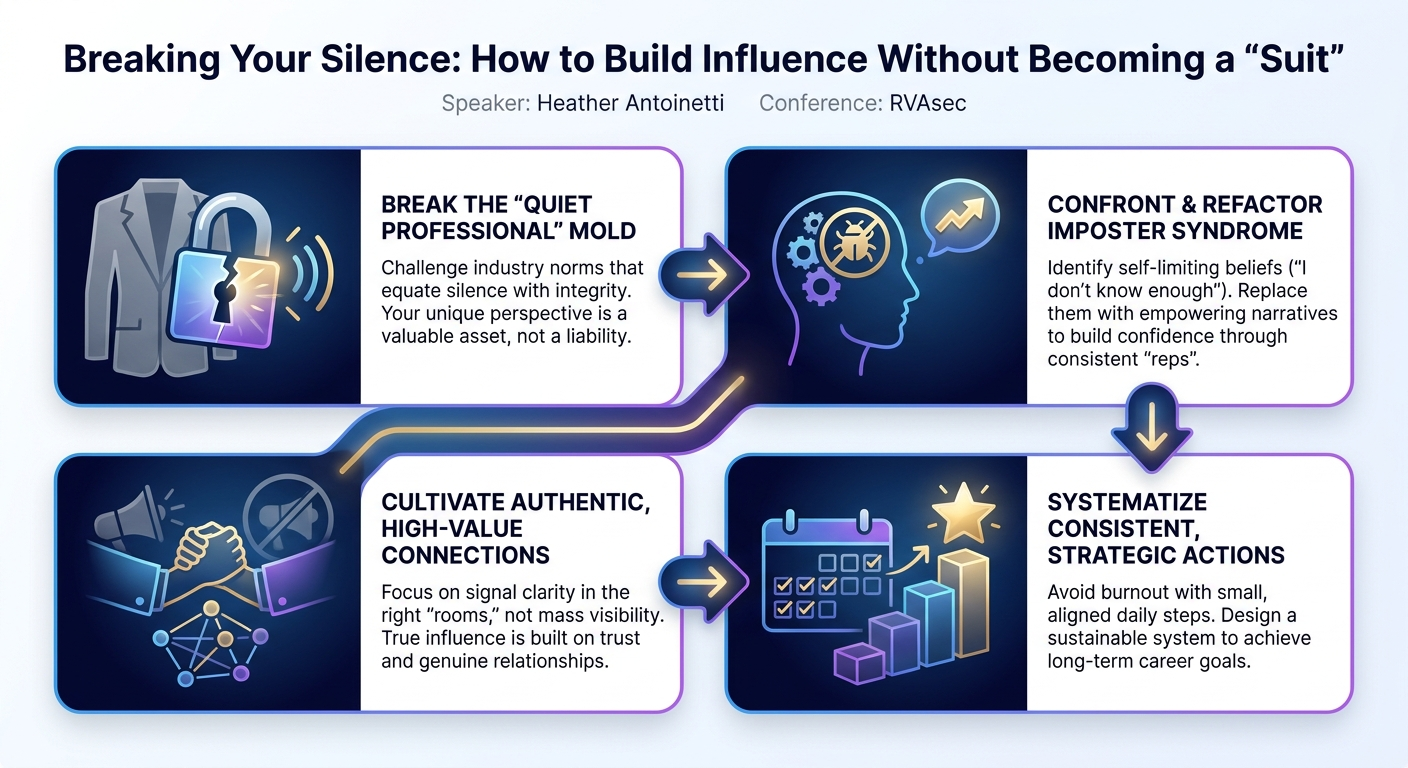
Antoinetti's core contribution is the Vela framework, a structured, five-part methodology designed to guide cybersecurity professionals from quiet competence to influential presence. The framework’s key findings revolve around identifying and overcoming internal and external barriers to sharing knowledge and building a strategic path for professional growth.
- The "Quiet Professional" Trap: The industry's cultural reward system for caution and discretion inadvertently fosters silence, which professionals mistakenly equate with integrity. This leads to missed opportunities for individuals and stifles collective innovation and knowledge sharing.
- Imposter Syndrome as a Primary Barrier: A significant number of professionals hold back due to beliefs like "someone else has already said it," "someone else said it better," or "I don't have enough certifications." Antoinetti identifies these thoughts as the primary drivers of inaction, emphasizing the need to identify and replace them.
- Influence vs. Visibility: A critical distinction is made between mass broadcasting for visibility and targeted transmission for influence. True influence is built "one relationship at a time" through high-value interactions, not just high-volume content creation. This reframes the goal from being a "LinkedIn creator" to being a "catalyst."
- The Compounding Effect of Inaction: Just as small positive habits compound (as in James Clear's Atomic Habits), repeated inaction leads to years of discomfort and missed opportunities. Pressing "send" or speaking up in a meeting, though uncomfortable initially, builds confidence and creates a positive feedback loop.
- Authenticity as a Differentiator: In a highly technical field, human connection and personal background are powerful differentiators. Professionals are encouraged to align their core values with their work, allowing their unique journey and personality to create memorable connections, rather than solely relying on technical credentials.
- Strategic Systematization: Influence building should not be random but a strategic system with clear, aligned goals. This prevents burnout from sporadic, uncoordinated efforts, ensuring sustainable progress towards career aspirations, such as CISO track advancement or advisory board positions.
These findings collectively offer a powerful reframing of professional development in cybersecurity, shifting the focus from passive competence to active, strategic contribution and relationship building.
Technical Deep Dive
▶ Watch: Focus on high-value interactions, not high visibility (22:00)
While "technical" in the traditional sense of code or vulnerabilities, Antoinetti's framework offers a detailed architecture for personal and professional growth, akin to a robust system design for influence. The Vela framework consists of five interconnected components, each designed to address specific psychological and strategic protocols for effective communication and engagement.
1. Foundation: From Hesitation to Presence
This initial stage focuses on mindset transformation. Antoinetti highlights the prevalence of imposter syndrome and self-limiting beliefs ("I should be quiet," "I don't know enough," "Someone else said it better"). The technical deep dive here involves:
- Identifying Triggers: Professionals must first recognize their specific self-sabotaging thoughts. These are the "bugs" in their mental operating system that prevent action.
- Mindset Refactoring: Actively replacing negative thoughts with empowering ones. For instance, instead of "I'm lucky," cultivating "I worked hard, I studied, I earned this." This is a crucial patch to the internal narrative.
- Growth Mindset Cultivation: Embracing discomfort as a sign of growth. "You're never ever ever going to feel ready to do whatever the thing is. But I can promise you that if you do the thing a few times, you'll feel a little more ready every time." This is akin to iterative development, where small, consistent "reps" build confidence and skill.
2. Narrative: From Expertise to Influence
This component is about crafting a compelling and authentic professional story. Many highly technical individuals struggle to articulate their value succinctly. The "technical" aspect involves:
- Self-Exploration and Value Alignment: Identifying core values and aligning them with one's professional work. This ensures that outward communication feels genuine and not like a performance.
- Differentiator Engineering: Understanding what makes one unique beyond technical skills. "How many of them grew up in your background? How many of them had, you know, whatever cool electronics little keyboard thing that you had?" These human elements are crucial connective tissue that build rapport.
- Concise Communication Protocol: Developing a "crisp couple of sentences" to answer "What do you do?" or "Tell me about yourself." This is a high-efficiency communication payload designed for memorability and impact, preventing rambling that leaves no lasting impression.
3. Signal: From Contributor to Catalyst
This is where the output of one's work is strategically shared. It's not about volume but high-value interactions and signal clarity.
- Message Optimization: Focusing on understanding the differentiated message and finding the most effective channels to communicate it. This is about selecting the right transmission medium for the message.
- Targeted Outreach: Instead of mass broadcasting, identifying the "right rooms" – specific communities, groups, or individuals – where one's expertise will be most valued and impactful. This is a form of packet filtering to ensure the message reaches relevant nodes.
- Leveraging Indirect Influence: Understanding that sharing knowledge and making connections can lead to others advocating for you. Antoinetti shares an example of receiving unsolicited job offers because her network remembers her and refers her. This demonstrates a network effect where small, consistent inputs yield significant, often indirect, returns.
4. Network: From Isolated to Integrated
This section emphasizes building genuine, high-trust relationships rather than superficial "grip and grin" networking.
- Community Building: Engaging in virtual or physical "high trust rooms" where people work on similar problems from different angles or share common interests. This is about building a distributed network of support and collaboration.
- Diverse Network Architecture: Cultivating relationships with people at different career stages: mentors (a few years ahead), peers (on the same level), and mentees (rising stars). This diverse topology provides different perspectives, challenges thinking, and fosters growth.
- Authentic Connection Protocols: Leveraging personal interests (like the client who connects with other cybersecurity professionals through motorcycle riding) to build deeper, more organic bonds. This moves beyond transactional interactions to genuine human connections.
5. System: From Random to Strategic
The final component integrates all previous elements into a sustainable, goal-oriented process.
- Goal Definition: Clearly articulating career goals (e.g., CISO track, advisory roles, specific job transitions). These are the target states for the influence system.
- Micro-Action Planning: Breaking down large goals into small, daily, actionable steps. "What is the thing I do every day? Do I just check in and read my goal every single day and remind myself of it? Do I reach out to one person? Do I remind myself to speak up in one meeting?" These are atomic habits that compound over time.
- Burnout Prevention: Designing a system that is aligned and authentic to prevent the "pedal to the metal" approach that leads to exhaustion and abandonment after a few weeks. This is about creating a sustainable operational tempo.
The Vela framework, therefore, provides a comprehensive, multi-layered approach to influence building, treating it as a system that requires careful design, continuous monitoring, and iterative refinement, much like any complex technical architecture.
Demo / Proof of Concept
▶ Watch: Realizing you're already the expert you're chasing (36:30)
While Heather Antoinetti's talk does not feature a traditional technical demonstration or a proof of concept in the cybersecurity sense (e.g., exploiting a vulnerability or showcasing a new tool), it effectively demonstrates its concepts through interactive exercises and real-world anecdotes.
The core "demo" comes from Antoinetti's engagement with the audience. Early in the talk, she asks attendees to stand up if they are "sitting on something... that they haven't put out cuz they think the time's not right," effectively illustrating the widespread prevalence of imposter syndrome and hesitation. This live, unscripted interaction serves as a compelling proof of concept for the problem her framework addresses.
Later, she challenges the audience to identify the specific belief holding them back from acting on their "thing," providing an immediate, personal application of the "Foundation" step of the Vela framework. The speaker also offers "hacks" or "baby steps" for easing into public contribution, such as co-presenting, contributing to group projects (like Dave Lewis's white paper with 250 CISOs), commenting meaningfully on platforms like LinkedIn or Reddit, or presenting at local chapter meetings. These are practical, actionable mini-demos of how to apply the "Signal" component in a low-stakes environment.
Finally, the talk itself, and Antoinetti's story of overcoming her own silence to blurt out a transformative idea (the customer-hosted CISO steak dinners in 2006), serves as an overarching demonstration of the framework's principles in action. Her continued success as a marketing founder for cybersecurity companies, built on relationships and clear communication, further validates the efficacy of the Vela framework. The "7-day imposter syndrome challenge" offered via QR code at the end is a direct, interactive "PoC" for immediate application of the "Foundation" principles.
Defensive Implications
▶ Watch: How personal hobbies fuel professional growth (42:00)
For cybersecurity professionals, the implications of Antoinetti's framework are profoundly "defensive" in the context of career longevity, personal reputation, and professional efficacy. Just as security defenses protect systems from external threats, the Vela framework equips individuals to defend against career stagnation, professional invisibility, and the erosion of personal impact.
- Mitigating Career Risk: Remaining a "quiet professional" can leave individuals vulnerable to being overlooked for promotions, new opportunities, or leadership roles. By actively building influence and a public narrative, professionals create a robust defense mechanism against professional obsolescence and ensure their value is recognized. This is a proactive risk management strategy for one's career.
- Protecting Intellectual Property (of Self): Ideas, insights, and unique problem-solving approaches are valuable intellectual property. If these are never shared, they remain confined and uncredited. The Vela framework encourages professionals to "push credit" and communicate their contributions, effectively claiming ownership and credit for their work, preventing others from inadvertently or intentionally taking the spotlight.
- Building a Resilient Professional Network: A diverse and high-trust network acts as a social firewall, providing support, mentorship, and opportunities. This network can buffer against job market fluctuations, provide alternative pathways, and offer crucial insights, making one's career more resilient to unforeseen challenges.
- Counteracting Imposter Syndrome: Imposter syndrome is an internal "attack" on self-confidence and can lead to self-sabotage. The "Foundation" component of Vela is a direct countermeasure, focusing on identifying and replacing these negative thought patterns. By building confidence through small, consistent actions, individuals strengthen their internal defenses against self-doubt.
- Ensuring Knowledge Transfer and Community Security: The cybersecurity industry faces a critical talent shortage and constantly evolving threats. If experts remain silent, vital knowledge is not shared, hindering the collective "defense" of the digital landscape. By encouraging professionals to share their expertise, the framework indirectly contributes to the broader security posture of the community by facilitating knowledge transfer and collaboration.
- Strategic Vulnerability Management (Personal): Just as systems have vulnerabilities, individuals can have "vulnerabilities" in their professional presentation (e.g., inability to articulate value, lack of a clear career path). The "Narrative" and "System" components help identify and address these, creating a strategic plan for personal development that minimizes professional weak points.
In essence, Antoinetti's framework provides a comprehensive "security architecture" for one's professional life, enabling individuals to proactively protect their growth, impact, and standing within a demanding and often insular industry.
Key Takeaways
- Challenge the "Quiet Professional" Culture: The cybersecurity industry's tendency to reward caution can inadvertently stifle individual growth and collective knowledge sharing. Actively resist the urge to remain silent, as your unique perspective is valuable.
- Influence is Built, Not Broadcast: True influence comes from high-value, authentic interactions and relationships, not from mass visibility or superficial social media engagement. Focus on signal clarity to the right people in the right "rooms."
- Confront Imposter Syndrome Head-On: Identify and replace self-limiting beliefs such as "I don't know enough" or "someone else said it better." Small, consistent actions (your "reps") will build confidence and help you overcome initial discomfort.
- Craft a Clear Professional Narrative: Develop a concise, confident story about who you are, what you do, and what opportunities you seek. This "connective tissue" differentiates you and makes you memorable, fostering genuine partnerships.
- Build a Strategic System for Growth: Avoid sporadic efforts by setting clear, aligned goals and taking consistent, small steps. This prevents burnout and ensures sustainable progress towards your career aspirations, whether it's becoming a CISO or an advisor.
- Leverage Collaborative Opportunities: If speaking or leading feels too daunting, start with collaborative efforts like co-presenting, contributing a chapter to a book, or actively commenting on professional platforms. These are effective "baby steps" for building influence and expanding your network.
About the Speaker(s)
Heather Antoinetti is the founder of Ah-Ha Marketing, a company she started in 2016 dedicated to helping cybersecurity companies with their marketing strategies. With over 20 years of experience specifically in cybersecurity marketing, Antoinetti has developed a deep understanding of the industry's unique culture and challenges. Beyond her entrepreneurial endeavors, she is actively involved with the Cyber Guild, a nonprofit organization focused on elevating the cybersecurity industry. In her personal life, Antoinetti engages in "insane things" like marathon running and rock climbing, activities she credits with making the challenge of public speaking feel less daunting. She is an avid reader, loves the outdoors, and values her family. Her insights on building influence are rooted in her extensive professional background and personal journey of overcoming initial self-doubt.
Reviews
Dr. Zero (Offensive Security Researcher) — WEAK
A marketing founder pitching a five-step acronym for personal branding to a room full of engineers. It’s generic self-help dressed up in forced tech metaphors like 'mindset refactoring' and 'packet filtering.' If you've read a single LinkedIn post about imposter syndrome in the last decade, you already know the entire deck.
Heather Calloway (CISO) — SOLID
A structured approach to solving the chronic communication gap in security engineering. The framework shifts the focus from superficial self-promotion to targeted signal clarity, which is exactly what security leadership needs to see from its technical talent.