The State of Information Security Today
Jeff Man (Co-Host · Paul's Security Weekly)
RVAsec 2026 · Day 2 · Madison / Jefferson / Monroe
Overview
In this insightful RVAsec talk, veteran cybersecurity professional Jeff Man, co-host of Paul's Security Weekly, takes the audience on a journey through the history of information security, drawing striking parallels between the challenges faced in the late 1990s and those confronting organizations today. Titled "The State of Information Security Today," Man argues that despite decades of technological advancement, the fundamental problems, organizational roadblocks, and even the core principles of effective security remain largely unchanged. His presentation leverages a unique historical perspective, using actual slide decks from his 1998 consulting work to underscore his central thesis: many of the issues we grapple with today are not new, but rather persistent echoes of past failures to adopt holistic, policy-driven security programs.
Key moments
- 0:00 Introduction: 45 years in information security
- 8:00 War Games movie sparks government security efforts
- 17:00 Pioneering government pentesting and the 'Pit'
- 23:00 1996 DOJ hack and leaving NSA
- 27:00 1998 security advice: still relevant today
- 38:00 AI: Can what's created by AI be broken by AI?
- 47:00 Fundamental problems: attitude, technology, purpose
- 49:50 New role as Executive Director for PCI at Secure Ideas
The State of Information Security Today
Speakers: Jeff Man, Co-Host, Paul's Security Weekly
Conference: RVAsec
YouTube: https://www.youtube.com/watch?v=6Lj3XFghdZE
Overview
In this insightful RVAsec talk, veteran cybersecurity professional Jeff Man, co-host of Paul's Security Weekly, takes the audience on a journey through the history of information security, drawing striking parallels between the challenges faced in the late 1990s and those confronting organizations today. Titled "The State of Information Security Today," Man argues that despite decades of technological advancement, the fundamental problems, organizational roadblocks, and even the core principles of effective security remain largely unchanged. His presentation leverages a unique historical perspective, using actual slide decks from his 1998 consulting work to underscore his central thesis: many of the issues we grapple with today are not new, but rather persistent echoes of past failures to adopt holistic, policy-driven security programs.
Man, with over 45 years of experience spanning the National Security Agency (NSA) and the private sector, provides a compelling, often humorous, and deeply analytical look at why the industry continues to struggle. He contends that a disproportionate focus on "silver bullet" technologies, a misunderstanding of core concepts like risk and vulnerability, and a pervasive attitude that security is "someone else's job" have hindered true progress. This talk is not merely a nostalgic trip down memory lane; it serves as a critical examination of the industry's evolution (or lack thereof), offering a call to action for defenders to re-evaluate their approaches based on timeless principles rather than succumbing to buzzword-driven trends.
Background
▶ Watch: Introduction: 45 years in information security (0:00)
Jeff Man's journey into information security began long before the commercial internet, rooted in the highly classified world of the National Security Agency (NSA) from 1986 to 1996. His early career involved working in the manual crypto systems branch, dealing with paper ciphers and one-time pads – cryptographic methods designed for maximum security, often used by spies during the Cold War. He achieved certification as a cryptanalyst from the NSA, a distinction he still highly values. One of his early "hacks" involved developing a software solution to automate the encryption/decryption process for one-time pads on a PC, a significant departure from the NSA's hardware-centric approach at the time. This project even involved designing a secure deletion routine for floppy disks, as none existed, and led to the creation of the "whiz wheel," a physical cipher tool used by Special Forces until the early 2000s, now displayed at the National Cryptologic Museum.
As the internet began its public emergence in 1993 with the launch of the first web browser, Man transitioned into an NSA office focused on distributed systems – the precursor to what we now call networking and the internet. It was here that he became an architect of the government's first dedicated computer hacking and network hacking group, informally known as "the pit." This clandestine team, which included future Tenable founder Ron Gula, was tasked with penetration testing the security of the NSA's own classified networks. Their methodology, Man notes, remarkably mirrored the fictional practices depicted in the 1992 hacker movie Sneakers, emphasizing physical and digital intrusion techniques.
Man's departure from the NSA in 1996 was partly spurred by political fallout from his team's involvement in forensics after the first public defacement of a government website – the Department of Justice (DOJ) site – which coincidentally occurred just days before his team was slated to pen-test it. Moving into the private sector, Man found himself trying to educate nascent internet-connected businesses about information security. This period, particularly around 1998, formed the basis of his talk, as he used the original slide decks from his consulting work to demonstrate how little the core challenges have evolved. He highlights the stark contrast between the government's focus on classified networks and the private sector's initial indifference, epitomized by statements like Home Depot's CEO questioning the need for cyber security when they "sell hammers." The events of 9/11 briefly shifted this paradigm, as organizations became more attentive to security threats, though this heightened awareness proved fleeting.
Key Findings
▶ Watch: Pioneering government pentesting and the 'Pit' (17:00)
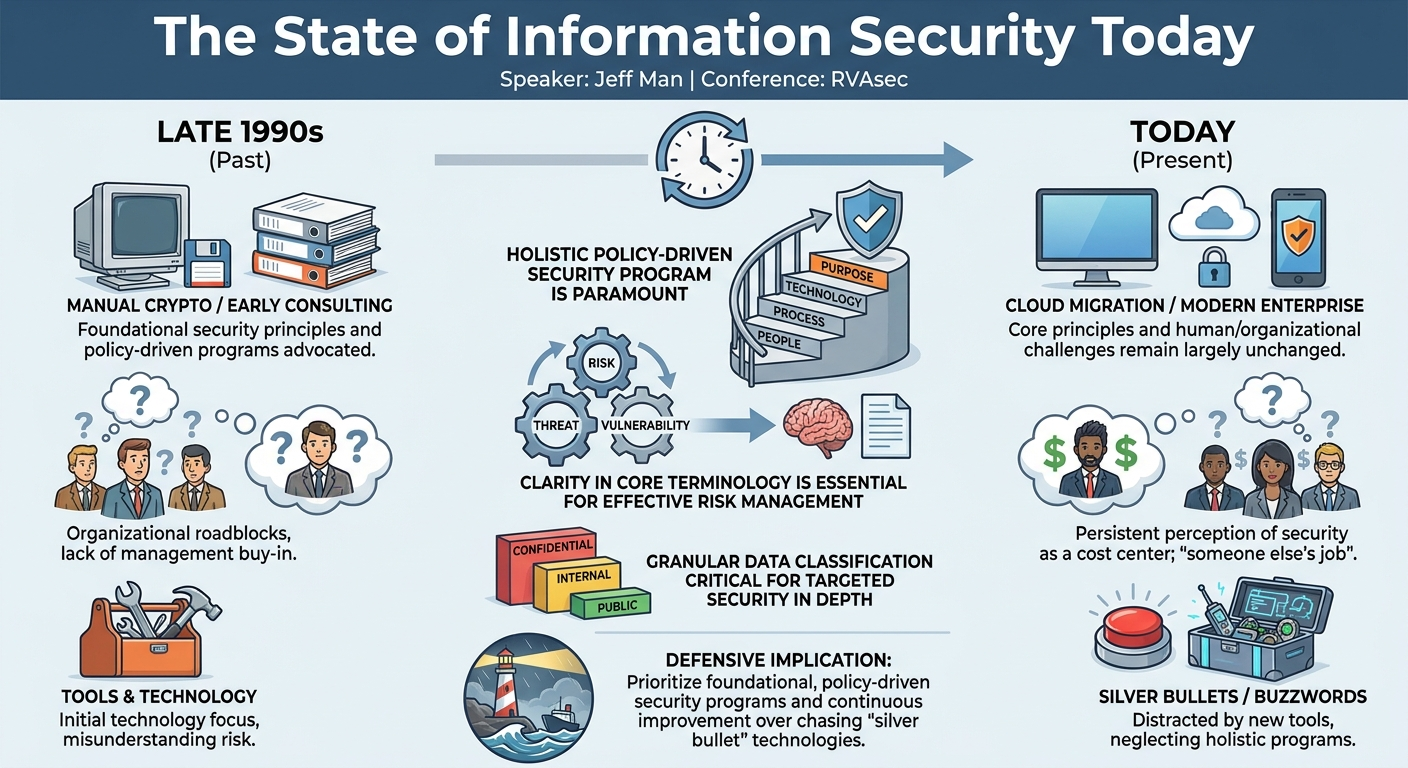
Jeff Man's central and most impactful finding is that the fundamental problems in information security have remained remarkably consistent over the past 25-30 years. He uses his original consulting slides from 1998 and 2002 to illustrate that the core principles, organizational challenges, and even the common mistakes made by IT professionals and senior executives are largely unchanged.
Key findings include:
- The Enduring Relevance of Foundational Principles: Man demonstrates that the concept of a holistic, policy-driven security program – encompassing planning, architecture, implementation, evaluation, and ongoing management – was advocated in 1998 and remains critical today. He argues that the security life cycle, while accelerated by technology (from 12-18 months to potentially 12-18 minutes today), still requires the same thoughtful, top-down approach, starting with a clear policy that defines what assets are valuable and need protection.
- Persistent Organizational Roadblocks: His 1998 slides detail "roadblocks and barriers" that are still prevalent, such as a lack of management understanding, resistance to change, and the perception that security is a cost center rather than a business enabler. The "seven worst security mistakes senior executives make" and "ten worst security mistakes IT people make" from his 2002 slides are presented as still "100% relative today," highlighting issues like relying solely on technology, neglecting backups, allowing shadow IT, and failing to integrate security with business objectives.
- The Misunderstanding of Core Terminology: Man laments the inconsistent and often incorrect use of terms like risk, vulnerability, and threat within the industry. Drawing from his NSA background, where these terms had precise definitions tied to the risk of human life, he emphasizes that a clear, shared understanding is crucial for effective risk management. He highlights that the industry's collective focus on vulnerabilities often overshadows a broader understanding of threats and overall risk appetite, especially when the added variable of "cost" enters the private sector equation.
- Technology as a Distraction, Not a Solution: While acknowledging the necessity of technology, Man argues that the industry's obsession with "silver bullets" and new products often distracts from fundamental security hygiene and strategic planning. He criticizes the pervasive FUD (Fear, Uncertainty, and Doubt) marketing tactics that drive sales but don't necessarily lead to better security posture. The rapid adoption of concepts like cloud migration, often driven by promises of cost savings that rarely materialize, exemplifies this.
- The Evolution of Hacking Motives: Man notes a significant, albeit undated, shift in hacking from benign, curiosity-driven exploration (as seen with early hackers and groups like The Loft) to malicious, profit-driven activities. This change fundamentally alters the threat landscape, demanding a more robust and proactive defensive posture.
- The "Compliance Does Not Equal Security" Fallacy: While a common industry mantra, Man challenges this, arguing that for many organizations, compliance requirements (like PCI DSS) are the only drivers for implementing security controls. Therefore, compliance does equal a baseline of security for a significant portion of the market, making it a critical, albeit minimum, standard.
In essence, Man's findings suggest that despite the exponential growth of cyber threats and defensive technologies, the human and organizational aspects of security have lagged, leaving many enterprises vulnerable to the same types of problems they faced decades ago.
Technical Deep Dive
▶ Watch: 1998 security advice: still relevant today (27:00)
Jeff Man's career at the NSA provided him with a foundational understanding of secure systems, starting with manual crypto systems. He detailed his work with one-time pads, a theoretically unbreakable form of encryption where a key is used only once and then destroyed. This method relies on a shared, random key of the same length as the message. He even designed a "whiz wheel" to facilitate the use of a Vigenere table for these pads, an adaptation of a polyalphabetic substitution cipher. The critical technical challenge with one-time pads, beyond key distribution, is ensuring secure deletion after a single use to prevent cryptographic vulnerabilities from key reuse. His early work involved developing the first secure deletion routine for floppy disks, a testament to the stringent security requirements of classified environments.
The transition to distributed systems and early penetration testing within the NSA marked a shift towards network and system exploitation. His team, "the pit," focused on identifying weaknesses in classified networks. This involved methods akin to the physical and logical attacks depicted in the movie Sneakers, aiming for root access on Unix workstations – the equivalent of domain admin credentials in modern Windows environments. Their goal was to demonstrate what information and data could be exposed, highlighting the real-world implications of security flaws.
In the private sector, Man's consulting work in the late 1990s and early 2000s focused on establishing comprehensive information security programs. The technical core of these programs was built around:
- Holistic Security Program Design: Moving beyond isolated technical controls, advocating for a program that integrates security into all aspects of an organization.
- Policy-Driven Security: Emphasizing that effective security begins with clearly defined policies that articulate what assets need protection, why, and to what extent. This precedes any technology selection.
- Security Life Cycle: A structured approach encompassing planning, architecture, implementation, evaluation (vulnerability assessment/penetration testing), and ongoing management. He noted that while the initial cycle might have been 12-18 months in the 90s, the speed of modern business demands a much faster iteration.
- Data Classification: A critical concept learned at the NSA, advocating for organizations to move beyond simple "public/private" classifications. Government systems employed multiple classification levels (e.g., Unclassified, Confidential, Secret, Top Secret) where data was handled and protected differently based on its value and sensitivity. This concept is vital for applying security in depth and allocating resources effectively.
- CIA Triad: The fundamental security objectives: Confidentiality (preventing unauthorized disclosure), Integrity (preventing unauthorized modification or destruction), and Availability (ensuring access to legitimate users when needed).
- Risk Management Framework: Man emphasized the formal risk equation learned in government, where risk is defined as the likelihood of a threat exploiting a vulnerability, multiplied by the impact (initially human life, later financial cost in the private sector). He critiques the industry's overemphasis on simply patching vulnerabilities without a comprehensive understanding of threats and overall risk appetite.
- Security in Depth: A multi-layered defensive strategy, keeping the most critical assets deep within the organization, protected by successive layers of controls. He noted the irony of this principle in the age of cloud computing, where everything is theoretically "out on the internet."
- People, Process, Technology, and Purpose: Man argues for adding "Purpose" as the fourth pillar to the traditional "People, Process, Technology" model. Understanding why security is being implemented—its business value and alignment with organizational goals—is crucial for sustained effectiveness and employee buy-in.
Man's technical deep dive isn't about specific exploits or vulnerabilities of the day, but rather the architectural and philosophical underpinnings of building resilient security, derived from his unique government background and decades of observing the private sector's struggles.
Demo / Proof of Concept
▶ Watch: AI: Can what's created by AI be broken by AI? (38:00)
Jeff Man's talk did not feature a live technical demonstration or a traditional proof of concept. Instead, his entire presentation served as a historical and comparative demonstration of his core thesis. The "proof" lay in the striking parallels he drew between his experiences and the original artifacts from his past.
Specifically, the "demo" aspects included:
- Historical Case Studies: Man used anecdotes from his NSA career – developing the one-time pad software, creating the "whiz wheel," and leading the government's first pen-testing team ("the pit") – to illustrate the origins of modern security practices and the challenges inherent in securing complex systems. His account of the 1996 Department of Justice website defacement underscored the real-world impact of early cyberattacks and the political complexities involved.
- The 1998 and 2002 Consulting Slide Decks: The most compelling "proof of concept" was the direct comparison of his actual consulting slides from 1998 and 2002 with the current state of information security. By showing slides detailing "roadblocks and barriers," "what you do to do things right," "seven worst security mistakes senior executives make," and "ten worst security mistakes IT people make," he effectively demonstrated that the problems and proposed solutions from decades ago remain profoundly relevant. The audience was invited to reflect on whether these issues resonated with their current organizational experiences, providing a collective, implicit confirmation of his argument.
- The Evolution of Terminology and Concepts: Man's discussion of the CIA triad (Confidentiality, Integrity, Availability), the risk equation, data classification, and security in depth served as a conceptual "demo." He illustrated how these foundational principles, while rooted in government security, are often poorly understood or inconsistently applied in the private sector, leading to persistent vulnerabilities.
In essence, Man's "demo" was a historical narrative and a comparative analysis, using his own journey and past materials to prove that many of the challenges in cybersecurity are not new, but rather deeply entrenched issues that the industry has yet to fully overcome.
Defensive Implications
▶ Watch: New role as Executive Director for PCI at Secure Ideas (49:50)
Jeff Man's historical perspective offers several crucial defensive implications for modern organizations, urging a return to fundamental principles and a critical re-evaluation of current practices:
- Prioritize Foundational Security Programs Over "Silver Bullets": Defenders should resist the urge to chase every new security product or buzzword. Instead, focus on building a robust, holistic information security program that is policy-driven and integrated into the organization's fabric. Technology is necessary, but it's not a substitute for strategic planning and process.
- Implement Granular Data Classification: Adopt a comprehensive data classification scheme beyond simple "public/private." Understanding the varying value, sensitivity, and shelf-life of different data types allows for more intelligent allocation of security resources and the implementation of appropriate security in depth measures. Not all data can or needs to be protected with the same intensity.
- Cultivate a Shared Understanding of Risk, Threat, and Vulnerability: Standardize the definitions and application of risk, threat, and vulnerability across the organization. This consistency, drawing from established frameworks like the InfoSec Glossary, enables more accurate risk assessments, better communication with leadership, and more effective decision-making regarding security investments.
- Embrace the "People, Process, Technology, Purpose" Model: Recognize that effective security is not solely a technical problem. It requires engaged people, well-defined processes, appropriate technology, and a clear organizational purpose for why security matters. Fostering a culture where every employee understands their role in security and the business value of these efforts is paramount.
- Challenge the "Security is Someone Else's Job" Mentality: Security is a collective responsibility, not just the domain of the security team. Leaders must actively promote this mindset, ensuring that security considerations are embedded in all business operations and decision-making, rather than being an afterthought.
- Be Skeptical of FUD and Buzzwords: Actively question new technologies and marketing claims driven by Fear, Uncertainty, and Doubt (FUD). Evaluate solutions based on their alignment with established security principles and actual organizational needs, rather than industry hype (e.g., AI solutions, cloud migration promises).
- Recognize the Value of Compliance: While not a complete solution, compliance frameworks (like PCI DSS) often serve as the only driver for many organizations to implement baseline security controls. Defenders should leverage compliance requirements as an opportunity to build out more robust security practices, rather than viewing them as a mere checkbox exercise.
- Focus on Continuous Improvement, Not "Achievable Security": Man posits that "security is not achievable" in an absolute sense. Instead, organizations should focus on continuous risk reduction and resilience. This involves ongoing vulnerability assessments, regular review of policies, and adapting to an ever-changing threat landscape, acknowledging that perfection is an unattainable goal.
By internalizing these lessons from the past, defenders can move beyond reactive, technology-centric approaches and build more resilient, strategically sound security programs that address the human and organizational factors that have historically hindered progress.
Key Takeaways
- Fundamental Security Problems Persist: Despite decades of technological advancement, the core challenges in information security, including organizational roadblocks and common mistakes by executives and IT, remain largely unchanged since the late 1990s.
- Policy and Purpose are Paramount: Effective security starts with a clear, top-down policy defining what assets to protect and why. Integrating "Purpose" into the "People, Process, Technology" model is crucial for building a sustainable security program.
- Data Classification is Critical: Organizations must adopt granular data classification schemes to understand the value and sensitivity of their information, enabling more targeted and efficient application of security controls and security in depth.
- Clarity in Terminology Matters: A consistent and accurate understanding of terms like risk, threat, and vulnerability is essential for effective communication, decision-making, and resource allocation in cybersecurity.
- Don't Rely Solely on Technology: "Silver bullet" technologies and buzzwords often distract from foundational security hygiene. A holistic approach that balances people, process, and technology, guided by clear policy, is more effective than chasing the latest tool.
- Security is a Shared Responsibility: The mindset that security is "someone else's job" is a major impediment. All employees, from the top down, must understand their role in maintaining organizational security.
About the Speaker(s)
Jeff Man is a highly respected veteran in the field of information security, boasting over 45 years of experience. His career began with a significant tenure at the National Security Agency (NSA) from 1986 to 1996, where he worked on manual crypto systems, earned a certification as a cryptanalyst, and was instrumental in developing early digital encryption solutions and secure deletion routines. He was also an architect of the government's first computer hacking and network penetration testing group, famously nicknamed "the pit."
After leaving the NSA, Man transitioned to the private sector, where he spent years consulting with companies on building their information security programs. He is well-known in the industry as a co-host of Paul's Security Weekly, a popular podcast he has contributed to for about 12 years. Jeff Man is also one of only two individuals featured in all four editions of the Tribe of Hackers book series and has been featured on the Darknet Diaries podcast (Episode 83). In 2017, he was inducted into the Cabal of the Curmudgeons, an exclusive group of cybersecurity pioneers. Most recently, as of two days before his RVAsec talk, Jeff Man joined Secure Ideas as the Executive Director for PCI, where he is establishing a PCI assessment practice. He identifies as a hacker and brings a unique, historically informed, and often skeptical perspective to the state of modern cybersecurity.
Reviews
Dr. Zero (Offensive Security Researcher) — SOLID
Jeff Man dusting off his 1998 consulting deck to prove the industry is still failing at the exact same fundamentals is both hilarious and deeply depressing. It doesn't drop any new research, but it serves as a brutal reality check for an industry drowning in hype while failing to maintain basic asset inventory.
Heather Calloway (CISO) — SOLID
This is a nostalgic, well-intentioned reminder that our fundamental governance failures haven't changed since 1998. It is entirely accurate, but strategically inert for a modern leadership team. Send your junior staff if they need a history lesson on risk equations, but your directors don't need a reminder that vendor tools won't fix bad policy—they need the mechanics to actually fix the policy.