Community is a Control: Strengthening Cybersecurity Through Connection
Chelsea Bryan (Security Operations Specialist · VCU)
RVAsec 2026 · Day 1 · Madison / Jefferson / Monroe
Overview
In a field often dominated by technical solutions and advanced threats, Chelsea Bryan, a Security Operations Specialist at VCU, delivered a compelling RVAsec talk titled "Community is a Control: Strengthening Cybersecurity Through Connection." Bryan's presentation transcends traditional cybersecurity discourse, advocating for the human element as a fundamental and often underestimated security control. She argues that fostering strong communities, both within and outside an organization, is not merely a soft skill but a critical component for preventing burnout, enhancing incident response, and building resilient security teams.
Key moments
- 0:00 Introduction: Community as a Cybersecurity Control
- 4:00 Defining a strong team: Trust, communication, respect
- 6:00 Why community is crucial beyond technology
- 10:00 Personal strategies for combating cybersecurity burnout
- 14:00 Community in action: Handling a major incident
- 20:00 Practical ways to find or create community
- 26:00 Live audience demonstrates community building
- 33:00 Q&A: How leaders foster team community
Community is a Control: Strengthening Cybersecurity Through Connection
Speakers: Chelsea Bryan, Security Operations Specialist, VCU
Conference: RVAsec
YouTube: https://www.youtube.com/watch?v=hCTx3rgmGyI
Overview
In a field often dominated by technical solutions and advanced threats, Chelsea Bryan, a Security Operations Specialist at VCU, delivered a compelling RVAsec talk titled "Community is a Control: Strengthening Cybersecurity Through Connection." Bryan's presentation transcends traditional cybersecurity discourse, advocating for the human element as a fundamental and often underestimated security control. She argues that fostering strong communities, both within and outside an organization, is not merely a soft skill but a critical component for preventing burnout, enhancing incident response, and building resilient security teams.
The talk delves into the pervasive issues of imposter syndrome and burnout prevalent among cybersecurity professionals, positing that isolation exacerbates these challenges. Bryan highlights the indispensable need for human connection, trust, and shared purpose to navigate the complexities and stresses of the industry. Her message resonates deeply with anyone working in a high-pressure, constantly evolving technical environment, emphasizing that even the most sophisticated tools and AI models cannot replace the collective strength of a well-connected, supportive team.
Ultimately, Bryan's presentation serves as a powerful call to action for cybersecurity professionals and leaders alike. She challenges the audience to view community building as a proactive security measure, encouraging individuals to seek out and create supportive networks. By reframing human connection as a security control, Bryan offers a fresh perspective on how to tackle the persistent challenges of workforce retention, mental well-being, and operational effectiveness in cybersecurity.
Background
▶ Watch: Introduction: Community as a Cybersecurity Control (0:00)
The cybersecurity landscape is characterized by its relentless pace, sophisticated threats, and a chronic shortage of skilled professionals. This environment often leads to immense pressure on existing teams, contributing to high rates of burnout and feelings of imposter syndrome among analysts. Chelsea Bryan, drawing from her four years as a Security Operations Analyst at VCU, points out that many professionals, including herself, frequently feel overwhelmed, isolated, and afraid to ask for help (0:00, 2:00). This pervasive sentiment undermines individual well-being and, consequently, organizational security posture.
Traditionally, the industry's response to security challenges has heavily leaned on technological solutions: purchasing advanced tools, implementing Large Language Models (LLMs), and deploying complex architectures. While these are undoubtedly crucial, Bryan argues that they are insufficient on their own. As she asserts, "You can buy all the tools you want, implement all the LLMs, but you're always going to need a community of people around you to guide, manage, and escalate when those things go wrong" (6:00). This perspective highlights a critical gap: the over-reliance on technology without adequately addressing the human factors that govern its effective deployment and response.
Bryan challenges the conventional definition of a "team," which often boils down to a staff list, a boss, and a paycheck. She posits that a truly effective team, especially in high-stakes environments like cybersecurity, is built on four non-negotiable pillars: trust, communication, respect, and a shared purpose (4:00). Without these foundational elements, teams risk operating as a collection of individuals rather than a cohesive unit, leading to inefficiencies, errors, and increased stress during critical incidents. The problem, therefore, is not just a lack of technical resources, but a systemic failure to cultivate the human infrastructure necessary for robust and sustainable security operations.
Key Findings
▶ Watch: Why community is crucial beyond technology (6:00)
Chelsea Bryan's talk unveils several crucial findings regarding the role of community in cybersecurity, repositioning it from a mere social amenity to an essential operational component:
- Community is a Fundamental Security Control: The most overarching finding is Bryan's central thesis: "Community is a Control" (30:00). She explicitly states that building and leveraging community is not a choice but a priority, akin to any other security control. This means dedicating time and effort to community is a strategic investment that directly enhances an organization's defensive capabilities.
- Burnout Prevention and Mental Well-being: Bryan identifies community as a powerful antidote to burnout and imposter syndrome, which are rampant in the cybersecurity field (0:00, 2:00, 8:00). Engaging in professional organizations like Toastmasters (10:00), participating in mentorship programs (10:00, 34:00), or even non-work-related groups like Muay Thai (12:00) provides crucial breaks, alternative perspectives, and a sense of belonging that recharges analysts and prevents emotional exhaustion.
- Enhanced Incident Response and Resilience: A strong community significantly improves an organization's ability to detect, prevent, and recover from threats (30:00). Bryan illustrates this with a scenario where a major incident occurs: a well-connected team with trust and clear communication can coordinate effectively, divide tasks, and collectively analyze the situation, transforming a stressful crisis into a collaborative "hangout" (14:00-16:00). In contrast, an isolated individual or a dysfunctional team will struggle, leading to prolonged incidents and increased stress.
- Facilitated Knowledge Sharing and Skill Development: Community fosters an environment where knowledge is freely exchanged, and individuals feel comfortable asking for help (18:00). Mentorship programs, both formal and informal, are highlighted as vital mechanisms for analysts to learn new skills, gain insights from experienced peers, and navigate complex challenges. This collective intelligence ensures that no single person has to "solve every IT problem out there" alone (28:00).
- Empowerment to Create Community: Bryan emphasizes that if a suitable community doesn't exist, individuals have the power to create one. She shares her own initiative to start a local chapter of Women in Cybersecurity (24:00) after discovering no existing group in Richmond. This finding encourages proactive engagement and leadership in fostering supportive networks, demonstrating that even a single motivated person can catalyze significant community growth (32:00).
- AI as an Enabler, Not a Replacement: While acknowledging the utility of tools like ChatGPT for finding information or local groups (4:00, 20:00), Bryan firmly states that AI cannot replicate the human need for connection and support. AI can assist in the search for community, but it cannot be the community, reinforcing the irreplaceable value of human interaction (6:00).
Technical Deep Dive
▶ Watch: Community in action: Handling a major incident (14:00)
While "Community is a Control" is not a talk about specific exploits or network configurations, it offers a deep dive into the socio-technical architecture necessary for effective cybersecurity operations. Bryan effectively redefines "technical" in this context to encompass the structured processes, communication protocols, and human-centric systems that undergird a robust security posture.
The foundational "technical" elements for building an effective security team, according to Bryan, are trust, communication, respect, and a shared purpose (4:00). These are not merely abstract ideals but serve as the "protocols" that govern how team members interact, share information, and collaborate. In a well-functioning team, analysts trust each other to complete tasks and handle incidents, communicate transparently about their actions (e.g., "I'm going to reply to this email, then I'm going to block that IP"), and maintain mutual respect, all while striving towards a common security objective. This structured approach to human interaction minimizes friction and maximizes efficiency, much like well-defined network protocols ensure data flow.
During a major incident response, the "technical deep dive" into community becomes particularly salient. Bryan contrasts the individualistic, heroic approach—where one person feels solely responsible for "saving the day"—with a collaborative incident management framework (14:00-16:00). In the latter, a strong leader facilitates task allocation, ensuring each team member understands their role. Communication is paramount, often occurring in a "war room Zoom call" where information is exchanged, actions are coordinated, and progress is tracked. Post-incident, the community's strength enables a collective effort to write after-incident reports and establish new Standard Operating Procedures (SOPs) (16:00). This shared responsibility transforms the often-dreaded documentation process into a collaborative effort, preventing individual overload and ensuring institutional learning.
Knowledge management and skill transfer are also deeply integrated into this community-as-a-control model. Bryan advocates for formal mentorship programs within organizations, where experienced analysts guide newer ones, fostering a continuous cycle of learning and development (10:00, 34:00). This acts as an internal knowledge-sharing pipeline, reducing reliance on individual Google searches or AI queries for complex problems (4:00, 28:00). Checking in after incidents and contributing to after-action reviews are further mechanisms for codifying lessons learned and disseminating best practices across the team (18:00).
Beyond the immediate team, Bryan emphasizes the importance of external community integration. This involves leveraging broader security networks for diverse perspectives and support. She highlights specific examples:
- Professional Organizations: Joining groups like Toastmasters for public speaking and leadership skills, which indirectly builds confidence and a sense of belonging (10:00, 20:00).
- Local Security Meetups: Participating in local conference monthly meetings, such as those offered by RVAsec (22:00), or open craft nights at hacker spaces like HackRVA (22:00). These provide platforms for casual networking, knowledge exchange, and peer support outside the immediate work environment.
- Creating New Communities: Bryan's initiative to start a Richmond chapter of Women in Cybersecurity (24:00) exemplifies a proactive "technical" solution to a perceived gap in the community infrastructure. This involves identifying a need, leveraging existing organizational frameworks (like the Women in Cybersecurity national body), and coordinating local efforts to build a new support network.
In essence, Bryan's "technical deep dive" reveals that the human network, when structured with intention and purpose, functions as a powerful distributed security system. It's a system designed for resilience, adaptability, and continuous improvement, where the collective intelligence and emotional support of its nodes (the individuals) are its greatest strengths.
Demo / Proof of Concept
▶ Watch: Practical ways to find or create community (20:00)
While Chelsea Bryan's talk did not feature a traditional technical demonstration of code, tools, or exploit techniques, it included a powerful and highly effective live proof of concept for the core message: the immediate impact and ease of building community.
Towards the end of her presentation, Bryan challenged the audience to "put themselves out there" and introduce themselves (26:00). Several attendees bravely stood up, shared their names, what they do, and their goals for connection. One attendee, Nick Binky from the Virginia State Bar, expressed a desire to build connections in the security space and invited others to greet him at the after-party (27:00). Another audience member, transitioning from mental health to cybersecurity, shared her aspiration to merge both fields (28:00). A third, Josh, was introduced as a junior analyst seeking opportunities (28:00).
This interactive segment served as a direct, real-time demonstration of the talk's central premise. It showed, unequivocally, that initiating connections is not only possible but can also be immediately rewarding, fostering a sense of camaraderie and shared purpose among strangers. The "smiling" faces Bryan observed in the audience (28:00) underscored the positive human response to genuine connection. This proof of concept effectively illustrated that the theoretical concept of "community as a control" can be put into practice instantly, transforming a passive audience into an active network of potential collaborators and supporters.
Defensive Implications
▶ Watch: Q&A: How leaders foster team community (33:00)
The concept of "Community is a Control" carries profound implications for defensive cybersecurity strategies, offering a human-centric layer of protection that complements technological safeguards. Integrating Bryan's insights into an organization's defense posture can lead to more resilient, adaptable, and effective security operations.
- Enhanced Incident Response and Recovery: A strong, communicative team is paramount during a security incident. When an organization cultivates trust, communication, and shared purpose among its security professionals, incident response becomes a coordinated effort rather than a chaotic scramble (14:00-16:00). Team members are more likely to share critical information quickly, divide tasks efficiently, and collectively analyze the threat, leading to faster detection, containment, and recovery times. Post-incident, a cohesive community facilitates constructive after-incident reviews and the collaborative development of new SOPs and policies, directly strengthening future defenses (16:00).
- Reduced Burnout and Improved Analyst Retention: The high stress and constant demands of cybersecurity contribute significantly to burnout and attrition (0:00, 2:00). By fostering a supportive community, organizations can provide a crucial buffer against these pressures. When analysts feel connected, respected, and supported, they are less likely to experience isolation and exhaustion. This leads to higher job satisfaction, increased mental well-being, and ultimately, better retention of skilled personnel. A stable, experienced security team is inherently more capable of defending against complex threats.
- Accelerated Knowledge Sharing and Skill Development: Community acts as a powerful engine for knowledge transfer and continuous learning. Internal mentorship programs, peer-to-peer discussions, and collaborative problem-solving sessions ensure that expertise is shared widely across the team (18:00, 34:00). This democratizes knowledge, reduces single points of failure, and allows less experienced analysts to quickly gain practical skills. External communities, such as local RVAsec meetups or HackRVA events, provide access to a broader pool of intelligence and diverse perspectives, helping teams stay current with emerging threats and defensive techniques (22:00).
- Proactive Threat Intelligence and Situational Awareness: Networking with peers in other organizations, even those facing similar challenges (e.g., the "Canvas incident" mentioned at 8:00), can lead to invaluable, real-time threat intelligence. Information sharing within a trusted community allows defenders to learn from others' experiences, anticipate potential attacks, and implement proactive countermeasures before they become direct threats. This collective awareness strengthens the entire defensive ecosystem.
- Strengthened Organizational Resilience: Ultimately, community building contributes to organizational resilience by making the security function more robust and adaptable. When the human element is prioritized and nurtured, the security team becomes a more cohesive, self-improving unit. This intangible "control" allows an organization to navigate not only technical failures but also the psychological and social challenges inherent in defending against sophisticated adversaries. It ensures that even when technology fails, the human network remains strong enough to predict, prevent, and recover (30:00).
Key Takeaways
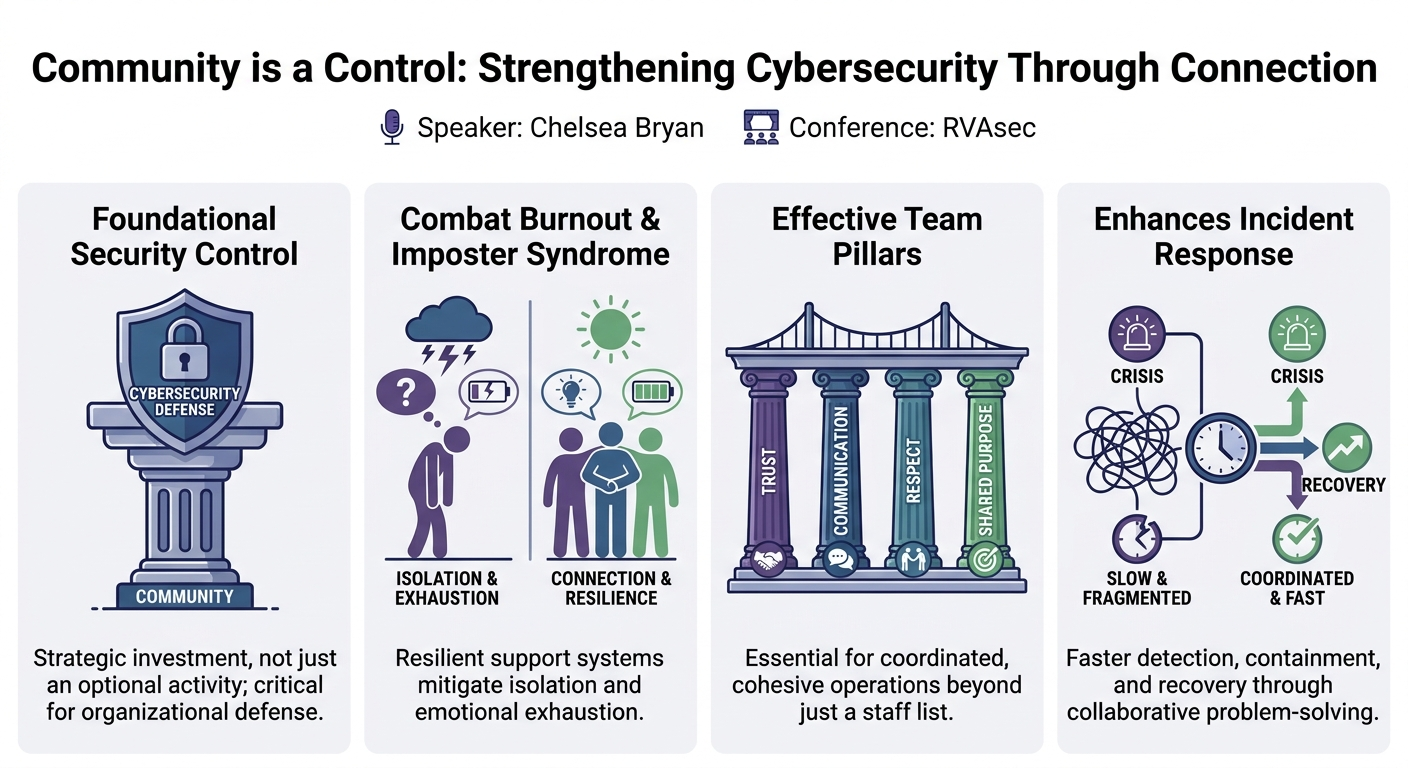
- Community is a Foundational Security Control: Proactively building and nurturing connections, both internal and external, is as critical to cybersecurity as any technical tool or policy. It's a strategic investment, not an optional activity.
- Combat Burnout and Imposter Syndrome Through Connection: Strong communities provide essential support systems that mitigate the pervasive issues of analyst burnout and imposter syndrome, leading to more resilient and effective security professionals.
- Effective Teams Require Trust, Communication, Respect, and Shared Purpose: Beyond a staff list, a high-performing security team is built on these four pillars, which are vital for coordinated incident response and daily operations.
- Proactive Community Building Enhances Incident Response: Teams with established trust and communication can more effectively detect, contain, and recover from security incidents, turning crises into collaborative problem-solving opportunities.
- Individuals Have the Power to Create Community: If a supportive network doesn't exist, individuals are empowered to initiate and build it, whether through formal organizations like Toastmasters or Women in Cybersecurity, or informal local meetups.
- AI Augments, But Does Not Replace, Human Connection: Tools like ChatGPT can assist in finding resources, but they cannot fulfill the fundamental human need for community, empathy, and collective problem-solving.
About the Speaker(s)
Chelsea Bryan is a Security Operations Specialist at VCU, where she has served as a SOC analyst for the past four years. Her professional focus extends beyond traditional technical analysis to a special interest in mental health and human dynamics in security. Bryan is passionate about preventing burnout among cybersecurity professionals and fostering strong human connections within the industry.
Throughout her career, Bryan has actively engaged in various communities to support her own growth and well-being. She is an active member of Toastmasters, where she has honed her public speaking skills and found a supportive professional network. She also participates in mentorship programs within VCU and finds community through non-work activities like Muay Thai. Recognizing a gap in local support, Bryan took the initiative to start a Richmond chapter of Women in Cybersecurity, demonstrating her commitment to building inclusive and empowering networks for her peers. Her experiences and insights underscore her belief in the power of community to strengthen both individuals and organizations in the demanding field of cybersecurity.
Reviews
Dr. Zero (Offensive Security Researcher) — SOLID
This is a completely fine, standard regional con talk about analyst burnout that the write-up tries way too hard to dress up as a technical framework. Bryan delivers a necessary message for frontline SOC analysts drowning in alert fatigue, but it doesn't move the needle for the industry at large.
Heather Calloway (CISO) — SOLID
A grassroots look at SOC burnout and the necessity of team cohesion during incident response. While the speaker offers excellent survival tactics for analysts, this talk is a stark reminder to leadership that we are failing to structurally manage operational fatigue.