Troubleshooting: Where Information Meets WTF
Aqeel Yaseen (Offensive Security Consultant · RedHelm)
RVAsec 2026 · Day 1 · Madison / Jefferson / Monroe
Overview
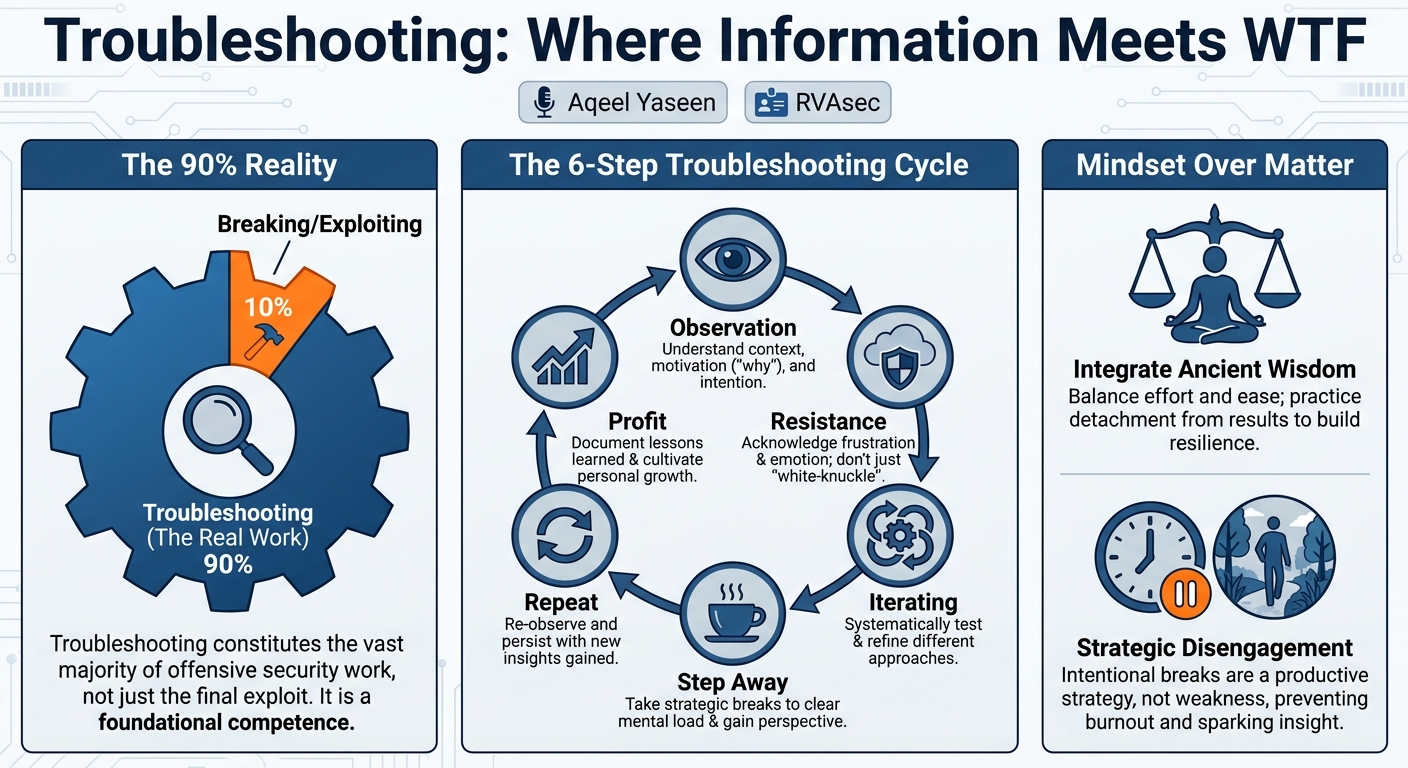
In his RVAsec talk, "Troubleshooting: Where Information Meets WTF," Aqeel Yaseen, an Offensive Security Consultant at RedHelm, delivers a refreshingly candid and profoundly insightful presentation that transcends typical technical discourse. Yaseen posits that troubleshooting constitutes a staggering 90% of his work in offensive security, with only the remaining 10% dedicated to "breaking things on purpose." This revelation immediately reframes the popular perception of hacking, emphasizing that the true art lies not just in exploit development or penetration testing, but in the relentless, often frustrating, process of figuring out why things aren't working as expected.
Key moments
- 0:00 Introduction: Troubleshooting is 90% of the job.
- 4:00 Philosophical concepts for handling difficult situations.
- 9:00 The power of intention: Understanding your 'why'.
- 12:00 Navigating frustration and the process of iteration.
- 16:00 Strategies for effective breaks and celebrating wins.
- 21:30 Applying troubleshooting to non-technical life challenges.
- 37:00 Cultivating discernment: When to ask for help.
- 41:00 Overcoming procrastination by embracing boredom for creativity.
Troubleshooting: Where Information Meets WTF
Speakers: Aqeel Yaseen, Offensive Security Consultant, RedHelm
Conference: RVAsec
YouTube: https://www.youtube.com/watch?v=naLmjeFyOYc
Overview
In his RVAsec talk, "Troubleshooting: Where Information Meets WTF," Aqeel Yaseen, an Offensive Security Consultant at RedHelm, delivers a refreshingly candid and profoundly insightful presentation that transcends typical technical discourse. Yaseen posits that troubleshooting constitutes a staggering 90% of his work in offensive security, with only the remaining 10% dedicated to "breaking things on purpose." This revelation immediately reframes the popular perception of hacking, emphasizing that the true art lies not just in exploit development or penetration testing, but in the relentless, often frustrating, process of figuring out why things aren't working as expected.
The talk is a unique blend of technical pragmatism and philosophical introspection, arguing that the principles of effective troubleshooting are universally applicable, extending far beyond the command line into every facet of life, especially interpersonal relationships. Yaseen challenges the audience to view themselves as "hackers" if they engage in any form of troubleshooting, thereby elevating this often-overlooked skill to a foundational competence. His presentation is a call to cultivate a more mindful and resilient approach to problem-solving, equipping individuals with a framework to navigate not only complex technical challenges but also the inherent frustrations and disappointments of human experience.
Yaseen's core message is that while the struggles of life have evolved since Seneca's time, the fundamental act of grappling with difficulty remains constant. By integrating ancient wisdom with modern problem-solving techniques, he offers a holistic methodology for converting moments of "WTF" into actionable insights. This article will delve into Yaseen's framework, exploring its technical implications and broader relevance, providing a detailed analysis of how this mindset can empower security professionals and individuals alike.
Background
▶ Watch: Introduction: Troubleshooting is 90% of the job. (0:00)
Yaseen establishes a critical background by highlighting a pervasive cultural deficit: the lack of widespread instruction on how to effectively process and respond to difficult emotions such as grief, frustration, or anger. He notes that dominant cultural narratives often model these emotions in highly negative, even destructive, ways—citing the extreme example of John Wick's revenge narrative. This cultural gap, Yaseen argues, leaves individuals ill-equipped to handle the inevitable "borked" situations, both technical and personal.
To address this, Yaseen introduces several profound concepts derived from ancient Buddhist and yogic traditions, which he believes offer a more constructive path. The first is right effort, a component of Buddhism's Eightfold Path. This concept emphasizes finding a crucial balance between exerting effort and allowing for ease. It's a reminder that relentless "white-knuckling" through every challenge often leads to burnout and suboptimal results, and that one's attitude significantly shapes the outcome.
The second concept is abiasa, a Sanskrit term signifying consistent practice until an action becomes natural. Yaseen illustrates this with the simple act of brushing teeth—a chore for a child, but an unconscious habit for an adult. He posits that consistent, deliberate engagement with problem-solving processes can transform initially arduous tasks into intuitive actions. This is particularly relevant in technical fields where complex skills, from debugging to exploit development, require repeated application to achieve mastery.
Lastly, Yaseen introduces vyagia, or dispassion. This isn't about apathy, but rather about acting without attachment to the specific results of one's actions. Drawing on the John Wick example, he contrasts passionate, result-driven actions with a dispassionate approach that allows for greater adaptability and resilience when faced with unexpected outcomes. This detachment helps mitigate the crippling effects of frustration when initial attempts fail, fostering a more objective and persistent problem-solving mindset.
These philosophical underpinnings are further contextualized by the law of diminishing returns, a principle Yaseen invokes to underscore that beyond a certain point, increased effort does not necessarily yield proportionally better results. This reinforces the need for balance and strategic disengagement, laying the groundwork for his structured troubleshooting methodology. By integrating these ancient wisdoms, Yaseen provides a robust framework for understanding not just how to troubleshoot, but how to be while troubleshooting, fostering intrinsic motivation and resilience in the face of inevitable challenges.
Key Findings
▶ Watch: The power of intention: Understanding your 'why'. (9:00)
Aqeel Yaseen's central contribution is a pragmatic, six-step troubleshooting framework designed to guide individuals through any complex problem, technical or otherwise. These steps, presented as a "TLDDR" (Too Long, Didn't Read) summary, encapsulate his holistic approach:
- Observation: This initial phase is about understanding the problem's context, your motivation ("why"), and your intention. It involves deeply comprehending the situation and recognizing the broader impact of your actions or inactions.
- Resistance: This step acknowledges and addresses the natural human responses of frustration, disappointment, and grief that arise when facing difficulties. It encourages self-awareness about one's coping mechanisms and willingness to ask for help.
- Iterating: The core of active problem-solving, where one systematically tries different approaches, analyzing patterns, and refining understanding through repeated attempts. This phase emphasizes taking one step at a time and being willing to uncover what is truly at stake.
- Step Away: Recognizing the limits of continuous effort, this step advocates for strategic breaks to clear the mental load, gain fresh perspective, and return with a renewed attitude.
- Repeat: If the problem persists, this step dictates a return to the beginning of the cycle, re-observing, re-evaluating, and re-iterating with the new insights gained. It emphasizes the importance of continually asking, "What can I do?"
- Profit: The concluding phase involves celebrating successes, documenting lessons learned, understanding the broader applicability of newly acquired knowledge, and reflecting on personal growth. This is about extracting maximum value from the troubleshooting experience.
These six findings represent a structured yet flexible methodology for navigating ambiguity and difficulty. They shift the focus from merely finding a solution to cultivating a resilient and adaptable problem-solving mindset, making them invaluable for anyone confronting intricate challenges.
Technical Deep Dive
▶ Watch: Strategies for effective breaks and celebrating wins. (16:00)
While Aqeel Yaseen's talk is fundamentally about a meta-skill applicable across domains, its implications for technical fields, particularly offensive security, are profound. The framework provides a crucial mental architecture for navigating the often-opaque and frustrating world of systems, networks, and code. The speaker's own admission that 90% of his offensive security role is troubleshooting underscores the practical necessity of this approach.
Let's contextualize each step within a technical security paradigm:
- Observation: In a technical context, this phase is paramount. Before attempting any exploit or debugging a system, a security professional must thoroughly understand the target environment. This involves:
- Defining the "Why": Why are we trying to exploit this system? What is the ultimate goal (e.g., data exfiltration, privilege escalation, demonstrating impact)?
- System Reconnaissance: Meticulously gathering information about the target. This includes identifying operating systems (e.g., Windows Server 2019, Ubuntu 22.04), running services (e.g., Apache HTTP Server 2.4, OpenSSH 8.9), installed software, network topology, and user accounts.
- Error Message Analysis: Yaseen's opening slide, displaying a "wonderful output" of command-line errors (02:00), perfectly illustrates the raw data of observation. Understanding what a
Segmentation fault,Connection refused, orPermission deniederror truly means is the first step towards resolution. - Vulnerability Identification: Pinpointing potential weaknesses, whether known CVEs (e.g., Log4Shell, CVE-2021-44228) or logical flaws. This requires deep contextual understanding of how a system should behave versus how it is behaving.
- Resistance: Technical work is rife with frustration. Exploits fail, tools crash, and documentation is often incomplete or misleading. This step addresses the emotional toll:
- Embracing the Unknown: Security professionals frequently encounter novel systems or zero-day scenarios where there is no existing playbook. Being "okay with not knowing what you're doing" (12:00) is critical for exploration and discovery.
- Managing Frustration: When a custom payload consistently fails, or a critical service remains unexploitable after hours of effort, frustration mounts. Yaseen encourages self-awareness of one's stress responses (e.g., "cry," "walk away," "scream" – 12:00) and developing productive coping mechanisms (e.g., "minimum exercise").
- Asking for Help: In complex technical environments, no one possesses all knowledge. Overcoming the reluctance to ask for assistance, whether from colleagues, online forums (e.g., Stack Overflow, security communities), or even AI tools, is vital to avoid "learned helplessness" (40:00) and accelerate problem-solving.
- Iterating: This is the core engine of technical problem-solving and offensive security. It's the process of hypothesis testing and refinement:
- Systematic Experimentation: Trying different payloads, modifying exploit code, adjusting network configurations, or altering attack vectors. For example, if a SQL injection attempt fails with one syntax, iterating means trying others (e.g.,
UNION SELECT,ORDER BY, time-based blind injection). - Pattern Recognition: Analyzing the output of each attempt to identify subtle changes or patterns. Does a specific input cause a different error code? Does a timing attack indicate a specific backend database?
- Deep Diving: When a vulnerability is suspected, iterating forces a deep dive into the underlying code, protocol specifications (e.g., HTTP, SMB), or system architecture to understand the root cause. This aligns with abiasa, as repeated engagement with complex technical details makes the process more intuitive.
- Step Away: Burnout and tunnel vision are significant risks in technical roles. Stepping away is a strategic necessity:
- Clearing Mental Load: After hours spent staring at a hex dump or debugging a complex exploit, a fresh perspective is invaluable. Strategies like the Pomodoro technique (e.g., 25 minutes of focused work, 5-10 minutes break – 35:00) are directly applicable.
- Task Switching: Engaging in unrelated activities (e.g., "walk your dog," "naps," "listening to music," "sitting in a dark room" – 16:00) allows the subconscious mind to process the problem, often leading to "aha!" moments.
- Time Blocking/Boxing: Scheduling focused work periods and mandatory breaks helps prevent excessive rumination and forces disengagement, improving overall efficiency and mental well-being.
- Repeat: If the initial cycle doesn't yield a solution, the process begins anew, but with enhanced knowledge:
- Re-evaluation: Re-observing the problem with new insights. Did a previous attempt reveal a hidden configuration? Is the initial "why" still accurate?
- Adaptive Strategy: Adjusting the approach based on lessons learned. If a network-based attack failed, perhaps a client-side vector is more viable. If one tool proved ineffective, research alternatives (e.g., Metasploit, Nmap, Burp Suite).
- Persistence: The "what can I do?" mindset (19:00) is crucial for overcoming seemingly insurmountable technical walls. It prevents premature surrender and encourages continuous exploration.
- Profit: In a technical security context, "profit" extends beyond financial gain to encompass knowledge acquisition and professional development:
- Documentation: Meticulously recording successful exploits, encountered roadblocks, and their resolutions. This includes tool usage, specific commands, and environmental factors. This documentation forms a valuable knowledge base for future engagements.
- Retrospective Analysis: Understanding why a particular vulnerability was exploitable or why a defense failed. What specific configuration allowed for remote code execution? What security control was bypassed and how?
- Knowledge Sharing: Presenting findings to clients, colleagues, or the broader security community (e.g., via conference talks, blog posts, internal wikis). Explaining complex technical successes (or failures) in a non-technical way (20:00) demonstrates deep understanding.
- Personal Growth: Reflecting on how the challenge enhanced one's technical skills, problem-solving abilities, and resilience. Every technical challenge provides "feedback" (20:00) that shapes future approaches.
In essence, Yaseen's framework, though presented philosophically, is a highly practical methodology for navigating the inherent complexity, ambiguity, and emotional demands of technical security work. It provides a robust mental toolkit for turning "WTF" moments into structured, repeatable processes that drive both technical success and personal development.
Demo / Proof of Concept
▶ Watch: Applying troubleshooting to non-technical life challenges. (21:30)
Aqeel Yaseen's talk, "Troubleshooting: Where Information Meets WTF," is primarily a conceptual and philosophical exploration of problem-solving methodology, rather than a demonstration of technical exploits or tools. As such, the presentation did not include a traditional technical demo or proof of concept in the security sense (e.g., live hacking, code walkthroughs of a vulnerability).
However, Yaseen did engage the audience in a simple, non-technical exercise to illustrate the concept of intention (09:00). He asked attendees to stand up, raise their arms over their heads, and then let them fall. He repeated this action several times, observing how the brain's clear intention to perform the action resulted in the body's immediate and unified execution, without internal argument. This exercise served as a tangible "proof of concept" for the power of a unified, clear intention in the Observation phase of troubleshooting, demonstrating how alignment of purpose enhances effectiveness. While not a technical demonstration, it effectively communicated a core principle of his framework.
Defensive Implications
▶ Watch: Overcoming procrastination by embracing boredom for creativity. (41:00)
Aqeel Yaseen's troubleshooting framework offers significant defensive implications for security teams and organizations, transforming the often reactive and stressful nature of cybersecurity into a more structured and resilient process. By adopting this holistic approach, defenders can enhance their capabilities in incident response, threat hunting, vulnerability management, and overall security posture.
- Incident Response (IR):
- Observation: During an incident, the initial phase is crucial for understanding the scope, impact, and nature of the breach. Defenders must define "why" they are investigating (e.g., contain, eradicate, recover) and meticulously collect all available data – logs from SIEMs (e.g., Splunk, Elastic Stack), endpoint detection and response (EDR) telemetry (e.g., CrowdStrike, SentinelOne), network flow data, and forensic artifacts. This also involves understanding the blast radius and potential exfiltration vectors.
- Resistance: IR is inherently high-stress. Teams will encounter frustration from incomplete data, sophisticated adversaries, and internal pressures. Recognizing and managing this frustration, openly communicating challenges, and being willing to admit "not knowing" certain aspects are vital for effective collaboration and avoiding premature conclusions. Asking for help from external experts or peer teams becomes a strength, not a weakness.
- Iterating: Incident containment and eradication are iterative processes. Defenders might try blocking specific IPs, isolating compromised systems, or deploying new detection rules. Each action provides feedback, requiring continuous analysis and adjustment of the response strategy. This involves repeated analysis of IOCs (Indicators of Compromise) and TTPs (Tactics, Techniques, and Procedures).
- Step Away: Long hours during a breach lead to fatigue and impaired judgment. Enforcing mandatory breaks, even short ones, allows IR teams to clear their minds, prevent tunnel vision, and return with fresh perspectives, potentially uncovering overlooked details or alternative solutions.
- Repeat: If initial containment or eradication efforts fail, the team must re-evaluate its understanding of the incident, re-observe the environment for new indicators, and iterate on different defensive measures. This ensures persistence in the face of evolving threats.
- Profit: Post-incident, a thorough post-mortem analysis is essential. Documenting the attacker's methodology, the effectiveness of defensive actions, lessons learned, and identified gaps directly contributes to hardening the organization's security. This "profit" translates into improved playbooks, enhanced detection rules, and stronger security controls.
- Threat Hunting:
- Threat hunting is inherently an iterative, hypothesis-driven troubleshooting exercise. Hunters observe anomalies, form hypotheses about potential threats, and then iterate through data sources (e.g., DNS logs, proxy logs, endpoint process data) to confirm or deny these hypotheses. Resistance might arise from false positives or elusive threats, necessitating a step away to re-evaluate the hunting strategy. The repeat cycle refines hunting queries and methodologies, ultimately profiting from new threat intelligence and detection capabilities.
- Vulnerability Management & Security Architecture:
- When a new vulnerability emerges (e.g., a critical CVE like Log4Shell), defenders must observe its potential impact on their environment, iterate through patching or mitigation strategies, and troubleshoot any deployment issues. For architectural designs, Yaseen's framework encourages a proactive troubleshooting mindset, identifying potential weaknesses and developing resilient solutions before they become exploitable.
- Team Dynamics and Communication:
- The framework's emphasis on managing frustration, asking for help, and clear communication directly improves team cohesion, especially during stressful security operations. Understanding different "conflict styles" (25:00) and adopting communication techniques like nonviolent communication ("When this happened, I felt like this, and what I need is this" – 26:00) can prevent internal conflicts from hindering defensive efforts.
- Continuous Learning and Skill Development:
- For security professionals, the field demands constant learning. Yaseen's advice to embrace discomfort, iterate through new challenges, and "profit" from every experience fosters a culture of continuous improvement. This applies to mastering new security tools, understanding emerging attack techniques, or developing new defensive strategies.
By embedding Yaseen's troubleshooting philosophy into their daily operations, defensive security teams can move beyond reactive firefighting to a more proactive, resilient, and continuously improving security posture, better equipped to handle the "WTF" moments that define the modern threat landscape.
Key Takeaways
- Troubleshooting is the Core Skill: Aqeel Yaseen argues that troubleshooting constitutes 90% of offensive security work, making it a foundational skill for anyone in technology, extending beyond just breaking or building things.
- Mindset Matters More Than Tools: Effective troubleshooting is deeply rooted in one's psychological approach, emphasizing self-awareness, managing frustration, and cultivating resilience rather than solely relying on technical tools or knowledge.
- Embrace Ancient Wisdom: Integrating philosophical concepts like right effort (balancing effort and ease), abiasa (consistent practice for naturalization), and vyagia (dispassion/non-attachment to results) can dramatically improve problem-solving effectiveness.
- Follow a Structured Six-Step Framework: The talk provides a clear, actionable methodology: Observation (understand why), Resistance (acknowledge feelings), Iterating (systematic trial-and-error), Step Away (gain fresh perspective), Repeat (re-evaluate and persist), and Profit (learn and document).
- Value Strategic Disengagement: Taking intentional breaks (e.g., using the Pomodoro technique, walking away) is not a sign of weakness but a critical strategy to avoid burnout, gain new insights, and return to problems with a clearer mind.
- Document and Learn from Every Experience: Every troubleshooting journey, successful or not, offers valuable "feedback." Documenting lessons learned, understanding personal growth, and sharing knowledge are crucial for continuous improvement and maximizing the "profit" from challenges.
About the Speaker(s)
Aqeel Yaseen is an Offensive Security Consultant at RedHelm, where he focuses on breaking things as part of his professional role. However, as highlighted in his talk, a significant majority—90%—of his work involves the intricate process of troubleshooting. Yaseen introduces himself as a "citizen of the cosmos" and a human being, emphasizing his multi-faceted identity as a parent and partner. Prior to his career in offensive security, he spent many years teaching yoga, an experience that profoundly influenced his holistic approach to problem-solving and his emphasis on mindfulness, breathwork, and emotional regulation. His unique background allows him to bridge the gap between technical challenges and personal well-being, advocating for a more integrated and self-aware approach to navigating difficulties in all aspects of life.
Reviews
Dr. Zero (Offensive Security Researcher) — HARD PASS
A 45-minute yoga retreat masquerading as an offensive security methodology. Stripped of the Sanskrit and mindfulness branding, the groundbreaking advice here is simply to take a break when you get stuck debugging. Fills a slot if you need a nap, but provides zero actionable signal for practitioners.
Heather Calloway (CISO) — SOLID
This is a practitioner-focused session on the psychology of troubleshooting, translating mindfulness principles into a structured methodology for navigating technical friction. It is not a strategic briefing. However, it addresses a core operational risk for security leadership: practitioner burnout and the cognitive failure of incident response teams under pressure.