Beyond the Tip of the Iceberg: Undercover HUMINT Operations Inside the Ransomware Ecosystem
Thomas Nance (Director of Intelligence · Darkweb IQ)
RVAsec 2026 · Day 1 · Madison / Jefferson / Monroe
Key moments
- 0:00 Introduction to HUMINT and ransomware ecosystem operations
- 6:00 Darkweb IQ's origin and IAB disruption strategy
- 12:00 The hidden world of Initial Access Brokers
- 21:00 AI's impact on IAB access volume and pricing
- 28:00 Common IAB tactics and CVE exploitation examples
- 39:00 Ransomware groups' evolving monetization strategies
- 42:00 Case study: Stopping 46 hospital ransomware attacks
- 47:00 The enduring importance of human intelligence
Beyond the Tip of the Iceberg: Undercover HUMINT Operations Inside the Ransomware Ecosystem
Speakers: Thomas Nance, Director of Intelligence, Darkweb IQ
Conference: RVAsec
YouTube: https://www.youtube.com/watch?v=ck7MM-qWLwU
Overview
In a compelling RVAsec presentation, Thomas Nance, Director of Intelligence at Darkweb IQ, unveiled the critical role of human intelligence (HUMINT) in understanding and disrupting the clandestine world of ransomware. Titled "Beyond the Tip of the Iceberg," Nance’s talk highlighted the limitations of traditional telemetry-based threat intelligence and advocated for direct engagement with cybercriminals, particularly Initial Access Brokers (IABs). Darkweb IQ, leveraging Nance's background as a former CIA case officer, employs undercover personas to infiltrate the ransomware ecosystem, buying access from IABs at scale to gather unique insights and proactively prevent attacks.
The presentation argued that while technical advancements and automation are crucial, the human element—the intent, targeting, and trust in criminal conversations—remains foundational to cybercrime. Nance demonstrated how Darkweb IQ's HUMINT operations provide an unparalleled view into the IAB market, revealing hidden tactics, pricing trends, and post-extortion monetization strategies that are otherwise invisible to public observation. This approach not only informs defensive strategies but also enables law enforcement to unmask and apprehend key players in the ransomware supply chain, as evidenced by a remarkable case study detailed in the talk.
Background
▶ Watch: Introduction to HUMINT and ransomware ecosystem operations (0:00)
The genesis of Darkweb IQ's unique approach is rooted in the dramatic shift in the cyber threat landscape around March 2020. With the sudden global pivot to remote work, organizations rapidly exposed internet-facing devices, often with inadequate security. This created a fertile ground for cybercriminals, leading to a staggering 300% surge in ransomware activity the following month. For cyber insurance carriers, this period represented an existential threat, prompting a desperate search for effective countermeasures.
It became evident that the ransomware ecosystem had industrialized, with specialized roles emerging. Ransomware gangs increasingly outsourced the laborious task of gaining initial network access to IABs, allowing them to focus on lateral movement and payload deployment. This made IABs the "weakest link" in the ransomware supply chain. However, traditional Cyber Threat Intelligence (CTI), heavily reliant on telemetry and Indicators of Compromise (IOCs), often suffered from a "telemetry bias," treating adversaries as mere tooling rather than human actors. Furthermore, public forums, a common source for CTI on IABs, were estimated to represent only about a third of actual IAB transactions, leaving a vast, invisible portion of the market unaddressed.
Recognizing this critical gap, Darkweb IQ's founder, hailing from the cyber insurance space, envisioned a strategy to intercept these initial accesses before they reached ransomware gangs. Thomas Nance, with nearly a decade of experience as a CIA case officer running clandestine human sources, brought the requisite expertise in HUMINT operations. With approved rules of engagement from the Department of Justice (DOJ), Darkweb IQ began running undercover personas to buy access from IABs at scale. This strategy aimed not only to disrupt the flow of access to ransomware groups but also to gather invaluable intelligence on adversary TTPs, informing security postures with direct insights from the criminal underground.
Key Findings
▶ Watch: The hidden world of Initial Access Brokers (12:00)
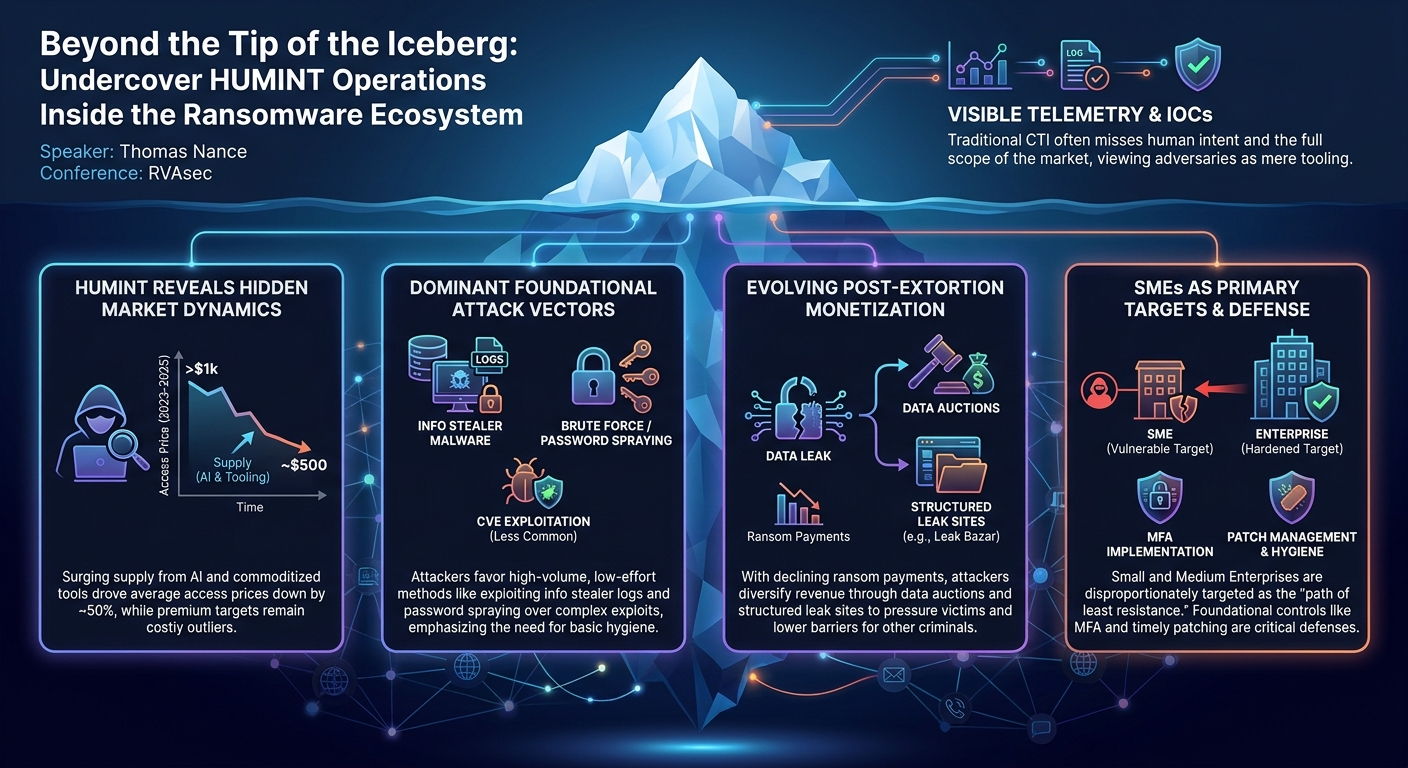
Darkweb IQ's extensive HUMINT operations have yielded a treasure trove of insights into the ransomware ecosystem, directly engaging with 637 unique IABs. These engagements reveal that the active IAB community, while dynamic, is surprisingly small, estimated at a few dozen to around a hundred actors at any given time.
A significant finding relates to pricing trends for initial access. From 2023 to 2025, the average cost of victim access observed by Darkweb IQ plummeted from over $1,000 to approximately $500. This decline is attributed to a massive surge in the supply of available access, particularly towards late 2024 and into 2025. This surge was primarily driven by the advent of Artificial Intelligence (AI), which, according to Nance, amplified the speed and volume of attacks by triple-digit percentages, rather than introducing entirely new Tactics, Techniques, and Procedures (TTPs). While average prices dropped, premium access to highly sought-after entities (e.g., major financial institutions, tech companies with valuable IP, or super administrator credentials) still commands six-figure prices, existing as outliers in the market.
The talk also detailed the primary attack vectors employed by IABs. The top two methods, consistently observed day in and day out, are exploiting info stealer malware logs to obtain compromised credentials and employing brute forcing or password spraying techniques. CVE exploitation ranks third in volume, generally requiring a higher skill set. This indicates that despite the focus on novel threats, basic password-centric attacks remain highly effective and prevalent. To maintain persistence after gaining initial access, especially through password-centric means that might be temporary, IABs have shown an increased reliance on downloading and utilizing Remote Monitoring and Management (RMM) tools. Furthermore, a spike in Social Engineering as a Service was noted, often used to bypass Two-Factor Authentication (2FA), which bottlenecked their ability to operationalize password-centric access.
IABs exhibit a "path of least resistance" in their targeting. Data from 2026 revealed that 50% of access offers targeted companies with less than $25 million in revenue, while 12% were for entities exceeding $1 billion. IABs often use publicly available information, such as ZoomInfo, to attribute companies to their access offers. This highlights the disproportionate impact on Small and Medium-sized Enterprises (SMEs), which are less likely to have robust cybersecurity defenses.
Finally, Nance discussed evolving post-extortion monetization strategies. With global ransomware payments declining—Chainalysis estimates only 26% of victims pay, while Verizon DBIR suggests 69% do not—threat actors are seeking alternative revenue streams. Darkweb IQ observed new tactics, including data auctions (similar to those run by groups like the CMD organization) and the emergence of structured leak sites such as Leak Bazar. Leak Bazar, reported in May, lists victims tied to at least five different ransomware gangs, cleaning and structuring stolen data (e.g., categorizing as R&D or financial records) to lower the barrier for criminal utilization. Crucially, direct engagement with an operator of such a site confirmed that the threat of listing data on these secondary monetization platforms has successfully pressured victims into paying ransoms, even securing a $200,000 payment in one instance.
Technical Deep Dive
▶ Watch: Common IAB tactics and CVE exploitation examples (28:00)
Darkweb IQ's undercover operations provide granular detail on the Initial Access Broker (IAB) modus operandi, going beyond theoretical TTPs to reveal what is actively being exploited and how. IABs predominantly target edge infrastructure and internet-exposed devices, which are readily discoverable and often less secured. Their methods are largely volume-driven and financially motivated.
The two most common initial access methods observed are:
- Info Stealer Malware Logs: IABs either operate info stealer campaigns themselves or purchase logs from other operators. These logs contain a wealth of compromised credentials, which are then checked against various services (log checkers) to find valid access.
- Brute Forcing/Password Spraying: This involves systematically trying common or leaked passwords against user accounts, often targeting services like Remote Desktop Protocol (RDP) or Virtual Private Networks (VPNs).
CVE Exploitation constitutes a smaller, but still significant, portion of IAB activity and typically requires a higher skill set. Nance provided several real-world examples illustrating both rapid and "long-tail" exploitation:
- Rapid Weaponization:
- Citrix Bleed (CVE-2023-4966): Within a week of its disclosure on June 16, 2025, Darkweb IQ received access offers explicitly stating exploitation of this CVE. Successful exploitation leading to access sales continued for months.
- AWS ClientVPN and Fortinet (CVE-2023-27997): Similar timelines were observed, with claims of successful exploitation and access sales emerging within days to a month of public disclosure, some linked to ransomware groups like Akira Play and Inc. Recidia.
- Long-Tail Exploitation:
- Netweaver: A vulnerability exploited by an IAB to compromise a healthcare company was confirmed to be five years old, highlighting that unpatched legacy vulnerabilities remain viable targets.
- Oracle E-Business: An Iranian threat actor, previously known for Oracle E-Business compromises, resurfaced offering access. Despite sanctions preventing a transaction, a screenshot provided by the actor to prove legitimacy enabled Darkweb IQ to identify the victim (a $12 billion European company) and confirm the unpatched vulnerability, leading to its remediation. This illustrates how even indirect engagement can yield critical vulnerability intelligence.
The talk also shed light on the tooling facilitating IAB operations. The surge in access observed in 2025 was directly linked to the increased sophistication and commoditization of criminal software. Examples include:
- TM checker clones: Supercharged versions of these credential-checking tools, enabling IABs to process info stealer logs more efficiently and at a greater scale.
- Fully Commoditized Software Packages: These plug-and-play solutions, some costing around $50,000 for lifetime support, offered features like web control panels, rotating proxies, dynamic scaling, and targeting capabilities for eight common enterprise protocols. Such tools allow even technically unsophisticated individuals to generate high volumes of access, lowering the barrier to entry for new IABs.
- RMM Tools: To establish persistence after gaining initial access, particularly via password-centric methods that might be temporary or easily rotated, IABs increasingly deploy legitimate RMM software.
The evolution of monetization extends beyond simple access sales. With declining access prices, IABs are diversifying their income streams by selling their tooling and infrastructure to other criminals. Post-extortion, the emergence of platforms like Leak Bazar exemplifies a new trend: victims who refuse to pay ransoms have their data cleaned, structured, and then auctioned or resold to other criminals. This structured presentation of stolen data (e.g., categorized as R&D, financial records) lowers the barrier to its criminal utilization, thereby creating new leverage points in negotiations and additional revenue for threat actors.
Demo / Proof of Concept
▶ Watch: Ransomware groups' evolving monetization strategies (39:00)
The most compelling "proof of concept" for Darkweb IQ's HUMINT methodology was the detailed case study of unmasking and apprehending a Romanian Initial Access Broker with significant ties to multiple sanctioned ransomware groups. This narrative vividly illustrates the power of sustained human engagement.
The operation began conventionally in 2021, with Darkweb IQ's undercover persona engaging the threat actor on a public forum. The relationship quickly moved to private channels like Jabber, where consistent access purchases cultivated trust. Over time, the IAB began sharing intricate details of their tradecraft, including methods for scanning RDP, brute-forcing techniques, and even samples of their custom tooling. Crucially, the IAB also divulged details about their buyer relationships and the victims they were targeting. Through this intelligence, Darkweb IQ was able to link the Romanian actor to affiliates of notorious ransomware groups such as Hive, LockBit, ALPHV (BlackCat). This information garnered the attention of the FBI.
A pivotal moment occurred when the Romanian IAB, enraged by a Russian ransomware crew's refusal to pay a $3 million commission for successful ransoms, took extraordinary action. The IAB deployed a keylogger on the Russian group's Command and Control (C2) infrastructure, successfully stealing back their owed funds. In an unprecedented move, the IAB then provided Darkweb IQ with access to this compromised C2 infrastructure. The FBI, leveraging this unique access, discovered that the ransomware group was mere days away from launching attacks on 46 US hospitals, along with three other victims through a shared C2. The timely intelligence allowed the FBI to completely shut down the entire ransomware infrastructure, averting a potentially catastrophic geopolitical event just four months after the Colonial Pipeline attack.
Despite this major disruption to one of his buyers, Darkweb IQ maintained the relationship with the Romanian IAB. The unmasking process involved a critical slip-up: during a chat, the IAB inadvertently spoke in Romanian. Darkweb IQ operators, fluent in the language, noted this. This linguistic clue, combined with a "selector" (an email address) provided by law enforcement, allowed Darkweb IQ to conduct OSINT (Open Source Intelligence). By cross-referencing the email with Romanian breach data sets and public platforms like Facebook, the IAB's true identity and even his apartment location were identified.
With sufficient evidence, the FBI sought to transition the IAB to one of their own undercover agents, but the IAB resisted. The culmination of this multi-year operation occurred in November 2024. In a coordinated effort, FBI agents and Romanian federal police raided the identified apartment while Darkweb IQ operators were "hands-on-keys," actively chatting with the IAB. The IAB was arrested, and after approximately a year and a half, pleaded guilty in May 2025, receiving a sentence of roughly five years in prison. This case stands as a powerful testament to the efficacy of HUMINT in disrupting sophisticated cybercriminal operations and directly protecting critical infrastructure.
Defensive Implications
▶ Watch: The enduring importance of human intelligence (47:00)
The insights gleaned from Darkweb IQ's HUMINT operations offer critical defensive implications for organizations of all sizes, emphasizing the need to address fundamental security weaknesses and adopt a threat-informed approach.
First and foremost, the prevalence of password-centric attacks (info stealer logs and brute forcing) underscores the enduring importance of foundational cyber hygiene. Organizations must prioritize strong, unique passwords, robust password policies, and widespread implementation of Multi-Factor Authentication (MFA) across all services, especially internet-facing ones. These basic controls, often overlooked in the pursuit of advanced defenses, remain the primary defense against the most common initial access vectors exploited by IABs. Microsoft's assertion that good cyber hygiene can prevent the majority of cyberattacks is directly supported by Darkweb IQ's findings.
Vulnerability management strategies also require a nuanced approach. While rapid patching of newly disclosed, actively exploited CVEs (like Citrix Bleed, AWS ClientVPN, and Fortinet vulnerabilities) is crucial, defenders must not neglect the "long-tail" of exploitation. The case of the Netweaver vulnerability, exploited five years after disclosure, and the Oracle E-Business compromise highlight that older, unpatched vulnerabilities continue to be successfully leveraged by IABs. Augmenting traditional vulnerability intelligence with insights from threat actor discussions (via HUMINT or other means) can help prioritize patching efforts by understanding which vulnerabilities are actively being weaponized in the wild, regardless of their age.
The "path of least resistance" targeting strategy of IABs reveals a significant vulnerability for Small and Medium-sized Enterprises (SMEs). These organizations, often lacking dedicated IT or cybersecurity personnel and budgets, are disproportionately targeted. This calls for increased awareness, accessible cybersecurity resources, and potentially government or industry-led initiatives to bolster basic defenses for SMEs, as they are most likely to suffer devastating consequences from a ransomware event.
Given IABs' focus on edge infrastructure, organizations must rigorously harden and continuously monitor all internet-exposed devices and services. This includes regular vulnerability assessments, configuration reviews, and proactive threat hunting for suspicious activity on these critical assets. Furthermore, the observed increase in the use of Remote Monitoring and Management (RMM) tools for persistence means defenders should implement strict controls and monitoring over the deployment and usage of such tools within their networks, flagging any unauthorized or unusual installations.
Finally, Nance's talk serves as a powerful reminder that while technical controls are vital, understanding the human element of cybercrime is indispensable. Purely automated threat intelligence can miss critical context regarding adversary intent, motivations, and evolving TTPs. Incorporating intelligence derived from direct engagement with threat actors provides a unique and actionable lens, allowing defenders to better anticipate, understand, and counter the credible threats they face today.
Key Takeaways
- HUMINT is Indispensable: Direct, undercover engagement with cybercriminals, particularly Initial Access Brokers (IABs), provides unique and actionable intelligence that traditional technical feeds often miss, revealing the hidden layers of the ransomware ecosystem.
- Dynamic IAB Market: The IAB market is characterized by fluctuating prices, with average access costs dropping due to an increased supply driven by commoditized tooling and AI-amplified speed, not novelty in TTPs.
- Foundational Attacks Dominate: Basic, password-centric attack methods—exploitation of info stealer malware logs and brute-forcing/password spraying—remain the most prevalent initial access vectors, underscoring the critical need for strong cyber hygiene and MFA.
- Comprehensive Vulnerability Management: Both rapid exploitation of newly disclosed CVEs and "long-tail" exploitation of older, unpatched vulnerabilities persist. Organizations must prioritize patching based on real-world exploitation intelligence.
- Evolving Monetization Strategies: Due to declining victim payments, ransomware groups are diversifying post-extortion monetization through data auctions and structured leak sites (e.g., Leak Bazar), creating new forms of leverage and revenue.
- SMEs as Primary Targets: Small and medium-sized enterprises (SMEs) are disproportionately targeted by volume-play IABs, highlighting their critical vulnerability and the need for accessible, foundational cybersecurity defenses.
About the Speaker(s)
Thomas Nance is the Director of Intelligence at Darkweb IQ, a company specializing in human intelligence operations within the cybercriminal landscape. With a background as a case officer for the CIA for less than a decade, Nance brings extensive expertise in managing clandestine sources and running human intelligence operations to the cybersecurity domain. In his current role, he oversees the production of intelligence and the protection of Darkweb IQ's consumers, focusing on direct engagement with cybercriminals to inform and enhance security postures.
Reviews
Dr. Zero (Offensive Security Researcher) — STRONG ACCEPT
This isn't another vendor scraping Telegram APIs and calling it 'threat intelligence.' Nance actually ran HUMINT ops, bought access under DOJ cover, and played Initial Access Brokers against each other. It walks a fine line with pitching Darkweb IQ, but the operational reality of the case studies makes it undeniably worth your time.
Heather Calloway (CISO) — STRONG ACCEPT
This talk strips the mystique away from ransomware operators and exposes the industrialized supply chain of Initial Access Brokers. The finding that corporate network access now retails for $500—primarily driven by infostealer logs and missing MFA—is a reality check every risk committee needs to hear.