The Interview Engine: A Career Readiness Framework
Vas Khomyk (Recruiting Consultant · Hampton North)
RVAsec 2026 · Day 2 · Madison / Jefferson / Monroe
Overview
In "The Interview Engine: A Career Readiness Framework," Vas Khomyk, a seasoned recruiting consultant with Hampton North, delivers a candid and critical examination of the modern cybersecurity hiring landscape. Khomyk, drawing on over a decade of experience in tech and national security recruiting, including extensive work with the Department of Defense and IC community, argues that the current system is fundamentally broken for both job seekers and hiring managers. This talk is not about offering a "magic bullet" solution, as Khomyk asserts none exists, but rather about empowering individuals to navigate an increasingly complex and adversarial environment by adopting a proactive, data-driven approach to career management.
Key moments
- 6:00 Hiring market data is often conjecture
- 10:50 Current challenges for job candidates
- 22:00 Adversarial techniques in hiring: fake candidates
- 32:30 Own your narrative: Importance of digital presence
- 37:50 How recruiters see your LinkedIn profile
- 42:50 The Interview Engine: Continuous career readiness
- 44:00 Gathering your own job market data
- 50:00 The '10-second test' for your resume
The Interview Engine: A Career Readiness Framework
Speakers: Vas Khomyk, Recruiting Consultant, Hampton North
Conference: RVAsec
YouTube: https://www.youtube.com/watch?v=qr_wvIZJEpI
Overview
In "The Interview Engine: A Career Readiness Framework," Vas Khomyk, a seasoned recruiting consultant with Hampton North, delivers a candid and critical examination of the modern cybersecurity hiring landscape. Khomyk, drawing on over a decade of experience in tech and national security recruiting, including extensive work with the Department of Defense and IC community, argues that the current system is fundamentally broken for both job seekers and hiring managers. This talk is not about offering a "magic bullet" solution, as Khomyk asserts none exists, but rather about empowering individuals to navigate an increasingly complex and adversarial environment by adopting a proactive, data-driven approach to career management.
The presentation provides a stark reality check, dissecting the myriad forces contributing to hiring friction, from the overhyped and often ineffective promises of AI in recruiting to the pervasive "unicorn syndrome" plaguing job descriptions. Khomyk challenges conventional wisdom and popular headlines about the job market, emphasizing that most public data is shallow and unreliable. Instead, he advocates for a personal "Interview Engine" framework, urging attendees to become their own data scientists, meticulously tracking their job search efforts, optimizing their digital presence for discoverability, and continuously iterating on their approach. This talk is crucial for anyone in cybersecurity looking to understand the true dynamics of talent acquisition and take control of their career trajectory in an era of rapid change and uncertainty.
Background
▶ Watch: Hiring market data is often conjecture (6:00)
The current state of the cybersecurity job market, as described by Khomyk, is a complex tapestry woven from a confluence of post-pandemic economic shifts, technological advancements, and systemic inefficiencies. Following the "overhiring highs of post-COVID rush" into 2022, the market experienced a significant "eb in tech employment" in 2023, marked by mass layoffs, particularly affecting recruiters—an estimated 60% of whom lost their jobs. This reduction in recruiting staff coincided with the "dawn of AI," where a single recruiter might now face 15,000 applicants daily, a drastic increase from the previous 1,000. This imbalance has severely degraded the effectiveness of traditional application channels, creating a "DOS effect on applicant systems."
Khomyk dismisses most AI recruiting tools as "slop cannons" that "degrade the experience on oftentimes on both sides," likening them to nuclear bombs that become useless once everyone possesses them. He argues that human data is inherently messy, making generalized AI solutions ineffective. Compounding these issues are a host of challenges for both candidates and hiring managers. Job seekers face a "doom loop" of applying to "tons of roles" with "no response, not even a no," encountering "wildly inaccurate" job descriptions that are often "an entire team's job" mashed into one. Interview loops have "been extended," and "comp levels have come down" while the cost of living has not.
Hiring managers, on the other hand, are frequently understaffed, approved for one hire when they need three, and pressured by leadership to adopt buzzword technologies like AI, Mythos, and Fable. Hiring becomes a "sideshow," an additional 20 hours on top of an already demanding 60-80-hour workweek. The influx of applications, often generated by AI tools that "fix your resume to match the job description and fire it off," leads to a high volume of uninterested or unqualified candidates. Khomyk highlights the prevalence of "adversarial techniques," including fake candidates, fabricated experience, and even "North Korean infiltrators" posing as remote tech workers, necessitating increased diligence and trust verification. This environment fosters a "unicorn syndrome," where tight budgets and smaller hiring numbers force roles to stretch, leading to unrealistic expectations and circular interview processes where companies endlessly search for a non-existent perfect candidate. The foundational problem, as Khomyk repeatedly stresses, is the lack of a "silver bullet" and the inherent "risk calculus" in every hiring decision, making the process one of mitigating risk at an acceptable cost, much like cybersecurity itself.
Key Findings
▶ Watch: Adversarial techniques in hiring: fake candidates (22:00)
Khomyk's talk reveals several critical findings about the dysfunctional state of the cybersecurity talent market and offers a strategic framework for individuals to navigate it. The primary finding is that the conventional wisdom and widely disseminated statistics about hiring are largely "conjecture," lacking depth and often based on flawed methodologies. He asserts that "human data is messy," rendering most generalized advice and AI-driven solutions ineffective at a personal level.
Another key finding is the significant degradation of the online application channel. Due to mass recruiter layoffs, the sheer volume of AI-generated applications, and the prevalence of fake or uninterested candidates, reviewing applicants has become "not time effective" for hiring managers. This has forced a shift towards outbound searches and discoverability as primary talent acquisition strategies. Recruiters are increasingly relying on active sourcing through platforms like LinkedIn Recruiter, internal databases, and personal networks.
For job seekers, Khomyk identifies the critical need to "own your narrative" and prioritize discoverability. In an environment where resumes have lost "the amount of signal that they provide," a strong digital presence—particularly on LinkedIn—serves as a "publicly verifiable ledger" for social validation. Recruiters, he explains, often give preference to candidates with mutual connections, indicating a higher likelihood of authenticity and relevance.
Finally, the talk's central finding is the urgent need for individuals to adopt a scientific, data-driven approach to their own career management. Given the lack of reliable external data, Khomyk argues that "the best method... is gather your own data." This involves treating job searching as an iterative process, experimenting with different resume versions, analyzing rejection patterns, and continuously refining one's approach based on personal outcomes. This "Interview Engine" framework is designed to break the "doom loop" of aimless applications, transforming rejections from personal failures into valuable data points for improvement.
Technical Deep Dive
▶ Watch: How recruiters see your LinkedIn profile (37:50)
While "The Interview Engine" isn't a traditional cybersecurity technical deep dive into code or protocols, it meticulously dissects the underlying mechanics and technical challenges of the modern recruiting ecosystem, offering a "technical" understanding of how job seekers can optimize their approach. Khomyk highlights the severe limitations of Applicant Tracking Systems (ATS), which he dismisses as glorified CRMs with ineffective "semantic lay filtering" and "bad boolean" logic. He explicitly warns against ATS optimization, stating that while it might get a resume past the initial automated screen, it often makes the resume unappealing to the human recruiter who ultimately reviews it, thus "setting yourself up for loss in the second stage."
Khomyk provides a rare glimpse into the recruiter's perspective, explaining how tools like LinkedIn Recruiter work. Unlike the public LinkedIn interface, recruiters see "cards" that prioritize headline, companies and titles, education, and connections, often without immediately viewing the detailed bullet points of a job description. This emphasizes the critical importance of a concise, impactful headline as "some of the most valuable real estate" on a profile. Recruiters primarily use Boolean queries (e.g., detection OR "detection rules" OR "affiliated tools") to search for candidates. A profile with a term mentioned 20 times will rank higher than one with a single mention, illustrating the underlying search engine optimization (SEO) principles at play.
This understanding underpins Khomyk's advice for candidates to treat their LinkedIn profile and personal website like an SEO-optimized asset. The goal is to "optimize for who you want to be found by," mirroring the "path of least resistance" philosophy in cybersecurity. This involves reverse-engineering target job descriptions to identify key technologies and specialties, then crafting a narrative that aligns with those search terms. For example, presenting oneself as a "detection and response engineer" rather than a generic "security engineer" can significantly increase visibility and click rates.
Furthermore, Khomyk stresses the importance of naming the problems you solve rather than just listing responsibilities. A hiring manager seeking a solution to "scanner noise" and a need for "data pipelines" will be more attracted to a profile that explicitly states, "I consolidate scanners because we had a massive noisy environment," rather than a vague bullet point about "managing security tools." This direct problem-solution mapping is critical because, as Khomyk notes, "most recruiters, especially even in cyber, aren't technical enough to really figure it out. So you need to spoon-feed it to them."
The talk also delves into the strategic use of resume versioning. Instead of customizing a single resume for every job, Khomyk recommends maintaining "different versions" tailored to distinct skill sets or career paths (e.g., an "op side" version vs. an "engineering side" version). This approach allows candidates to "highlight things that are more or less relevant" without creating "formatting chaos" or engaging in ineffective "keyword stuffing," which recruiters are "wise to." These insights collectively form a "technical deep dive" into the strategic optimization of one's professional persona for maximum impact within the current recruiting infrastructure.
Demo / Proof of Concept
▶ Watch: The Interview Engine: Continuous career readiness (42:50)
While "The Interview Engine" talk did not feature a traditional live software or hardware demonstration common in many cybersecurity conferences, Vas Khomyk effectively used the entire presentation as a conceptual "proof of concept" for his Interview Engine framework. The framework itself serves as a model for how job seekers can proactively manage their careers, and Khomyk's detailed explanations and practical examples act as the demonstration.
He "demonstrated" the brokenness of the current system by vividly describing the frustrations of both candidates (e.g., applying to "tons of roles" with "no response") and hiring managers (e.g., facing "DOS effect on applicant systems" from fake resumes). The core of his "proof of concept" was the conceptual "Interview Engine" itself, broken down into its states (Cold, Idling, Running) and components (Fuel, Air, Spark). He "showed" how to build and maintain this engine through a scientific method of gathering personal data, versioning resumes, and iterating based on observed outcomes. For instance, he illustrated the difference between an ineffective LinkedIn headline and an optimized one, effectively "demonstrating" the impact of SEO on discoverability. The success stories of placements made through niche communities or open-source contributions, where a resume wasn't even needed, served as powerful anecdotal evidence for the efficacy of his discoverability principles.
Defensive Implications
▶ Watch: The '10-second test' for your resume (50:00)
For cybersecurity professionals, the "Interview Engine" framework offers crucial defensive implications against a highly adversarial and often opaque hiring market. Khomyk's insights empower individuals to protect their careers and proactively secure future opportunities by understanding and adapting to the current landscape.
Firstly, the concept of "owning your narrative" is paramount. In an environment rife with fake profiles and unreliable resumes, maintaining a consistent, verifiable, and optimized digital presence (especially on LinkedIn and GitHub) acts as a strong defense. LinkedIn, serving as a "publicly verifiable ledger," allows for social validation through connections, making a candidate more trustworthy to a recruiter. Without this, individuals risk having a less charitable, inaccurate narrative created for them by others.
Secondly, understanding how recruiters utilize Boolean queries and the LinkedIn Recruiter interface provides a defensive advantage. By thinking in terms of SEO for personal profiles, candidates can strategically embed keywords related to their desired roles and specialties into their headlines and summaries. This ensures they appear high in search results, effectively defending against being overlooked by automated or rushed recruiter searches. Khomyk's advice to "name the problems you solve" rather than just listing responsibilities also helps cut through the noise, making a candidate's value immediately apparent to a hiring manager grappling with specific challenges.
Thirdly, the framework encourages a proactive "idling" state for career management. This means continuously nurturing one's network, attending conferences, contributing to niche communities (like Discord or GitHub), and being vocal about one's expertise, even when not actively job searching. This constant "air" supply ensures that opportunities can "reach you," providing a defensive buffer against unexpected layoffs or market shifts. When a job loss occurs, an "idling" engine can quickly transition to "running" without the shock and paralysis of a "cold" start.
Finally, the emphasis on gathering your own data and treating rejections as impersonal "data" points rather than emotional setbacks is a powerful psychological defense. This scientific approach fosters resilience and allows for continuous iteration on resumes and interview techniques, turning every interaction into a learning opportunity. By understanding the "risk calculus" from the hiring manager's perspective (e.g., hiring someone from a different environment, or a potential stopover candidate), job seekers can better position themselves to mitigate perceived risks and present a more compelling, low-risk profile. These defensive strategies collectively equip cybersecurity professionals to navigate the complexities of the job market with greater agency and control.
Key Takeaways
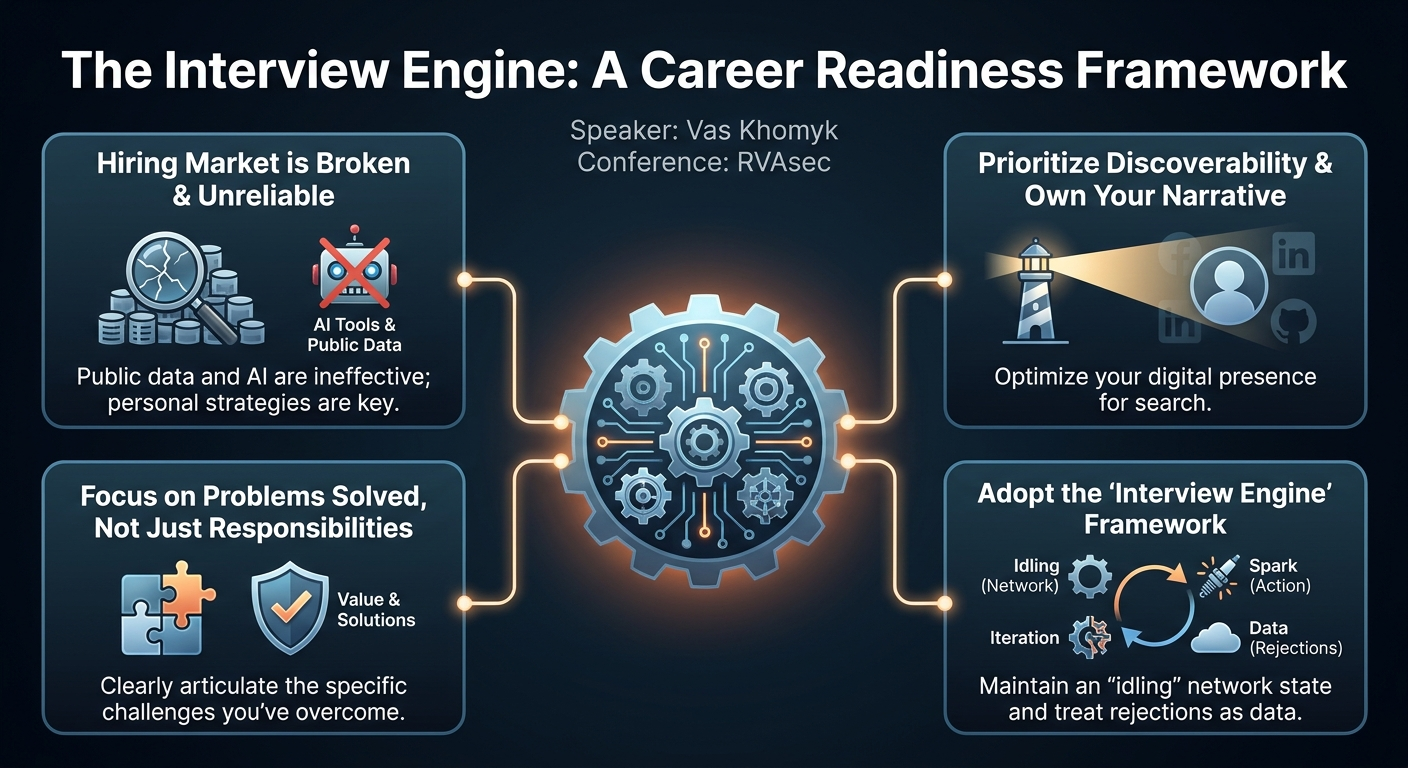
- The Hiring Market is Broken & Unreliable: Most public data and AI recruiting tools are superficial or ineffective. There's no "magic bullet"; success hinges on personal, data-driven strategies.
- Prioritize Discoverability and Own Your Narrative: In an era of degraded application channels, your digital presence (especially LinkedIn and GitHub) must be optimized for how recruiters search (SEO, Boolean queries). Your headline is crucial for attracting attention and conveying your specialty.
- Focus on Problems Solved, Not Just Responsibilities: Clearly articulate the specific challenges you've overcome and the value you bring. Recruiters and hiring managers are looking for solutions to their problems, not just a list of tasks.
- Adopt the "Interview Engine" Framework: Maintain your career in an "idling" state through networking, public contributions, and continuous learning ("Air"). Ensure your skills are top-notch ("Fuel") and be ready to take action ("Spark") by applying and interviewing.
- Gather and Analyze Your Own Data: Treat your job search scientifically. Version your resumes, experiment with different approaches, and view rejections as impersonal data points for iteration and improvement. This builds resilience and provides a realistic roadmap.
- ATS Optimization is a Trap: While getting past an ATS is a first step, optimizing solely for machines often makes your resume less appealing to human recruiters. Focus on clear, concise, and human-readable content that effectively communicates your value.
About the Speaker(s)
Vas Khomyk is a highly experienced Recruiting Consultant at Hampton North, specializing in cybersecurity and technology talent acquisition. With over a decade in the recruiting field, Khomyk has a deep understanding of market dynamics, having built out a local company, Senica Resources, from 12 to over 400-500 employees before its acquisition. His expertise spans both the "cybersecurity vertical" (companies making money from cyber) and the "cybersecurity horizontal" (companies spending money on cyber), giving him a broad perspective on industry needs.
Khomyk also brings significant experience from his five years recruiting for the Department of Defense (DoD) and Intelligence Community (IC), making him fluent in "DoDs" terminology and familiar with the unique challenges of national security talent acquisition. Known for his candid insights and active participation in RVAsec meetups, Khomyk identifies himself as a "woodworker" and "builder" by nature, driven by a desire to understand how things work and how they can be improved—a mindset he applies directly to deconstructing and optimizing the complex hiring process. He is passionate about flipping the traditional recruiter-candidate dynamic to be more "value forward" for job seekers.
Reviews
Dr. Zero (Offensive Security Researcher) — SOLID
Most career talks are LinkedIn thought-leadership garbage. Khomyk actually drops real signal on how broken the hiring machinery is right now. If you're stuck in a resume black hole, this is a pragmatic guide to bypassing brain-dead Applicant Tracking Systems and gaming recruiter search habits.
Heather Calloway (CISO) — STRONG ACCEPT
This is a clear-eyed diagnosis of why our talent pipelines are failing. Khomyk accurately maps the breakdown of traditional recruiting, where AI tools have turned applicant tracking systems into useless noise generators. It’s required viewing for any security leader struggling to fill headcount and tired of fighting their own HR department.