Alert Fatigue Is a Misdiagnosis
Kim Mahan (Founding Apprentice · MAXX Potential)
RVAsec 2026 · Day 2 · Grand Ballroom D/E
Overview
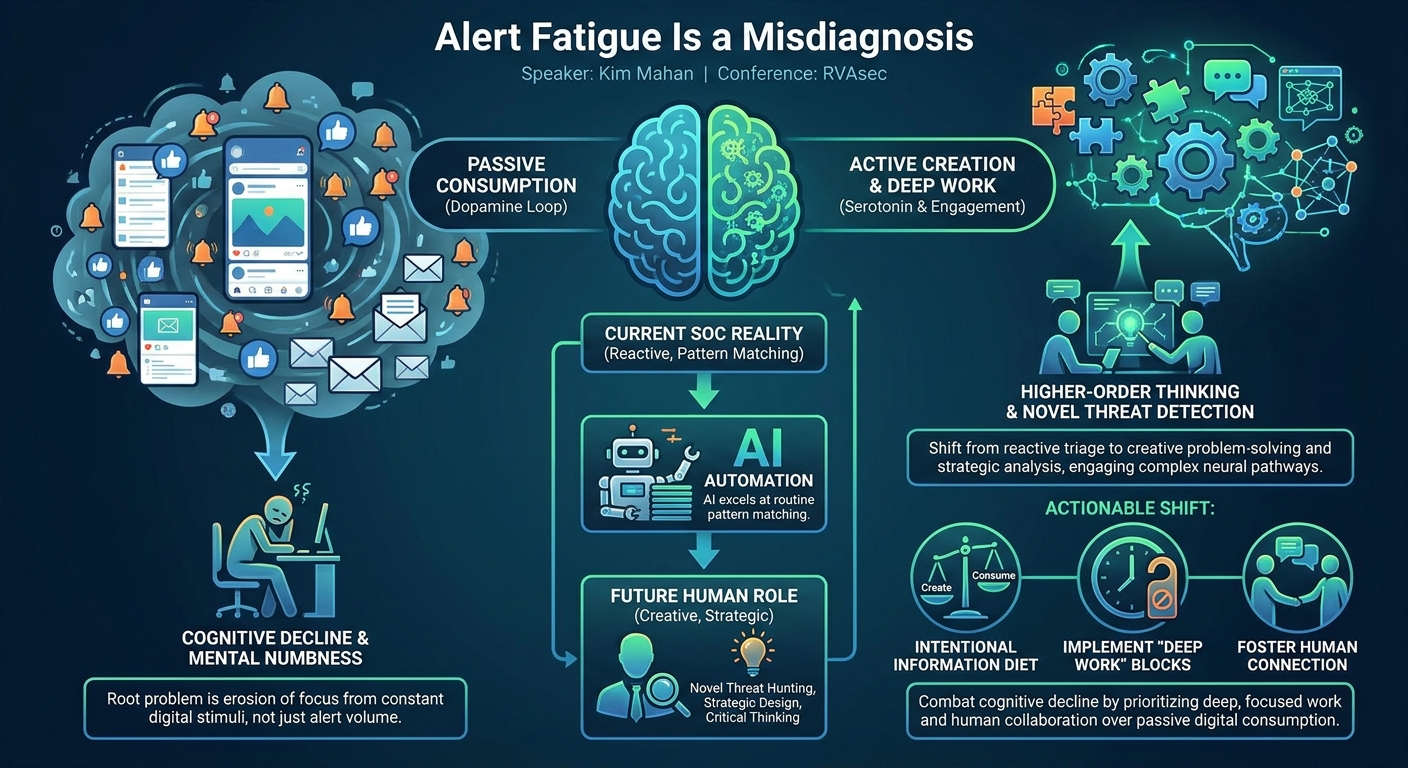
In her RVAsec talk, "Alert Fatigue Is a Misdiagnosis," Kim Mahan, Founding Apprentice and CEO at MAXX Potential, challenges the conventional understanding of "alert fatigue" in security operations centers (SOCs). Mahan argues that the constant influx of digital information, notifications, and social media feeds creates a persistent dopamine loop that erodes cognitive function, leading to a deeper problem than mere alert volume. This cognitive decline, she posits, is the true root cause of what we label as alert fatigue, hindering analysts' ability to engage in critical thinking and deep work.
Key moments
- 0:00 Introduction and personal motivation for talk
- 2:06 Speaker's personal struggle with screen time and cognitive decline
- 9:35 Alert fatigue is a misdiagnosis; AI's impact on security roles
- 14:30 Audience exercise: Experiencing the numbing effect of scrolling
- 21:00 Neuroscience of consumption vs. creation; Meta's Tribe V2
- 24:30 Max Potential's shift: from reactive SOC to creative development
- 30:00 Dunning-Kruger effect with AI; importance of human collaboration
- 45:00 Team strategies: deeper labs, in-person meetups, intentional consumption
Alert Fatigue Is a Misdiagnosis
Speakers: Kim Mahan, Founding Apprentice, MAXX Potential
Conference: RVAsec
YouTube: https://www.youtube.com/watch?v=9QBEnfe6lNo
Overview
In her RVAsec talk, "Alert Fatigue Is a Misdiagnosis," Kim Mahan, Founding Apprentice and CEO at MAXX Potential, challenges the conventional understanding of "alert fatigue" in security operations centers (SOCs). Mahan argues that the constant influx of digital information, notifications, and social media feeds creates a persistent dopamine loop that erodes cognitive function, leading to a deeper problem than mere alert volume. This cognitive decline, she posits, is the true root cause of what we label as alert fatigue, hindering analysts' ability to engage in critical thinking and deep work.
Mahan's talk is a compelling blend of personal introspection, neuroscience, and practical implications for the cybersecurity industry. Drawing from her own struggles with digital consumption and cognitive focus, she presents a framework for understanding how continuous screen time and passive information intake can negatively impact mental acuity. The core message is a call to action for security professionals and organizations to shift from a consumption-driven mindset to one focused on creation, interaction, and intentional use of technology, particularly in the age of rapidly advancing AI.
This perspective is particularly vital as AI tools become increasingly capable of automating pattern-matching tasks, which currently constitute a significant portion of entry-level security roles. Mahan contends that for humans to remain valuable in the security landscape, they must cultivate higher-order cognitive skills—critical thinking, creative problem-solving, and novel threat detection—which are actively undermined by unchecked digital consumption. The talk offers a paradigm shift for how we train, manage, and empower security analysts, urging a re-evaluation of current SOC practices and a proactive approach to cognitive well-being.
Background
▶ Watch: Introduction and personal motivation for talk (0:00)
The problem of alert fatigue has plagued security operations for over a decade, with countless talks and articles dedicated to tuning Security Information and Event Management (SIEM) systems to reduce noise. Despite these efforts, Kim Mahan highlights that the volume of alerts continues to rise, and the industry still grapples with high rates of analyst burnout (71%) and short average tenures (18-24 months). Mahan argues that the prevailing focus on simply reducing alert volume misses a crucial underlying factor: the cognitive impact of constant digital stimuli on the human brain.
Mahan's journey to this insight began with a deeply personal experience of cognitive decline in 2022, characterized by difficulty focusing, communication struggles, and getting caught in "social media doom cycles." She describes herself as having become a "vulnerability" during this period, constantly consuming digital content without productive output. This personal struggle led her to delve into neuroscience, observing the detrimental effects of dopamine-driven consumption loops—the "bing bing bing" of notifications and endless scrolling that provide fleeting satisfaction but ultimately leave the brain unsatisfied and fatigued. She likens this to "empty calories" for the brain, drawing parallels to a "functional alcoholic" who maintains daily work but succumbs to unhealthy consumption patterns after hours.
The advent of powerful AI models like ChatGPT, Gemini, Claude, and Grok further solidified her concerns. While these tools offered a pathway back to creativity by enabling her to "kick the tires" and build things, they also underscored the vulnerability of human roles centered on pattern matching. Mahan questions whether the industry has inadvertently trained an entire generation of security analysts to be "pattern matching machines," a task that AI is increasingly adept at. This realization, coupled with her observations at MAXX Potential—where apprentices in SOC/NOC roles were leveling up slower, especially during low-volume shifts—illuminated the critical need to re-evaluate the nature of security work and its cognitive demands. She cites research by Gloria Mark, noting that knowledge workers self-interrupt frequently, and it takes an average of 23 minutes to regain focus after an interruption, a stark reality for constantly barraged security analysts.
Key Findings
▶ Watch: Alert fatigue is a misdiagnosis; AI's impact on security roles (9:35)
Kim Mahan's talk unveils several critical findings that reframe the challenges facing security operations:
- Alert Fatigue as Cognitive Decline: The central and most profound finding is that "alert fatigue is a misdiagnosis." The underlying issue is a decline in cognitive function and executive control, exacerbated by constant digital consumption that triggers addictive dopamine loops. This leads to a state of mental numbness, making analysts less effective at critical thinking and deep problem-solving.
- The Dopamine Trap vs. Cognitive Engagement: Mahan distinguishes between passive consumption (e.g., endlessly scrolling social media, watching repetitive videos, chasing Duolingo streaks) that primarily triggers dopamine, and active creation or complex interaction (e.g., speaking, writing, solving hard problems, conversing with AI) that engages more parts of the brain and triggers cortisol and serotonin, leading to deeper learning and satisfaction. She argues that traditional alert monitoring keeps analysts in the unproductive dopamine loop.
- AI's Role in Reshaping Human Work: AI's superior capability in pattern matching poses an existential threat to many current entry-level security analyst roles. Instead of fearing replacement, Mahan advocates for humans to leverage AI to automate mundane tasks and pivot to higher-order cognitive functions that AI cannot yet replicate, such as novel threat detection, strategic analysis, and creative solution design.
- The "Creation vs. Consumption" Information Diet: Mahan proposes an intentional "information diet" where individuals consciously balance time spent consuming information with time spent creating or actively engaging. Her personal goal is an equal measure of both, aiming to spend screen time generating value rather than passively reacting or getting caught in "inbox dopamine loops."
- Impact on Learning and Development: Observations at MAXX Potential revealed that apprentices in SOC/NOC triage roles, despite having more "free time," were leveling up slower than their dev counterparts. This suggests that the nature of their work—often reactive and consumption-heavy—impeded their ability to engage in the creative, problem-solving activities necessary for skill progression. Errors were even more frequent during low-volume shifts, indicating that idle time was often filled unproductively.
- The Value of Human Connection and Deep Work: Through interactive audience exercises, Mahan demonstrated the cognitive numbing effect of endless scrolling versus the joy and mental engagement derived from discussing complex problems and human interaction. She emphasizes the importance of "deep work" blocks and fostering environments that encourage shared learning and collaborative problem-solving.
Technical Deep Dive
▶ Watch: Neuroscience of consumption vs. creation; Meta's Tribe V2 (21:00)
Mahan’s technical deep dive isn't into specific security tools but rather into the neuroscience of human-computer interaction and its implications for security professionals. She presents a "loose framework" for understanding brain function, comparing it to the OSI stack – a conceptual model for how we process information and stimuli. Her insights are based on a synthesis of research, critiqued by various AI models like Grok, Claude, and Gemini, reflecting her method of using AI adversarially to deepen understanding.
Central to her argument is the distinction between brain states triggered by different types of digital engagement:
- Dopamine Loops: Mahan explains how social media feeds, news alerts, notifications, and even gamified learning apps like Duolingo are designed to create continuous dopamine hits. This neurotransmitter is associated with reward-seeking behavior, creating an addictive loop where users are constantly chasing the next "ding ding ding" or piece of information. This process, while seemingly engaging, is described as consuming "empty calories" for the brain, leading to a state of perpetual dissatisfaction and cognitive numbness. Mahan highlights the irony of passively consuming information (e.g., watching YouTube videos) that promises self-improvement but actually contributes to the very cognitive issues it claims to solve.
- Cortisol, Serotonin, and Cognitive Engagement: In contrast, activities involving creation, active problem-solving, and verbal communication engage more complex neural pathways, triggering neurotransmitters like cortisol and serotonin. Mahan uses the example of talking to an AI (e.g., Gemini) to learn a language versus passively following a Duolingo streak. Formulating words, retrieving information, and expressing ideas require the activation of broader parts of the brain, leading to deeper learning, mental stimulation, and a sense of accomplishment. She mentions using multimodal AI, like taking ChatGPT into her garden to ask about plants, as an example of integrating AI into her creative process rather than being pulled into its world.
Mahan introduces Meta's Tribe V2 model, an open-source tool released in March, which she describes as a "new toy." This model, trained on MRI data, predicts which parts of the brain light up during different types of content consumption. She explains that during passive consumption (like scrolling social media or watching videos), primarily the visual cortex is engaged, reinforcing the dopamine loop. Conversely, when engaged in creation or active retrieval (like giving a talk or solving a problem), a much broader network of brain regions is active, indicating healthier cognitive function. While she did not perform a live demo, she encourages the audience to explore Tribe V2's demo mode on Meta's website to visualize these differences.
The discussion also touches upon the Dunning-Kruger effect in the context of AI. Mahan expresses concern that AI can create an illusion of competence ("Mount Stupid"), leading individuals to overestimate their abilities and believe they can replace specialists (e.g., an engineer thinking they no longer need to talk to PR, or a marketing person building things without tech input). She argues that the human role should evolve to ask better questions, collaborate effectively, and use AI to augment human intelligence rather than isolate it. This requires fostering critical thinking skills, which she believes are often lacking in current educational systems, leading to a reliance on "repeating stats" rather than challenging assumptions. Mahan's personal use of AI involves system prompts like "challenge my assumptions" and "ask me Socratic questions," aiming to use AI to think harder, not less.
Demo / Proof of Concept
▶ Watch: Max Potential's shift: from reactive SOC to creative development (24:30)
While Kim Mahan's talk did not feature a traditional software demonstration, she engaged the audience in two powerful interactive exercises that served as compelling proofs of concept for her core arguments about cognitive function and digital consumption.
The first exercise involved asking the audience to pull out their phones and spend 60 seconds scrolling their "guilty pleasure app" (e.g., Reddit, Instagram, Facebook, LinkedIn). After the minute, she instructed them to put their phones down and try to recall "the most important thing" they had just seen, or even anything specific. The collective response, or lack thereof, underscored her point: many struggled to recall anything significant, leading to a "numbing experience." Mahan explained that this demonstrated the nature of the dopamine loop – "the emptiest calories you can consume for your brain," where one is "never satisfied" and the constant consumption yields little lasting value or recall. This vividly illustrated the mental state of an analyst constantly bombarded by low-value alerts.
The second exercise prompted the audience to reflect on the last time they were genuinely absorbed in a hard problem at work, so much so that they lost track of time. This invitation elicited immediate, enthusiastic discussions among audience members, with examples ranging from solving complex technical issues to intense team-building activities. Mahan deliberately allowed these conversations to run, observing the palpable shift in energy and engagement. She highlighted that this experience of "sharing and human connection" and the "retrieval and thinking about those times where you really lost track of time" is what brings true joy and activates the problem-solving parts of the brain. This contrasted sharply with the isolated, numbing experience of passive digital consumption, demonstrating the inherent human drive for meaningful engagement and collaboration.
Beyond these interactive exercises, Mahan presented MAXX Potential's internal operational changes as a real-world application of her principles. Recognizing that their SOC/NOC apprentices were leveling up slower due to the reactive nature of their roles, MAXX Potential implemented:
- Intelligent Automation: Automating routine, repetitive tasks to reduce the constant "pings and dings" that contribute to dopamine loops.
- Deep Work Rotations: Explicitly carving out time for analysts to engage in "deep work" activities, such as novel threat detection, build projects, or internal "chaos monkey" exercises, forcing them to create and solve complex problems rather than just react.
- Performance Metrics Shift: Tying raises and progression not to the volume of tickets closed, but to the demonstration of skills, creative output, and the ability to explain client businesses and contribute to strategic thinking.
- Knowledge Sharing: Encouraging apprentices to lead "lunch and learns" where they report out on significant findings or projects, forcing recall and communication.
These internal adjustments serve as a practical proof of concept for how organizations can combat cognitive decline and foster higher-order skills within their security teams by intentionally shifting from a consumption-heavy, reactive model to a creation- and engagement-focused approach.
Defensive Implications
▶ Watch: Team strategies: deeper labs, in-person meetups, intentional consumption (45:00)
Kim Mahan's talk offers profound and actionable defensive implications for cybersecurity leaders, managers, and individual practitioners seeking to build more resilient, effective, and cognitively healthy security operations:
- Re-evaluate and Redefine SOC Roles: The traditional SOC analyst role, heavily reliant on pattern matching and alert triage, is increasingly vulnerable to AI automation and detrimental to human cognitive health. Organizations must redefine these roles to focus on higher-order tasks such as novel threat detection, threat hunting, security engineering, automation development, and strategic analysis. Entry-level positions should serve as a launchpad for skill development, not a prolonged "dopamine loop" trap.
- Aggressively Automate Repetitive Tasks: Identify and automate all routine, low-cognitive-load tasks that contribute to the "pings and dings" environment. This includes automating the closure of redundant tickets (e.g., 12 Jira tickets for a single app outage) and initial triage of common alerts. Freeing analysts from these monotonous tasks is crucial for their cognitive well-being and allows them to engage in more impactful work.
- Cultivate a Culture of Creation and Deep Work: Implement structured "maker blocks" or "deep work" periods where analysts can focus on creative projects, tool development, and complex problem-solving without interruption. Encourage internal hackathons, "chaos monkey" exercises on internal systems, and "lunch and learns" where team members present their findings and creations, fostering recall and communication skills.
- Shift Performance Metrics: Move away from volume-based metrics (e.g., number of tickets closed, Mean Time To Resolve - MTTR) that incentivize speed over critical thinking. Instead, focus on metrics that reward skill demonstration, contributions to automation, novel insights, strategic thinking, and the ability to explain complex issues or client business contexts. This incentivizes the development of uniquely human skills.
- Prioritize Cognitive Health and Human Connection: Managers must acknowledge the cognitive toll of constant digital consumption and proactive steps to protect their teams' mental space. This includes encouraging intentional "information diets," promoting breaks from screens, and fostering in-person or highly interactive virtual collaboration. Human connection and shared problem-solving (like the bridge calls Mahan reminisced about) are crucial for psychological well-being and effective teamwork.
- Integrate AI as a Cognitive Augmenter, Not a Replacement: Train security professionals to use AI tools (ChatGPT, Gemini, etc.) not to "think less," but to "think harder." Encourage using AI to challenge assumptions, ask Socratic questions, summarize vast amounts of information (e.g., 2x speed videos, AI summaries of podcasts), and accelerate creative projects. The goal is to leverage AI for efficiency in consumption and power in creation, allowing humans to focus on judgment, strategy, and ethical oversight.
- Rethink Hiring and Education: The skills required for success in cybersecurity are evolving. Hiring processes should prioritize critical thinking, curiosity, adaptability, and the ability to learn and apply knowledge, rather than rote memorization or pattern-matching experience. Educational systems need to emphasize critical questioning and problem-solving over simply repeating facts.
By implementing these defensive strategies, organizations can transform their SOCs from burnout factories into environments that foster cognitive health, continuous learning, and genuinely impactful security contributions, ensuring human relevance in an AI-driven future.
Key Takeaways
- Alert fatigue is a symptom of cognitive decline: The real problem isn't just too many alerts, but the erosion of focus and executive function caused by constant, dopamine-driven digital consumption.
- Prioritize creation over consumption: Intentionally balance screen time between passive intake (e.g., social media, endless feeds) and active creation (e.g., building, writing, speaking, solving hard problems) to maintain cognitive health and develop higher-order skills.
- AI demands a shift in human roles: As AI excels at pattern matching, security professionals must pivot from reactive triage to novel threat detection, threat hunting, strategic thinking, and creative problem-solving.
- Rethink SOC operations and metrics: Automate repetitive, low-value tasks to free up analysts for "deep work." Shift performance metrics from task volume (e.g., tickets closed) to value creation, skill development, and critical thinking.
- Foster human connection and cognitive well-being: Encourage collaboration, knowledge sharing, and in-person interaction to counteract the isolating and numbing effects of excessive screen time and promote healthier brain function.
- Use AI to think harder, not less: Leverage AI tools to challenge assumptions, ask better questions, and accelerate creative processes, rather than allowing them to replace human critical thinking or lead to intellectual laziness.
About the Speaker(s)
Kim Mahan is the Founding Apprentice, CEO, and Visionary at MAXX Potential, an organization focused on developing technical talent through a "learn by doing" model. With an undergraduate background in behavioral science, Mahan brings a unique, interdisciplinary perspective to the challenges facing the tech industry. Her role as "visionary" at MAXX Potential involves constantly looking "around the corner" to anticipate future trends and adapt the company's approach to talent development.
Mahan is a passionate advocate for cognitive health and intentional technology use, drawing from her personal experiences with digital consumption and its impact on focus. She is an author, having contributed Chapter 21 to a book by Chris Voss, which recently hit bestseller status. Her work at MAXX Potential is deeply informed by her belief in fostering critical thinking, creativity, and the ability to ask hard questions, aiming to equip apprentices with the skills needed to thrive in an evolving, AI-driven technological landscape. She emphasizes human connection and the joy derived from collaborative problem-solving.
Reviews
Dr. Zero (Offensive Security Researcher) — SOLID
This is a SOC management talk dressed up in pop-neuroscience, but the core premise lands: we are burning out analysts by turning them into pattern-matching robots. It's not a technical talk, and the audience exercises are pure conference theater, but the operational takeaways—killing ticket-volume metrics and forcing deep work blocks—are practical.
Heather Calloway (CISO) — STRONG ACCEPT
This talk reclassifies SOC burnout from an HR complaint to a structural program failure. Mahan correctly identifies that treating analysts as pattern-matching machines destroys their cognitive ability to hunt novel threats, offering a clear mandate to rethink how we staff and measure security operations.