Secure by Design, Trusted Through Compliance
Michael Darling (Principal Consultant · Solstice Security)
RVAsec 2026 · Day 1 · Grand Ballroom D/E
Overview
In his RVAsec talk, "Secure by Design, Trusted Through Compliance," Michael Darling, Principal Consultant at Solstice Security, presents a compelling argument for adopting a systemic approach to security. He posits that just as the internet's success is built on standards, technology, and coordination, so too must our security programs be. Darling critiques the common pitfalls in cybersecurity, such as organizations being "audit-ready but operationally fragile," or exhibiting a significant disconnect between documented policies and actual practice. His talk aims to provide a structured methodology for building robust security programs that effectively manage complexity and genuinely enable business operations.
Key moments
- 0:00 The problem: complexity in security programs
- 3:50 Security as an enabler, not a roadblock
- 13:50 Coordination is our superpower: military meeting analogy
- 16:00 Differentiating security frameworks from technical baselines
- 18:00 Structured approach for a systemic security program
- 36:00 Processes: managing complexity with people, tech, procedures
- 39:30 Compliance as an API for trust and competitiveness
Secure by Design, Trusted Through Compliance
Speakers: Michael Darling, Principal Consultant, Solstice Security
Conference: RVAsec
YouTube: https://www.youtube.com/watch?v=gooVCUCN1y0
Overview
In his RVAsec talk, "Secure by Design, Trusted Through Compliance," Michael Darling, Principal Consultant at Solstice Security, presents a compelling argument for adopting a systemic approach to security. He posits that just as the internet's success is built on standards, technology, and coordination, so too must our security programs be. Darling critiques the common pitfalls in cybersecurity, such as organizations being "audit-ready but operationally fragile," or exhibiting a significant disconnect between documented policies and actual practice. His talk aims to provide a structured methodology for building robust security programs that effectively manage complexity and genuinely enable business operations.
Darling emphasizes that security should never be an end in itself or perceived as "the department of no." Instead, he redefines its core purpose, drawing on Rick Howard's "First Principles of Cybersecurity," as reducing the probability of a material impact to an organization. This reframing positions security as a critical business enabler, helping organizations achieve their goals by mitigating risks across technical, data, regulatory, contractual, human, AI, and physical domains. The talk is particularly relevant for security professionals struggling with organizational silos, overwhelming complexity, and the challenge of communicating security value to diverse stakeholders, offering a path towards integrated, effective, and demonstrable security.
Background
▶ Watch: The problem: complexity in security programs (0:00)
The pervasive challenge in cybersecurity, as highlighted by Michael Darling, stems from the inherent complexity of modern IT environments. With millions of lines of code and thousands of users, simply making systems work is arduous, and securing them is exponentially more difficult. A significant contributor to this complexity is the absence of a "definitive guidebook on security" – no single, empirically-driven resource dictates universally effective security practices. Instead, the industry relies on a multitude of smart people with good ideas, which, while valuable, often leads to fragmented approaches and a problem of complexity that is difficult to translate to customers, regulators, or internal stakeholders.
This environment often results in a critical dichotomy: organizations that are audit-ready on paper but operationally fragile in reality. Darling illustrates this with the stark image of the "most secure computer" being one that is simply turned off, underscoring the impracticality and misunderstanding of security's true purpose. He advocates for a shift in perspective, moving away from a reactive "protecting your stuff" mentality or the "department of no." Citing Rick Howard's "First Principles of Cybersecurity," Darling defines the ultimate goal of security as reducing the probability of a material impact to our organization. This business-centric definition aligns security with financial and operational objectives, transforming it from a cost center into an enabler of organizational success.
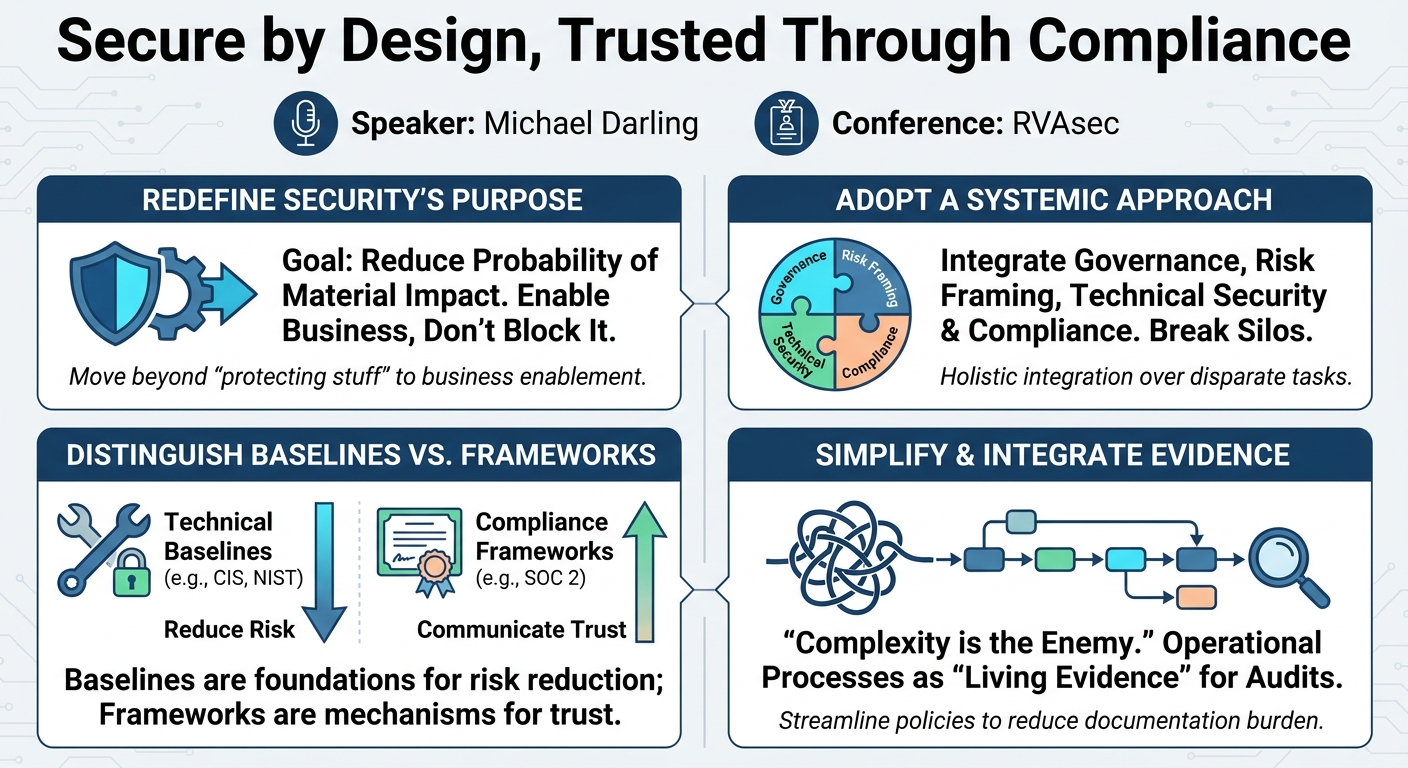
Darling outlines a broad spectrum of risks that a comprehensive security program must address, extending beyond purely technical concerns. These include technical security (engineering discipline for unauthorized access), data security (encryption, usage controls), regulatory compliance (privacy, GDPR, HIPAA, CCPA), contractual obligations (business competitiveness for fintechs selling to banks), human factors (weakest link/last line of defense, social engineering awareness), AI risk (prompt injection, model poisoning, rogue agents), and physical security. He stresses that while individual roles may focus on specific areas, all security professionals must understand these interconnected domains as part of their common goal. The talk also touches on organizational inefficiencies, such as stovepiped teams (e.g., GRC vs. technical), and the prevalence of "heroics" over systemic thinking. Darling draws an analogy from his time as a Marine, where a brief, targeted "meeting" before intense live-fire exercises ensured critical coordination. He argues that well-designed meetings, focused on syncing diverse teams, are a "superpower" for overcoming organizational disunity and managing complexity. A crucial distinction Darling makes is between security frameworks and security baselines. Baselines, such as CIS Benchmarks, NIST 800-53, or Microsoft Security Baselines, are technical sets of controls, settings, and configurations designed to lower the risk of incidents. Frameworks, like SOC 2, ISO 27001, or HITRUST, are mechanisms for communicating an organization's security posture to external parties, acting as an "API for trust." This distinction forms the bedrock of his proposed structured approach.
Key Findings
▶ Watch: Coordination is our superpower: military meeting analogy (13:50)
Michael Darling's talk presents several key findings that challenge conventional security paradigms and offer a systemic pathway to more effective cybersecurity. Central to his argument is the necessity of viewing security not as a collection of disparate tasks but as an integrated system. He proposes a structured approach that moves beyond reactive measures and siloed departments, advocating for a holistic integration of governance, risk framing, technical security, and compliance. This systematic methodology ensures that security efforts are aligned with business objectives and demonstrably effective.
A significant finding is the redefinition of security's ultimate goal: to reduce the probability of a material impact to our organization. This shifts the focus from merely "protecting stuff" to enabling business functions while managing quantifiable risks, a language readily understood by executives and finance professionals. Darling emphasizes that complexity is the enemy of security, and conversely, designing simplicity is hard but crucial. This principle underpins his call for concise, actionable policies and streamlined processes that are easy to understand, implement, and audit.
Furthermore, Darling highlights that coordination is a superpower in security. He argues that targeted, well-designed meetings—like the 1-minute sync-ups used in military operations—are essential for bridging the common divide between technical and GRC teams, ensuring everyone is "rowing in the same direction." This systemic thinking extends to the crucial differentiation between security baselines (technical controls that reduce risk, e.g., CIS Benchmarks, NIST 800-53) and compliance frameworks (communication mechanisms for trust, e.g., SOC 2, ISO 27001). He asserts that compliance, when properly integrated, becomes a business enabler and a competitive advantage, rather than a mere burden. Finally, Darling introduces the concept of "living evidence," where operational procedures and workflows (e.g., incident response tickets, change management logs) directly serve as audit artifacts. This eliminates the need for redundant, often outdated, documentation, simplifying the compliance process and ensuring that reported security postures accurately reflect real-world operations.
Technical Deep Dive
▶ Watch: Differentiating security frameworks from technical baselines (16:00)
Michael Darling's structured approach to security is a meticulously designed framework intended to harmonize technical controls with organizational governance and compliance requirements. It begins with governance, establishing how decisions are made, identifying stakeholders, and defining the organization's place in the world (e.g., highly regulated financial institution vs. lightly regulated law firm with ethical obligations). This initial step ensures executive buy-in and a technical steering committee to align security initiatives with broader business interests.
The next critical phase is risk framing, which systematically identifies constraints, restraints, and threats. Constraints are mandatory requirements like complying with GDPR or CCPA, tracking PII, or ensuring its deletion. Restraints define what the organization cannot do, such as not protecting sensitive data. Industry standards, like ethical obligations in the legal sector or HIPAA in healthcare, also dictate risk. Customer requirements, such as data segregation and "need to know" access, directly impact technical capabilities and procedural development. Darling stresses the importance of an industry threat profile, advocating for attribution-focused threat intelligence. He notes that knowing specific actors like Lunamoth (targeting legal with social engineering, impersonation of IT, Teams takeovers) or Scattered Spider (targeting financial) allows organizations to identify relevant attack techniques and sub-techniques. This intelligence, even sourced from open-source information or AI agents, should drive testing of existing detections and mitigations. Organizational policies and culture also influence effective controls; for instance, a badge policy is only effective if the organizational culture actively enforces it. Finally, understanding the impacts (technical, regulatory, business competitiveness) of security decisions, such as an exposed S3 bucket in a manufacturing versus a financial firm, guides appropriate risk tolerance and control implementation.
Darling then touches on the NIST Cybersecurity Framework (CSF), clarifying that while not a baseline or a compliance framework itself, it serves as an excellent starting guide for defining the scope of a security program and as a mapping tool to cross-reference different standards (e.g., SOC 2 to CIS to NIST 800-53). He mentions Expel's free online tool for self-assessment against the CSF.
The core of the technical security foundation lies in selecting and customizing security baselines. Darling highlights three primary options:
- Microsoft Security Baselines: Ideal for Windows environments due to integration, but may lack comprehensive administrative controls.
- CIS Benchmarks/Controls: Highly recommended for their comprehensiveness, offering baselines for entire environments (Level 1, 2, 3 mapping to NIST low, medium, high) and extensive product-specific benchmarks (e.g., for AWS instances alongside a Microsoft shop). Access to advanced features like build kits and OSCAP automation may require membership.
- NIST 800-53: The most comprehensive option, deeply integrated into other frameworks like CSF and CMMC (NIST 800-171), and supporting OSCAP for audit automation. Its main drawback is being technology-neutral, requiring effort to translate controls into specific product configurations.
Beyond technical configurations, administrative controls are crucial. Darling argues that well-defined policies, such as an authentication policy (covering password complexity, change frequency, special characters), are essentially technical controls because they dictate what engineers must implement. Other vital administrative controls include data management and classification frameworks. He stresses the importance of simplicity in policy writing, stating, "complexity is the enemy of security, and designing simplicity is hard." Overly verbose policies become "shelfware," ignored by users and engineers alike.
Further technical considerations include physical controls (briefly mentioned) and Zero Trust networking. While easier to implement in cloud environments, Darling advises integrating Zero Trust principles into on-premise upgrade strategies to gradually build this foundation. Defense in depth is paramount, requiring security to be integrated early into engineering decisions, especially during architecture design, to minimize attack surfaces.
Darling introduces a tiered approach to attack surface management for prioritizing vulnerability remediation:
- Tier 1 (Internet-facing): Web servers, VDI, VPN, cloud services accessible from the internet. These are primary targets for attackers, and vulnerabilities (e.g., a CVE-5 here) demand rapid remediation, especially given the trend of exploits emerging in the malicious ecosystem before defenders are ready.
- Tier 2 (Internet-interacting): Laptops, computers, tablets that connect to the network and can download malware or initiate ransomware callouts.
- Internal & Segmented: Less immediately critical, allowing for a slower response to even higher-severity vulnerabilities (e.g., a CVE-9 isolated behind multiple security layers).
The culmination of this approach is the creation of robust processes. Darling defines a process as the intersection of people, procedures, and technology, optionally mapping to specific security controls. For instance, an account management process involves an IAM manager, provisioning/deprovisioning procedures, and technology like On-Premise ID or Okta, all linked to a NIST 800-53 account management control. These processes are designed to be "living evidence," reflecting actual operational practices rather than theoretical documentation. He cites an example where a small organization addressed 320 CMMC objectives through 27 manageable processes, such as a roles matrix that alone satisfied 25 CMMC objectives.
Finally, compliance frameworks (e.g., SOC 2, ISO 27001, HITRUST) serve as an "API for trust and competitiveness." They are communication mechanisms to demonstrate competence to clients, regulators, and internal auditors. Darling emphasizes that operational procedures should directly generate audit evidence (e.g., Jira ticketing for incident response, change management logs), avoiding the "nightmare" of separate, often outdated, system security plans. He highlights OSCAL (Open Security Controls Assessment Language) as a valuable NIST-created resource for standardizing and automating the communication of GRC information, particularly for organizations using NIST 800-53 controls, enabling more efficient and automated audits.
Demo / Proof of Concept
▶ Watch: Processes: managing complexity with people, tech, procedures (36:00)
The talk "Secure by Design, Trusted Through Compliance" is a conceptual and strategic presentation outlining a systemic approach to cybersecurity. It does not include a live demonstration or a proof of concept of any specific tool, exploit, or architectural implementation. Instead, Michael Darling focuses on the theoretical framework and practical methodology for designing and implementing robust security programs.
Defensive Implications
▶ Watch: Compliance as an API for trust and competitiveness (39:30)
Michael Darling's systematic approach offers crucial defensive implications for organizations striving for robust and sustainable security. Defenders should:
- Adopt a Systemic, Business-Centric View: Reframe security's purpose as reducing the probability of a material impact to the organization. This requires moving beyond technical silos and integrating security into governance, risk management, and business strategy. Security teams should communicate in terms of business enablement and risk mitigation, aligning with executive and financial stakeholders.
- Differentiate and Leverage Baselines and Frameworks: Understand that security baselines (e.g., CIS Benchmarks, NIST 800-53) are the technical foundation for reducing risk, while compliance frameworks (e.g., SOC 2, ISO 27001) are tools for communicating trust. Implement strong technical baselines first, then use compliance frameworks to articulate that posture to external parties, transforming compliance into a competitive advantage.
- Prioritize Risk with Granular Threat Intelligence: Utilize industry-specific threat intelligence to identify actors (e.g., Lunamoth for legal, Scattered Spider for financial) and their specific attack techniques and sub-techniques. This intelligence should drive the selection, implementation, and rigorous testing of defensive controls, ensuring resources are focused on the most relevant threats. Organizations can even use AI agents to scrape and analyze this information.
- Simplify Policies and Embed Them in Processes: Embrace the principle that "complexity is the enemy of security." Develop clear, concise, and actionable policies (e.g., an authentication policy outlining technical requirements) that directly translate into operational procedures. These processes (people, procedures, technology) should be the "living evidence" of security controls, streamlining compliance and reducing the burden of separate, often outdated, documentation.
- Integrate Security Early and Practice Defense in Depth: Embed security considerations into the earliest stages of engineering and architectural decisions to proactively minimize attack surfaces. Implement a tiered attack surface management strategy, prioritizing rapid remediation of vulnerabilities, especially those with lower severity (CVE-5) on internet-facing assets (Tier 1: web servers, VDI, VPN, cloud logins) over higher-severity (CVE-9) vulnerabilities on deeply isolated internal systems.
- Automate Audit Evidence and Embrace OSCAL: Integrate the generation of audit evidence directly into daily operational workflows (e.g., Jira for incident response, change management systems). Leverage OSCAL (Open Security Controls Assessment Language) to standardize and automate the communication of GRC information, particularly for organizations using NIST 800-53 controls, to significantly reduce manual audit burdens and improve accuracy.
- Foster Cross-Functional Coordination: Actively break down silos between technical and GRC teams through structured, targeted meetings. Embrace the idea that coordination is a superpower to ensure all parts of the organization are aligned in their security efforts, preventing operational fragility despite audit readiness.
Key Takeaways
- Security is an Enabler: The fundamental goal of security is to reduce the probability of a material impact to the organization, transforming it from a cost center or "department of no" into a strategic business enabler.
- Systemic Approach is Essential: Effective security requires a holistic, integrated system encompassing governance, risk framing, technical security (baselines), and compliance (frameworks), rather than disparate, siloed efforts.
- Baselines vs. Frameworks: Clearly distinguish between security baselines (e.g., CIS Benchmarks, NIST 800-53) as technical control foundations and compliance frameworks (e.g., SOC 2, ISO 27001) as mechanisms for communicating trust and demonstrating competence.
- Simplify for Security: "Complexity is the enemy of security." Policies and processes must be concise, clear, and actionable to ensure adoption and effectiveness. Operational procedures should serve as "living evidence" for compliance, reducing documentation overhead.
- Coordination is a Superpower: Targeted, well-designed cross-functional meetings are crucial for aligning technical and GRC teams, ensuring everyone is working towards shared security objectives.
- Risk-Driven Prioritization: Utilize specific threat intelligence (e.g., Lunamoth, Scattered Spider) and tiered attack surface management to prioritize defensive efforts, focusing on critical internet-facing assets and the most relevant attack techniques.
About the Speaker(s)
Michael Darling is a Principal Consultant at Solstice Security, bringing extensive experience in the cybersecurity field. His background includes significant time in the military, specifically as a Marine, where he gained firsthand experience in high-stakes coordination and planning. Prior to his current role, Darling worked at PwC and ran the security program for a law firm, which provided him with deep insights into the unique challenges of data protection, regulatory compliance, and ethical obligations in various industries. He has also spent considerable time in threat intelligence, informing his emphasis on attribution and industry-specific threat profiles in security strategy. Darling's diverse experience underpins his advocacy for a systemic, practical, and business-aligned approach to cybersecurity.
Reviews
Dr. Zero (Offensive Security Researcher) — SOLID
Darling gives a competent, sobering look at how to stop compliance from strangling your security program. It's mostly standard GRC doctrine repackaged for the trenches, but he correctly identifies SOC 2 and ISO as marketing tools rather than defensive architectures. Solid session if you're building a program; skip it if you're looking for new techniques.
Heather Calloway (CISO) — STRONG ACCEPT
Darling clearly articulates the difference between executing security and proving it. This is highly actionable for any leadership team struggling to bridge the gap between their engineering realities and their compliance obligations.