The Pre Internet Computer Why Mainframe Security Breaks Cloud Era Thinking
Adam Toscher (Security Engineer and Red Team Operator)
SEC-T 2026 · Day 2 · Main hall
Overview
In his compelling SEC-T talk, "The Pre Internet Computer Why Mainframe Security Breaks Cloud Era Thinking," Adam Toscher, a seasoned security engineer and red team operator, tackles a critical yet often overlooked domain: mainframe security. Toscher argues that despite their foundational role in global commerce and critical infrastructure, mainframes are largely misunderstood and neglected by modern cybersecurity professionals, particularly red teams who often halt their engagements upon encountering these "big iron" systems. This oversight is perilous, as mainframes frequently house the "crown jewels" of an organization—sensitive data, financial transactions, and mission-critical applications—making them prime targets for sophisticated adversaries.
Key moments
- 0:00 Introduction: Why mainframes are overlooked by red teams
- 4:00 Swedish hack: Real-world mainframe exploitation story
- 19:00 Introducing AI wrapper for mainframe emulation and training
- 20:50 The 'no one left to read' mainframe expert crisis
- 26:00 Mainframe security: Different concepts for shell, root, files
- 28:00 Core thesis: Mainframe attack surface and lateral movement
- 30:00 Live demo: Navigating the Big Iron AI tool
- 32:20 Download and explore the Big Iron AI tool
The Pre Internet Computer Why Mainframe Security Breaks Cloud Era Thinking
Speakers: Adam Toscher, Security Engineer and Red Team Operator
Conference: SEC-T
YouTube: https://www.youtube.com/watch?v=OeqsF7imGtk
Overview
In his compelling SEC-T talk, "The Pre Internet Computer Why Mainframe Security Breaks Cloud Era Thinking," Adam Toscher, a seasoned security engineer and red team operator, tackles a critical yet often overlooked domain: mainframe security. Toscher argues that despite their foundational role in global commerce and critical infrastructure, mainframes are largely misunderstood and neglected by modern cybersecurity professionals, particularly red teams who often halt their engagements upon encountering these "big iron" systems. This oversight is perilous, as mainframes frequently house the "crown jewels" of an organization—sensitive data, financial transactions, and mission-critical applications—making them prime targets for sophisticated adversaries.
Toscher's motivation for this talk stems from a recurring observation in his red teaming career: highly skilled operators would capture screenshots of TN3270 terminal sessions but then cease their efforts, intimidated by the unfamiliar environment. This talk aims to demystify mainframe security, highlighting that its underlying principles and attack vectors diverge drastically from contemporary cloud and Linux-based systems. With mainframes processing an astounding 30 billion transactions daily, underpinning major financial institutions, retail giants like Walmart (which only recently adapted to tap-to-pay due to mainframe integration challenges), and critical government services, understanding their unique security landscape is not merely academic—it is an imperative for organizational resilience and national security. Toscher's presentation combines historical context, a real-world hack analysis, and a demonstration of his AI-driven tool designed to bridge the growing knowledge gap in this specialized field.
Background
▶ Watch: Introduction: Why mainframes are overlooked by red teams (0:00)
The journey into mainframe security begins with a deep dive into IBM's storied history, illustrating how these systems evolved from their inception to their current, often invisible, ubiquity. The bedrock of this evolution is the IBM System/360, unveiled in 1964. This ambitious project, spearheaded by Thomas Watson Jr., cost more than the Manhattan Project at the time and aimed to create a unified, backwards-compatible architecture—a visionary concept that predated modern compatibility efforts by decades. Toscher notes that code written in 1967 can still run unmodified on contemporary mainframes, a testament to this foundational design principle.
Early mainframes, such as the System/360, were designed for a pre-Internet era, where users interacted via "dumb terminals" and punch cards. Networking protocols like TCP/IP and security mechanisms such as RACF (Resource Access Control Facility) were later additions, layered on top of an architecture not originally conceived with external threats in mind. This layering creates unique vulnerabilities, as modern network services interact with legacy core components. Subsequent iterations like System/370 introduced virtualization with MVS (Multiple Virtual Storage), commercializing concepts like virtual memory, which IBM adapted from academic work at the Atlas computer in Manchester. System/390, the generation Toscher worked on, further advanced these capabilities, enabling true enterprise-grade, multi-process systems with built-in redundancy, designed for continuous operation.
A critical aspect of mainframe operation is its distinct paradigm: there are no traditional file systems or shells. Instead, mainframes utilize data sets for storage and interact via a Time Sharing Option (TSO) for command-line access. Job execution is managed by JES (Job Entry Subsystem), which handles batch processing in a deferred, queued manner, rather than immediate, prioritized commands. This fundamentally alters the landscape for penetration testers and defenders alike, as familiar Linux/Unix concepts simply do not apply.
The problem is compounded by a severe knowledge gap. The original architects and operators, fluent in esoteric languages like JCL (Job Control Language) and Rexx (REstructured eXtended eXecutor), are retiring en masse. Toscher recounts personal experiences, like writing Rexx macros in a freezing upstate New York data center, highlighting the steep learning curve and the almost mystical ability of veteran engineers to diagnose issues by simply glancing at a stack trace. This loss of institutional knowledge leaves many organizations, particularly in finance (e.g., Morgan Stanley), struggling to manage and secure their critical mainframe infrastructure.
Toscher uses a compelling real-world example: the 2010 Logica/Nordea Bank incident. A group of Swedish hackers successfully infiltrated Logica, a major IT sourcing company, to target Nordea Bank, which relied on mainframes. These attackers, notably using emulated z/OS machines on their private PCs, discovered and exploited multiple 0-day vulnerabilities. IBM's historical response to such findings has been to "bury this stuff under the rug," often patching silently without accreditation, making public knowledge of mainframe exploits scarce. The attackers leveraged a vulnerability in the FTP daemon and a specific JES command (site file take with JES command) to extract approximately 5.7 million Swedish Krona. This incident underscores that mainframes are not immune to sophisticated attacks and that their unique architecture presents exploitable avenues not found in modern systems.
Key Findings
▶ Watch: Introducing AI wrapper for mainframe emulation and training (19:00)
Adam Toscher's talk illuminates several critical findings regarding mainframe security that challenge conventional cybersecurity wisdom:
- Pervasive but Hidden Criticality: Mainframes remain the backbone of global commerce, processing billions of transactions daily for major enterprises and critical infrastructure. Despite this, their presence and importance are often overlooked by the broader cybersecurity community, leading to a dangerous blind spot. The anecdote about Walmart's delayed adoption of tap-to-pay due to mainframe integration issues perfectly illustrates their deep, often constraining, influence.
- Fundamentally Different Security Paradigm: The core security model of mainframes diverges significantly from modern distributed systems. There are no traditional shells, file systems (only data sets), or readily available EDR agents. Lateral movement is not about host-to-host pivoting but rather about escalating privileges across "control planes" by leveraging relationships between identities, jobs, data sets, programs, and applications. This necessitates a shift from a host-centric view to a "trust graph" analysis.
- Exploitation of Legacy Protocols and Commands: Mainframes, being "pre-Internet" systems, had modern networking protocols like TCP/IP layered on top. This often introduces vulnerabilities in services like the FTP daemon, which can be exploited to gain unauthorized access or execute commands. The Logica/Nordea Bank hack explicitly demonstrated how a critical vulnerability in a JES command could be abused for financial gain. Toscher also highlights that a simple Nmap -p- (full port scan) can sometimes cause a Denial of Service (DoS) on mainframes running numerous WebSphere instances, a testament to their often-fragile legacy configurations.
- IBM's Stance on Vulnerabilities: IBM has historically maintained a policy of burying mainframe security bugs, offering no accreditation for researchers who discover them. This lack of transparency and incentive for public disclosure contributes to the scarcity of documented exploits and the general perception that mainframes are inherently secure due to obscurity. This contrasts sharply with the bug bounty programs and open disclosure policies prevalent in the modern security ecosystem.
- Unix/Linux Layer as an Entry Point: While the core z/OS mainframe is a formidable target, many modern mainframes also run Unix or Linux environments. Toscher points out that these layers often represent the "low-hanging fruit" for attackers, as they are more familiar and have a wider array of known exploits compared to the esoteric mainframe operating system itself. Attackers, even highly skilled ones, may opt for these easier targets to gain initial access before attempting to pivot to the mainframe's core.
- The Critical Knowledge Gap: The retirement of a generation of mainframe experts is creating a severe deficit in the specialized knowledge required to secure these systems. This gap makes it difficult for organizations to identify vulnerabilities, monitor for threats, and respond effectively to incidents. Toscher's personal experience and the observation of red teams stopping at the TN3270 interface underscore this growing crisis.
- AI as a Bridge for Knowledge and Automation: Toscher's most significant contribution is demonstrating how specialized, fine-tuned Large Language Models (LLMs) can democratize mainframe security knowledge and automate reconnaissance. By training an LLM on mainframe-specific documentation and examples, it can guide users, interpret screen output, suggest commands, and even generate basic reports, effectively acting as an intelligent tutor and assistant for a field suffering from a severe lack of human expertise. This approach suggests a future where AI helps bridge the chasm between legacy systems and modern security practices.
Technical Deep Dive
▶ Watch: Mainframe security: Different concepts for shell, root, files (26:00)
Securing mainframes necessitates a granular understanding of their unique architecture, operating systems, and control planes, which significantly predate the Internet. Toscher meticulously details these elements, contrasting them with modern computing paradigms.
The IBM System/360 laid the groundwork with its single architecture and revolutionary commitment to backwards compatibility. This vision, driven by Watson Jr., ensured that applications written decades ago could still run, often unmodified, on current z/OS systems. Subsequent systems like System/370 introduced MVS (Multiple Virtual Storage), pioneering virtualization by commercializing virtual memory concepts. The System/390, where Toscher gained hands-on experience, evolved into an advanced, multi-processor enterprise system, featuring inherent redundancy for high availability—a critical design choice for systems supporting continuous, mission-critical operations.
Key mainframe components and their functions are crucial:
- RACF (Resource Access Control Facility): This is the mainframe's primary security manager, akin to a sophisticated identity and access management system. It controls user authentication, authorization, and access to all system resources, including data sets, programs, and system services. Unlike Active Directory, RACF's control is deeply integrated into the mainframe's core.
- JES (Job Entry Subsystem): Responsible for managing batch processing. When users submit JCL (Job Control Language) scripts, JES places them in a queue, and they are executed in a deferred manner based on priority and user identity. This "deferred execution" model is a key differentiator from immediate command-line execution on other systems. Exploiting JES, as seen in the Nordea Bank hack, can allow attackers to execute arbitrary code or commands with elevated privileges.
- TSO (Time Sharing Option): The primary interactive interface for users to log into the mainframe and execute commands. It's the equivalent of a shell, but its commands and environment are entirely distinct from Unix/Linux shells.
- VTAM (Virtual Telecommunications Access Method): A network component that manages communication sessions between terminals (like TN3270) and mainframe applications. It acts as a virtual terminal layer, sitting atop the network stack.
Languages central to mainframe operation include JCL and Rexx. JCL is a command language used to instruct the operating system on how to execute a batch job, defining resources, programs, and data sets. Its syntax is notoriously complex and unforgiving. Rexx, a higher-level scripting language, is widely used for system automation and, crucially, for exploiting mainframes, as it can interact with system services. Toscher's personal anecdote about crying while writing Rexx macros underscores its steep learning curve.
Attack vectors often exploit the layering of modern protocols onto legacy systems:
- FTP Daemon Exploits: As mainframes were not originally designed with network security in mind, the FTP daemon (File Transfer Protocol) implementation can contain vulnerabilities. Philip Young ("Soldier of Fortran"), a leading mainframe security expert, developed one of the few publicly documented Metasploit modules for mainframe exploitation, targeting such FTP weaknesses.
- JES Command Injection: The Logica/Nordea Bank attack leveraged a specific JES command,
site file take with JES command, to gain unauthorized execution capabilities. This highlights how specific, esoteric commands within the mainframe environment can be exploited if proper controls are not in place. - Denial of Service (DoS) via Port Scanning: Surprisingly, a simple full Nmap -p- scan can sometimes cause a DoS on mainframes, particularly those running numerous instances of WebSphere or other network services (Toscher mentions seeing over 100 instances). This vulnerability arises from the mainframe's architecture being less resilient to high-volume, unexpected network traffic than modern systems.
Persistence on a mainframe isn't achieved through cron jobs but via "things that are constantly running in memory"—system tasks or applications designed for continuous operation. Lateral movement also fundamentally differs. It's not about moving from one host to another but about escalating influence across "control planes" by manipulating relationships between identities, jobs, data sets, programs, libraries, and business applications. A "trust graph" that maps these interdependencies is far more relevant than a network topology map.
To address these complexities, Toscher developed "Big Iron AI." This tool is built upon a local instance of Olama, running a super fine-tuned Mistral 7B parameter model. The fine-tuning process involved feeding the LLM curated examples, IBM "red books," and other mainframe documentation. The AI runs on MLX (Apple's Metal architecture) on his Mac, demonstrating that specialized, smaller LLMs can be effective without massive compute resources. The "Big Iron AI" integrates with Hercules, an open-source mainframe emulator, which runs an MVS operating system. The AI processes the output of the emulated TN3270 terminal, interprets it, and provides guidance, explains concepts, suggests commands, and even automates basic enumeration. This system is designed to teach users the unique methodologies of mainframe penetration testing, acting as an intelligent tutor and reconnaissance agent.
Demo / Proof of Concept
▶ Watch: Core thesis: Mainframe attack surface and lateral movement (28:00)
Adam Toscher provided a live demonstration of his innovative "Big Iron AI" tool, showcasing its capabilities as an AI-driven mainframe penetration testing and educational platform. The core of the demonstration involved an interface that wraps a Hercules emulator, which itself is running an emulated IBM MVS operating system (specifically, a System/380). This setup allows users to interact with a functional mainframe environment locally.
Key features demonstrated included:
- Interactive Terminal: The tool presents a simulated TN3270 terminal session where users can type commands directly into the emulated mainframe. This hands-on interaction is crucial for learning the unique command syntax and operational flow of mainframes.
- Red Team Tutor: A central component, the "Red Team Tutor," guides users through fundamental mainframe concepts and red teaming methodologies. It explains various entities and plays within the mainframe environment, providing a structured learning path for those unfamiliar with big iron.
- System Enumeration and Scanning: The tool includes a scanner that can identify VTAM sessions, grab banners, and perform basic reconnaissance. It processes the output using its fine-tuned LLM to provide meaningful insights, which can then be incorporated into assessment reports.
- Assessment and Reporting: "Big Iron AI" can generate findings based on its analysis, assisting users in documenting vulnerabilities and observations in a structured report format. This automates a significant portion of the assessment lifecycle, from execution to reporting.
- Knowledge Base (KB): The platform integrates a knowledge base containing extensive resources, including IBM "red books" and architectural documentation. This provides context and deep dives into mainframe internals, accessible directly within the tool.
- Custom Screens and Walkthroughs: The tool offers custom screens and tutorials designed to simplify complex mainframe interactions and concepts, making them more approachable for newcomers.
- Easter Eggs: As a playful touch, Toscher included an OS/2 Easter egg, reflecting his history with IBM systems.
The primary objective of the "Big Iron AI" is to democratize mainframe security knowledge. By providing an accessible, interactive, and intelligent platform, Toscher aims to bridge the significant knowledge gap caused by the retiring generation of mainframe experts. The tool serves as a starting point, enabling security professionals to understand, interact with, and ultimately secure these critical, complex systems without requiring decades of specialized experience. Toscher encouraged the audience to download and fork the tool, providing a QR code for access to the Git repository, emphasizing the open-source nature of his contribution to the community.
Defensive Implications
▶ Watch: Download and explore the Big Iron AI tool (32:20)
The unique nature of mainframe security demands a significant paradigm shift for defenders, moving away from conventional cloud and endpoint security models. Adam Toscher's talk highlights several critical implications for organizations seeking to protect their "big iron":
- Absence of Traditional EDR: Mainframes do not support traditional Endpoint Detection and Response (EDR) agents. This means defenders cannot rely on familiar endpoint telemetry, behavioral analysis, or automated remediation tools that are standard in modern environments. Alternative, mainframe-specific monitoring and logging mechanisms must be implemented and understood.
- Rethinking Lateral Movement: The concept of lateral movement is fundamentally different. It's not about host-to-host pivoting but rather about escalating privileges and influence across "control planes" by exploiting trust relationships between identities, jobs, data sets, programs, and applications. Defenders must map these internal trust relationships (a "trust graph") rather than focusing solely on network topology. Understanding how an attacker might move from a low-privilege JES job to a higher-privilege RACF identity is paramount.
- Vigilance Against Legacy Attack Vectors: Older protocols and services, such as the FTP daemon, remain significant attack surfaces. Defenders must ensure that these legacy components are properly configured, patched (if updates are available), and monitored for suspicious activity. The ease with which a full Nmap scan can potentially disrupt older mainframe services also underscores the need for robust network segmentation and ingress filtering.
- Addressing the Knowledge Gap: The most pressing defensive implication is the dwindling pool of mainframe expertise. Organizations must invest in knowledge transfer initiatives, training programs, and potentially leverage AI tools like "Big Iron AI" to onboard new talent and preserve institutional knowledge. Without this, the ability to detect, analyze, and respond to mainframe-specific threats will severely degrade.
- Specialized Monitoring and Logging: Defenders need specialized tools and expertise to monitor mainframe-specific events. This includes analyzing RACF logs for unusual access attempts, monitoring JES queues for suspicious job submissions or modifications, tracking VTAM sessions, and understanding application-level logs. Traditional SIEM solutions may struggle to ingest and contextualize this unique data without significant customization.
- Secure Configuration Management: Given the longevity and complexity of mainframes, ensuring secure configurations is a continuous challenge. This involves rigorous review of JCL scripts, RACF profiles, and network service configurations. Default credentials, if they exist, must be eliminated, and strong authentication mechanisms implemented.
- Embrace "Trust Graph" Analysis: Instead of relying on network-centric security, defenders should shift to an identity and privilege-centric view. Understanding which identities can execute which jobs, access which data sets, and interact with which applications is crucial for identifying potential abuse paths and implementing least privilege.
- AI as a Defensive Aid: Just as AI can assist red teams, it holds immense potential for defenders. Fine-tuned LLMs could help interpret complex mainframe logs, identify anomalous behavior, assist in incident response by suggesting relevant commands or procedures, and even help train new security analysts on mainframe specifics.
In essence, mainframe defense requires a bespoke strategy, acknowledging the system's unique operational reality and historical context, rather than attempting to force-fit modern security solutions designed for entirely different architectures.
Key Takeaways
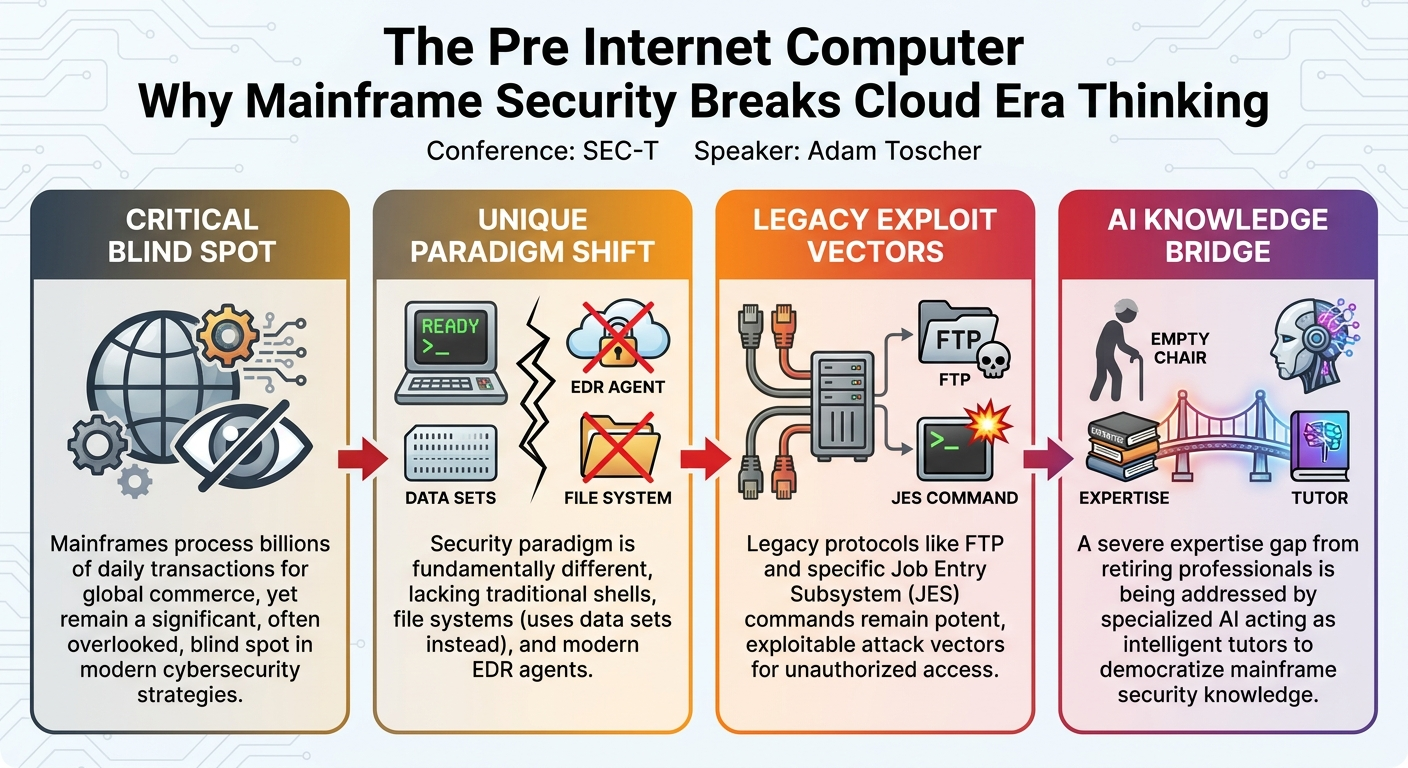
- Mainframes are Critical and Overlooked: Despite processing billions of transactions daily and underpinning global commerce, mainframes are often neglected in modern cybersecurity strategies, creating a significant blind spot for organizations.
- Unique Security Paradigm: Mainframe security is fundamentally different from cloud or Linux environments, lacking traditional shells, file systems, and EDR agents. This necessitates a distinct approach to threat modeling, detection, and response.
- Legacy Vulnerabilities Persist: Older protocols (e.g., FTP daemon) and specific job control commands (JES) remain potent attack vectors, as demonstrated by the Logica/Nordea Bank incident, and can be exploited for unauthorized access or disruption.
- The Knowledge Gap is a Crisis: The retiring generation of mainframe experts is leaving a severe void in specialized knowledge, making it increasingly difficult for organizations to secure these critical systems.
- AI as a Bridging Technology: Specialized, fine-tuned Large Language Models (LLMs) can democratize mainframe security knowledge, acting as intelligent tutors and reconnaissance agents to help new professionals understand and interact with these complex systems.
- Defensive Shift to "Trust Graph": Defenders must move beyond host-centric security to analyze "trust graphs" – the relationships between identities, jobs, data sets, and applications – to effectively understand and counter lateral movement within the mainframe environment.
About the Speaker(s)
Adam Toscher is a Security Engineer and Red Team Operator with extensive and unique experience in the field of cybersecurity. His career began as an IBM intern, providing him with firsthand exposure to mainframe technology early on. He was involved in groundbreaking work, including porting GNU/Linux to mainframes in the late 1990s, giving him a deep understanding of these complex systems.
Throughout his career, Toscher has worked across various critical sectors, including government-adjacent industries, focusing on areas such as cellular infrastructure and critical infrastructure security. He is also highly experienced in Active Directory and red teaming, where he observed a recurring problem: even highly talented red team operators would halt their engagements when confronted with mainframes, often simply taking a screenshot of the TN3270 terminal session and stopping. This observation became the driving inspiration for his talk and the development of his "Big Iron AI" tool, aimed at demystifying mainframe security and equipping the next generation of security professionals to tackle these often-overlooked but critically important systems.
Reviews
Dr. Zero (Offensive Security Researcher) — SOLID
Red teams hit a TN3270 prompt, take a screenshot for the report, and quit. Toscher is calling out this massive industry blind spot and dropping a local, fine-tuned LLM tool to translate legacy IBM mainframe output into actionable lateral movement paths. It's a highly practical bridge for a dying, yet globally critical, skillset.
Heather Calloway (CISO) — STRONG ACCEPT
Toscher exposes a massive, unquantified blind spot in enterprise risk: we rely on mainframes for our most critical transactions, yet our security teams have no idea how to test or defend them. If your red team stops at the TN3270 login screen, your penetration test is giving you a false sense of security. This is mandatory viewing for security leaders in finance, retail, and critical infrastructure.