The hype is killing kittens, but not that grumpy old cat
Edwin van Andel (CTO · Zerocopter)
SEC-T 2026 · Day 2 · Main hall
Overview
In his compelling SEC-T talk, "The hype is killing kittens, but not that grumpy old cat," Edwin van Andel, CTO of Zerocopter, delivers a poignant critique of the cybersecurity industry's relentless pursuit of "game-changing" technologies. Van Andel argues that despite continuous innovation—from early computing to the latest AI advancements—the fundamental challenges and human element of security remain stubbornly constant. He posits that new technologies often merely rebrand or shift existing vulnerabilities, rather than eradicating them, leading to a perpetual cycle of hype, panic, and eventual acceptance without true paradigm shifts.
Key moments
- 4:20 Talk thesis: Hypes and stubbornly human security
- 8:40 Captain Crunch's whistle and early phone phreaking
- 13:40 The Morris Worm: Internet's 'death' and resilience
- 14:20 Clifford Stoll: Hunting a spy for 75 cents
- 21:40 Security solutions: Solving names, not core problems
- 25:00 AI's true capabilities and limitations in security
- 28:00 Why human hackers remain indispensable
The Hype is Killing Kittens, But Not That Grumpy Old Cat
Speakers: Edwin van Andel, CTO, Zerocopter
Conference: SEC-T
YouTube: https://www.youtube.com/watch?v=sWkPX76Yaug
Overview
In his compelling SEC-T talk, "The hype is killing kittens, but not that grumpy old cat," Edwin van Andel, CTO of Zerocopter, delivers a poignant critique of the cybersecurity industry's relentless pursuit of "game-changing" technologies. Van Andel argues that despite continuous innovation—from early computing to the latest AI advancements—the fundamental challenges and human element of security remain stubbornly constant. He posits that new technologies often merely rebrand or shift existing vulnerabilities, rather than eradicating them, leading to a perpetual cycle of hype, panic, and eventual acceptance without true paradigm shifts.
Van Andel, a self-proclaimed "grumpy old hacker," uses a historical retrospective of technological "hypes" to illustrate his central thesis: human ingenuity, curiosity, and even annoyance are irreplaceable in the security landscape. He highlights that while automation and AI excel at prediction and calculation, they lack the nuanced understanding, contextual awareness, and subversive thinking that define effective offensive and defensive security work. The talk serves as a vital reminder for the industry to temper its enthusiasm for silver bullet solutions and instead focus on foundational security principles and the enduring value of human expertise.
This article delves into Van Andel's arguments, exploring the historical context, key findings, technical examples, and practical implications for defenders. It underscores his message that despite the ever-evolving technological landscape, the core of security—its problems and its solutions—will always be intrinsically human.
Background
▶ Watch: Talk thesis: Hypes and stubbornly human security (4:20)
The premise of Van Andel's talk is rooted in the observation that the cybersecurity industry is perpetually caught in a cycle of "hypes." Each new technology, from the advent of the telephone to modern AI, is heralded as a revolutionary force that will fundamentally alter the security landscape, only for the core challenges to persist or reappear in new forms. This cyclical pattern, driven by marketing and the human desire for ultimate solutions, often distracts from the enduring nature of security vulnerabilities and the critical role of human insight.
Van Andel traces this pattern through several historical epochs, demonstrating how each "world-changing" invention was quickly met with security challenges that often mirrored those of previous eras. For instance, the social engineering tactics used to exploit early telephone switchboard operators find modern parallels in phishing and pretexting. The speaker also points to the persistent existence of vulnerabilities like buffer overflows and stack overflows, first widely recognized in 1996, which continue to plague systems today, albeit in different contexts like Bluetooth stacks.
The underlying problem, as Van Andel highlights, is the tendency to seek technological fixes for what are often human or systemic failures. Companies invest heavily in new security products (firewalls, antivirus, SIEM, SOAR, XDR) that promise comprehensive protection, yet breaches continue to occur due to missed patches, weak configurations, or successful social engineering. This constant pursuit of the next big thing, without a critical understanding of its limitations or its interaction with human behavior, creates a "graveyard" of abandoned or ineffective solutions, perpetuating the cycle of security "kittens" being killed by the hype, while the "grumpy old cat" of human-driven security problems remains alive and well.
Key Findings
▶ Watch: The Morris Worm: Internet's 'death' and resilience (13:40)
Edwin van Andel's talk distills several critical insights about the nature of cybersecurity and technological advancement:
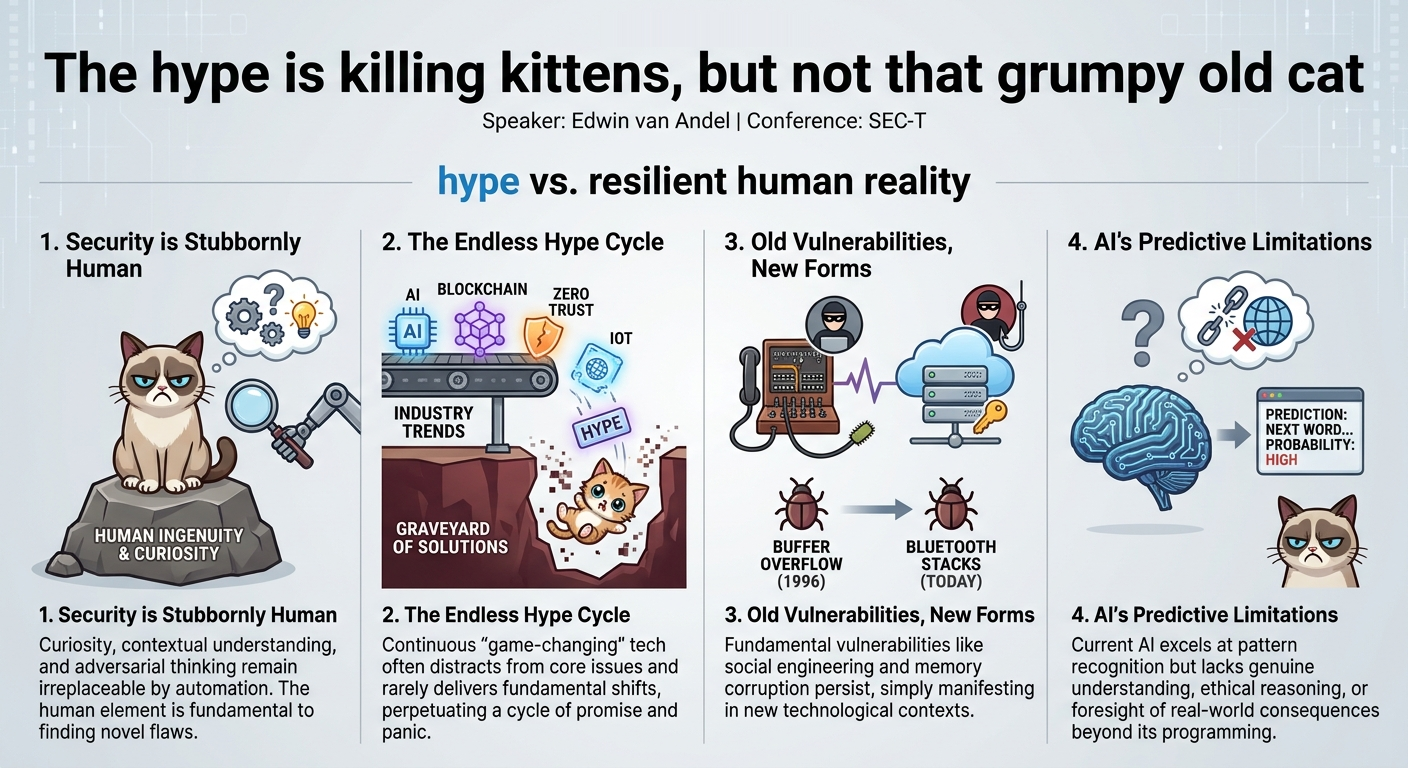
- Security Remains Stubbornly Human: This is the talk's central thesis. Despite the proliferation of automation and AI, the ability to find novel vulnerabilities, understand complex systems, and contextualize threats remains a uniquely human trait. Human curiosity, "annoyance" (the drive to understand how things truly work), and the ability to think adversarially are irreplaceable.
- Hype Cycles Are Constant and Misleading: The industry is plagued by a continuous stream of "hypes" – new technologies or methodologies proclaimed to "change everything." From cameras and telephones to blockchain and AI, these hypes rarely deliver on their promise of fundamental transformation, often just shifting or repackaging existing problems. Marketing often exaggerates capabilities, leading to unrealistic expectations and a diversion of focus from core issues.
- Old Problems Persist in New Forms: Fundamental vulnerabilities like social engineering, weak authentication, configuration errors, and memory corruption (e.g., buffer overflows) have never truly disappeared. They simply manifest in new technological contexts. An early telephone phreaker's manipulation of network tones is analogous to modern API key exploitation.
- Automated Solutions Have Inherent Limitations: Tools like automated scanners (Nessus, Satan) and even advanced AI are effective at finding known patterns or performing repetitive tasks. However, they struggle with identifying subtle anomalies, understanding complex intent, or exhibiting the creative problem-solving required for deep vulnerability research. Van Andel humorously notes scanners are "really good at" finding default passwords, open SMB, and PHP issues, but miss the bigger picture.
- AI's Current Role is Predictive, Not Consequential: Van Andel asserts that current AI is primarily adept at predicting the next word or calculating probabilities. It lacks the capacity for genuine curiosity, emotional understanding, or predicting the real-world consequences of its actions beyond its programmed parameters. This limitation makes it a powerful tool for certain tasks (like generating convincing phishing emails) but inadequate for truly autonomous, intelligent security operations that require human-like intuition and ethics.
- The Industry's Response to Crises is Often Cyclical: Historically, major security incidents (like the Morris Worm) provoke panic and pronouncements of the "internet is over," followed by the creation of new institutions (like CERT) and a return to "denialism" as the network inevitably survives. This pattern suggests a failure to learn fundamental lessons, leading to repeated cycles of vulnerability and response.
These findings collectively argue for a more grounded, human-centric approach to cybersecurity, emphasizing critical thinking, historical awareness, and the irreplaceable value of human expertise over the fleeting promises of technological "hypes."
Technical Deep Dive
▶ Watch: Clifford Stoll: Hunting a spy for 75 cents (14:20)
Van Andel's talk masterfully weaves through the history of technology, highlighting specific technical advancements and their immediate security implications, demonstrating how fundamental issues persist across different eras.
The journey begins not with computers, but with the camera in the 1700s. While seemingly benign, the camera's ability to capture images led to the identification and eventual arrest of figures like George Parker, a notorious social engineer who "sold the Brooklyn Bridge 20 times." This early example shows technology aiding in the identification of criminals, but also the vulnerability of human trust.
The telephone, invented by Graham Bell, introduced a new "hype" in the 1900s. Early telephone networks relied on human operators, who acted as the first identity providers. This human-centric system was immediately susceptible to social engineering, as exemplified by someone impersonating Barry White to speak with Frank Sinatra. The technical "fix" was the introduction of automated switches, which removed the human element from routing calls. However, this introduced a new technical vulnerability: phreaking. John Draper, known as Captain Crunch, discovered that a 2600 Hz whistle (found in cereal boxes) could trick the network into granting free international calls. This was not a zero-day or a nation-state attack, but the exploitation of a fundamental network control mechanism based on tones. Van Andel directly links this to modern systems: "We still trust a network based on the tone. We just call it an API key now. There is no difference." The famous blue boxes, built by Steve Jobs and Steve Wozniak, were hardware devices designed to automate such phreaking.
The advent of modems and remote access in the 1960s sparked another wave of panic. Dialing into networks at 300 baud, accompanied by the "computer screamed in pain" sounds, was seen as a radical new threat. Yet, this "hype" eventually became an accepted part of networking.
Then came actual computers. The ENIAC, built from 1943-1946 with 18,000 tubes and weighing 30 tons, had its security primarily based on physical security – a locked room. Its sheer size and limited access made it inherently secure from remote attack. However, as computing evolved, new vulnerabilities emerged. Punch cards, a staple of early programming, presented unique challenges: dropping a pack was an "incident," and "change management" involved changing a rubber band. In 1962, the first passwords were introduced for computer time-sharing, and almost immediately, the first password dump occurred when someone simply printed the password file. Van Andel calls this "credential stuffing on a line printer."
The formation of ARPANET and the Network Control Program (NCP) marked the beginning of interconnected computing. The first virus, Creeper, and its counter, the Reaper (an early form of antivirus), appeared shortly thereafter. Security requirements for ARPANET were hilariously simple: "have a beard and be in a university." The introduction of TCP in 1983, a foundational internet protocol, coincided with the movie "WarGames," which popularized the notion that "the only winning move is not to play" in cyber warfare.
A major turning point was the Morris Worm in 1988. This self-replicating program exploited vulnerabilities like buffer overflows and weak passwords, causing widespread disruption. The press declared the "internet is over," but the response was the creation of CERT (Computer Emergency Response Team), mailing lists, and a period of "denialism." The network, of course, survived.
Even in the mid-90s, the talk highlights the persistence of issues. Buffer overflows and stack overflows were widely publicized with tools like Frack in 1996, yet they remain a threat, simply migrating to new contexts like Bluetooth stacks. The release of Satan (Security Administrator Tool for Analyzing Networks) in 1995, an early network vulnerability scanner, caused a similar panic. It was feared to "destroy the internet" by enabling remote scanning and compromise. However, the industry "chilled," and automated scanners like Nessus became commonplace, primarily identifying low-hanging fruit: default passwords, open SMB shares, and PHP misconfigurations.
Modern examples continue this trend. Heartbleed (2014) exposed a fundamental flaw in cryptographic libraries. Equifax (2016) was a case of a "missed patch." SolarWinds (2020) highlighted the catastrophic impact of supply chain attacks combined with egregious password choices (SolarWinds123). Even a pervasive issue like Log4j (2021) is presented as a continuation of "we don't get any better."
Van Andel then pivots to AI, arguing it's the latest "hype." He acknowledges AI's strengths: predicting the next word, tireless research, and generating convincing phishing emails (due to good grammar). However, he vehemently argues its limitations:
- It cannot predict "the next consequences" beyond calculations.
- It lacks human curiosity, annoyance, and the ability to care about subtle anomalies (like Clifford Stoll's 75-cent discrepancy that led to hunting a spy).
- It can generate "brilliantly big" code that is impossible for humans to debug.
- AI-driven attacks can be inefficient, such as burning a valuable zero-day to ransom a "tiny company" when the exploit could be sold for millions.
- It contributes to the bundling of CVEs, making vulnerability triage harder.
These technical examples, spanning centuries, serve to reinforce Van Andel's core message: while technology evolves, the underlying patterns of vulnerability, exploitation, and human response remain remarkably consistent.
Demo / Proof of Concept
▶ Watch: AI's true capabilities and limitations in security (25:00)
While the talk itself is a historical narrative, Edwin van Andel intersperses it with several personal anecdotes and real-world examples that function as compelling proofs of concept for his central argument: that security remains "stubbornly human" and that basic, human-driven flaws persist even in complex systems. These aren't traditional technical demos with live code, but rather illustrative stories of how human oversight and curiosity can expose significant vulnerabilities.
- Conference CFP Bypass (The One Conference): Van Andel recounts his attempt to submit a talk to a large Dutch government conference. After filling out a lengthy form, he was met with a "contributions closed" message. His "grumpy old hacker" instinct kicked in. He noticed the submission URL contained an ID (e.g.,
.../submit?id=X). Incrementing the ID (.../submit?id=X+1) unexpectedly changed his role to a "reviewer." This privilege escalation via an IDOR (Insecure Direct Object Reference) allowed him to review other submitted talks. This simple, human-driven enumeration attack highlights a common, often overlooked vulnerability that automation might miss, but a curious hacker would find. - FIA Driver Categorization Site Admin Access: Three researchers (friends of Van Andel) investigated the FIA's driver categorization website, where individuals sign up for racing licenses. They discovered that by manipulating a parameter in the URL or request to include
role=Admin, they gained administrative access to the site. This privilege escalation allowed them to view sensitive data, including Max Verstappen's driver's license and passport. This case perfectly illustrates how a basic lack of authorization checks, a human design flaw, can lead to severe data exposure even in a high-profile organization. - Hospital Medical Device Hacking: A friend of Van Andel, a "brilliant" but sometimes "tempered" hacker, was left alone with a medical device in a hospital. Within a week, he discovered 10 CVEs in the device and gained access to an estimated 2,500 hospitals and 250,000 devices. The ultimate "proof" of compromise and the hacker's curiosity? He successfully ran Doom on the medical device. This anecdote powerfully demonstrates the impact of physical security weaknesses (leaving a device unattended) combined with dedicated vulnerability research on embedded systems. It underscores that even highly specialized, critical infrastructure can harbor fundamental flaws exploitable by human ingenuity, and that the hacker's ultimate satisfaction often comes from profound technical understanding, not just financial gain.
These examples, shared from personal experience, serve as powerful "demos" that ground Van Andel's historical narrative in contemporary reality, proving that the core principles of human-driven exploitation remain as relevant today as they were in the days of phreaking or early password dumps.
Defensive Implications
▶ Watch: Why human hackers remain indispensable (28:00)
Edwin van Andel's talk, while critical of industry trends, offers several crucial defensive implications for organizations and security professionals:
- Prioritize Foundational Security Over Hype: Defenders should critically evaluate new technologies like AI, blockchain, or "zero trust" frameworks. Instead of assuming they are silver bullets, understand their specific benefits and limitations. Core security hygiene—patching, strong authentication, secure configurations, and input validation—remains paramount, as demonstrated by incidents like Equifax and SolarWinds.
- Embrace and Foster Human Expertise: The "grumpy old cat" represents the indispensable human element in security. Organizations must invest in and empower security professionals who possess curiosity, critical thinking, and a deep understanding of systems. Automated tools are force multipliers, but they cannot replace the intuition and creativity required to find novel vulnerabilities or adapt to new threats.
- Strengthen Social Engineering Defenses: The historical recurrence of social engineering, from telephone operators to modern phishing campaigns (now enhanced by AI-generated grammar), underscores its enduring effectiveness. Comprehensive training, robust authentication mechanisms (e.g., multi-factor authentication), and a culture of skepticism are essential to combat human-centric attacks.
- Implement Robust Authorization and Access Controls: The FIA and conference CFP examples highlight the critical importance of properly implemented authorization checks. Systems must rigorously validate user roles and permissions for every action, preventing privilege escalation and IDOR vulnerabilities. Defaulting to "least privilege" is key.
- Secure Embedded and IoT Devices: The hospital device hack is a stark reminder of the security risks associated with embedded systems and IoT. Organizations, especially in critical infrastructure sectors, must prioritize vulnerability research on these devices, implement strong physical security measures, and ensure vendor security practices are thoroughly vetted.
- Be Skeptical of "AI-Driven" Claims: While AI can assist in security operations (e.g., threat intelligence, anomaly detection), defenders should be wary of claims that AI will fully automate or solve complex security problems. Understand that current AI excels at pattern recognition and prediction, but lacks the ability to understand context, consequences, or exhibit true adversarial thinking. Guard against "brilliantly big" AI-generated code that could introduce new, unmanageable vulnerabilities.
- Learn from History: A historical perspective on security "hypes" and recurring vulnerabilities can inform better defensive strategies. Understanding that buffer overflows still exist, or that password dumps are as old as passwords themselves, helps to maintain a focus on persistent threats rather than chasing fleeting trends.
- Focus on Incident Response and Resilience: Given that breaches are inevitable (the "buildings were on fire, but the dashboards were green" analogy), robust incident response plans, effective logging, and the ability to recover quickly are crucial. Denialism, as seen after the Morris Worm, is not a viable strategy.
In essence, Van Andel advocates for a pragmatic, human-centered approach to defense that respects the lessons of history, critically evaluates new technologies, and empowers skilled professionals to navigate the ever-present challenges of cybersecurity.
Key Takeaways
- Security is Fundamentally Human: The core of cybersecurity, both in offense and defense, relies on human curiosity, ingenuity, and the drive to understand (and sometimes break) systems. No amount of automation or AI can fully replace this essential human element.
- Hype Cycles Distract from Core Issues: The industry's continuous cycle of "hypes"—from modems to blockchain to AI—often overpromises revolutionary change. These trends frequently obscure the persistence of fundamental vulnerabilities like social engineering, weak authentication, and configuration flaws.
- Old Problems Reappear in New Forms: Vulnerabilities such as buffer overflows, password dumps, and privilege escalation have existed for decades. While the technologies they exploit evolve (e.g., from punch cards to Bluetooth stacks), the underlying attack vectors remain remarkably consistent.
- AI Has Significant Limitations in Security: Current AI excels at prediction and calculation but lacks human traits like contextual understanding, ethical reasoning, curiosity, or the ability to predict real-world consequences beyond its programming. Relying solely on AI for complex security tasks risks missing subtle, human-driven exploits.
- Foundational Security Practices are Paramount: Despite the allure of advanced solutions, basic security hygiene—strong passwords, timely patching, robust access controls, and diligent vulnerability research—remains the most effective defense against the majority of real-world threats.
- Critical Thinking is a Defender's Best Tool: Security professionals must maintain a critical perspective, questioning claims of "game-changing" technologies and focusing on verifiable effectiveness rather than marketing rhetoric. Learning from historical incidents and the cyclical nature of security problems can foster a more resilient defensive posture.
About the Speaker(s)
Edwin van Andel is the CTO of Zerocopter, a company focused on bug bounty programs and continuous security testing. Known affectionately as Yavapse, he identifies as a member of the "guild of the grumpy old hackers," associated with Defcon groups 672 and DC31 in the Netherlands. Van Andel is recognized for his candid and often humorous takes on the cybersecurity industry, including admitting when his own past predictions (like "pentesting is dead" due to bug bounties) were incorrect. Beyond his security roles, he recently co-founded Cheo, a marketing agency, which notably designed the Defcon badge for the current year, showcasing his diverse talents and entrepreneurial spirit. His talks are characterized by a deep historical perspective and a strong emphasis on the enduring human element in security.
Reviews
Dr. Zero (Offensive Security Researcher) — WEAK
Van Andel gets on stage to state the blindingly obvious: AI is mostly marketing bullshit and we're still failing at basic access control. It's an entertaining historical retrospective that hits the right philosophical notes about the industry's hype cycle. You won't learn a single new technique here, but it's a solid, necessary reality check for the vendor-obsessed crowd.
Heather Calloway (CISO) — SOLID
A necessary, if familiar, reminder that vendor hype cycles do not fix fundamental business risk. Van Andel correctly diagnoses that while technology changes, the root causes of our breaches—missed patches, weak authorization, and human error—remain constant.