Veilid: The Private Internet we were all promised
BiaSciLab
SEC-T 2026 · Day 3 · Main hall
Overview
In an era dominated by corporate data harvesting and pervasive surveillance, the promise of an open, free, and private internet often feels like a distant dream. BiaSciLab's compelling talk at SEC-T, "Veilid: The Private Internet we were all promised," introduces a groundbreaking project aiming to reclaim this lost vision. Veilid, a portmanteau of "veil," "valid," and "identity," is an open-source, peer-to-peer (P2P), mobile-first networked application framework designed to fundamentally rebuild the internet with privacy and security at its core.
Key moments
- 0:00 Speaker Introduction and Veilid background
- 2:24 Why the Cult of the Dead Cow created Veilid
- 4:33 Veilid's mission: Defending human and civil rights
- 11:00 How Veilid differs from Tor, IPFS, and blockchain
- 15:53 Veilid Chat app: showcasing privacy and UX
- 18:30 Understanding Veilid's private communication routing
- 24:44 Veilid's future roadmap and how to contribute
- 29:00 Q&A: What if a privacy node goes down?
Veilid: The Private Internet we were all promised
Speakers: BiaSciLab
Conference: SEC-T
YouTube: https://www.youtube.com/watch?v=8ung6ooAL7w
Overview
In an era dominated by corporate data harvesting and pervasive surveillance, the promise of an open, free, and private internet often feels like a distant dream. BiaSciLab's compelling talk at SEC-T, "Veilid: The Private Internet we were all promised," introduces a groundbreaking project aiming to reclaim this lost vision. Veilid, a portmanteau of "veil," "valid," and "identity," is an open-source, peer-to-peer (P2P), mobile-first networked application framework designed to fundamentally rebuild the internet with privacy and security at its core.
Developed by the legendary Cult of the Dead Cow (CDC), a hacker group founded in 1984, Veilid stands as a direct response to the current digital landscape where users' private information is routinely monetized through opaque end user license agreements (EULA). BiaSciLab, a 19-year-old cybersecurity prodigy and member of the CDC, articulates Veilid's mission: to provide a platform where anyone can communicate safely without compromising their identity or location, asserting that privacy is a fundamental human right. The project’s nonprofit status ensures it will never monetize user data, setting it apart from virtually every major tech company.
This talk is particularly significant because it not only diagnoses the critical flaws in the modern internet — from pervasive tracking to the neglect of security in application development — but also offers a tangible, user-friendly solution. Veilid aims to empower developers to build privacy-focused applications by abstracting away the complexities of secure communication, while simultaneously making these applications accessible and intuitive for the general public, including non-technical users. It represents a collective effort to shift from an "opt-out" world of surveillance to an "opt-in" paradigm of true digital autonomy.
Background
▶ Watch: Speaker Introduction and Veilid background (0:00)
The internet, in its nascent stages, was envisioned as a realm of open and free collaboration, primarily utilized by scientists for sharing knowledge and expanding digital frontiers. This utopian ideal, however, has been systematically eroded. Today, the digital landscape is dominated by large corporations that profit immensely from collecting and selling users' private information. This pervasive data exploitation is largely facilitated by the end user license agreement (EULA), a legal document that most users blindly accept, granting applications 24/7 access to sensitive device features like microphones, keystrokes, and camera rolls. As BiaSciLab highlights, the vast majority of users, particularly non-technical individuals, are unaware of what they are agreeing to, transforming privacy into an afterthought rather than a default.
This "opt-out" world forces users to actively disable tracking settings, a task many are either unwilling or unable to perform. The consequence is a collective ignorance regarding the profound impact of personal data collection, leading to a dangerous complacency about digital privacy. Furthermore, the current software development paradigm often treats security and privacy as secondary concerns, to be addressed "later" – a promise that rarely materializes effectively. Existing privacy-focused tools, such as Tor, while valuable to the security-minded, are often too complex, slow, or intimidating for the average person, failing to achieve widespread adoption.
Against this backdrop, the Cult of the Dead Cow (CDC) embarked on the Veilid project. Founded in 1984, the CDC has a long history of advocating for digital rights and developing tools that challenge the status quo, including releasing the first Windows Trojan (Back Orifice) to highlight security vulnerabilities. Veilid is their ambitious attempt to "take back the internet" by providing a robust, user-friendly platform and protocol that ensures privacy and security are baked in from the ground up. This initiative is born from the recognition that individuals should not have to be cybersecurity experts to navigate the internet safely, and that a truly private internet is a prerequisite for defending fundamental human and civil rights.
Key Findings
▶ Watch: Veilid's mission: Defending human and civil rights (4:33)
Veilid represents a significant departure from conventional internet architectures, offering a fundamentally new approach to privacy and security. Its core contributions and findings can be summarized as follows:
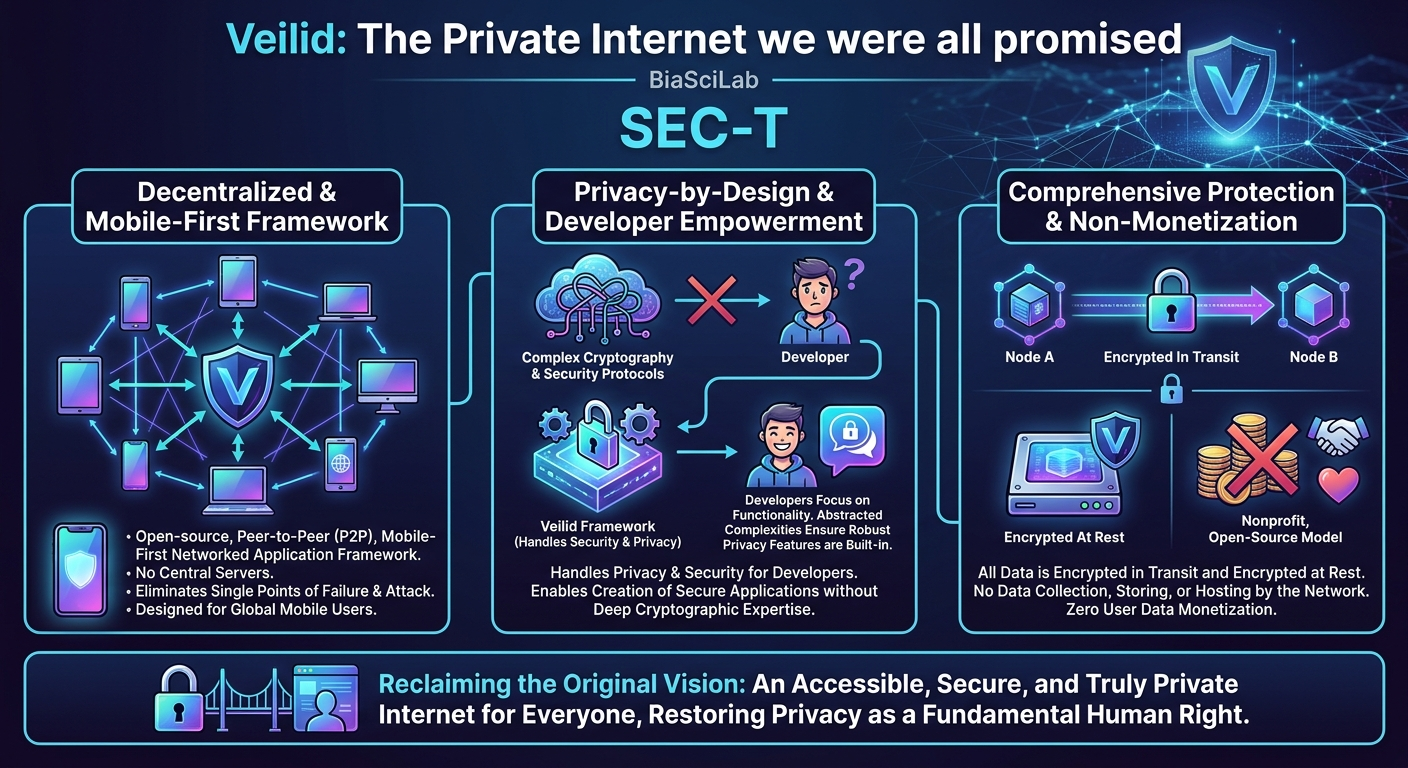
- Open Source, Peer-to-Peer, Mobile-First Framework: Veilid is a fully open-source, peer-to-peer (P2P) networked application framework. This design means there are no central servers or middlemen, eliminating single points of failure and attack. Its mobile-first approach is a strategic decision, acknowledging that the majority of global internet users access the web via mobile devices, a demographic often underserved by traditional privacy tools developed primarily for desktops.
- Built-in Privacy and Security for Developers: A key innovation is Veilid's ability to handle privacy and security for the developers. This allows app builders to focus on functionality and user experience, rather than grappling with complex cryptographic implementations or network security protocols. Veilid abstracts these critical concerns, ensuring that all applications built on its framework inherit robust privacy features by design.
- Nonprofit and Anti-Monetization Model: Veilid is officially a nonprofit project. This institutional structure guarantees that it can never, and will never, monetize user data. Unlike profit-driven tech companies that eventually resort to selling user information to cover infrastructure costs, Veilid's model removes this incentive entirely, aligning its goals directly with user privacy.
- Cross-Platform Compatibility and Accessibility: Built primarily on Rust, Veilid achieves exceptional cross-compilation capabilities, meaning applications can run seamlessly across diverse operating systems including Windows, macOS, Linux, Android, iOS, and WebAssembly. It provides a user-friendly Python API for backend development and leverages Flutter and Dart for intuitive mobile and desktop UI development, making it accessible to a broader range of developers, including those with less programming experience.
- No Tracking, No Storing, No Hosting: Veilid is designed so that the framework itself does not store or host any user data. Consequently, it performs no tracking whatsoever. This architecture fundamentally prevents the collection and aggregation of user information by the network maintainers, offering an unprecedented level of data sovereignty.
- Upgradable and Backwards-Compatible Cryptography: Recognizing that cryptographic standards evolve and can be broken over time, Veilid features an upgradable crypto system that is also backwards compatible. This ensures that as new cryptographic techniques emerge or existing ones are deprecated, the network can adapt without fragmenting the user base, allowing older nodes (e.g., Veilid 0 nodes) to remain part of the network until their sunset.
- Comprehensive Encryption: All data on the Veilid network is encrypted in transit, as expected for secure communication. Crucially, it is also encrypted at rest. This means that even if a user's device is lost or compromised, their data remains inaccessible to unauthorized parties, a critical safeguard against personal data breaches.
- Node Equality and Decentralization: The network consists of two types of nodes: app nodes (running a Veilid application) and appless nodes or headless nodes (running Veilid without an application). All nodes are equal, meaning no single node possesses more power or hierarchical authority than another, further enhancing decentralization and resilience against censorship or attack. Spinning up an appless node is remarkably simple, taking "literally 5 minutes," and contributes directly to the network's strength.
These findings collectively demonstrate Veilid's commitment to building a genuinely private, secure, and accessible internet infrastructure, addressing the systemic privacy failures of the current digital age.
Technical Deep Dive
▶ Watch: Veilid Chat app: showcasing privacy and UX (15:53)
Veilid's technical architecture is a sophisticated blend of modern programming languages, established network protocols, and innovative routing mechanisms, all geared towards achieving unparalleled privacy and security without sacrificing performance or usability.
At its foundation, Veilid is built using Rust, a systems programming language known for its memory safety, performance, and concurrency. This choice is pivotal for Veilid's ability to cross-compile and run natively on virtually all major platforms, including Windows, macOS, Linux, Android, iOS, and WebAssembly. This broad compatibility ensures that Veilid applications can reach a massive user base across diverse devices. For developers, Veilid offers a user-friendly Python API, simplifying interaction with the core framework. Mobile and desktop applications leverage Flutter and Dart for their front-end development, allowing for consistent and performant UI across platforms.
The core of Veilid's network is a peer-to-peer (P2P) system composed of numerous equal nodes. Unlike traditional client-server models that rely on centralized infrastructure prone to surveillance and single points of failure, Veilid routes all traffic through its distributed network. Developers build applications on top of this framework, and Veilid handles the underlying privacy and security mechanisms. This includes using established communication protocols within an "all-in network," meaning no external services are required for communication, significantly reducing potential attack vectors and points of failure.
Veilid employs a unique routing mechanism to ensure anonymity and privacy. When a user (e.g., "me") wants to communicate with another user (e.g., "my friend"), each user first establishes a trusted privacy node. This node is chosen for its reliability, speed, and age on the network. Veilid then generates a public key for each account, bundled with the chosen privacy node, into a sharable link or QR code. When "me" sends a message to "my friend," the message is routed through "my" safety node (which hides the origin) to "my friend's" privacy node, and then to "my friend's" device. This connection involves only three hops: "Me" -> "My safety node" -> "Friend's privacy node" -> "Friend."
Crucially, each node in this chain only knows two pieces of information: the node from which it received a packet and the node to which it must send the packet next. It does not know its position within the overall connection chain (start, middle, or end), nor does it have knowledge of the original sender or final recipient. This "need-to-know" basis is a cornerstone of Veilid's privacy guarantees.
Establishing an initial connection involves a discovery process. When a user first joins the Veilid network, they connect to a bootstrap server which provides a list of a few cryptographically close nodes – nodes whose public keys are mathematically near the user's own. If the target privacy node (e.g., "my friend's" privacy node with public key 24) is not on this initial list, the user queries the closest known node (e.g., node 16). Node 16 might not know node 24 directly but can direct the user to a closer node (e.g., node 23). This iterative process of querying cryptographically closer nodes continues until the target privacy node is located, allowing the connection to be established.
The encryption scheme in Veilid is reminiscent of Tor (the onion router), earning it the moniker "Ogre routing" (referencing Shrek's layers). As a message traverses the Veilid network, it is wrapped in multiple layers of encryption. Each node in the path uses its private key to decrypt only the outermost layer, revealing the address of the next hop. This ensures that no single node can see the entire message path or its contents, with the final layer being stripped only upon arrival at the intended recipient. Beyond transit, all data is also robustly encrypted at rest, protecting information even if a device is physically compromised.
Veilid distinguishes itself from other privacy tools. It is not a proxy or a direct replacement for Tor, though it shares inspiration from onion routing. It is not IPFS, and it explicitly avoids blockchain technology or crypto coins, which the speaker humorously calls "a little gross." Key differentiators include its speed (it's designed to be much faster than Tor), its 100% privacy-first design, and its "human element" – a focus on user-friendliness to ensure adoption by everyday, non-technical users. The use of a Distributed Hash Table (DHT), as seen in the Tail Veil project (a Tailscale-like P2P VPN built on Veilid), further exemplifies its advanced capabilities for storing authentication and access control data in a decentralized manner.
Looking ahead, Veilid is continually evolving. Veilid Framework 1.0 and Veilid Chat 1.0 are slated for release in Q2 of next year, alongside Private Routing 2.0 and crucial post quantum support to future-proof against advancements in quantum computing.
Demo / Proof of Concept
▶ Watch: Understanding Veilid's private communication routing (18:30)
The core proof of concept demonstrated in the talk is the Veilid Chat application, developed by the Veilid team itself. This application serves as a prime example of what can be built on the Veilid framework and how it delivers on its promise of user-friendly privacy.
The design philosophy behind Veilid Chat prioritizes both robust privacy and an intuitive user experience. The UI was considered "just as important, if not even more important than the technical bits," ensuring that non-technical users, like a "grandma," would find it as familiar and easy to use as popular messaging apps like WhatsApp. The initial setup features a "vaporwave aesthetic" and a straightforward profile creation process, asking for basic information like name and pronouns, akin to any social media platform. It also supports familiar features such as group chats.
To unequivocally prove its privacy claims, the talk highlights Veilid Chat's privacy policy, which explicitly states:
- "What information do we collect? Valid chat collects no information from you."
- "How do we process your information? We don't. Valid chat does not collect your information, nor are we able to collect it."
- "What legal basis do we rely on to process your information? Valid chat does not process any personal information."
- "When and with whom do we share your personal information? In no way, shape, or form do we ever share your personal information. We cannot share what we do not retain or what we cannot access."
This transparent and absolute commitment to zero data collection is a stark contrast to virtually all mainstream communication platforms. The speaker even demonstrated a successful chat with her non-technical mother, underscoring its ease of use. Furthermore, Veilid Chat includes extensive customization options for aesthetics (e.g., changing themes from the default pink) and accessibility needs, such as text size adjustments, read-aloud functions, and color/font changes, reinforcing its goal of being "for everyone."
The talk also provided a simplified visual demonstration of how two users communicate on the Veilid network using Veilid Chat. Each user selects a trusted privacy node and a safety node. A sharable link or QR code containing the user's public key and their privacy node's address is exchanged. When a message is sent, it routes from the sender's device, through their safety node, to the recipient's privacy node, and finally to the recipient's device. This three-hop connection ensures that neither party knows the other's physical location or device information, and the intermediate nodes only know the previous and next hop in the chain, maintaining strict anonymity. The process of discovering a recipient's privacy node via a bootstrap server and querying cryptographically close nodes was also clearly illustrated, showing how connections are established securely and privately across the distributed network.
Defensive Implications
▶ Watch: Q&A: What if a privacy node goes down? (29:00)
Veilid offers profound defensive implications for both individuals and the broader cybersecurity landscape. Its design principles directly address many of the vulnerabilities and privacy infringements prevalent in today's internet.
For developers, Veilid simplifies the creation of secure and private applications. By abstracting away the complexities of cryptography, secure routing, and data handling, Veilid allows developers to build privacy-focused tools without needing to be security experts themselves. This means that more applications can be developed with privacy by design, rather than as an afterthought. Integrating Veilid into new projects can drastically reduce the attack surface related to data collection, central server compromises, and user tracking, providing a robust foundation for ethical software development. The existence of projects like Tail Veil, a Tailscale-like P2P VPN built on Veilid's DHT, showcases its utility for building secure infrastructure components that are resilient to single-point-of-failure attacks.
For end-users, Veilid provides a crucial alternative to the data-hungry services that dominate the market. By using applications built on Veilid, individuals can communicate and share information with confidence that their data is not being collected, stored, or sold. The guarantee of encryption in transit and at rest means personal information remains secure even if devices are lost or network traffic is intercepted. The user-friendly design of applications like Veilid Chat ensures that these privacy benefits are accessible to everyone, regardless of technical proficiency, moving beyond the niche appeal of tools like Tor. This empowers individuals to reclaim their digital privacy as a human right, particularly vital in contexts where surveillance or censorship is a threat.
Beyond direct usage, individuals can actively contribute to the network's resilience by spinning up appless nodes (or headless nodes). This process is described as taking "literally 5 minutes" and requires minimal technical skill (essentially copy-pasting commands from GitLab). Each additional node strengthens the peer-to-peer network, enhancing its decentralization, speed, and resistance to attack or disruption. Even passively using Veilid applications contributes to the network by acting as an app node. This collective participation fosters a more robust and distributed "private internet."
Finally, Veilid serves as a powerful model for the future of internet architecture. Its nonprofit status and explicit stance against data monetization set a standard for ethical development. By being fully open source, it encourages scrutiny, community contributions, and continuous improvement, ensuring transparency and trustworthiness. As quantum computing advances, Veilid's commitment to post quantum support demonstrates foresight in anticipating future threats and proactively building defenses. Veilid encourages a shift from passive acceptance of surveillance to active participation in building a more secure and private digital future.
Key Takeaways
- Privacy as a Human Right: Veilid's fundamental mission is to re-establish privacy as a default on the internet, asserting it as a non-negotiable human right, especially critical in an era of pervasive data exploitation and global conflicts.
- Decentralized, Peer-to-Peer Architecture: Veilid is an open-source, peer-to-peer (P2P) networked application framework that eliminates central servers and middlemen, enhancing security, resilience, and user data sovereignty.
- Privacy-by-Design for Developers: The framework handles core privacy and security mechanisms, allowing developers to build secure applications without deep cryptographic expertise, fostering a new generation of privacy-focused software.
- Comprehensive Data Protection: All communications are encrypted in transit, and all data is encrypted at rest, ensuring that user information is protected from interception and device compromise, with no data collected, stored, or tracked by the Veilid network itself.
- Accessibility for Everyone: Designed with a "mobile-first" approach and user-friendly interfaces (as demonstrated by Veilid Chat), Veilid aims to make private communication accessible and intuitive for non-technical users, including "grandmas," bridging the gap between advanced security and everyday usability.
- Community-Driven and Future-Proof: As a nonprofit and open-source project, Veilid relies on community contributions for development, documentation, and network expansion (e.g., spinning up appless nodes), with ongoing efforts for performance enhancements and post quantum support.
About the Speaker(s)
The talk was delivered by BiaSciLab, whose real name is Bianca. At 19 years old, she proudly identifies as the youngest speaker at SEC-T, bringing a fresh and energetic perspective to complex cybersecurity topics. Her hacker handle, BiaSciLab, is a blend of her name (Bia), science (Sci), and laboratory (Lab), reflecting her passion for scientific exploration that transitioned into computers.
BiaSciLab is an accomplished international speaker, having presented globally on diverse cybersecurity subjects, including election security, social media psyops, psychological warfare, women in tech, and the next generation in technology. She is the founder and CEO of Girls Who Hack, a nonprofit organization dedicated to providing free online and in-person introductory cybersecurity classes for young girls and women.
Beyond her own initiatives, BiaSciLab plays a significant role in fostering the next generation of hackers. She runs DC NextGen, the official DEF CON Youth track, which in its third year attracted over 400 young attendees. She also collaborates with The Hacking Games, an organization working to guide young individuals interested in hacking towards ethical paths and career opportunities. A notable affiliation highlighted in her talk is her membership in the Cult of the Dead Cow (CDC), one of the world's oldest and most influential hacker groups, underscoring her deep roots and credibility within the hacker community. BiaSciLab's work consistently emphasizes the importance of education, community, and ethical engagement in the realm of cybersecurity.
Reviews
Dr. Zero (Offensive Security Researcher) — SOLID
BiaSciLab walks through Veilid, the Cult of the Dead Cow's new Rust-based P2P application framework. It actually attempts to build a private overlay network without strapping a useless blockchain token to it. Strong architectural release that abstracts onion routing so mobile developers stop rolling their own broken crypto.
Heather Calloway (CISO) — SOLID
BiaSciLab introduces Veilid, a P2P application framework from the Cult of the Dead Cow designed to eliminate centralized data collection. It’s a well-executed technical overview of a privacy-first protocol. For enterprise leaders, however, it represents a looming headache for eDiscovery, data loss prevention, and compliance.