Root From Kilometers Away: Ubiquiti AirMax RCE
Gastón Aznarez (Principal Security Researcher · Faraday Security), Dan Borgogno (Security Researcher · Faraday Security)
SEC-T 2026 · Day 3 · Main hall
Overview
In an illuminating talk at SEC-T, Gastón Aznarez and Dan Borgogno from Faraday Security unveiled critical Remote Code Execution (RCE) vulnerabilities affecting Ubiquiti's widely deployed AirMax wireless devices. This presentation, titled "Root From Kilometers Away," details a journey from initial curiosity to discovering severe, unauthenticated, over-the-air RCE with kernel privileges across a significant portion of Ubiquiti's product line. The implications are profound, given that these devices form the backbone of network infrastructure for ISPs, surveillance systems, critical national infrastructure, and even military deployments globally.
Key moments
- 4:30 Easy root access and old Linux kernel
- 8:30 AirMax: Ubiquiti's proprietary TDMA over Wi-Fi
- 18:00 Weak AES-ECB encryption using MAC addresses
- 25:00 Live demo: Remote Code Execution with kernel privileges
- 27:00 Critical CVE impact & bug bounty 'adjacent' dispute
- 31:30 Demonstrating 1.72 km remote code execution range
- 36:00 Full exploit demo: Persistent root access via provisioning
- 38:00 Post-exploitation capabilities and wormable potential
Root From Kilometers Away: Ubiquiti AirMax RCE
Speakers: Gastón Aznarez (Principal Security Researcher, Faraday Security); Dan Borgogno (Security Researcher, Faraday Security)
Conference: SEC-T
YouTube: https://www.youtube.com/watch?v=bAPZdgGQEd4
Overview
In an illuminating talk at SEC-T, Gastón Aznarez and Dan Borgogno from Faraday Security unveiled critical Remote Code Execution (RCE) vulnerabilities affecting Ubiquiti's widely deployed AirMax wireless devices. This presentation, titled "Root From Kilometers Away," details a journey from initial curiosity to discovering severe, unauthenticated, over-the-air RCE with kernel privileges across a significant portion of Ubiquiti's product line. The implications are profound, given that these devices form the backbone of network infrastructure for ISPs, surveillance systems, critical national infrastructure, and even military deployments globally.
The research highlights the inherent risks of proprietary protocols built on top of common standards like Wi-Fi, especially when coupled with outdated software and weak security practices. Aznarez and Borgogno demonstrated how a custom TDMA implementation by Ubiquiti, despite appearing encrypted, harbored fundamental flaws that allowed attackers to gain full control of devices from distances far exceeding typical Wi-Fi ranges. Their work not only exposed critical vulnerabilities (assigned two CVEs) but also challenged the industry's perception of "adjacent" attack vectors, proving that "line of sight" can extend for miles.
This talk serves as a stark reminder for both users and vendors about the importance of thorough security auditing, responsible disclosure, and maintaining up-to-date software in embedded systems. The ability to achieve root access on millions of devices, often forming essential communication links, underscores the potential for widespread disruption and compromise, ranging from network sniffing and traffic manipulation to full control over critical infrastructure.
Background
▶ Watch: Easy root access and old Linux kernel (4:30)
The journey into Ubiquiti AirMax devices began with a simple observation: these antennas are ubiquitous. Ubiquiti, a major player in wireless networking, estimates having sold 60 million devices worldwide, with approximately 37 million being AirMax products. These devices are designed for point-to-point or point-to-multipoint communications, operating on unlicensed spectrum, and are crucial for various applications including general network connectivity, CCTV surveillance, critical infrastructure, and even military communications. The sheer scale and criticality of their deployment immediately piqued the researchers' interest.
Initial reconnaissance involved acquiring several cheap Ubiquiti devices, such as NanoBeams and LightBeams, to build a lab environment. The first steps revealed an astonishing lack of basic security: connecting via UART to the device's serial console or even just SSH on the same network provided root access using the same credentials configured by the user. Further investigation showed these devices run on an extremely old Linux kernel 2.6.32, a version dating back to 2009. Compounding this, many standard user and kernel space mitigations were entirely disabled, making exploit development significantly easier. This immediate root access allowed the researchers to run "Doom" on the antennas, a humorous but telling demonstration of the control they had.
A crucial observation came from the web interface, which could scan for nearby AirMax devices and display unique information, such as the device name, not visible through standard Wi-Fi scanning tools like aircrack-ng. This suggested a proprietary protocol at play. By flashing OpenWRT onto a LightBeam and inspecting the underlying Atheros 9340 chipset, the researchers confirmed that the standard Wi-Fi drivers did not expose this unique information. This led to the conclusion that the AirMax protocol was implemented entirely in the device's firmware, a custom layer built on top of standard Wi-Fi. The historical context of TDMA implementations and the evolution of Atheros open-source drivers (specifically ATH5K and ATH9K) further explained why Ubiquiti adopted this approach around 2010, leveraging cheaper hardware and open-source advancements to build their proprietary solution. This custom firmware layer became the primary target for their in-depth analysis.
Key Findings
▶ Watch: Weak AES-ECB encryption using MAC addresses (18:00)
The core discovery was the existence and structure of the proprietary AirMax protocol, a TDMA (Time Division Multiple Access) implementation operating directly over standard Wi-Fi (802.11). Unlike traditional Wi-Fi, TDMA allocates specific time slots for each client to transmit and receive, enabling stable, high-latency communication over very long distances without interference. This protocol is not new, with predecessors like Motorola Canopy dating back to 2001, but Ubiquiti's implementation was unique and custom-built.
The researchers found that AirMax leverages vendor-specific Information Elements (IEs) within standard Wi-Fi management frames (Beacons, Probe Request/Response, Association, Authentication, and Action frames). These IEs, identifiable by a tag (Type 221) and an Organization Unique ID (OUI), allow vendors to embed custom data without breaking compatibility with standard Wi-Fi clients. By using Wireshark, they observed these custom IEs carrying critical device information.
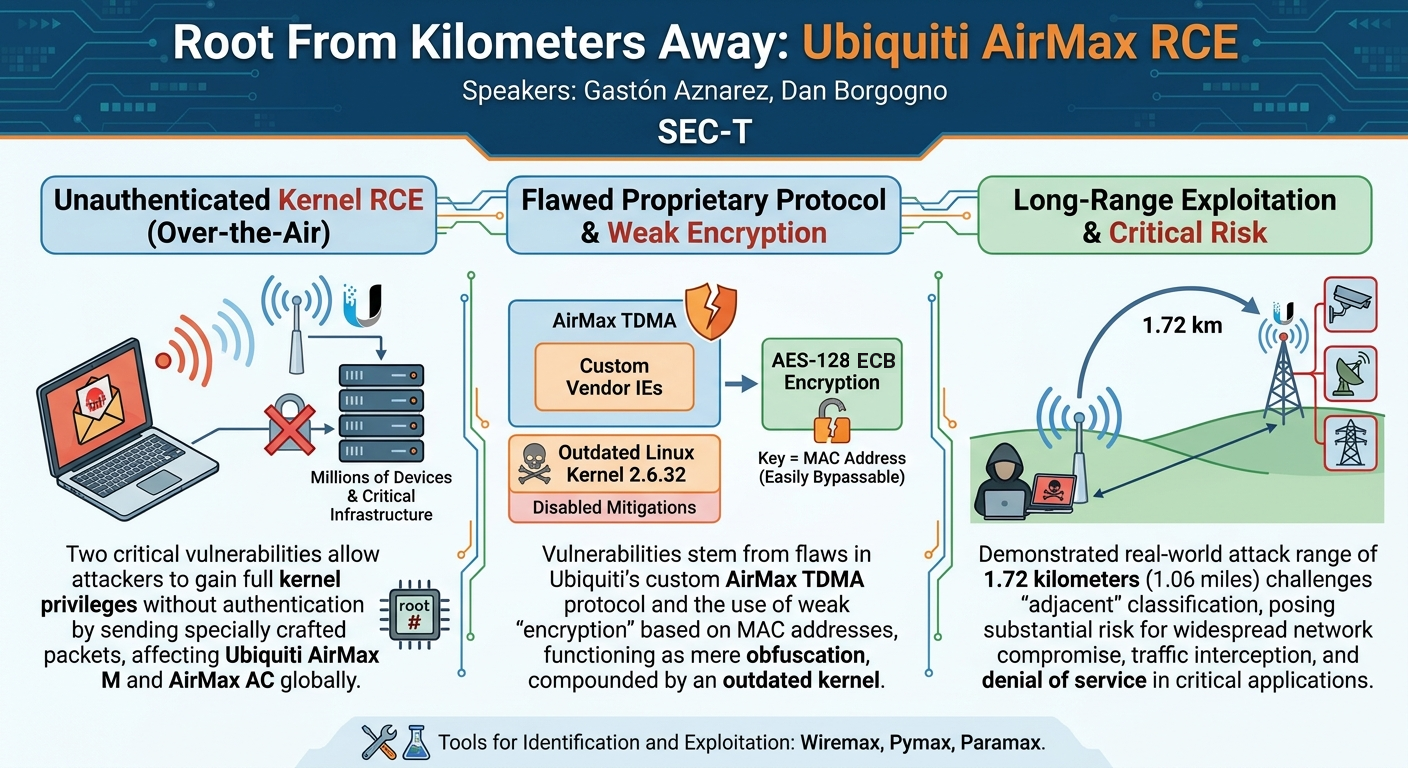
Two distinct AirMax protocol versions were identified: AirMax M (older, found in NanoBeams) and AirMax AC (newer, in LightBeams). Both versions embed device metadata, but AirMax AC includes a plaintext header followed by what appeared to be encrypted data. Crucially, the "encryption" mechanism was found to be AES-128 ECB, a weak cipher mode, where the encryption key was derived directly from the source and destination MAC addresses of the message. This meant that all necessary information to decrypt the data was available within the unencrypted Wi-Fi frame header, rendering the encryption effectively a form of obfuscation or a "speed bump" rather than true security.
The reverse engineering effort pinpointed two key kernel modules responsible for the AirMax functionality: uvnt_mac and uvnt_poll. uvnt_mac was identified as a modified fork of the ATH9K driver, while uvnt_poll contained the core AirMax logic for parsing and inserting these custom Information Elements. This tight integration within the kernel, combined with the vulnerable parsing logic of the custom protocol and the weak "encryption," created a fertile ground for Remote Code Execution, allowing crafted packets to trigger arbitrary code execution with kernel privileges.
Technical Deep Dive
▶ Watch: Critical CVE impact & bug bounty 'adjacent' dispute (27:00)
The technical foundation of the AirMax RCE lies in its unique implementation of a proprietary protocol over standard 802.11 Wi-Fi. Wi-Fi communication is structured around different frame types: management, control, and data. The AirMax protocol primarily abuses management frames, specifically Beacons, Probe Requests/Responses, Authentication, Association, and Action frames. These frames contain a header, a body, and a trailer. The body includes fixed parameters and tag parameters, known as Information Elements (IEs), which follow a TLV (Tag, Length, Value) format.
Standard IEs might carry an SSID (Tag 0), but the critical vulnerability surface emerged from vendor-specific IEs (Tag 221). These IEs include an Organization Unique ID (OUI) and a vendor-specific type, allowing manufacturers to insert custom data. While standard Wi-Fi devices ignore unknown IEs, AirMax devices are specifically programmed to parse and act upon them. This mechanism is what Ubiquiti used to implement their TDMA layer.
The researchers identified two generations of the AirMax protocol:
- AirMax M: The older protocol, found on devices like the NanoBeam, uses two distinct IEs. One carries the device name, while the other contains additional, sometimes encrypted, information.
- AirMax AC: The newer protocol, prevalent in LightBeam devices, consolidates information into a single IE. This IE begins with a plaintext header (containing flags, message type, and length), followed by encrypted data. This encrypted section includes vital details such as the protocol version, the source MAC address, the radio name, the device name (referred to as the TCD beacon), the network SSID, and crucially, the firmware name and version, especially within association requests and responses.
The "encryption" employed for these IEs was a significant point of failure. Ubiquiti used AES-128 ECB (Electronic Codebook mode), a weak cipher mode, where the encryption key was derived directly from the source and destination MAC addresses present in the unencrypted Wi-Fi frame header. This design choice meant that any passive listener could easily reconstruct the key and decrypt the payload. In essence, it was not true encryption but rather obfuscation, providing a "speed bump" for casual inspection but no real security barrier against a determined attacker.
The reverse engineering process delved into the device's Linux kernel modules. The core AirMax functionality was found within two modules:
uvnt_mac: This module was identified as a heavily modified fork of the open-source ATH9K driver, responsible for low-level interaction with the Atheros 9340 Wi-Fi chipset. It was instrumented with hooks to interact with the proprietary AirMax protocol.uvnt_poll: This module contained the core logic for the AirMax protocol itself. It implemented the parsing of incoming vendor-specific IEs from management frames and the insertion of outgoing AirMax IEs into frames before transmission. Whenuvnt_macreceived a management frame, it would call a hook inuvnt_pollto process any embedded AirMax IEs. Conversely, whenuvnt_macneeded to send an AirMax message (like a beacon), it would calluvnt_pollto construct and insert the relevant IEs.
The vulnerability stems from flaws in how uvnt_poll parses these custom Information Elements. By crafting malicious AirMax packets with specially malformed IEs, the researchers could trigger memory corruption vulnerabilities within the kernel modules. Given the antiquated Linux kernel 2.6.32 and the absence of modern exploit mitigations (such as ASLR, DEP, or stack canaries), exploiting these kernel-level vulnerabilities for Remote Code Execution was significantly simplified. The ability to send these crafted packets over-the-air, unauthenticated, and with line of sight enabled attackers to achieve full kernel privileges on target devices. The researchers also noted that while the authentication frames used a more secure key derived from the 4-way handshake, the critical information (like firmware version) was often transmitted in earlier, unencrypted association requests, providing valuable fingerprinting data for attackers.
Demo / Proof of Concept
▶ Watch: Demonstrating 1.72 km remote code execution range (31:30)
The researchers provided compelling demonstrations of their Remote Code Execution capabilities, both in a controlled lab setting and in real-world urban environments.
Their initial RCE proof-of-concept involved causing a target device to reboot simply by sending a specially crafted AirMax packet. This was demonstrated using a laptop with a cheap USB network adapter in monitor mode, connected to a NanoBeam, with a Bus Pirate attached to the device's UART port to observe kernel logs during the exploitation. This setup confirmed that malformed AirMax packets could indeed trigger kernel-level crashes.
The more advanced and impactful demonstration showcased full, unauthenticated RCE with kernel privileges. Using a LightBeam AirMax AC antenna as the target and a standard laptop with a USB Wi-Fi adapter as the attacker, the process unfolded as follows:
- Scanning and Selection: A Python script was run on the attacker's laptop, which put the Wi-Fi adapter into monitor mode and began scanning for vulnerable AirMax devices by dissecting their custom IEs.
- Packet Crafting and Injection: Once a vulnerable device was identified, the script crafted and injected malicious AirMax packets. These packets were designed to execute specific commands on the target's kernel.
- SSH User Creation: The first command executed created a new SSH user with a predefined password hash directly on the device's operating system.
- Provisioning Mode Activation: The next command forced the target antenna into "provisioning mode." This special mode causes the AirMax device to temporarily broadcast an open Wi-Fi network for easy management. The SSID of this network was uniquely identifiable, often including the device's name and MAC address.
- Connection and Root Shell: The attacker's laptop then switched its Wi-Fi adapter from monitor mode to managed mode, connected to the newly created open Wi-Fi network broadcast by the target antenna, and finally established an SSH connection using the newly created credentials. This granted the researchers a full root shell on the compromised device.
A critical aspect of their demonstration was challenging Ubiquiti's classification of the vulnerability as "adjacent," implying a limited attack range. The team assembled a portable exploitation kit, consisting of a Raspberry Pi, a motorbike battery, and a Ubiquiti antenna, all discreetly housed in a box (humorously likened to Solid Snake's stealth tactics). They then walked through the streets of Buenos Aires, successfully exploiting target antennas from distances of 1.5 kilometers. Pushing the limits further in Puerto Madero, an area with a long line of sight, they achieved a remarkable 1.72 kilometers (over a mile) of RCE. This real-world proof unequivocally demonstrated that the attack range was far greater than what Ubiquiti's "adjacent" classification suggested, highlighting the widespread theoretical exploitability from immense distances, even referencing a record Wi-Fi reception from 7,445 kilometers.
Defensive Implications
▶ Watch: Post-exploitation capabilities and wormable potential (38:00)
The discovery of Remote Code Execution vulnerabilities in Ubiquiti AirMax devices carries significant defensive implications for network administrators, ISPs, and critical infrastructure operators worldwide.
- Immediate Patching: Ubiquiti responded swiftly to the responsible disclosure, releasing patches for affected AirMax M and AirMax AC products within 10 days of the vulnerability report via their HackerOne platform. The most critical defensive action is to ensure all AirMax devices are updated to the latest firmware versions that incorporate these patches. However, the researchers noted a common problem: many devices are deployed with automatic updates disabled by default, leaving a vast attack surface unpatched.
- Vulnerability Detection and Fingerprinting: Defenders need tools to identify vulnerable devices within their networks and surrounding environments. The researchers released several open-source tools to aid in this:
- Wiremax: A Wireshark dissector that allows analysts to parse and view the custom AirMax Information Elements, revealing device names, firmware versions, and other proprietary data.
- Pymax: A Python library for creating, dissecting, and manipulating AirMax packets programmatically.
- Paramax: A tool that can scan for AirMax devices, extract their protocol versions, and, crucially, determine their firmware versions by simulating association requests. This allows administrators to fingerprint devices and assess their vulnerability status based on known patched versions.
- Understanding Post-Exploitation Risks: Once an attacker gains root access to an AirMax device, the potential for further compromise is extensive:
- Network Reconnaissance: Attackers can use the compromised antenna as a pivot point to fingerprint other nearby AirMax devices, perform port scanning, conduct host discovery, and even perform credential spraying within the internal network.
- Traffic Sniffing: Many networks using these devices are "closed networks" where TLS or other security measures are not prioritized. Attackers can use tools like
tcpdump(which can be cross-compiled for the device's MIPS architecture or downloaded) to sniff network traffic, potentially capturing critical unencrypted communications. - Persistence and Evasion: With root privileges, attackers can modify the device's operating system. This includes disabling automatic updates by rewriting the underlying bash scripts, ensuring the device remains vulnerable even if administrators attempt to patch it remotely. They can also cross-compile and deploy custom tools (like Nmap for MIPS) directly onto the antenna.
- Wormability Considerations: While not immediately wormable out-of-the-box, the researchers suggest that with sufficient effort (e.g., cross-compiling custom drivers or injecting code into existing ones), the RCE could be made wormable. This would allow an attacker to compromise one device and then use it to automatically scan for, exploit, and propagate to other vulnerable AirMax devices in range, potentially owning entire city-wide networks.
In conclusion, the widespread deployment of Ubiquiti AirMax devices, their use in critical infrastructure, the ease of exploitation, and the long-range capabilities of the attack necessitate a proactive and comprehensive defensive strategy. Regular firmware updates, network segmentation, and diligent monitoring for unusual activity on or around these devices are paramount.
Key Takeaways
- Widespread Critical Vulnerabilities: Two Remote Code Execution (RCE) vulnerabilities (assigned CVEs) were discovered in Ubiquiti's AirMax M and AirMax AC product lines, affecting millions of devices globally.
- Unauthenticated, Over-the-Air, Kernel RCE: The vulnerabilities allow attackers to gain full kernel privileges on affected devices without any prior authentication, simply by sending specially crafted packets over the air.
- Long-Range Exploitation: The attack can be executed from significant distances, demonstrated at 1.72 kilometers (over a mile) in real-world scenarios, challenging Ubiquiti's "adjacent" classification for the vulnerability.
- Proprietary Protocol Weaknesses: The vulnerabilities stem from flaws in Ubiquiti's custom AirMax TDMA protocol, which is built on top of Wi-Fi using vendor-specific Information Elements (IEs).
- Weak "Encryption" and Outdated Software: The protocol's "encryption" (AES-128 ECB using MAC addresses as keys) was easily bypassed, functioning as mere obfuscation. Furthermore, the devices run an ancient Linux kernel 2.6.32 with disabled security mitigations, greatly simplifying exploitation.
- Significant Impact on Critical Infrastructure: Given the pervasive use of AirMax devices in ISPs, surveillance systems, critical infrastructure, and military applications, these vulnerabilities pose a substantial risk for widespread network compromise, traffic interception, and denial of service.
- Tools for Identification and Exploitation: The researchers released open-source tools (Wiremax, Pymax, Paramax) to help identify and analyze AirMax devices, aiding both attackers and defenders.
- Importance of Patching: While Ubiquiti rapidly patched the vulnerabilities, many devices remain unpatched due to disabled automatic updates, leaving a persistent attack surface.
About the Speaker(s)
Gastón Aznarez is a Principal Security Researcher at Faraday Security. His work, as demonstrated in this talk, focuses on deep technical analysis and vulnerability research in complex systems.
Dan Borgogno is a Security Researcher also at Faraday Security. He contributed significantly to the reverse engineering and exploitation efforts detailed in the presentation.
Both Aznarez and Borgogno hail from Cordova, Argentina, and their research embodies a strong sense of curiosity and a commitment to understanding underlying technologies. The initial spark for this project came from Fede Kishbang, co-founder of Faraday and currently Head of Security Lab at Expo, whose fascination with Ubiquiti antennas initiated this impactful security research.
Reviews
Dr. Zero (Offensive Security Researcher) — MUST SEE
This is how you do hardware vulnerability research. Gastón and Dan tore apart Ubiquiti's proprietary AirMax protocol to deliver unauthenticated, over-the-air kernel RCE from 1.7 kilometers away. It's a masterclass in reverse engineering embedded systems and a massive reality check for any WISP relying on this gear.
Heather Calloway (CISO) — SOLID
This is consequential offensive research that redefines the physical threat model for wireless infrastructure. Faraday Security demonstrated unauthenticated, kernel-level RCE spanning over a mile on Ubiquiti AirMax devices, entirely bypassing the usual physical proximity controls. If your enterprise relies on this hardware for site-to-site links or physical security backhaul, this is an immediate priority.